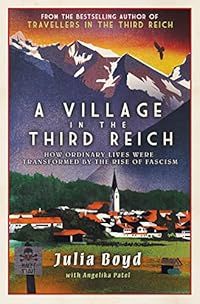
A Village in the Third Reich by Julia Boyd

A Village in the Third Reich by Julia Boyd is about the village of Oberstdorf in Bavaria. I requested it from NetGalley because I have had a Bavarian penfriend since the early 1970s and I first visited her Bavarian village back in 1970 when I was 11 or so. It was a strange experience.

Anyway, this book goes into a lot of detail of how a small village reacted to the Nazis as they became more powerful and then took over most of the village with Nazis being put in positions of power. How did it happen that normal people and particularly their children were influenced by the regime and turned into Nazis? As the Nazis grip on power strengthened it was pure fear for some people that made them join the Nazis. With people like teachers being dismissed if they didn’t toe the National Socialist Party line it was easier just to sign up I suppose.

This is quite a depressing read in places as it goes into the details of who were euthanised/murdered for being less than perfect specimens of human beings, as well as the more usual poor souls targeted by the Nazis. At one point I’m sure the author implied that the German people were not particularly anti-Jew, but I’ve read a travel book by Cicely Hamilton which was published in 1931 and she wrote that everyone in Germany was against the Jews, which she was puzzled by,

This book is an interesting read but I’ve always wondered what would have happened if a similar cult had tried to take over the UK, and I can’t see it being able to happen somehow, and I don’t think that’s me just being optimistic. There were still Nazis in Bavaria in the 1970s, proudly displaying their medals in their china cabinets and complaining that the local church had been damaged by the RAF!! And that they had suffered badly as a prisoner of war at the end of it all! I forbore to mention that my own great-grandmother had been killed by the Luftwaffe and my father had been torpedoed several times by the German navy – and I’m still annoyed at myself for being so polite.

Anyway, if you’re interested in the rise of the Nazis you will probably find this book to be a worthwhile read. I received a digital copy of it from the publisher via Elliott and Thompson via NetGalley. Thank you.

A Therapist’s Garden by Erik Keller

A Therapist’s Garden by Erik Keller isn’t quite what I expected it to be, I thought there would be more in the way of horticulture in it, but it was still a fairly entertaining and interesting read.

The author manages the gardens and horticultural therapy programme at Ann’s Place, Danbury CT, so the weather and planting seasons don’t exactly match up with my experiences of gardening in Scotland, I’ve just about given up on growing any vegetables as sometimes it doesn’t even get warm enough for the seeds to germinate! The book is split up into monthly sections.

Erik Keller works with all sorts of vulnerable people of all ages such as patients with cancer, children with challenging emotional problems, the elderly and the very young. So a lot of this book is him explaining how he dealt with difficult situations with his many clients and usually managed to turn what could have been an upsetting ordeal into a learning experience which often added to the person’s development. As people get their hands in the soil it calms them without them really realising it and they learn patience and concentration which hopefully will be transferable in different situations.

I know that in Britain the pandemic has had a silver lining of making millions of new gardeners as people in lockdown looked for ways of not going mad with boredom. That often neglected patch of land out the back that they didn’t have time to do anything with became a mental health lifesaver for so many. Actually I think people have been prescribed ‘gardening’ on the NHS, it’s a lot cheaper and healthier than anti-depressants and is probably more efficacious!

My thanks to Black Rose Writing and NetGalley for providing me with a digital copy of this book for review.

The School That Escaped the Nazis by Deborah Cadbury

The School That Escaped the Nazis

The School That Escaped the Nazis by Deborah Cadbury wasn’t quite what I expected it to be from the title, as although it is about a school which was moved from Germany in 1933 to England by a very far-seeing and dynamic woman called Anna Essinger (Tante Anna) there’s also an awful lot of quite harrowing history from the early 1930s in Germany. Anna’s school in Germany had been a liberal one and as she herself was Jewish she saw the dangers for her pupils as the Nazis took power, and she began to get as many children over to Britain as she could, it wasn’t easy. The school which she set up in Kent was in dilapidated buildings and by the time she had got it into shape the war had begun and the buildings were requisitioned by the government for the army so she had to start all over again in a different location.

She did manage to save a lot of children over the years, but there were so many that couldn’t be saved, and the story of the school is interspersed with what was going on in Germany over this time and what was happening to the families of some of the children. Just when I thought I knew all of the ghastly things that the Nazis got up to I discovered that I didn’t.

With what’s going on in Ukraine now, I found it quite depressing, although it’s a well written book . However, it is important that the story has been told – ‘lest we forget.’

I had thought that the book might have been more like the wonderful BBC programme The Windermere Children which is the true story of young Jewish refugees who had been liberated from concentration camps and flown to a very different kind of camp in the Lake District of northern England. If you haven’t seen it it’s well worth watching if you can.

Thanks to NetGalley for sending me a digital copy for review.

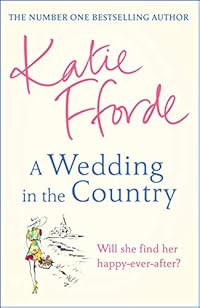
A Wedding in the Country by Katie Fforde

A Wedding in the Country is the first book that I’ve read by the very popular author Katie Fforde and I must say that it was the perfect antidote to the stress of books which I’ve recently read which feature the pandemic or terrorism in their plots.

The setting is London, 1963 and Elizabeth (Lizzie to her friends) has just enrolled in a cookery/domestic godess course, but she’s feeling rather down because most of the other students are aristocratic females who don’t really take much notice of the classes – or her. They’re being groomed to look after their future wealthy husband’s home – whoever he may be. But Lizzie has left her comfortable suburban home to get away from her parents who have her future all mapped out for her. Her mother has been planning her wedding since she gave birth to Elizabeth.

Luckily not all of the debutante types are snooty and Lizzie finds two good friends in the shape of Alexandra who invites Lizzie to stay in a large once very grand but now rather ramshackle house which she has the use of – and Meg who intends to have a career in catering. The other house-mate is David who is an older gay friend, an antique dealer who is of course completely in the closet as homosexuality is still illegal in 1963. There’s a romance which doesn’t run smooth but works out well in the end, as you would expect from the title of the book!

This book is such a great look back at a time when young women and men were just beginning to think about being able to have a life of their own instead of toeing the line and obeying their parents who already had everything planned out for their futures. I well remember when mothers of daughters just wanted to get them safely married off as fast as possible for fear that they would end up pregnant without benefit of a marriage certificate. How times have changed!

Apart from the social history aspect of the book I really enjoyed the houses, gardens, fashion, food (can you remember jap cakes?) flowers, the linen cupboard full of fabric as well as the trunk and the bags full of vintage clothes that the talented Lizzie could get her hands on. There are characters to despise and some to love. It was a real comfort read, which I was in need of.

Thanks to NetGalley for sending me a digital copy of the book for review.

Murder at Primrose Cottage by Merryn Allingham

Murder at Primrose Cottage

Murder at Primrose Cottage by Merryn Allingham is the third book in her Flora Steele series, but it’s the first one that I’ve read, I would probably have enjoyed it more if I had read the first two. The setting is Sussex and then Cornwall, apparently in the 1950s but to be honest there isn’t much in the way of 1950s ambience.

Flora Steele owns a bookshop in Sussex, but when her friend Jack has to go to Cornwall to research a book that he’s writing she decides to accompany him. Jack writes murder mysteries and when he receives a threatening letter just before they set off for Cornwall, he thinks it might be better if Flora stays at home, but she’s determined to go with him.

The morning after they reach their rented cottage (with separate bedrooms) Flora discovers their landlord’s body in the orchard. The locals are quick to point the finger at Mercy Dearlove, the local witch or ‘peller’, and the police don’t seem at all interested in solving the crime, so Flora and Jack oblige and do it for them, and that obviously throws them into the path of danger.

I think the Cornish setting was quite realistic, there seemed to be quite a lot of rain and I remember that from the one time we travelled to that far end of England, as usual everyone said we should have been there the previous week!

I am of course a bit of a nit-picker when it comes to details in books, so I was annoyed that the author seems to think that grammar schools have fees – they don’t and never have had, you get in by academic merit. I was also puzzled by the use of torch and a flashlight in the same sentence as if they are two different things, when they are the same thing with flashlight obviously being the US word for what we call an electric torch, although nowadays the ‘electric’ bit is dropped. But this is quite an enjoyable read anyway and I would read the next one in the series I think.

My thanks to the publisher Bookouture who sent me a digital copy via NetGalley for review.

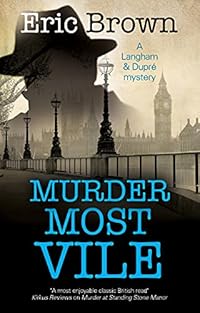
Murder Most Vile by Eric Brown

The setting is 1957 London and the private detective and sometime author Donald Langham has been approached by a wealthy elderly retired businessman Vernon Lombard. He wants Langham to investigate the disappearance of his favourite son who is an artist. Lombard seems to be besotted with Christopher while he despises his younger son and treats his daughter as a dogsbody.

When Langham visits the artists’ colony where Christopher had been living it’s evident that all the other artists really disliked him, and with good reason. When a body is discovered it seems there are plenty of possible murderers.

Meanwhile Langham’s associate Ryland is investigating the disapperance of a champion racing greyhound which belongs to Arnold Grayson who had been a Fascist leader before WW2, and Ryland’s father had been involved in the mob violence that had ensued in the famous “Battle” of Cable Street. The whole thing turns into a nightmare for Ryland.

This is a really enjoyable read although I would have liked a bit more of Maria (Dupre), Donald Langham’s wife. I think they’re a really good partnership and I also missed Langham’s literary agent, Charles, who doesn’t feature at all in this one.

Thank you to Severn House who sent me a digital copy of this book via NetGalley.

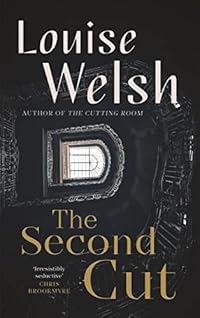
The Second Cut by Louise Welsh

The Second Cut by Louise Welsh is a sequel to The Cutting Room which was published way back in 2002 – that’s a long time to wait for a continuation, but it was worth it. Neither of the books are the sort of thing that you would give to your maiden great-aunt to read though, this one features quite a lot about drugs and the gay/LGBT etc. communities. The setting is Glasgow which has a certain reputation for toughness or roughness, but I can assure you it is at heart a great place full of lovely people. Can you tell it’s my home city?!

Anyway, we’re catching up with Rilke again, he’s still the head auctioneer at Bowery Auctions and the business is struggling, they could really be doing with some luck – and it comes in the shape of a tip-off from Rilke’s old friend Jojo. The two bump into each other at the wedding of their gay friends – the two Bobbys – and Jojo gives Rilke the address of a large remote home, Bannatyne House, which the owners want cleared. This could be a godsend for the Bowery business.

It seems that Bannatyne House belongs to an elderly lady who will be moving to a care home, but it is her son and nephew who are dealing with it all. Although the house is full of wonderful antiques Rilke is a bit uncomfortable and suspicious as the lady owner is nowhere to be seen.

I really liked this book which involves murder, modern slavery, gangsters, the drug scene and even a gay orgy. Not my normal reading fare at all, but I like that Welsh’s characters are so well-drawn and human, with good and bad sides to them, often quite well hidden. I also appreciate the author’s descriptive qualities, especially of Rose the owner of the auction house. I do like to know what people look like and what they’re wearing and quite often those sorts of details are missing – or thin on the ground.

I wonder if it will be another 20 years before the next book in this series appears, I do hope not as I might not be around to see it. We’re getting on you know!

The Second Cut was published by Canongate on the 27th of January and I was sent a digital copy for review via NetGalley. Thank you.

Death on the Trans-Siberian Express by C. J. Farrington

Death on the Trans-Siberian Express by C. J. Farrington is the first book by the author and it’s the first in an Olga Pushkin series. As you would expect from the title it’s a murder mystery, but the very different contemporary Siberian setting was an enjoyable change for me, although I have to say that it took me a while to get into the book, this is inevitable with the first in a series I think.

Olga Pushkin is a Railway Engineer (Third Class) based in Siberia, a very rural area where her main job is to maintain the tracks. However Olga has dreams, her father had forced her to follow him into work on the railway, although he hasn’t worked for years and he’s now a drunkard. Olga’s mother is dead so she lives with her father alone and Olga is such a soft and kind soul that she ends up doing good turns for everyone and putting herself last. But in her heart she longs to be a writer and wants to study literature at the Tomsk State University. Meanwhiel she’s writing a book called Find Your Rail Self: 100 Life Lessons from the Trans Siberian Railway.

But for years there has been a serial murderer opertaing on the Trans-Siberian Railway and one night Olga is felled by a body hitting her, it had been thrown from a train as she walked along by the side of the track. It’s the beginning of her involvement in the investigation.

I really liked the character Olga Pushkin and I plan to read the next one in the series. I am thankful I was sent a digital copy of this book from Constable via NetGalley.

The Girl From Bletchley Park by Kathleen McGurl

The Girl From Bletchley Park cover

The Girl From Bletchley Park by Kathleen McGurl is a dual timeline tale, beginning in 2019 where Julia is running her own IT business from her home along with her business partner and a few members of staff. Life is hectic as she also has two young sons and a less than helpful husband who is often absent from the home. Hmm.

When Julia discovers that Pamela, her grandmother had worked at Bletchley Park during the war the time slips back to 1943 where Pamela has just been offered a place at Oxford University to study maths, but when her brother joins the RAF to do his bit she begins to think that she should do something to help the war effort too. Her maths teacher suggests that she could defer her Oxford place as people with her mathematical abilities are needed. Pamela passes the Bletchley interview and in no time she’s in her WRNS uniform and is billeted at the nearby very grand Woburn Abbey.

Back in 2019 Julia’s brother is moving house and has brought boxes of old family related photos and books for Julia to look through, it’s only then that they discover that their grandmother had worked at Bletchley Park during World War 2, she had kept it secret her entire life.

I enjoyed this one but as ever with a dual timeline novel there’s one that I prefer and it annoys me when the action moves away from my preferred setting. Obviously it was the Bletchley Park setting that I found most interesting, especially as we managed to visit the place in 2020 – during a brief lift of the lockdown. You can see some my blogposts about it here.

Both stories do have echoes of each other with the women suffering betrayal at the hands of their menfolk, but I found the 2019 story to be so predictable, possibly it was meant to be.

I was sent a digital copy of this book by the publisher HQ/HarperCollins via NetGalley.

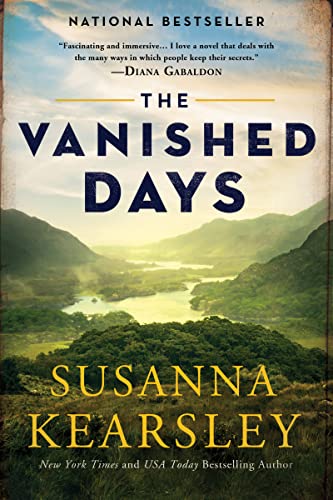
The Vanished Days by Susanna Kearsley

The Vanished Days cover

The Vanished Days by the Canadian author Susanna Kearsley is a prequel to her book The Winter Sea which I haven’t read, but I think this one can quite happily be read as a standalone. The setting is mainly Edinburgh 1707, the Union of Scotland and England, something which most ordinary Scots didn’t agree with but the ‘aristocracy’ sold the country for their own gain, so there’s discontent in the country. The tale loops back to the 1690s from time to time, and the disastrous Darien Venture which more or less bankrupted the country and led to the union with England. It’s suspected that the whole thing was an English plot. It was such a nice change to be reading about a different part of Scottish history as most authors stick to writing about the 1745 ‘Rebellion’, as if nothing else of significance ever happened in Scotland. Rebellion is in the air though with rumours of the French standing by to invade and help the Stewart King James III to regain the throne from the Dutch usurper King William.

Part of the settlement for the union is that England will provide money to pay off debts incurred because of the Darien scheme, including payments to the dependents of those who had lost their lives in Jamaica. Lily Aitcheson (Graeme) comes forward to claim her late husband’s wages, and Adam Williamson a former soldier has the job of investigating her claim, it’s suspected that she wasn’t actually married to her husband. But Adam is attracted to Lily and becomes embroiled in her life. There are lots of surprises along the way. This is not the sort of book that you could call a light read, but I loved it.

I was sent a digital copy of this book for review by Simon and Schuster via Netgalley.