Dimsie Among the Prefects by Dorita Fairlie Bruce – 20 Books of Summer 2023

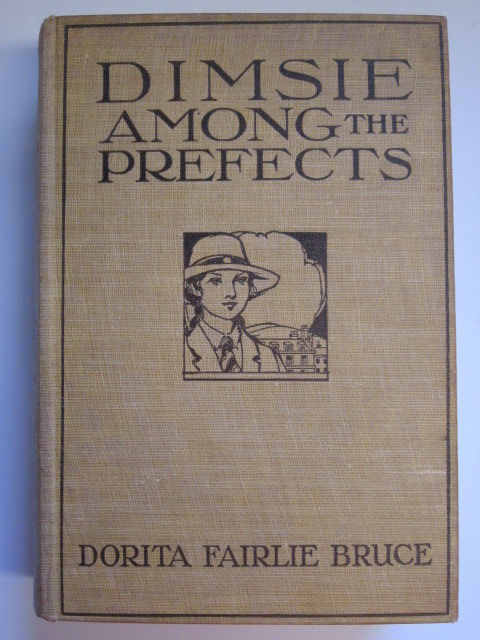
Dimsie Among the Prefects by the Scottish author Dorita Fairlie Bruce is the fourth book in her Dimsie series and it was published in 1924.

It begins with Hilary Garth in disgrace,  something she’s not a stranger to, in fact her grandparents are at their wits’ end with her and they’ve decided that it’s time to give up on her being educated at home by a governess, she needs the more strict regime of a boarding school. Part of the problem is that Hilary’s parents had died in India when she was very young and her grandparents had always spoiled and indulged her for that reason. Their own daughter Rosamund isn’t best pleased however as Hilary will be at the same school she is, and she’s not keen to have her out of control niece at what she regards as her school.

Hilary is of course thrilled to be going to school and she seems to spend all her time thinking up ways of causing mayhem, ‘inventing’ adventures. She quickly becomes the dominant character in her dorm as the other girls are so easily led.

Dimsie can see some parallels with her own behaviour as a junior, but she’s a prefect now and thinks that she will be able to deal with Hilary and sort her out. At the same time Dimsie is having to help Rosamund with her problems within the school, but it’s an oversight by the local council which leads to the most serious incident, as you would expect, all’s well that ends well.

I was very lucky to be sent lovely old copies of most of this series by a very kind lady in London who was looking for a good home for her Dimsie books. Thanks again, Clodagh.


The Stronghold by Mollie Hunter – 20 Books of Summer 2023

The Stronghold by Mollie Hunter was first published in 1974 and it is a Carnegie Medal Winner.
The setting is the Orkneys at a time when the islands were often being raided by Romans (around the middle of the first century BC) who were searching for people they could drag off to enslave. This meant that the islands were being deprived of the strongest and fittest members of their society. Somthing had to be done. When Coll was a child he had witnessed a violent Roman raid which had culminated in his mother being dragged away and enslaved, Coll was thrown on the rocks by a Roman, breaking his hip badly, and now as an 18 year old cripple he’s left behind as a look-out while other males of his age are taking a more active role in the defence of their island.

Coll has spent a lot of time thinking about how things can be improved and eventually in desperation the leader agrees to allow Coll to organise and direct the building of a huge defensive structure, called a broch. It will be big enough to house the whole community and they can safely fight against the Roman Navy from the top of the tower.

In reality nobody knows how brochs came about, there are the remains of over 500 of them in the north of Scotland and the islands to the north of the mainland. It’s thought they originated on Orkney and they have all been built to the same design. They are drystone roundhouses with outer and inner walls with a stone staircase between the two walls.

Mollie Hunter took this information and developed a plausible and entertaining tale around it, featuring some great characters, both good and evil. The Stronghold won the Carnegie Medal in 1974.

You can read a bit more about brochs here.


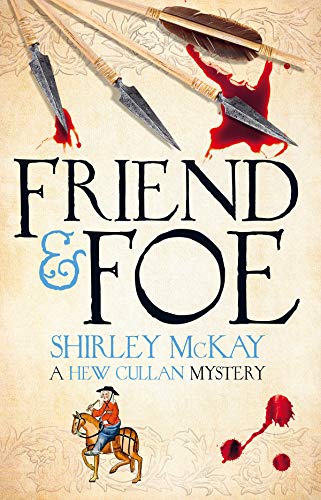
Friend and Foe by Shirley McKay – 20 Books of Summer 2023

Friend and Foe by Shirley McKay is the fourth book in the author’s Hew Cullan mystery series. The setting is St Andrews in 1583. At the back of this book there is a glossary of Scots words used by the author which I imagine will be useful to some readers, I must admit there were a few that even I didn’t know, but I think they’re always easy to take a guess at from the context.
It’s over three weeks since I read this book and so much has happened in the time since I finished it that some of the details of the mystery are a bit of a blur to me, but I did really enjoy it.

Hew’s sister Meg isn’t really happy in her new home in St Andrews, but her physician husband Giles works at the university and must live within the town. Meg misses her old home which is just a few miles outside the town, but she had a garden there where she grew the herbs she needed to make her lotions and potions. Giles is worried about her and has begun to extend their home so that Meg will have a place of her own where she can continue with her own herbalism.  But they find themselves in trouble when it looks to others that their renovations have an ulterior motive.

Hew has made more enemies and things are just too hot for him in Scotland, it looks like he’ll be leaving home for his own safety, but will he be jumping from the frying pan into the fire?  It looks like the next book in this series will find Hew in England again.


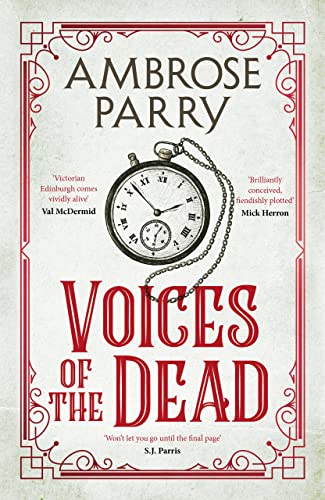
Voices of the Dead by Ambrose Parry

Voices of the Dead by Ambrose Parry has just been published and I was lucky enough to be sent a digital copy of the book by the publisher Canongate via Netgalley.

The setting is Edinburgh, 1853, where Raven is finding life tough as a father to little James who always seems to be crying and it’s taking a toll on his marriage as Raven spends a lot of his time avoiding family life.  When he gets a message that he’s needed, body parts have been found at Surgeons’ Hall, it’s grim but Raven is glad of the excuse to get out of his home and avoid more tantrums from his small son.

The city is being visited by an American mesmerist who is holding meetings and trying to drum up interest in it, claiming it as being scientific. Sarah, Raven and Simpson’s assistant is frustrated at not being allowed to study to become a doctor, despite her knowledge and experience, she’s keen to find out more about mesmerism, hoping it might be a way forward for her.

When more body parts are found McLevy the detective has to be told, and he always does his best to make things even worse than they are.

This is the fourth book by Ambrose Parry – aka the author Christopher Brookmyre and his consultant anaesthetist wife Marisa Haetzman, I believe that she provides the details of the medical history, amongst other things. I’m really enjoying this series which combines murder mysteries with history and social history in a Victorian Edinburgh setting.


In Place of Fear by Catriona McPherson – 20 Books of Summer 2023

In Place of Fear by Catriona McPherson is set in Edinburgh in 1948. The National Health Service is just being set up and Helen Crowther has got a job as a medical almoner, akin to a social worker nowadays, attached to two local doctors’ surgery. Previously the work had been done by a sort of ‘lady bountiful’ type of woman who had been doing the work voluntarily, and she had trained up Helen to help her.  Helen has trouble making people believe that they won’t have to pay for visits to the doctor as the idea of the NHS seems too good to be true to them, but as she has been brought up in similar circumstances to her clients she’s more in tune with their problems.

When Helen and her husband get the chance to move into a home of their own they’re ecstatic.  Helen hopes that not sharing cramped accommodation with her parents and sister will mean that things will now be different in their marriage, her husband isn’t interested in her and her mother is champing at the bit to be a grandmother.

When Helen stumbles across a body she’s sure she knows who the victim is, but she’s perplexed when the investigation doesn’t proceed the way she thinks it should. There’s a lot going on in the secretive life of some of Edinburgh’s more prominent citizens and Helen needs to untangle it all. This was a really good read. This is one of my 20 Books of Summer reads.


The Big House by Naomi Mitchison

The Big House by Naomi Mitchison was first published in 1950 and it’s aimed at children over 9 years old, it’s good no matter how many years you are beyond that age though.

Susan is the daughter of the local landowner, so she lives in The Big House and most of the people living in the area are employed by her family. That makes life difficult for Su in school at Port-na-Sgadan as just about all of the other children hate her. Not only is her family rich, but she can’t even speak Gaelic like the other children.

The story begins on  Halloween and some of the local children take the opportunity to beat Su up. They have their ‘false-faces’ on so they feel safe enough to do it. Only Winkie the fisherman’s son is her friend and he helps her. Of course the fisherman doesn’t have the landowner as his boss, so there’s no resentment there. As Winkie is helping Su back to her home to clean her up they hear a piper in the distance.  It turns out that the piper was captured by evil fairies hundreds of years ago and Halloween is his only chance of escape. He needs the children to help him. Su and Winkie end up in the underworld of the evil fairies, in danger of never being able to get back home.

If you know fairy tales at all you’ll recognise some common themes, such as a stolen baby and someone being changed into a swan but this one does have a very Scottish flavour about it and it brought back some memories for me. I had completely forgotten that when I was wee we called Halloween masks false-faces, but as soon as I read those words it brought back the horrible smell they had, compressed cardboard I suppose,  but we all wore them, at least they were bio-degradable, unlike the plastic ones nowadays.  As the book was written/published in 1950 and food rationing still existed in the UK this tale features quite a lot of feasts and food which would have been unobtainable at the time, like so many books written in this era.

Naomi Mitchison was herself the daughter of a  Big House but she seems to have had a governess before being sent to a boarding school, I’m sure she would have had experience of being despised by the local children when she was growing up. She died when she was 101 and had quite a life, being politically active and a lifelong Socialist.

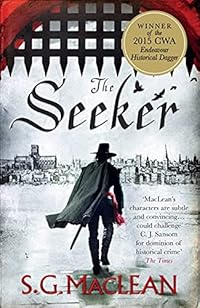
The Seeker by S.G. MacLean

The Seeker by S.G. MacLean was published in 2015 and it’s the first in her series which is set in Oliver Cromwell’s England.

The setting is London 1654 and there are spies everywhere, especially in the coffee houses that have become popular. Damian Seeker is an Intelligence Officer in Oliver Cromwell’s government and everyone is terrified of him. If you’re arrested by Seeker, it’ll probably be the end for you, his men are brutal.

It’s the sixth year of the English Commonwealth and Oliver Cromwell is king in all but name. He’s just not quite brave or mad enough to have himself crowned and all of the hopes for a more equal society have come to nothing. The Royalists haven’t given up their hopes of reinstating the monarchy and Cromwell lives under the threat of assassination.

But it’s one of Cromwell’s captains who is murdered. John Winter had been a popular officer in the New Model Army, and a young lawyer is found standing over his still bleeding body and holding a knife. It seems obvious that the lawyer is guilty, but The Seeker isn’t convinced, and he is honest enough not to want just anyone as the culprit, it must be the guilty person who pays the price.

Slavery comes into this book with Londoners being grabbed off the streets, sold off and transported to plantations in Barbados. Even children were abducted. The poet John Milton makes an appearance as a spy for Cromwell, something that I certainly didn’t know about, but apparently he was.

This was a good murder mystery with plenty of atmosphere and I think there’s also a lot of history which isn’t often written about. Oliver Cromwell isn’t a popular figure, even among Republicans. It’s quite surprising that the Commonwealth of England lasted as long as it did – just over ten years in total – because just about everything was banned, including Christmas, theatres, bright clothing and make-up. Such a dismal existence was bound to get people down. After Cromwell’s death his son only lasted nine months in power, then Charles II was invited back from his exile and the monarchy was restored.

However, I’m sure there’s still a lot to be written about in this series, so I hope to be reading the next one The Black Friar – soonish.

Hue and Cry by Shirley McKay

Hue and Cry cover

Hue and Cry by Shirley McKay is the first book in the author’s Hew Cullan series. It’s a murder mystery with a 16th century Scottish setting.

It begins in St Andrews in 1579. The town’s cathedral has long been wrecked by the religious reformers and many of the town’s newer buildings have been built using the robbed stone from it.

Hew Cullan has just returned home after studying law in Paris, he’s keen to catch up with some of his old friends before travelling on to his father’s house. But he gets caught up in a search for a young boy who has disappeared from his father’s shop. It’s thought that his father has probably beaten the young lad for some mistake he had made, but things take an ominous turn when his body is found.

Hew’s old friend Nicholas had been tutoring the victim as the father was hoping to get his son into the university, and suspicion falls on Nicholas. There’s been gossip about Nicholas and as we know, mud sticks, especially in the atmosphere of strict Scottish Presbyterianism. Hew has been shocked by the corruption at the university and also within the law courts, with nobody seeming to care if the actual culprit has been found, or just a handy fall-guy.

This makes it all sound quite grim but there’s a lot more to it of course. Hew is a great character, as is his sister Meg and there’s even some humour with Hew buying a ‘characterful’ horse. The very young King James VI makes an appearance and given the date and location witches are mentioned.

I was however perplexed by mention of ‘a bishop’ on page 257 as the religious upheaval of the Scottish Reformation was to get rid of bishops – which they did.

Otherwise this was a very enjoyable read, enhanced for me because all of the locations are very familiar to me. I think that it would have been a good idea to have a map of St Andrews and environs, as Hew does a lot of stravaiging around the streets and it would have been useful for people who don’t know the area I’m sure.

I’m really looking forward to reading the next book in the series, it’s called Fate & Fortune.

The Freebooters by Nigel Tranter

The Freebooters by Nigel Tranter was first published in 1950 and it has been accused or blamed by unionists of promoting the subject of Scottish Nationalism and the eventual ‘theft’ of the Stone of Destiny which of course we have back in Scotland again after it being in London for centuries, although it will be going down to England for the coronation of Charles III.

Anyway, to the book. It begins with Adrian Hope seeking shelter from wild weather in a cave, but his solitude is invaded when a big red-headed man joins him, he had been expecting to meet up with some friends in the cave, they were supposed to be doing some hill-walking together, and he’s furious with his friends who he presumes haven’t bothered to exert themselves. It turns out that the red-head’s name is Rod Roy Macgregor, which Adrian can hardly believe, but Rod doesn’t have the same inclination for confrontation as his almost namesake (Rob Roy Macg) and in fact Rod tells Adrian that he’s seriously thinking of giving up on Scotland and going to live in New Zealand. Adrian Hope tells him that he is just the sort of young man that Scotland needs to fight against the powers that be in London.

The upshot is that Adrian and Rod plan a campaign against London/Westminster as the extreme austerity which means that every bit of Scottish beef and whisky is taken straight down to London, with the people in Scotland only getting small frozen bits of meat from south America and very little in the way of whisky. It takes a while for the newspapers to print the first adventures that Rod and his friends get up to. Appropriately they begin with cattle rustling and there’s a rather ghastly description of the butchery that follows, with the proceeds from that scene being divided up and passed out to the inhabitants of Glasgow for nothing. Then the campaign concentrates on whisky but there is romance of a sort, as you would expect.

I really enjoyed this one which has similarities with John Buchan’s writing with adventure and men being hunted by the police over the hills of Scotland although I have to say that Tranter surpasses Buchan with this one in my opinion.

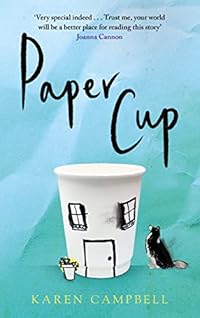
Paper Cup by Karen Campbell

Paper Cup by the Scottish author Karen Campbell was published in 2022. It begins in Glasgow where Kelly a down and out is in George Square sleeping on a park bench. A young woman dressed as a bride sits beside Kelly – it’s ‘a bottling’ in Scotspeak – otherwise known as a hen party, but the hens have abandoned the bride while looking for chips and cheese. The bride takes pity on what she thinks is an old man and ends up giving all of her ‘takings’ – the bottling money gathered – to Kelly. At £1 a kiss from any poor guys who couldn’t avoid them in a pub, it amounts to about £50. Kelly is ecstatic to have the money but it sets her off on a drinking binge, but not before she discovers that the bride has accidentally left her engagement ring among the coins.

The bride left a couple of clues as Kelly heard that her name is Susan and she lives in Gatehouse-of-Fleet, in Dumfries and Galloway. It’s a place that Kelly knows well as she grew up nearby, but she hasn’t been there for years because of the sort of life she’s living now. Alcohol has ravaged her, but deep down Kelly is a decent person and she’s determined to track down Susan to return her ring. But before Kelly can get on the road to Gatehouse she witnesses a horrific accident when a bus ploughs through a crowd of people, causing several deaths. Kelly does her best to save one of the men, sacrificing her coat to help stop his bleeding, and she’s caught on camera doing it. While Kelly seeks Susan she herself is being sought by the newspapers.

This is a well written book, it’s definitely not a comfort read as it deals with substance abuse and the darker side of city life, but it does have an upside and although Kelly is very far from perfect, it’s alcohol that brings out the worst in her.

It annoys me when authors use actual incidents in their books with just a small change. Obviously the bus crash and fatalities were based on the horrific bin lorry crash in Glasgow’s George Square some years ago. I may be being oversensitive here.

We had a holiday in Dumfries and Galloway some years ago so we had visited all of the locations that Kelly visited on her ‘pilgrimage’ and that always adds to a book when you can see all of the scenery at the locations.

You can read Jack’s thoughts on the book here.