Hannah The Complete Story by Hannah Hauxwell and Barry Cockcroft – 20 Books of Summer 2023

Hannah Hauxwell  was a bit of an unexpected celebrity in 1973 when her lifestyle was filmed by the BBC’s Yorkshire television. I think it was part of a series called A Hard Life about  people who weren’t living a sort of ‘normal’ life. This book tells how it all came about.  To begin with Hannah was only 46 but she seemed much older as her life was like something from another century. She was the last person standing in a family which had lived in the Baldersdale area of County Durham for several generations. Nothing had changed in all that time, apart from Hannah being left to do all the farm work on her own. There was no running water in the farmhouse and no electricity. There was a small stream about forty yards from the house and often the ice had to be broken on it with a pick axe. There was no road to the farm and Hannah was so desperately poor that she couldn’t even afford the luxury of a dog for company as she could hardly afford to feed herself. She was dressed in rags. Baldersdale is in north east England, County Durham and it was settled by Vikings which is how the area got its name, Balder was Odin’s son in Norse myths.

Despite all that she radiated contentment, she wouldn’t contemplate leaving her harsh life. Hannah understood what was important in her life and it was the land, her ‘beasts’ which were mainly cows, and her love of music and books. Although she was shy she was very talkative whenever she did get into company, making up for all that time when she had nobody to speak to. Her cheerful and stoical personality shone out on TV apparently – and the viewers adored her.

This was a good read, I had heard of Hannah before reading the book, but I hadn’t realised that her farm was near where we have been visiting friends in the north of England. I didn’t see the TV documentaries, I don’t think I would have been that interested in watching them when I was 13 or 14, after all she wasn’t T.Rex or Bowie, but I did see her being interviewed on Wogan, she seems to have taken the country by storm, and her personality captivated viewers all over the world, and they sent her gifts and cards which filled up her home. Life was a bit more comfortable with the money that she got for making the documentary. At least she wasn’t in danger of starving to death! She was even invited to royal garden parties and was voted Woman of the Year.

Hannah reminisces about all the neighbours who used to live in the dale, back in the days when it was quite well populated. It was a hand to mouth existence for most of them, but if anybody had a bit of spare food they shared it around with the neighbours. The narrative switches to Barry Cockroft from time to time as he explains the background of how he came to make the documentaries and people’s reactions to Hannah.

She eventually realised that  she couldn’t continue that way of life forever.  She couldn’t stand another freezing cold winter and she did sell her farm and moved to a cottage in a nearby village. This is an entertaining and informative read, full of  social history, there are a lot of photos of the neighbours over the years, and it’s funny in parts. Hannah was a character.

In Place of Fear by Catriona McPherson – 20 Books of Summer 2023

In Place of Fear by Catriona McPherson is set in Edinburgh in 1948. The National Health Service is just being set up and Helen Crowther has got a job as a medical almoner, akin to a social worker nowadays, attached to two local doctors’ surgery. Previously the work had been done by a sort of ‘lady bountiful’ type of woman who had been doing the work voluntarily, and she had trained up Helen to help her.  Helen has trouble making people believe that they won’t have to pay for visits to the doctor as the idea of the NHS seems too good to be true to them, but as she has been brought up in similar circumstances to her clients she’s more in tune with their problems.
When Helen and her husband get the chance to move into a home of their own they’re ecstatic.  Helen hopes that not sharing cramped accommodation with her parents and sister will mean that things will now be different in their marriage, her husband isn’t interested in her and her mother is champing at the bit to be a grandmother.

When Helen stumbles across a body she’s sure she knows who the victim is, but she’s perplexed when the investigation doesn’t proceed the way she thinks it should. There’s a lot going on in the secretive life of some of Edinburgh’s more prominent citizens and Helen needs to untangle it all. This was a really good read. This is one of my 20 Books of Summer reads.


Non-Combatants and Others by Rose Macaulay

Non-Combatants and Others by Rose Macaulay was first published in 1916, and that really is the most surprising thing about it. It’s described as a pacifist novel and I find it amazing but also heartening that it was allowed to be published at a time when the government was exhorting all males to join up and do their bit. There’s quite a lot about the waste and ghastliness of war.

Alix Sandomir is a young art student who has been living at Wood End with her aunt and cousins. Both of her parents had been political peace campaigners and her father had died in a Russian prison. Her mother is busy in America giving speeches on pacifism. Alix isn’t really interested in anything like that.

‘Life at Wood End, as at other homes was full of letters from the front. They seemed to Alix like bullets and bits of shrapnel crashing into her world, with their various tunes. She might, from her nervous frown have been afraid of ‘stopping one’.’

When she is given the chance to move to a villa in Clapton which is nearer her art school, she takes it. The house is called Violette and is peopled by various relatives who are all busy getting on with their own lives. In truth though life at Wood End had become too much for Alix to cope with. The war was too close for her liking as John, a relative, had been wounded and was back at Wood End, scarred and unable to speak properly, a nervous wreck, prone to sleep-walking and talking, and crying in his sleep.

Alix is also worried about her younger brother who had gone straight to the army instead of to Oxford where he had got a scholarship. She thinks that they shouldn’t be sending children to war.

As time goes on and bad news from the war gets closer and closer to Alix, she realises that she can’t stay aloof from it all, it has changed her profoundly.

This is a really good read if you’re interested in the Great War and the social history side of it. The book ends on the last day of 1915 and it’s probably just as well that as the author wrote it she was obviously unaware that that there were almost three whole years more to go before the armistice.

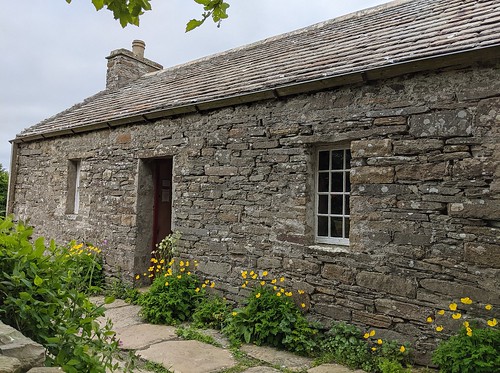
Kirbuster Museum, Orkney, Scotland

Kirbuster Farm Building, museum, Orkney, Scotland

Orkney isn’t all about Neolithic and Viking heritage, we visited the Kirbuster Museum which is about far more recent times, it was a farm in the 19th century and was occupied and farmed by two brothers up until the 1960s. It was opened up as a farm museum in 1986 and it’s the last un-restored ‘firehoose’ in Northern Europe, with the fire being in the centre of the room. It certainly smells very peat smoky.

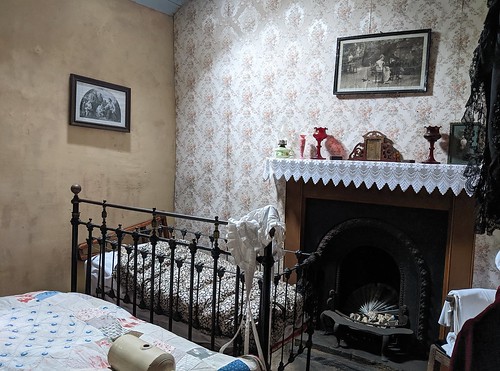
The bedroom in the photo below has a Victorian cot at the foot of the bed, the quilt in it is exactly the same as two that I have!

Kirbuster Museum, Victorian bedroom, Orkney,Bed

Kirbuster Museum, bedroom, Orkney, farm museum

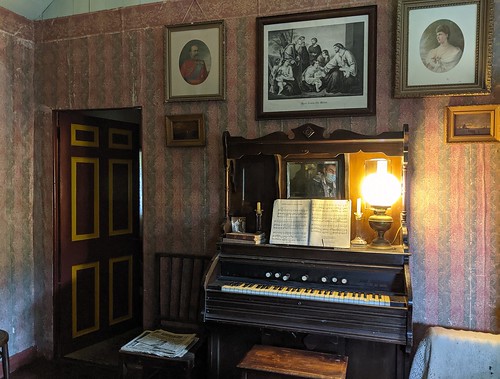
The living-room, or maybe they called it the parlour below is very typical of a Victorian one, complete with harmonium. I managed to capture a very sinister looking Jack in the mirror above the harmonium, complete with face mask on!

Kirbuster Museum, Orkney,Harmonium

Fireplace , Mantel, Kirbuster Museum, Orkney

Below is a box-bed in a bed-recess which is in the kitchen. I suppose that the children probably slept in those, or maybe a servant/farmhand. The walls don’t look that different from how the Neolithic dwellings would have looked in their heyday.

Bed Recess, box beds, Kirbuster Museum, Orkney

You can see a cruisie lamp hanging from the wall.

Kitchen Dresser, Kirbuster Museum, Orkney

And there’s a building full of old farm implements, we had fun trying to guess what some of them were for. We swithered about going to visit Kirbuster Museum but it turned out to be a very enjoyable visit, we had the whole place to ourselves, which was a shame really. I hope they get more visitors in the future. The guide was a lovely woman who was chatty and informative. I hope she had something to occupy her time as she was the only person there and it must be a lonely job!

Kirbuster Museum, Orkney, Farm Implements

The Diary of a Farmer’s Wife 1796-1797 by Anne Hughes – 20 Books of Summer 2022

Diary of a Farmer's Wife 1796-1797 cover

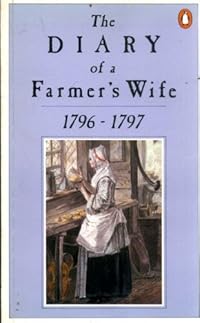
The Diary of a Farmer’s Wife is a bit of a conundrum, as strictly speaking it’s not what most of us would think a diary would be. Supposedly it was written in 1796-1797 by Anne Hughes who lived in a remote country farmhouse near Chepstow, Monmouthshire. However the existence of the diary seems only to have come about because a young girl who was born in 1884 and was called Jeanne Keyte met an elderly woman who told her about her mother – Anne Hughes who had kept a diary. The old lady read to Jeanne from a thin book containing spidery writing, and also told her lots of stories about her mother Anne Hughes, and Jeanne wrote them all down so that she could put them in a book eventually. Michael Croucher who wrote the Foreword says, Certainly it should not stand as a historical text in the conventional sense, he views the diary as being more like a folk song.

However, it’s a really entertaining read. Anne Hughes led a very busy life as a farmer’s wife and if there was anyone in the neighbourhood in need, she took it upon herself to send them food and blankets, whatever she thought would make them more comfortable. She had to do it under cover though as her husband wasn’t so open-handed. There’s a lot of humour involved as her husband had a hot temper, but she was always able to defuse it by feeding him his favourite food or drink. She described him as being like a great baby – which he was.

There are a lot of hatches, matches and dispatches, scandals and cooking, including recipes if you’re that way inclined. Anne comes across as being a really lovely woman, even hoping that men who might have stolen some sheep won’t be caught as they would be hanged.

In the end it doesn’t really matter if a lot of the book is the result of embroidery by Jeanne, it’s an interesting and comfortable read, one of those books that you could dip into at any time and find something to amuse you.

I read this one for 20 Books of Summer 2022.

Emily Davis by ‘Miss Read’

Emily Davis cover

Emily Davis by ‘Miss Read’ was first published in 1971 and it’s the last in the Fairacre series by the author. There are eight novels in the series.

Dolly Clare and Emily Davis have been life-long friends since early school-days and after World War 1 when they both found themselves bereft of their fiances their friendship became even stronger. They had both become primary school teachers and had taught in and around the village of Caxley. On retirement Emily had moved into Dolly’s little thatched cottage, and there they had lived very happily for over twenty years until the very peaceful death of Emily.

The news of her death travelled fast, even to far-flung places and it’s evident that many of Emily’s ex-pupils had held her close in their memories. She had helped so many of them over the years and each chapter is the story of how Emily had influenced their futures and had even managed to browbeat a bullying father/husband.

This was a charming comfort read with a lot of rural social history thrown in.

The Way Things Are by E.M. Delafield

The Way Things Are by E.M. Delafield was first published in 1927, but my copy of the book is a Virago Modern Classic which was printed in 1988. It has an introduction by Nicola Beauman.

Prior to reading this book I had read the author’s ‘Provincial Lady’ books and really enjoyed them, this one is along the same lines really although I couldn’t help being reminded of the film Brief Encounter.

Laura is a 37 year old wife and mother, lucky enough to be living in a lovely large house (with garden of course.) I suppose she could be described as being upper middle class, and she is also a successful author. On the face of it she has it all, two healthy sons and an unobjectionable if reserved husband Alfred, but like most women of her class she is beset by that perennial problem – servants. Living deep in the countryside it isn’t the perfect location for servants so they tend not to last long there, or maybe it’s the two young boys Edward and Johnnie that people get fed up with. Laura favours her youngest son outrageously, apparently because he has curly hair and is the naughty one!!

Laura is constantly shattered if she has to deal with her own children even for a short time and dreads the inevitable exit of their Nurse. To be fair she does realise that the ‘women in the village’ have to deal with their children on their own and do all their own housework, instead of just having a life of tennis parties and visiting neighbours as she does.

When Laura’s younger sister Christine arrives to stay she has a young man in tow. Laura thinks it must be serious but it soon appears that Marmaduke Aylford is more interested in Laura and of course as a supposedly neglected wife she’s very flattered.

Having been married for seven years Laura thinks she has never really been in love, although she’s very fond of Alfred. She wants some romance in her life. Silly woman!

Anyway, this is funny in parts but not to the same extent as Delafield’s ‘Provincial Lady’ books.

As an acquaintance of mine once said, “Romance goes out the window as soon as you start washing their socks and pants.” Which was a bit shocking really as she had persuaded a man to leave his wife and three sons for her! Stick to fictional romance – it’s safer.

Everyman’s Castle by Philippa Lewis

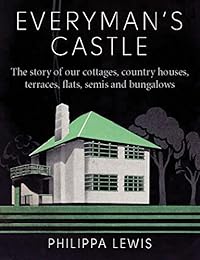
Everyman’s Castle by Philippa Lewis was first published in 2014, and it’s subtitled The Story of our cottages, country houses, terraces, flats, semis and bungalows.

This is such an interesting and informative read, but it references quite a lot of other books, mainly novels which of course I’ve taken a note of – it has bumped up my book list considerably! It also has plenty of lovely illustrations, and obviously there’s quite a lot of social history involved too.

I had always wondered why a great-uncle of Jack’s had insisted that his house was NOT a bungalow. They were the kind of house popular in colonial India amongst the Anglo Indians or ‘ex-pats’. But the early UK versions were often little more than wooden shacks, often built by soldiers after the end of WW1 when decent housing was difficult to find. Then after WW2 the prefabricated bungalows erected to try to alleviate the housing shortage tended to be despised, although they were loved by the people who actually lived in them.

I was surprised to discover that people in England were really reluctant to live in flats, so they were difficult to sell or let when builders first offered them. Eventually service flats became popular among the wealthy in London, it must have seemed like living in an hotel as meals could be sent up from the kitchen or you could go down to the restaurant, but there would have been more privacy than in an hotel. But flats have always been very popular in Scotland’s cities, they tend to be roomier than the narrow terraced housing on offer in England, but even those tiny houses ended up being split up into bed sitting rooms with kitchens being shared as the housing difficulties got worse.

It’s not all about grim housing problems though, having said that the ‘nobs’ who lived in country estates had problems of their own as new death duties took effect, and some were just abandoned and demolished but others such as Longleat took on the challenge and made a successful business out of the estate. It’s the suburban villas and semis section that I enjoyed most, and it was interesting to read that people in privately owned homes were building walls to separate themselves from newly built social (council) housing nearby.

This book has all sorts of interesting bits and pieces in it about old places such as Edinburgh and Bath as well as information about the ‘garden cities’ that became popular.

So this was a really good read, and I love the cover too. I really like those 1930s art deco homes – Crittall curved windows and all.

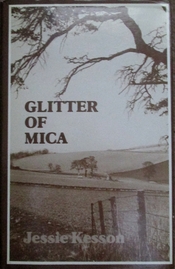
Glitter of Mica by Jessie Kesson

Glitter of Mica cover

Glitter of Mica by the Scottish author Jessie Kesson was first published in 1963. Previously I’ve read Another Time Another Place and The White Bird Passes and I enjoyed those ones but I didn’t like this one nearly as much.

The setting is rural Aberdeenshire in the north-east of Scotland, the parish of Caldwell and the book begins in the 1930s. Hugh Riddell is a farm worker who is never kept on after his year of contracted work is up, which means that every year he has to find a new job in the area at a different farm. His wife is sick fed up with the constant moving, she can’t even plant a garden as she would be working for whoever would take over the tied house that goes with the farm work. They had a son, also Hugh and it’s his family that this book is mainly involved with.

The marriage of Hugh and his wife Isa isn’t any more successful than that of his parents, Hugh despises Isa and she seems afraid of him, they did manage to produce a daughter though, Helen does well at school and goes to university, but her mother is disappointed that she is only doing a diploma in social sciences and won’t come back with the MA that past ‘scholars’ have attained.

Helen gets work as a youth worker and unknown to her father starts a relationship with Charlie Anson, someone else that Hugh despises. As you can imagine it all ends in tears.

There are some flashes of humour in this book such as ….for she was a tight woman and had she been a ghost she would have grudged giving you a fright.

The characters in this book remind me, if I ever needed to be reminded of why I am ‘pining for the west’ as they are almost all miserable and mean spirited and are their own worst enemies. Love doesn’t seem to enter into anyone’s life, people get married because they have to marry someone and quickly go right off them it seems. There’s only one character who seems to have any human warmth – and she’s the talk of the place – being a wee bit too friendly with some of the local men. But the women have to admit that she always hangs out a ‘bonnie white washing.’ High praise indeed among the women.

This is supposedly Jessie Kesson’s best book but I just found it too depressing, I have no doubts that it is a very true portrait of the area and the times. Some readers wallow in misery, but it’s not for me

You can read what Jack thought of the book here.

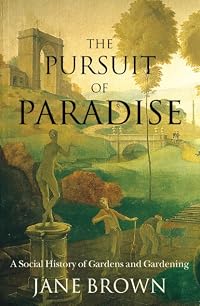
The Pursuit of Paradise by Jane Brown

The Pursuit of Paradise cover

I think it must be a few years since I bought The Pursuit of Paradise – A Social History of Gardens and Gardening by Jane Brown. I wasn’t really too sure what to expect of it. Sometimes gardening books are a bit like ‘teaching granny to suck eggs’, not that I think I know everything about the subject, but as I’ve been gardening since I was a wee girl, over fifty years!! – it’s inevitable that you pick up a lot of information one way and another.

But this book was informative, it has eleven chapters:
1. The Purest of Human Pleasure
2. The Secret Garden
3. The Military Garden
4. Emancipated Gardeners
5. The Rise of the Small Garden
6. Acquiring Eden
7. Science Lends a Hand
8. It’s Clever, but is it Art?
9. Labour of Love
10. The Formative Garden
11. Future Gardens

I found The Military Garden most interesting as it hadn’t dawned on me that so many gardening terms come from the arts of warfare – cordon, earthing-up, trench, bastion, palisade, covered way and more. It seems that when generals were at a loose end after wars were won, they went home and started to plan gardens where they could keep everything under control, just as they had commanded their men. All that topiary stood in for regiments of men!

This one is definitely worth reading if you enjoy social history and gardening.