The Mystery Mile by Margery Allingham

Time for some more vintage crime which for some strange reason is always a comfort read. Margery Allingham came from a family of writers and she started her writing career at the age of eight, but was nineteen when she had her first book published. This one was first published in 1930 and it’s the second book by Allingham featuring Albert Campion as the ‘detective’ and the character is developing nicely. I wasn’t sure about him to begin with but he’s growing on me. It was Allingham’s American publishers who were keen that she kept him as a character. I read somewhere that Campion was Allingham’s parody of the Dorothy Sayers aristocratic detective, Lord Peter Wimsey, who I think is a sort of love him or hate him character.

Anyway, the story begins on a ship which has sailed from New York and is bound for England. An American called Crowdy Lobbett is one of the passengers, along with his adult son and daughter. There have been several attempts on retired judge Crowdy Lobbet’s life recently which have ended up with his companions being the victim. There have been four people murdered in his house in the last month. He’s hoping to be able to escape from his enemies in England.

It’s a vain hope because there’s another attempt on Judge Lobbett’s life whilst on the ship and it’s Albert Campion who saves him. Marlowe Lobbett, the son, ends up asking Campion for help and when they get to England the Lobbett family rents an old country house and it isn’t long before Judge Lobbett disappears from it.

As usual, Albert Campion provides quite a bit of humour as he poses as an upper class twit, and his servant the ex-burglar Lugg adds to it too. There’s quite a bit of cockney in it which I sometimes had to read twice before I got the meaning of it but other than that it’s an enjoyable read.
The Singer not the Song by Audrey Erskine Lindop

I remembered that I really enjoyed reading a few of Lindop’s books way back in the 1970s and for that reason I decided to add her to the CPR Book Group list, which is a place for neglected authors and books which deserve to be better known than they are at present. It only seems to be myself and Anne Hayes who have any interest in Lindop’s books at the moment.

Unfortunately her books are quite difficult to get a hold of but I bought The Singer not the Song in an Edinburgh second-hand bookshop and it was one which I hadn’t read before. At first I was really disappointed when I realised that the book is set in Mexico and is about the Roman Catholic church, in fact I almost didn’t read it for that reason, but I’m glad that I persevered.

Firstly I have to say that my copy is from 1954 and the blurb on the cover is wrong when it says that it is set in the revolutionary period of the 1920s and 30s. It is definitely post World War II early 1950s and a bishop is interviewing priests for an appointment in Quantana to replace the elderly Father Gomez who hasn’t exactly stuck to his vows and has lost the respect of his parishioners.

Quantana is a small village in the mountains and is very cut off from the rest of society and the whole place has been taken over by Malo, a young bandit, and his sidekicks. Basically Malo – the Bad One – runs a protection racket in that if the villagers don’t pay him ‘tax’, nasty things are going to happen to them. Malo has an affinity with cats and he has the same habit of playing with his victims.

Father Keogh, a young priest from Ireland, is chosen for the difficult position. Just about the first thing he has to do is get Father Gomez out of the village alive as Gomez believes Malo will kill him.

The whole book becomes a fight for the lives and souls of the villagers as Malo is determined to keep his evil hold on them and tries to humiliate the priest. Father Keogh struggles against Malo for the good of the people who are all terrified of the bandit gang.

It doesn’t sound like much I suppose but it is a very good read and the book was made into a film in 1961. I had already finished the book when I realised this but strangely I had imagined Dirk Bogarde as Malo so maybe I did see it when I was knee high.

There seems to be virtually nothing on the internet about Audrey Erskine Lindop. Possibly her mother or grandmother was Scottish as Erskine is a Scottish surname and place name. She was married to a playwright called Leslie Dudley and I’ve discovered that at one point she lived in a place called Chagford in South Devon. I discovered that because someone is selling a letter from her on Ebay at the moment and you can just make out the address. Does anybody have any more information on this sadly neglected writer?

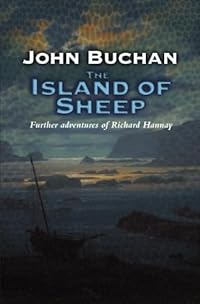
The Island of Sheep by John Buchan

The Island of Sheep cover

I hope to work my way through all of Buchan’s books so when I saw this one for sale in the library I snapped it up. It’s a continuation of Richard Hannay’s adventures, a good few years on from The Thirty-Nine Steps, and the now Sir Richard Hannay is married to Mary and they have a 14 year old son called Peter John.

He’s in a very comfortable rut and living a pleasant country- gentleman’s existence when the past pops up and Hannay finds himself embroiled in another adventure with his old friend Sandy, now Lord Clanroyden. Years before whilst on another jaunt in South Africa they had taken an oath to protect the explorer and prospector Haraldsen and his descendants, they hadn’t really taken it seriously at the time but when they discovered that Haraldsen’s son was being hunted down by a nasty set of characters, they feel obliged to go to his aid.

The action moves from Buchan’s beloved Scottish border country to the Norlands and The Island of Sheep (The Faroe Islands). Another enjoyable ‘Boys Own Storybook’ sort of a romp ensues.

I enjoyed this one even more than The Thirty-Nine Steps although towards the end it does feature a whaling ship and its crew, it was a surprise to me that it was sort of frowned upon, even in 1936 when the book was published.

Miss Pym Disposes by Josephine Tey

I picked this one out from a pile of Penguin vintage crime books in the second-hand book shop in St Andrews. It’s certainly worthwhile reading it if you like crime books. Having said that, when I was about half-way through it I found myself turning the book round to have a look at the cover again. Sure enough, it is a Penguin Classic Crime publication, but the crime is a long time a-coming.
I prefer crime stories to be of the “Good lord! There’s a dead man in my bath!” variety, within the first few pages.

Miss Pym Disposes was first published in 1946 and it’s set in Leys Physical Training College for young women. I always find that settings like that remind me of boarding school books, I half expected Darrel from Malory Towers to be there with her hockey stick.

Anyway, Miss Lucy Pym has been invited to Leys to give a psychology lecture and it is so successful that she’s invited to stay on for a few weeks. Not being one of the staff or a student and being welcomed by them all, Lucy has the opportunity to get to know them all better than would normally have been the case. She uses her knowledge of psychology but things aren’t always what they seem to be, and that is the moral of the story really. Well that and the fact that when a teacher has ‘favourites’ it can have dire consequences.

This book reminded me so much of The Small Room by May Sarton which was published in 1961 and is about plagiarism and favouritism. I think if I had been Josephine Tey I wouldn’t have been happy about it at all. But Tey died in 1952 and nobody seems to have noticed the similarities.

Tey even has the word ‘brilliant’ bandied about to describe various students. In The Small Room ‘brilliant’ is used to describe the student who has plagiarised. However, thankfully Tey has one character who points out that they only have one student who is ‘brilliant’ and in fact she shouldn’t be at the college but should be studying medicine, if only her parents could have afforded it.

I know that if you read lots of books you obviously find similarities in storylines but this just jumps out at you. I think that Miss Pym Disposes is the better book though, it’s a pity that people just think of The Franchise Affair when they think of Josephine Tey.

The Grand Babylon Hotel by Arnold Bennett

It was Susanne who recommended this one for the CPR Book Group which is a place for neglected authors or books. The only books by Arnold Bennett which I had previously read were all set in The Potteries and this one is completely different from them, as far as I can remember anyway because I think I was a teenager when I read them, which wasn’t yesterday! I don’t know how widely read his books are nowadays, I certainly haven’t come across many people reading them but this one is certainly worth reading.

I really enjoyed this book which was first published in 1902 but my copy is a 1954 Penguin, orange. It could just as well have been in their green vintage crime livery because that is what it is.

The Grand Babylon Hotel in London is the sort of discreet but oppulent place that if you have to ask the price – you can’t afford it. The American multi millionaire Theodore Racksole is staying there with his daughter Nella and he isn’t pleased by the way the head waiter, Jules is looking down his nose at them. On the spur of the moment Theodore decides to buy the prestigious hotel, at least then he’ll be able to get the steak and bottle of Bass which he wants.

Things aren’t what they seem to be and it isn’t long before Theodore and Nella realise that there are nefarious goings on behind the facade of quiet classiness.

This was originally published as a serial and Bennett wrote the 15 installments in 15 days and sold it for £100. It was described as the most original, amusing and thrilling serial written in a decade.

Arnold Bennett lived at the Savoy Hotel in London and it was the chef there who came up with the dish which became known as Omelette Arnold Bennett because he was so fond of it. You can see Sophie Dahl whipping one up if you’re interested.

There aren’t many people who have had dishes named after them. The only others that I can think of at the moment are Peach Melba and Melba toast, named after the opera singer Dame Nelly Melba and Pavlova after Anna. Eggs Benedict too, Lemuel Benedict was an American stockbroker. There must be others though.

The Flight of the Falcon by Daphne du Maurier

The Flight of the Falcon Book Cover

This book was first published in 1965 and although I enjoyed it, I don’t think it is anywhere near as good as du Maurier’s earlier work. At 272 pages, it is a very quick read. I must admit that I am not a fast reader as I take the view that as someone has gone to the bother of writing every word, it is only fair that I should read them all and not skim. It is well written and I found that it hadn’t really dated that much.

It is the story of a holiday courier called Armino Fabbio who conducts coach parties of tourists from Genoa to Rome. When a male tourist propositions the young and handsome Armino and slips a 10,000 lire note into his hand, Armino decides to get rid of the money by passing it on to an old lady who is slumped on the cathedral steps.

Unfortunately, she is murdered soon after and Armino decides that the safest thing for him is to get away from the area and he ends up back in the town where he had grown up, having left it as a young boy at the end of the war.

Since then his home town of Ruffano has enlarged due to the local university expanding, with as many as 5,000 students residing there or nearby.

Nobody recognizes the adult Armino and he takes a job in the university library, becoming involved with the students and staff and discovering that there is a disturbing rivalry between the Arts and Economics faculties, creating an atmosphere of menace.

He lives in fear of being traced to Ruffano by the police, especially when he discovers that the murder victim was his childhood nanny.

The book finishes with a spectacular festival which the students take part in and draws to what was for me an unexpected conclusion.

I don’t think I would read this one again though. It’s certainly not in the Rebecca league.