
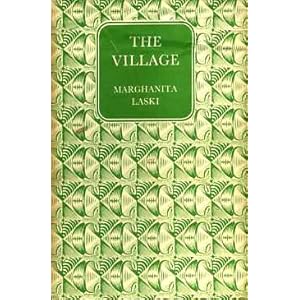
This is the first book by Marghanita Laski which I’ve read but I’ll definitely be reading more in the future. It was first published in 1952 and my copy is one of the books which I stumbled upon recently in one of those bookshops in Edinburgh which I didn’t even know existed, close by the east gate of the Edinburgh Botanic Gardens. It’s not a Persephone, it’s one of those Companion Book Club publications, just in case you’re interested in such things.
The story begins the night World War II ended. The inhabitants of the village of Priory Dean aren’t quite sure what they should be doing now that there is no need to worry about air raids and casualties of war. They’ve been dancing in the streets and the whole place is practically unrecognisable as they can actually see now that there’s no blackout.
Mrs Trevor and Mrs Wilson come to the same decision separately and so both take themselves off to their usual destination – the Village Hall where they would normally be on Red Cross duty, each of them dressed in the Red Cross uniform. They had always liked each other but they were from entirely different backgrounds and in fact Mrs Wilson had been a ‘domestic’ for Mrs Trevor in the past.
They have a lot in common really, their families are uppermost in their thoughts but Mrs Trevor is seen as one of the upper class families and lives in a large house while Mrs Wilson lives in Station Road which is a very much poorer part of the village.
A sense of ‘class’ stops them from being friends and when a romance springs up between their grown-up children – Margaret Trevor and Roy Wilson – the Trevors are appalled at the thought of their eldest daughter having anything to do with the Wilsons. But Roy Wilson had been a sergeant in the army and is determined that things are going to be different now that he’s in civvy street and earning very good money as a printer. As far as he’s concerned the forelock tugging days are over.
This is an entertaining and at times quite comical read. I saw a comment on a blog recently to the effect that all English novels were about class, it made me laugh but I did think that it was a wee bit unfair, because ‘class’ is a universal thing. Think of Mark Twain and Louisa M. Alcott. To Kill a Mockingbird is as much about class as it is about racism. I’ve always found Germans to be much more concerned about class than Brits are and every Polish person I’ve ever known has claimed to be of aristocratic blood!
So yes it is about class and the fact that Margaret Trevor has ‘no sense of class’ despite the fact that she is supposed to be from one of the ‘better’ families. She was the heroine of the story, unloved and taken for granted by her snobbish family, she rose above it all whilst they thought she was marrying down.
The world of Priory Dean seemed so familiar to me, in the 1970s, when I was young, there were still some dinosaur types around who thought they were better than everyone else but were penniless and up to their eyes in debt. Have they all shuffled off now? I hope so but you can never be quite sure.
I thoroughly enjoyed ‘The Village’ with its simple, direct style of writing which contained depth and complexity and by the end I was convinced I was living in the village, amongst those people at the end of the war. I’ve read three of Laski’s books – ‘Little Boy Lost’, which is heart rending and ‘The Victorian Chaise-Longue’, which is different and not nearly as good or as satisfying as the other two.
By the way the library does have a few Michael Innes books, not The New Sonia Wayward, but some of the Appleby mysteries, although they’re in large print, which I don’t really like.
Margaret,
It’s always a shock to read a book with normal print after you read a large print one.
What a shame the other books aren’t quite as good, I do enjoy books with that sort of setting. It’s just before my time as I wasn’t born until the end of the 1950s but my siblings were around then. I suppose to a lot of people it’s historical fiction now – what a thought!
I didn’t mean to imply that Little Boy Lost isn’t as good as The Village – it is excellent and maybe even better than The Village!
Margaret,
I think I was just hoping for something similar to The Village, but I’ll look out for Little Boy Lost anyway. Thanks!
Eee Gads!
Katrina, Little Boy Lost!
Oh gosh, this title was made into a movie in the 1950s, starring Bing Crosby, I believe. I know, just mentioning Crosby makes it sound like it would be a schmaltzy movie, but it wasn’t, not at all.
I saw it when I was 12 in the seventh grade (1965-66). I was glued to the set. The story was so poignant, so well-acted, I can remember how I cried and cried at the end, joyously.
My mother, seeing my fascination, wisely did the rare thing and allowed me to watch it until the end, way past my bedtime.
Age 12 was the year in my life when I first started learning of the effects of the war on civilians. I will never forget this film experience. Funny, I’d like to see what I’d think of it now. Or, of the book!
Judith,
It must have made a big impression on you to remember it so well after all that time. I can’t imagine Bing Crosby in anything other than a schmaltzy film. I must admit I’m not a fan but it would be worth watching the film just to see the difference! I’ll have to get the book.
BTW – were you thinking of going to Worcester?
I loved this book, I think it’s one of my favorite Persephones (I think I used the same image on my review last year as well! Pretty.)
And it’s so interesting to me that Laski’s books are so different. I’ve only read Little Boy Lost and the VCL. I don’t have To Bed With Grand Music but I’d like to read that one too. So many Persephones, so little time!
Karen,
I knew when I saw this book that someone had loved and blogged about it recently, it was probably you and Margaret! I like the old hardback books so I’m going to be looking out for more of hers in that Edinburgh bookshop – or anywhere else for that matter. I only have 2 or 3 Persephone books which I haven’t got around to reading yet.
I have wanted to read Laski for a while because so many bloggers have written favorably about her novels. The Village would be just my cup of tea. I will have to add it to my multi-page list of books to read before I die.
I don’t think all British novels are about class, but so what if they are? American novels are very concerned with class also – it’s just a common conflict for novels to revolve around.
Anbolyn,
I think you would enjoy it. I know how you feel about that list and I already have so many in the house unread. I’m fairly sure that even in the stone age people were saying: You should see those folks in the next cave along the coast, they’re like animals!