
Just because it’s Hallowe’en.
Monthly Archives: October 2012
Tomato and Bean Soup (Fasolatha)
This recipe originates from Macedonia, Greece, and it’s back by popular demand, because Joan hadn’t heard of Fasolatha, as you can see it’s just ordinary tomato and bean soup, but it’s very tasty and nourishing, a real winter warmer.
Soup which is suitable for vegans!

I blogged about this soup a few years ago, early on in my blogging career. It’s Duncan’s favourite soup and as he is living in his own place now he might tackle making it himself!
1 mugful of dried haricot beans soaked overnight
3 tomatoes, quartered or about 12 tiny ones
2 onions
4 carrots
3 sticks of celery (optional)
2 200g tins of chopped tomatoes
2 tsp dried oregano
1 tbsp tomato puree
chopped parsley and thyme (to your taste)
Roughly chop the onions carrots and celery and whizz up in a blender with water. You will have to do this a few times to deal with it all. Reserve some of the carrot and celery just roughly chopped if you like chunky bits in your soup as we do. Add all of this to a large pan with the haricot beans and tins of tomatoes. Then. add the tomato puree, dried oregano and chopped parsley and thyme. Lastly, add the quartered tomatoes and more water. I use my pressure cooker for this recipe as then you don’t have to bother about soaking the beans first, just cook at pressure for about 20 minutes. I add enough water to make about 12 bowls of soup. If you don’t have a pressure cooker then just boil it all up for about 1 hour. Season to taste. Try it, you’ll love it. If you can’t be bothered with the dried beans, try using ordinary tinned beans. Obviously you will only have to boil the soup for about 20 minutes then. I’ve never tried tinned beans but I think it will work fine.
In Tearing Haste: Letters between Deborah Devonshire & Patrick Leigh Fermor
The letters have been edited by Charlotte Mosley.
I’ve read quite a few books now by both of the writers of these letters and it seemed the right time to read a book by the two of them together in the shape of letters which they had sent to each other over a period of 53 years from 1954 to 2007.
Whilst it isn’t a book to read if you don’t know either of the two writers, you’ll definitely find it interesting and entertaining if you do know them and at least some of the people who feature in the letters. That’s giving you quite a lot of scope because so many people are mentioned, obviously not in any sort of name dropping way, it’s just that they knew/know so many well known and influential people.
Deborah Devonshire is the youngest of the Mitford girls and is related by marriage to both Harold MacMillan (British Prime Minister) and John F Kennedy and people like Evelyn Waugh and Ian Fleming also have parts in the letters. It is mentioned that Mary Russell Mitford, author of a book called Our Village about rural life and published in the 1820s was actually a distant relative of the Mitford girls.
That’s all interesting in itself but there’s just as much written about unknown private people as there is about royalty or war heroes. Sometimes it’s mentions of people they just come across in life which have amused them and they feel the urge to share it with each other. They both had a good sense of humour, veering towards the daft, like when Debo asked Paddy for suggestions for spoof book titles, he gave her a long list, she only needed 28, but here are a few of them to give you an idea.
Reduced to the Ranks by D. Motion
Haute Cuisine by Aga Khan
St Symeon Stylites by A. Columnist
Intuition by Ivor Hunch
Dipsomania by Mustafa Swig
In the Soup by A. Crouton
The last one is The Ruined Honeymoon by Mary Fitzgerald and Gerald Fitzgeorge.
As you would expect from a correspondence over so many years there are ups and down in their lives and in common with Letters Between Six Sisters – it gets quite sad towards the end as the family, friends and latterly even their respective spouses disappear, much to their chagrin.
I’m wondering what to read next in the Devonshire or Fermor line. Any suggestions?
BBC Radio 4 extra on the iPlayer
I was listening to Radio 4 Extra this afternoon whilst making a pot of lentil soup, as you do, well it has suddenly got really cold, I got caught in a hailstorm today and it’s going to be icy overnight apparently, so soup is a necessity!
Anyway, at the end of ahem Dick Barton Special Agent, the presenter mentioned some of the up and coming attractions in the shape of an Eric Ambler thriller, Sherlock Holmes and much more. I’ve just realised that I missed a Jill Paton Walsh thing so I’ll be listening to that via the iPlayer soon too. Have a look here if you haven’t already!
I also saw an episode of the Martin Clunes programme Islands of Britain on the telly last night and wondered if some of it might be on You Tube and sure enough it is. I thought it might be of interest to some people who can’t get it on their TV.
The other thing which I thought folks might like to see is good old Tom Weir. I think I saw that Peggy Ann was watching him. You might never have heard of him before, he died a couple of years ago but he was a good age and about 30 or 40 years ago his short TV programmes used to be on a lot. I was amazed when I looked in on my insomniac then teenage son some years ago to see that he was watching an ancient Weir’s Way at about 3 o’clock in the morning. Tom had a big following with the insomniacs I think.
Although Tom had climbed all over the world, even up the Himalayas, it was always the hills of home which were his favourites and they happened to be in the area which I grew up, he was a a bit of a local hero and could often be seen on the hills. If you’re interested in some Scottish scenery there are loads of clips of Tom. Here’s one for a starter!
Fountains Abbey, Yorkshire
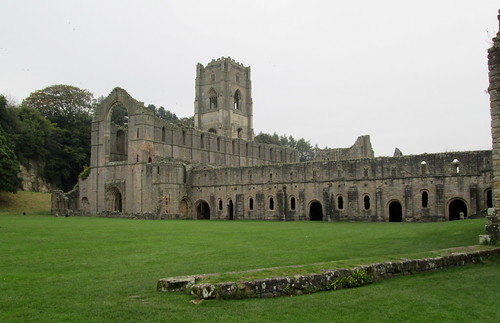
Well it is that season of mists and mellow fruitfulness and this was what Fountains Abbey in Yorkshire looked like last week when we visited it. It was a Cistercian Abbey and the grounds lead into Studley Royal which is a beautiful water garden which was created in the 1700s, but more about that in another post.
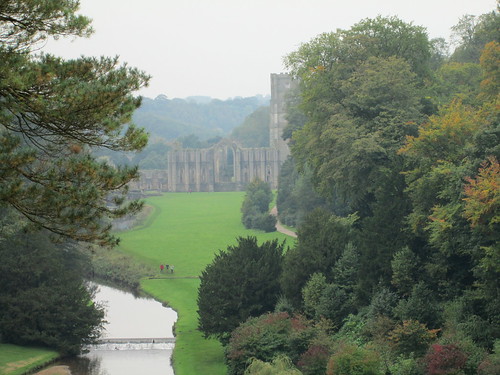
It didn’t look quite so misty close up, but it was very chilly and I imagine it must have been bitterly cold for the monks who lived here, they first settled in this area in 1132. In fact there was a party of schoolchildren there at the same time as us and they got to dress up in monks’ habits, hoods and all. I actually envied them as they looked a lot warmer in them than I felt.
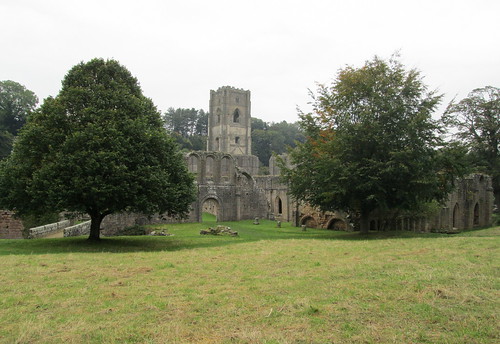
There’s still quite a lot of the main building left and there’s a great model in the Porter’s Lodge which shows how large the whole place was in its heyday. A lot of the buildings have just disappeared.

The setting is beautiful with streams and fountains leading in to the river which would have provided the monks with fish. They were very good businessmen and turned the surrounding land into productive farmland for crops and sheep.
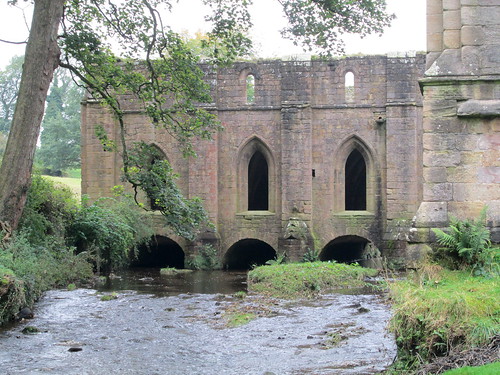
I can’t resist a bridge of course and there are a few like this one around the abbey.
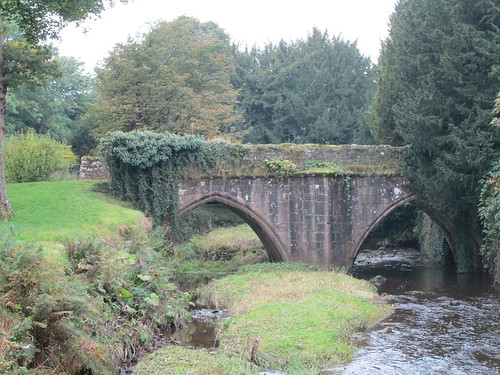
This abbey was one of the many casualties of Henry VIII and his disagreement with the Pope in order to get his hands on Anne Boleyn. It had been one of the richest abbeys in Europe until then.
There’s a lot of walking involved if you want to go around the adjoining water gardens too so flat shoes are required, but it’s a lovely place and is well worth a visit, I’ll be posting those photos soon I hope.
Young Men In Spats by P.G. Wodehouse
It’s such a long time since I read anything by P.G.Wodehouse, but I bought this lovely hardback at a National Trust booksale recently and although I have loads of books waiting in a queue to be read, this one jumped to the front because I was just in need of something really light and cheery.
It’s a book of short stories and I suppose you could say that the subject of most of them is cherche la femme as they’re all about young men trying to win the attention of bright young things.
They young men are all members of the Drones Club and most of the stories feature Freddie Widgeon, Wodehouse was economical about the other characters, most of whom are categorized as Beans, Crumpets or Eggs. The later stories feature a Pint of Bitter, a Small Bass, a Light Lager – you get the idea I’m sure. So there’s a lot of: A Crumpet said to a Bean…. And it was this mode of writing which made me stop and think – what does this remind me of and of course it was Damon Runyon‘s Tales on Broadway.
Do I hear you say That’s absurd? Fair enough, after all on the surface the only similarities are that they are both books of short stories. They’re set in different continents, the characters are from very different backgrounds but there’s the same sparkling wit, stupid men, fearsome as well as delectable women and lots of fun.
A Day In York
We used to visit the Yorkshire area fairly regularly when our boys were wee, then for years we didn’t go anywhere because they didn’t want to leave their friends, computer, computer games, and were generally miserable away from home, so there was no point in going anywhere. They they got to the teenage years when officially we could have left them on their own but although we could have trusted them to be sensible, it was a bit of a worry that others might realise there was a house with no parents around and it would have become a Facebook party disaster area!
So it was nice for us to revisit York on our own after so long away from it, mind you it doesn’t really change. As you can see from the photo below of the famous Shambles area. York is very busy at the best of times and we did get stuck between a large party of tourists, it makes it difficult to photograph things, they were probably complaining about us being in the way! We had to go back later to take this photo otherwise it would have been just full of people.

This part of York is just outside the Minster which is why it’s called Minster Yard I suppose. It’s very chocolate boxy and would make a good jigsaw puzzle. We visited the Treasurer’s House which is near this part, it’s another National Trust property.

I think the building below must be one of the best looking locations for a shoe shop. I still find it amazing that such old buildings are still in everyday use.

What no photos of York Minster?! I hear you say. No, not one, as you can see from this one it’s in the background swathed in scaffolding like almost every ecclesiastical building we’ve been to recently. It’s a never ending battle to keep them standing and I seem to remember that York Minster was built on sand so they have a tougher time than most trying to stop it from falling down. You can see images of it here.

Never let anyone say that we don’t have talented stonemasons around nowadays. This yard just by the Minster is just about the most interesting bit of York. You can watch really talented masons at work and given the amount of beautifully worked stone around, all carefully numbered of course, I think they must have just about renewed every stone in the Minster over the years. Women carve the stones too, they must have great muscles.

York was enjoyable but tiring. We didn’t go to the Yorvik Centre this time. If you have kids with you then that’s a must to visit, then at least you can have a sit down whilst you get whisked back to Viking York.
Books
Why am I reading the classics? Before you start, I’m warning you this is a ramble and a half!
There are lots of reasons why I read classic books. When I was about 9 or 10 I started reading classics which had been abridged for children and Charles and Mary Lamb’s Tales from Shakespeare. I really enjoyed reading books which were set in a more genteel time I think and it was about that time I tried my hand at embroidery, I think I fancied myself as a Victorian heroine!
I soon moved on to reading the unabridged books like Jane Eyre and then everything by Jane Austen, and George Elliot’s Mill on the Floss was a favourite of mine when I was about 12. I think at the back of my mind I had a feeling that if a book was still being read and reprinted after so many years then it must mean that it’s a book worth reading. I do hate giving up on books which have been a disappointment to me, there’s less chance of that with a classic I think.
I still have the very first classic book which I bought with my own money, and I can clearly remember buying it. My mum gave all of my books away when she was having a mad clear out, apparently I had grown out of them, I of course knew nothing about it until the deed was done. But my first purchase survived the pogrom because it was for adults. It is a small cream coloured book, published by Thomas Nelson and it’s Catriona by Robert Louis Stevenson. Apart from being a dinky wee book it was the title which made me buy it, vanity I suppose, or just curiosity because Catriona is the Gaelic spelling of my own name of course, and I wanted to know what this other Catriona/Katrina got up to.
I had to wait though as I hadn’t looked inside the book where it says – sequel to Kidnapped. As I hadn’t read Kidnapped I had to find that one first. Both books are well worth reading and have a Scottish setting, which is something else which I enjoy. I know – how parochial of me!
I’ll give you a flavour of that first classics book purchase. I bought it in John Menzies (pronounced Ming-is – it’s that yogh letter of the alphabet again) Stationers and Bookshop in Helensburgh, on the west coat of Scotland, north of Glasgow. Helensburgh is a town just about 7 miles north of where I was brought up and it was a favourite place to have a nice day out, a bit of a change of scene. It was a popular destination for day trippers, holidaymakers and at that time had the most millionaires living in it of any town in Scotland. It attracted successful football players and theatrical entertainers, showbiz types I suppose you could say. The actress Deborah Kerr was born there and John Logie Baird lived there and apparently started his experiments on the development of television there in the 1920s.
But all that was of not very much interest to my mum, what she liked Helensburgh for was the American Navy! At the time they were based at the Holy Loch and possibly Faslane, on the Clyde. Yes, all the nice girls love a sailor – so they say, and my mum certainly did. She was always terribly disappointed if for some reason there were no US sailors in the town when we were there. I was always quite relieved because she would urge me in a stage whisper, which really more resembled a fog horn. Touch their stars for luck! She always got the attention of the sailors – I always just about died of embarrassment and of course refused to touch up any sailors. I’m sure my mum made it up – that it’s supposed to be lucky to touch the star on the bottom corner of a US sailor’s collar.
Well I warned you it was going to be a ramble! But when I look at my copy of Catriona it reminds me of sailors and my somewhat eccentric mum. As it happens my dad had been a sailor when they got married, but then, it was during World War II and there were a lot of them about back then.
If you look carefully you should be able to see my cream coloured copy of Catriona on the shelf below.

The Violins of Saint-Jacques by Patrick Leigh Fermor
I’ve recently enjoyed reading some of Patrick Leigh Fermor’s travel books and I have a habit of trying to read everything by an author once I’ve ‘found’ them, so when I saw this book in a shop in Great Malvern I had to buy it, even although it’s a novel, his only one actually.
It was originally published in 1953 and is set in the Caribbean, a place I would never want to visit, being a cold country person. I usually avoid ‘hot climate’ books when I can, I know – daft but true!
Anyway, I did enjoy the book but not nearly as much as Fermor’s A Time of Gifts and Between the Woods and the Water. There is the same sparkling descriptive prose of course and if you want to ‘experience’ a volcanic eruption in safety then you couldn’t do better than to read this book.
To begin with I found myself thinking that it seemed to be exactly like one of his travel books but when Fermor befriends Mademoiselle Berthe de Renne a very elderly artist who is living in Mitylene in Greece, he becomes entranced by her stories of life on the Caribbean island of Saint-Jacques before the Great War. Berthe is looking back to her youth but this book is more than descriptive decadence. If you want to go deeper I suppose it’s about disappearing worlds and loss.
It has plenty of interesting ‘by the byes’ such as the fact that the French Revolution shenanigans extended to the French colonies, something I hadn’t realised before but I suppose it is obvious they would. The really heartening thing though is that when a guillotine was erected in Saint-Jacques and the first Royalist head hit the basket, the negroes who witnessed it were horrified and broke through a cordon of guards to tear the guillotine to bits. The same thing apparently happened in Haiti, thus proving that the negroes were more civilised than the French if you ask me. I believe that yesterday (16th October) it was the 220th anniversary of Marie Antoinette being guillotined and there was an auction of some of her possessions, if you’re interested have a look here.
Finished At Last!
I actually started knitting this jumper last winter so I was determined to get it finished before the cold weather really set in this year. It took a bit of sorting out as I’d left it half done for so long, I couldn’t even remember which size I had opted to knit it in. I’ve used this pattern quite a few times since I originally did it way back in the 1970s when I was a teenager and knitted the smallest size, this one is two sizes bigger but I was a real skinny-malinky as a teenager so it’s not as bad as it sounds.

The great thing about this pattern is that the jumper is nice and long so it keeps my bahookie (bum) warm and I need that especially as it was freezing last night and it’s only October. We gave in and put our central heating on despite the price hikes (does the price ever come down when the global price of gas goes down? – I don’t think so.)
Anyway, I was determined to finish the jumper before going on to the next knitting project, I have so many sewing projects on the go at the moment and I don’t want to get into the same fankle with knitting too. But it’s crucial that I start on the babies’ bootees and scratch mits which I said I would knit for a baby boy who is due to be born any day now. Laura’s best friend will be his mummy and Laura (our son Gordon’s betrothed) has been chosen as a godmother. How different it all is from my day when the big excitement was whether it was going to be a boy or a girl, and it was deemed to be bad luck to buy anything for the baby before it was safely in this world. He has even been named already!

The other bit of knitting comment I want to make is that I was absolutely chuffed when I was leafing through a pile of knitting patterns in a charity shop a few weeks ago, to find the pattern on the left. It is a copy of a pattern which my mum used ever since I can remember, she knitted my dad the lower right hand zipped cardigan/jacket every other year it seemed. As you can see it’s a pre-decimal priced pattern from about 1950 I think. In fact her copy of the pattern eventually fell apart but by then she had done it so many times she didn’t need the instructions. I don’t suppose I’ll ever knit anything from the pattern but it’s just nice to have it as a reminder. Dad died in 1980 when he was just 55 and whenever I think of him he’s wearing one of those knitted jackets.