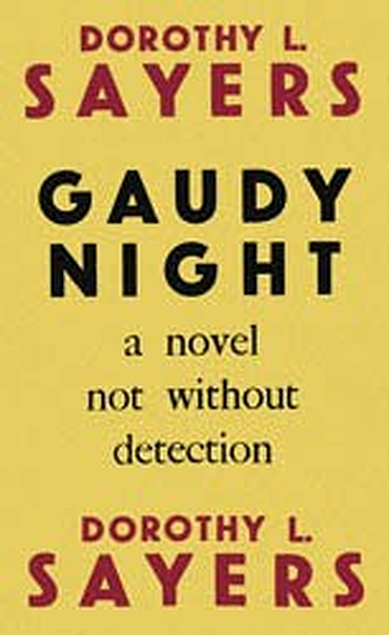
Gaudy Night by Dorothy L. Sayers – 20 Books of Summer 2024

Gaudy Night by Dorothy L. Sayers was first published in 1935 and it was a re-read for me, for at least the third time. The first time I read it was in the late 1970s. I think this one might be a love or hate book as I’ve realised over the years that some people hate it. I think they think that Sayer’s writing is pretentious because she did write quite a lot of quotes, bits of poems. I still love it and I’ve decided to re-read the other Lord Peter Wimsey books soon, in order this time. He probably annoys some readers, I just think he is funny and I’m pretty sure she modelled him and his ‘man’ Bunter on Wodehouse’s Wooster and Jeeves.

Anyway, the setting is mainly a women’s college in Oxford where Harriet Vane has gone to do some academic research. Shrewsbury is her old college so she knows some of the staff. Not all is well though, some of the staff and students have been receiving poison pen letters, and they think that as Harriet writes detective novels she might be able to get to the bottom of it all.

Things escalate though and even Harriet is targeted with letters, grafitti appears, there’s vandalism, destruction of academic work and all sorts of nastiness going on. Harriet decides that she needs help from Lord Peter, but he is out of the country and uncontactable.

Meanwhile she meets Peter’s nephew for the first time and he doesn’t realise that Harriet is completely in the dark about large parts of Peter’s life, he’s far from being the sybaritic poseur and posh twit that she thought him to be. When he’s out of the country he’s on important government business. Harriet begins to revise her feelings about Peter.

In a weird way this is my comfort read, – well – that and du Maurier’s Rebecca.

Do you have a comfort read that you turn to now and again? My mother-in-law’s was Gone with the Wind, but I am never going to go to that one.
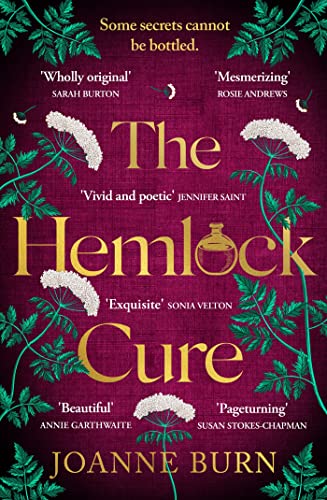
 

The Hemlock Cure by Joanne Burn 20 Books of Summer 2024

The Hemlock Cure by Joanne Burn was first published in 2022 by Sphere. The setting is Eyam in  England’s Peak District  in 1665/66. Apparently I’ve been pronouncing that village name wrongly for decades, it should be ‘Eem’. This is a book which I borrowed from the library, so it wasn’t on my original list of 20 Books of Summer, but I realised that I had inadvertently added three books to that list which I had already read, so I substituted this book for one of them.

Mae is the surviving daughter of Wulfric, a herbalist/apothecary and religious zealot, unhappy about the introduction of the new Book of Common Prayer by the king. Mae is keen to become her father’s apprentice but she’s kept busy with housework.  Her mother had died not long after she had given birth to a dead son. Isabel Frith is the local midwife and herbalist. Wulfric despises Isabel and seems to think that she caused his wife and son’s death, hinting at witchcraft. Unknown to Wulfric Mae is being taught herbalism by Isabel. He has taken on a young man as his apprentice, so Mae’s hopes for her future are dashed.

Obviously The Plague features in the book, but not to any huge extent, as does homosexuality. It was an enjoyable read.


Mayland Hall by Doreen Wallace – 20 Books of Summer 2024

Mayland Hall by Doreen Wallace was published in 1960. It’s one of my 20 Books of Summer. I had only just read a review of a Doreen Wallace book when this one popped up in a secondhand bookshop, otherwise I may not have bought it, but I’m glad that I did.

The setting is East Anglia, the Sculpher family makes a living from travelling around farms and woodlands of the area, cutting down any trees that the landowners want to be felled. It’s difficult work and the young women of the family are expected to do their fair share of felling too. They all live in ‘vans’ and the younger ones sleep under them, it’s a tough and spartan life.  One of the daughters is apt to lie down in a ditch with any man she can find, and those children are just seen as part of the future workforce by their grandfather. But one night Maud, another daughter doesn’t come home, she has legged it with one of the gentry. Sculpher is incensed.

The focus switches to Mayland Hall where Daniel and Mary Gooderham live.  The Sculphers do occasional work for them. The Gooderhams are ‘county’ people, an ‘old’ family and well-respected. They don’t have a huge amount of ready money but over the years they have built up more and more stocks of land, so they are land wealthy. In their society primogeniture rules, but Daniel’s elder brother had died in World War 2. He had been the one to get the expensive education while younger brothers just went to the local school. Apparently any daughters were also sent to expensive schools, to make them more likely to find a wealthy husband in the future! Janey, the daughter-in-law has cousins who are ‘honourables’ like the Mitfords and it has gone to her head, she’s a horror.

This was a good read, full of social history now as it is 64 years since it was written. It features the Gooderhams worrying about the new Death Tax when Daniel dies, and what they had to do to avoid it. This was something that a Labour government had brought in, in an effort to redistribute wealth. It reminded me that the Death Tax is often mentioned in Angela Thirkell’s books too.

Virginia Plain by Roxy Music on Top of the Pops 1972

I think it’s a few years since I did a music blogpost but I was listening to the radio a couple of days ago and the DJ mentioned that Roxy Music’s Virginia Plain had been released FIFTY-TWO YEARS AGO. How is that possible? Well, fair enough, in the summer of 1972 I had just become a teenager so I am a good deal older now.  For me back then everything was Glam Rock, specifically T Rex but I soon branched out to David Bowie and Roxy Music. I remember this Top of the Pops appearance as if it was yesterday! Those were the days.

Hop Scot by Catriona McPherson

Hop Scot by Catriona McPherson (Last Ditch series) was published by Severn House (Canongate Books) in 2023. I picked this one up recently from the New Arrivals shelf in my local library. I enjoyed the author’s previous Dandy Gilver series which is set in the 1920s/30s. This series is contemporary and unfortunately I’ve found it rather late because when I started to read it I realised that this one is sixth in the series, but I don’t think it’s really necessary to read them in order, although I wish I had.
Lexy Campbell is living in California but she’s travelling to Scotland to spend Christmas with her parents, and the Last Ditch Motel extended family is accompanying her. They’ve never been to Scotland before and they’re all geared up to spend their time in Dundee, but there has been a last minute change of plan and they all end up being driven to the pretty village of Yule not far from Edinburgh to spend Christmas at Mistletoe Hall. Lexy’s parents have bought it intending to run it as a posh B&B – after a lot of refurbishment.

This is a good mystery with lots of humour and quirky characters. I’ll have to go back to the beginning of the series though to get to know them all better. A lot of the humour revolves around the differences between American and Scottish society.

The blurb on the back says: Deadly secrets, berry rustlers, skeletons and a snowy Christmas Eve in the booze aisle at Tesco; the last Ditch crew won’t forget their Scottish holiday in a hurry.

On balance I preferred the Dandy Gilver series, for the setting.

The Little Bookroom by Eleanor Farjeon – 20 Books of Summer 2024

The Little Bookroom by Eleanor Farjeon was first published in 1955, it is illustrated by Edward Ardizzone. It’s one of my 20 Books of Summer. This book won the Carnegie Medal.

There’s an Author’s Note at the beginning of this book, she explains that the house she grew up in was filled with books everywhere but there was one room which was called The Bookroom which housed ‘a motley crew of strays and vagabonds, outcasts from the ordered shelves below’. There was so much dust in that room it made her eyes smart, but it was still her favourite place to be. I must say that the whole house sounds like a wonderful place to grow up in.

Anyway, this is a book of charming short stories, suitable for children of all ages. some of them feel quite traditional in the fairly tale mode, and others are really different. I can see why it won the Carnegie Medal in 1955.

I’m doing well with 20 Books of Summer. I’ve read 14 so far, but still have four or five to review.

Sloten, Friesland, Netherlands

Sloten is another of the eleven ‘cities’ of Friesland, where they have ice skating races on the canals when they freeze hard enough.

Sloten Canal, Netherlands, Friesland

The photo below is just so Dutch, boats moored outside your house, a canal, a lovely hump-back bridge and a windmill – what more can you ask for?

Sloten Canal ,windmill , Friesland

Well, another bridge with Jack standing on it is all I have of Sloten, it’s a very quiet but scenic small town. Even smaller than I thought when we were there, apparently it only has about 700 inhabitants. It’s the smallest Elfsteden in Friesland, the smallest of the ‘eleven cities’  five of which we have visited. Hopefully we’ll be able to visit the others some time in the future.

Jack Canal, windmill , Sloten, Friesland, Netherlands


a flat place by Noreen Masud

a flat place by Noreen Masud was published in 2023 and it has been shortlisted for several prizes. It’s described as a memoir and Masud writes about her love of flat places, something which she first realised when she was being driven to school in Pakistan every morning by her mother. She longed for her first sight of a flat expanse of land which they passed by, it was something that her sisters didn’t even notice.

Later when family problems led her Scottish mother to leave Pakistan and take her daughters to live in Fife, where she had grown up, Masud went on to visit other flatlands such as Ely in Cambridgeshire, Orford Ness in Suffolk, Morecambe Bay, Newcastle Moor and Orkney, and here she writes of her experiences. Her love of stones, particularly hag stones, is something that I can understand, but where scenery is concerned I’m not so keen on flat vistas. In fact my definition of a good High Street is one where I can stand in it and look up and see soft, rolling green hills, which for me are comforting and enveloping. I remember reading somewhere years ago that the wide skies and flat scenery of Norfolk were thought to contribute to the higher than usual suicide rates in the county!

Masud can’t get away from her childhood traumas, she had grown up cloistered in one room with her mother and three sisters, except for when she went to school. She was in a strange position of not being part of the community that she is growing up in, not even being able to speak Urdu very fluently. Her father was a doctor and he wanted his daughters to grow up speaking English with no hint of a Pakistani accent.

Masud is still haunted by her upbringing, she was lucky in that her father regarded his four daughters as being his sons, and so was keen on them having a good education, but on the other hand he was still wedded to the more traditional morals of his own upbringing. It seems to have been a bit of a toxic mixture. In the end he cared more about what the neighbours/extended family thought than about his own family, luckily for the author and her mother.

I must admit that I learned quite a few things while reading this one, it’s so much more than a memoir. I’m sure it will win more prizes. I’m also sure that I read about this book on a blog, but of course I can’t remember whose it was. Thank you anyway.

There’s one flat land that I visited which I feel Noreen Masud would relish. When we visited Lindisfarne in Northumberland some years ago I watched several pilgrims walking across the the tidal mudflats to the Holy Island and the ruins of the monastery. Although not in the least bit religious I did think that it looked like it might be a good experience – if messy.

Noreen Masud is now a lecturer in 20th century literature at the University of Bristol.

Hindeloopen, Netherlands

Hindeloopen is another one of the eleven ‘cities’ of Friesland, in north east Netherlands. I’ve always fancied being able to moor a small boat by my house so that I could just pootle about on a river, you can actually do that in the Netherlands, well their canals look just like rivers.

Dutch house, Hindeloopen, canal


Hindeloopen ,Small Canal, Netherlands

How scenic is the photo below, it almost looked like something from a children’s story book.

Hindeloopen, Bridge, Netherlands

There are plenty of bridges and locks.

Hindeloopen Locks, Netherlands, Friesland

But Hindeloopen is very popular with sailors. I thought it would be similar to the coastal villages in Fife, but it was very different. There wasn’t much in the way of shops at all, just eateries, and there were millions of midges. You might think that coming from Scotland I would be well used to midges but I had never see anything like it, and it was a really windy day. I would hate to be there on a still day – if they have them.

Hindeloopen Harbour , Friesland, Netherlands

There were lots more yachts than can be seen in the photos.

Hindeloopen Harbour , Friesland, Netherlands

Beyond the harbour is the IJsselmeer. This used to be the Zuiderzee but in 1932 they constructed a dyke to close it off from the open sea, and now it is a freshwater lake.

IJselmeer , Hindeloopen, Netherlands

It is very different from the North Sea in coastal Fife.

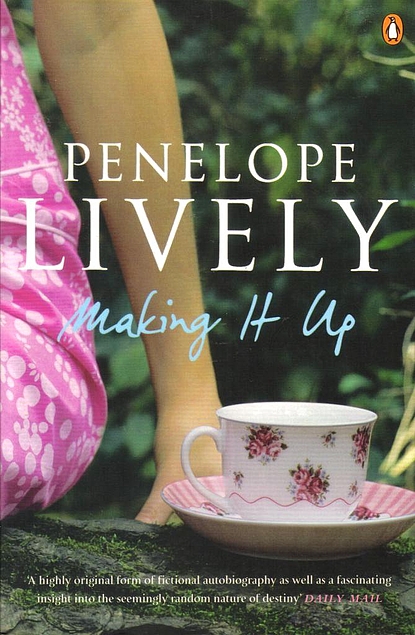
Making It Up by Penelope Lively – 20 Books of Summer 2024

Making It Up by Penelope Lively was first published in 2005. It’s one of my 20 Books of Summer.  This book is an exercise in ‘whatiffery’ something which we all indulge in from time to time I’m sure. What would have happened if I had taken another path in life, all those decisions that we take – or don’t take. It’s a really good read.

The blurb on the back says: Taking moments from her own life and asking ‘what if?’, Penelope Lively constructs fictions about possibilities and alternative destinies.

As you would expect she starts off with a story about her childhood, Mozambique Channel. Born in Egypt, she was caught up in WW2, when it looked like the Germans were going to be heading for Cairo, the civilians that could get on ships did so and sailed for South Africa, but the journey was a dangerous one.

In Imjin River the what if is about her husband who had been due to be sent to Korea as war had broken out there while he was doing his National Service.

Transatlantic is the one which spoke to me most I think as it is about leaving your own country to live elsewhere, and how that impacts on your life and experiences.

Other stories have the titles  – The Albert Hall, Comet, Number Twelve Sheep Street, The Temple of Mithras and Penelope.

These ‘what ifs’ are entertaining, but I found the explanations and the backgrounds which Lively has written for each one to be even more interesting.