My 2024 reading statistics

I write down the books that I’ve read as I finish them – in an old school jotter. With notes in the margins as to what sort of book they are, so I’ve totted up my stats and here they are.

I’ve read 122 books in 2024, I’ve reviewed most of them.

I’ve only read 11 non fiction books – I must do better, although I have also dipped in and out of quite a lot – as you do.

I’ve only read 10 vintage crime books. I thought it would have been more than that.

I seem to have only read 2 contemporary crime novels – how did that happen?

I read 36 books by Scottish authors.

I read 39 contemporary novels.

I read 20 children’s (YA) books

I read 19 historical fiction books, I thought it would have been more.

Only 13 classics, although I am notoriously strict (or picky) about what I deem to be a classic.

Only three books in translation.

It has been quite a good reading year for me. I’ve found more than a few new to me authors that I plan to read more of – or have already done so, particularly C.J. Sansom.

In 2025 I intend to take a very relaxed attitude to my reading so I almost certainly won’t commit myself to joining in with any challenges. I’m going to ‘dree my ain weird’ as we say in Scotland, in other words I’ll do my own thing and go my own way, depending on how I feel, with no pressure whatsoever. I’ll be visiting the library a lot, so many have been closed down completely in Fife over the past ten or so years and I hate to think that they might be going to have another cull of them, but with the state of local council finances it’s a distinct possibility in the future I think. I want to keep their borrowing statistics healthy.

I hope to do more gardening, craft and cookery posts in 2025 – well that’s the plan anyway, but 2024 was a very poor year for gardening. The only decent weather that we had in Scotland during the summer happened to be the almost three weeks when we were in the Netherlands. It was so annoying watching the BBC news while there (they’ve always been able to see the BBC as the signal is so strong) and seeing that the weather was so good back home, especially as we didn’t have very good weather where we were on holiday. To make matters worse as soon as we got back to Scotland the rain started and didn’t stop, if it wasn’t too wet to garden, it was too windy. Such is life.

So that was 2024 – blogwise anyway.


Kimono Exhibition at the V&A Dundee – part 2

Back to the V&A Dundee  Kimono Exhibition and as you can see from the two photos below they also had some kimonos being shown on models so that you could see how they would have been worn back in the day.

Kimono Exhibition , V&A, Dundee

You can see the roll of padding at the hemline which would have weighted the fabric down and make it hang better. Sadly it wasn’t possible to avoid reflections.

Kimono , Exhibition, V&A, Dundee

Kimonos were still popular in Japan in the 1930s, the kimono below from 1930 has a very modern design.

Japanese, KimKimono Exhibition, V&A Dundee,

They are a lot gaudier than the traditional kimonos, the one in the middle below definitely has a Charles Rennie Mackintosh Glasgow Rose vibe about it.

Japanese ,Kimono Exhibition, V&A, Dundee

In the 1930s  things were getting more European in design. The small kimono for a young boy features an aeroplane which says kamikaze on it.

Japanese, Kimono Exhibition, V&A, Dundee

As you can see from the designs on the kimonos below dating from 1938 the Japanese had their minds firmly set on getting ready for war with warships and aeroplanes popular motifs on kimonos.

Japanese Kimono , V&A, Dundee

Kimono info, V&A Dundee, exhibition

There might be a part three to this Kimono Exhibition as I took quite a few photos of the contemporary kimonos which have been designed by well known fashion designers more recently. But that’s enough for now.


Kimono Exhibition at the V&A Dundee

We had been meaning to go to see Kimono at the V&A in Dundee since it opened way back in May but ‘stuff’ just got in the way. I was a bit shocked when I discovered that the exhibition closes on the 5th of January, so we had to just make time for it, or miss it completely.  So we went there yesterday – unfortunately we weren’t the only people who had almost missed it, it was very busy!  But I managed to take quite a lot of photos while there, it was much bigger than I had expected and there were a lot of details to pore over as well as information cards to read. We were there for quite a long time. I’m just putting a few photos on here just now. I’ll leave the rest for the new year.

Below is a photo of pieces of fabric which make up a kimono. It’s all straight edges so should be very simple to put together.

Kimono , V&A, Dundee, Japanese

Although they’re made out of silk these ones below must be from top quality heavy silk as some of them date from around the 1700s, they’re amazing survivors.

Kimono , Dundee, V&A, exhibition

The grey kimono below was made for a young woman. It looks deceptively simple but does have embroidery and texture woven into the fabric.

Kimono , V&A , Dundee, exhibition

The portrait below is of Elizabeth Smith, wife of publisher George Murray Smith. She added some embelishments to it, such as buttons and fasteners. The portrait is right next to the actual garment which is below.

Kimono , Dundee, V&A, exhibition

Kimono , V&A, exhibition, Dundee

Below is a close up of the beautiful embroidery. All things Japanese were incredibly fashionable for quite a number of years in Victorian times. I can well understand the attraction. I’m sure they would be very comfortable, especially when compared with what European women were expected to wear at the time.

Kimono , V&A, exhibition, Dundee

The exhibition at the V&A in Dundee is only on until January 5th, 2025 so there are only a few days left to see it, and I suppose the V&A will be closed on the 1st and 2nd of January. I’m glad that we managed to see it after putting it off for so long.

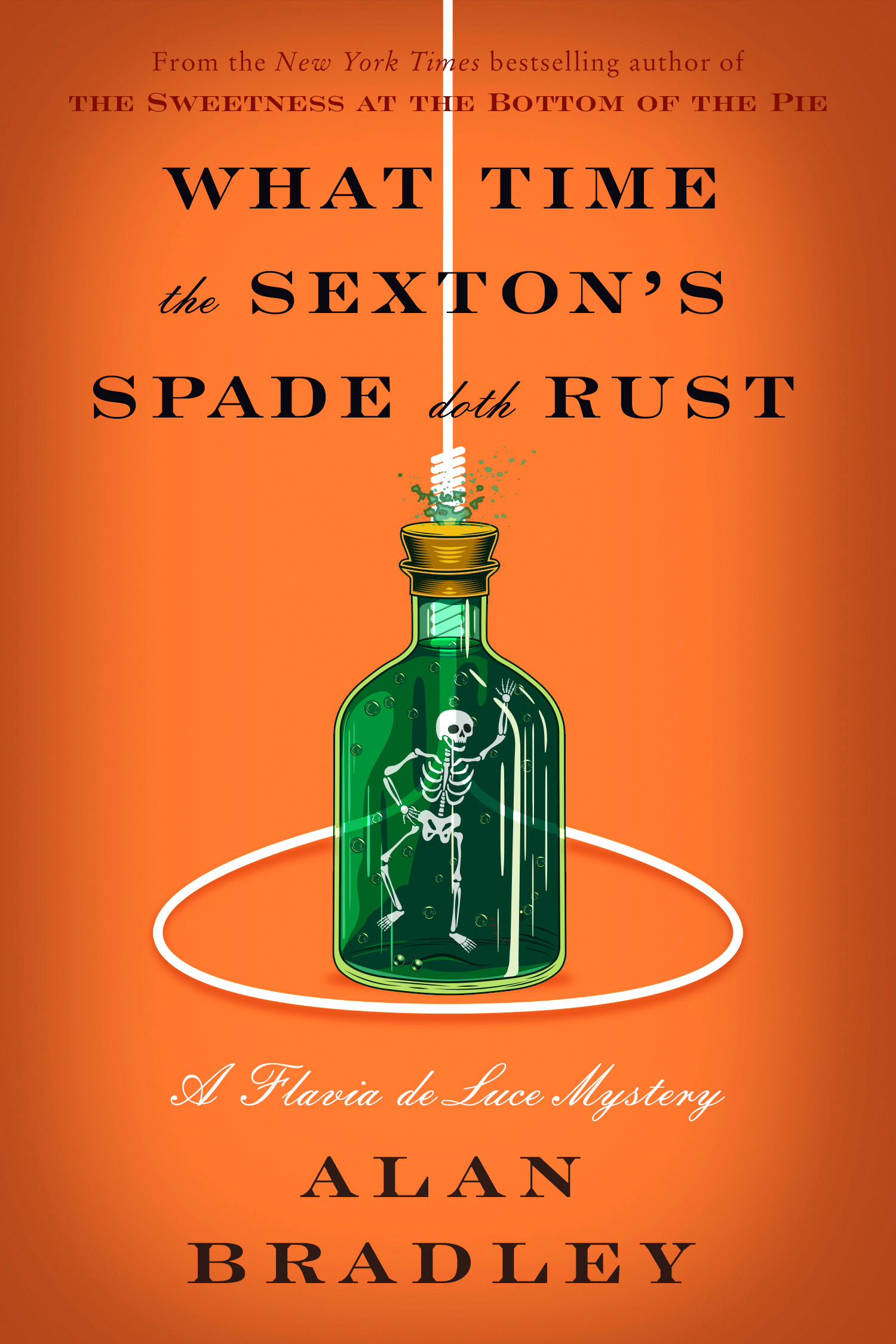
What Time the Sexton’s Spade Doth Rust by Alan Bradley

What Time the Sexton’s Spade Doth Rust by Alan Bradley was published by Orion in 2024 which means that there was a five year gap between this one and the previous book in the Flavia de Luce series – The Golden Tresses of the Dead. I had thought that the author might have run out of steam – or indeed life, so I was glad to hear that this one had been published.

Flavia has been left the family home Buckhouse after her father’s unexpected death. Her two older sisters weren’t at all happy about that, but it means that things go on much as before for Flavia and for the staff who help to run the house – Dogger and Mrs Mullett the cook  – in truth Flavia is closer to those two than she is to her sisters who are almost completely absent from this book.  A younger cousin called Undine has joined the household, she’s a bit of a handful, even for Flavia, she’s a law unto herself so she supplies some entertainment, but I feel that she doesn’t make up for the lack of snarky banter between Flavia and her older sisters.

When Major Greyleigh, one of the villagers is found dead in his kitchen it’s Mrs Mullett who is suspected of poisoning him. She gave him mushrooms that she had foraged from the woods and she wonders if some of them had been poisoned. It turns out that the Major and Mrs Mullett had had a romantic relationship years before in their youth, but Flavia can’t believe that she could be a murderer.

This tale takes a very unexpected turn towards the end, for me anyway. I enjoyed it although there were some aspects that annoyed me. The setting is 1950s England and everything feels authentic, the suddenly the reader is confronted with American spellings such as tire, color, I didn’t take note of the others. I was particularly annoyed by the word ‘purse’ being used to mean a handbag more than once.

“She rumaged in a sideboard and pulled out her purse. It was a flat Monda-go-to market  straw receptacle, good for carrying everything from a check to a chicken. She reached into the depths and dredged up a small sketchbook.”

So definitely not a small purse with just enough space for some coins and paper money then.

It just throws the reader (well me anyway) out of the setting. I was also annoyed by the use of the word foyer when it should have been hall or hallway as it was in a private home. In the UK the word foyer is reserved for theatres, cinemas, large hotels, conference centres and the like. Nit-picking maybe, but I think things like that should be picked up by an editor.


A Darker Domain by Val McDermid

A Darker Domain by Val McDermid was first published in 2008, the setting is mainly Fife in the east of Scotland, and the time switches between 1985 and 2007. This is the second in the author’s Karen Pirie series.

DI Karen Pirie is in charge of cold cases. An adult daughter is desperate to discover the whereabouts of her estranged father who hasn’t been seen since the miner’s strike in 1985. It’s thought that he had been a ‘scab’ who had gone down to Nottingham to get work there. That turned his abandoned wife and young daughter into pariahs as far as the mining community was concerned.  It’s now 2007 and the action swings between 1985 and 2007 although it isn’t at all confusing.

Karen Pirie finds herself investigating two cold cases as in 1985 there had been a kidnapping in Fife. The daughter of a very wealthy and well-known businessman had been abducted along with her small son and in the chaos of a handover she had been shot dead, and her young son had never been handed over to his wealthy grandfather with the kidnappers disappearing with him. When an investigative journalist discovers a possible clue in an abandoned building in Tuscany – of all places – Karen has to open that case again too.

I enjoyed this one, I must say that a lot of people have in the past complained that Val McDermid’s books are too grim and violent, but this one isn’t like that. There’s violence but nothing really graphic.

This is the most local to me book that I’ve ever read, one of the detectives even bought a house that must have been about five minutes away from where I lived for 26 years, going from the description. It definitely adds to the experience when you can visualise all the wee villages mentioned in Fife.

The miners strike took me right back to 1985. Jack had trouble getting to work as the police were stopping any cars which only had men in them and as teachers had all been encouraged to car share as parking at schools was a problem, they didn’t have enough spaces. So the car they were travelling in was stopped by the police and turned back as they were suspected of being ‘flying pickets’ travelling to coal pits to help out the striking miners. So the police were menacing and threatening cars full of teachers – and getting huge pay packets for their troubles. Grim times all round.

Christmas Days by Jeanette Winterson

Christmas Days Book CoverI borrowed Christmas Days by Jeanette Winterson from the library and it looks like it might be the only Christmas related book that I’ll get around to reading this year. It was first published in 2016 and amazingly it’s the only book that I’ve ever read by Winterson. I enjoyed it and I’ll definitely read more of her books

Christmas Days is a mxture of short stories, biography, recipes, poetry and anecdotes, with quite a lot of humour thrown in. It’s illustrated in black and white by Katie Scott and all very entertaining. I don’t know if you could call it ‘name dropping’ but she does mention a lot of fairly well known people that she had befriended, she even spent many Christmases with Ruth Rendell until her death. Jeanette Winterson comes across as being a very kind and forgiving person, a good friend and in the end a good daughter to her father. Her mother is named Mrs Winterson throughout the book, and if you ever watched Oranges Aren’t the Only Fruit when it was on TV years ago you will know that she had good reason for that.


Ring Out, Solstice Bells by Jethro Tull

It’s the Winter Solstice, the original winter festival. I love Ring Out, Solstice Bells by Jethro Tull but I haven’t heard it on the radio for years. Jack says he actually has a copy of it on EP – somewhere. Anyway below is Jethro Tull performing it on Top of the Pops in 1976. I remember it so well. I know I’ve blogged this previously but that was yonks ago I’m sure.


North England, The Lake District – jigsaw puzzle

, North England, Lake District, Jigsaw box

Yes it’s jigsaw season again, we’ve been a bit later than usual in doing a jigsaw puzzle this year, and we have a queue of new puzzles to get around to. As we were in the Lake District in the north of England fairly recently I decided to choose this one as the first to tackle. It’s one of those with several scenes on it which sort of morph into each other. I thought it might be a difficult one to do but it wasn’t too bad at all.

Lake District Jigsaw

The different skies were fairly easy to discern, and actually a lot easier than trying to complete a vast sky of the same shade of blue.  We had the usual scrabble on the floor for the last piece of puzzle, surely it wasn’t missing?! Thankfully we found it. I think I’ll leave it until after Christmas to start another one.

Over the River by John Galsworthy

In Over the River by John Galsworthy Dinny Cherwell’s younger sister comes home from India where she had been for all of the seventeen months of her marrriage to the much older Sir Jerry Corven. She has left her high ranking British army officer husband as she’s unable to put up with his cruelty and brutality any more, she’s been thoroughly humiliated by him.

On the voyage back Clare has begun a friendship with Tony Croom, a man nearer her own age. He has fallen in love with Clare, but it’s all very platonic as far as Clare is concerned.

When the dastardly husband arrives in London to make Clare go back to him in India he’s outraged that as far as he is concerned she’s already moved on in her life. If she doesn’t go back to him he will sue Tony Croom, naming him as co-respondent in the divorce case, despite the fact that there is no evidence of infidelity. It will ruin Tony’s life, especially as the husband intends to ask for £2,000 as ‘damages’ from Tony.

This was a really good read, it features Fleur Forsyte and Michael Mont as minor characters.

As usual Galsworthy was writing about the hypocrisy of society, it was almost impossible for ordinary people to get a divorce, but even for wealthy people it wasn’t straightforward, especially if only one of the spouses wanted a divorce.

I can clearly remember the shenanigans that people had to get up to even in the late 1970s, involving private detectives and chamber maids in divorce courts as ‘witnesses’ to infidelity – not that Clare and Tony got up to anything nefarious at all, it just looked it.


Flowering Wilderness by John Galsworthy

Flowering Wilderness  is the second last book of the last Forsyte trilogy (End of the Chapter), a nine book series which for years I thought ended with the death of Soames Forsyte, just as the TV dramatisation did – but it didn’t.

The year is 1930 and Dinny Cherrell (Cherwell) has fallen head over heals with Wilfred Desert, a fairly impoverished poet. He had been the best man at Dinny’s cousin’s (Michael Mont) wedding to Fleur Forsyte, and a few years after that he had caused ructions within that marriage which led to Wilfred leaving Britain for the Middle East. When he returns to London it seems that Wilfred is as besotted with Dinny as she is with him so all should be sweetness and light, but a rumour has reached London that while Wilfred was living in the Middle East he had been forced to renounce Christianity and become a Muslim – at the point of a gun!

Nowadays that would be a no brainer but back in 1930 among the upper classes it was an outrage – what sort of man wouldn’t be happy to have his brains blown out rather than abandon Christianity?  Not that Wilfred was any sort of believer anyway.

Dinny doesn’t care a hoot about it all, and she’s happy to get married and follow him back on his eastern wanderings, but her parents think very differently, and when Wilfred makes matters worse by writing to a newspaper admitting his ‘conversion’ it makes the whole situation impossible as far as Dinny’s family is concerned.

This is a great read, Galsworthy’s books are full of social history, often highlighting the hypocrisy of the law, and of those in society who think they are above everyone else. I suppose Galsworthy was the Dickens of his day, but I’m not a big fan of Dickens, controversially (no doubt) I think Galsworthy is a better writer.

I’m now half way through the last book in this series, Over the River, and I hope to be able to review that one soon too.