Guardian links

Spookily – just as I have started reading Shirley Jackson’s books, up pops a biography of her called Shirley Jackson: A Rather Haunted Life by Ruth Franklin. You can read a review of it by Sarah Churchwell here.

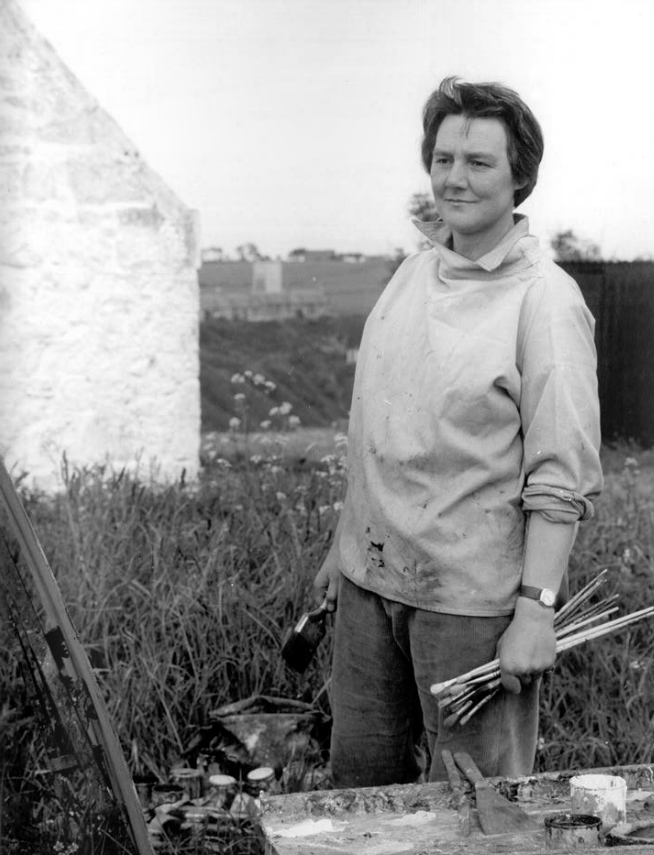
There’s also an article by Frances Spalding about the Joan Eardley exhibition at Modern Art 2 in Edinburgh – the one we went to a couple of weeks ago, you can read the article here.

There’s also an article about Doris Lessing’s books by Nick Holdstock, and you can read that here.

In this article Nick Holdstock writes that he had been asked to make an inventory of Lessing’s over 4,000 books. He had hoped that Doris Lessing’s books might have notes in the margins, clues to her work maybe, but very few of her books had been written in.

How do you feel about writing in books? I have to admit that I don’t write anything in books, not even my name, although when I was first married I did do that on bookplates that I stuck in my books. I think that was because I was putting both my own name and my married name on them. I had a friend who used to write her name and the date and place that she bought the book on the inside cover. I thought that was quite a good idea but I’ve never done it myself.

I buy a lot of old books and often they were originally gifts, in fact I’m just about to start reading Miss Mole by E.H. Young and I noticed that it was given to Evelyn Heaton-Smith from Rodi – in July 1937. I love that, I want to know who they were, what sort of lives did they have?

Partly I think that it’s because I have so many books that makes me not bother to write even my name in them. I can’t really understand why anyone would want to write notes in books – to themselves. But I do have just one of my dad’s books and he wrote his name in it, it’s one of the very few examples of his handwriting that I have. Mind you people tend not to write anything at all nowadays, everything’s done on computers.

Children’s illustrated books

I still find myself eyeing up children’s books even although there are no wee ones in our family now, and sometimes I just have to add a few more to my collection. My most recent purchases have been:

Wenceslas cover

WENCESLAS by Geraldine McCaughrean and illustrated by Christian Birmingham. It’s obviously just a re-telling of the traditional Good King Wenceslas fairy tale but the illustrations are lovely and give a real sense of the falling snow. You can see for yourself here and can also see some of the other books he has illustrated, more for me to look out for!

And another book I bought recently is:

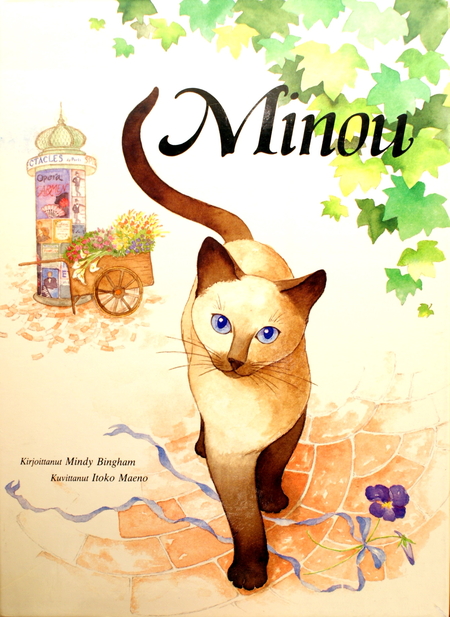
Minou cover

Minou – it’s a book about a cat called Minou whose ‘owner’ dies, so Minou ends up on the streets having to learn how to fend for herself. Minou lives in Paris and it was really the beautiful illustrations of Paris that attracted me to the book, but the story is a way of teaching little girls to be independent and confident, to rely on themselves. It was written by Mindy Bingham and illustrated by Itoko Maeno. You can see some illustrations here.

Some people on the internet are trying to sell this book for silly money – such as £88 but I bought a perfect copy (1st edition) for all of £3.

Guardian links

I didn’t find an awful lot to interest me in this week’s Guardian review, but I’ve read and enjoyed a few Michael Chabon books in the past so I enjoyed reading this interview with him.

I also enjoyed reading this article about Vanessa Bell, but I won’t be going to the exhibition of her work which is on at Dulwich Picture Gallery in London. She is of course famous as being one of the Bloomsbury Group and sister of Virginia Woolf.

I’ve gone right off doing any road trips in England for the moment, after they voted for Brexit – I think it’s fair enough that I spend money holidaying in Scotland instead and doing something for the Scottish economy – hopefully.

I read on a blog recently that the Brexit vote could be described in Austen terms as 48% voting for Sense and Sensibility and 52% for Pride and Prejudice. That just about sums it up.

Joan Eardley Exhibition

Joan Eardley

On Thursday afternoon we went to Edinburgh to visit the Scottish artist Joan Eardley’s exhibition at the Modern Art Gallery 2 Sadly this exhibition isn’t free, I think it cost £9 but we became ‘friends’ of the galleries which is well worth the money if you enjoy visiting art exhibitions. Firstly we parked the car at the wrong gallery and had to walk across the road to Gallery 2. Then when we did get there I was quite disappointed because there was just one small room with her Glasgow children paintings on display and I nearly left a comment saying I was disappointed that it was so small. Just as well I didn’t as it turned out that there are four more rooms full of her work upstairs. lots of them are landscapes of the wee village of Catterline that she stayed in for years, travelling between her cottage there and her studio in Glasgow. Catterline is north east of Aberdeen, and in the 1950s when she was painting there they still had a small salmon fishing business going on. She bought a cottage there for £30, it had no running water or anything but even so, I wonder how much those cottages cost nowadays!

It’s fair to say that Eardley’s paintings of the Samson children who lived in a flat beneath her studio in Glasgow are not things of beauty. They were living in abject poverty – a family of twelve children who were all models for Eardley, but when you see the actual paintings you see the detail in the background and she captured the essence of a time and place that no longer exists. There are three short films in the exhibition too where you can see her at work and old Glasgow of the 1950s in a film about renewal plans.

The Catterline paintings were my favourites though and there were a couple that I would happily have hung on walls in my home. Unfortunately as usual the gallery shop didn’t have any prints of my favourites.

The exhibition also has a lot of photographs of the Samson children and letters from the artist to friends and her sister. It’s so sad that she died of breast caner when she was only 42, especially as one of the letters says that she is going to the doctor because her bosom was giving her such a lot of pain. Obviously she should have gone to the doctor a lot earlier than she did.

If you’re interested in seeing images of her artwork have a look here.

You can see images of Catterline here.

Catterline

Art from the Second World War

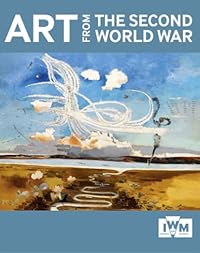
 Art from the Second World War cover

Art from the Second World War is one of the books that I got for Christmas. It was published by the Imperial War Museum and it’s their collection of artworks.

I’m interested in the war although mainly from the social home front aspect, and many of the artworks depicted in this book are of war workers and even of people queuing outside a fishmongers and poulterers.

It’s a lovely book although some of the images are quite disturbing – such as the one of bodies in Belsen. I prefer to concentrate on the more domestic images.

It contains works by Paul Nash, Graham Sutherland, Henry Moore, Mervyn Peake ( I didn’t even know he painted), Laura Knight, Eric Ravilious and many more.

The image below was painted by Evelyn Dunbar.

Evelyn Dunbar

And the one below by Laura Knight (Dame) is of a balloon team.

A Balloon team Laura Knight

Another Trip to Edinburgh

Last week we decided to have another jaunt over to Edinburgh, mainly to visit the J.M.W. Turner watercolour exhibition which is on every January and then disappears for the rest of the year.

So we made our way along Princes Street to The National Gallery where we met up with a couple of family members who had never seen the watercolours. You can have a look at the collection and watch a wee video here. It’s a bit of an annual pilgrimage for us, but this time it was busier than usual, it serves us right for going on a Saturday!

After that it was time for lunch so we crossed Princes Street and went up South Saint David Street (I think – I’m not good with Edinburgh’s geography), turned left into George Street to have lunch at The Dome. It’s a fabulously ornate building in Edinburgh’s New Town (which of course is quite old by now, Georgian in fact.)
Dome

The Dome

The Dome was indeed originally a bank, it definitely has that feel about it, very opulent, all of our poshest buildings seem to have been built by banks – nothing changes does it?

The Dome

The Dome

You can see more images of The Dome here.

After that we went back up to Princes Street, really so that we could sign up to become ‘friends’ of The National Galleries.
Princes Street

Princes Street

Then we walked through the Christmas market, I thought it would have been cleared away by now but it’s still hanging on. It is really incongruous to see these fairground rides sitting cheek by jowl with Sir Walter Scott’s monument. I must say that they do get a great view of it from those swing seats but you won’t catch me up there!

Princes Street Gardens Christmas 7

Kirkcudbright – Dumfries and Galloway, Scotland

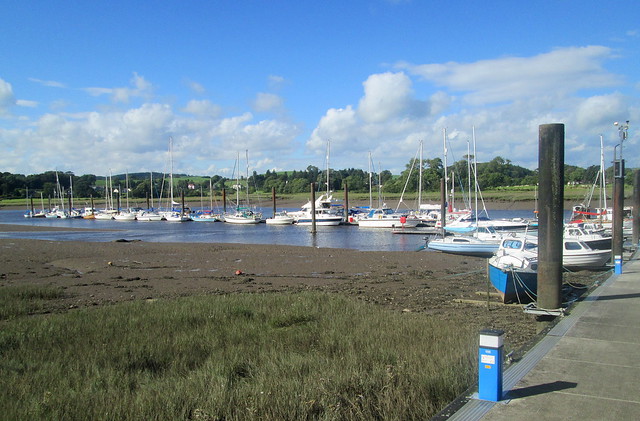
harbour 1

Kirkcudbright was one of the places that I particularly wanted to visit when we were down in the south-west of Scotland recently with Peggy. I had been there once before, years ago when our boys were wee and we stopped off there just to break a journey. McClellan Castle below is a stone’s throw from the harbour.

McClellan Castle 1

a street  Kirkcudbright 2

It’s well worth visiting this wee town but I must admit that I was a wee bit disappointed that it doesn’t have an awful lot in the way of shops or interesting places to visit. I had read somewhere that there were quite a few art galleries around as the town has always been very popular with artists, but we only found two galleries, one that had been taken over by an Edinburgh gallery for some weeks, and one which had artwork by just one artist.

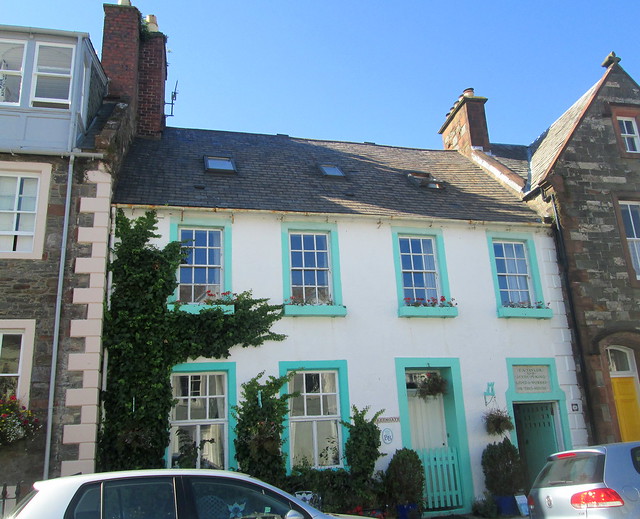
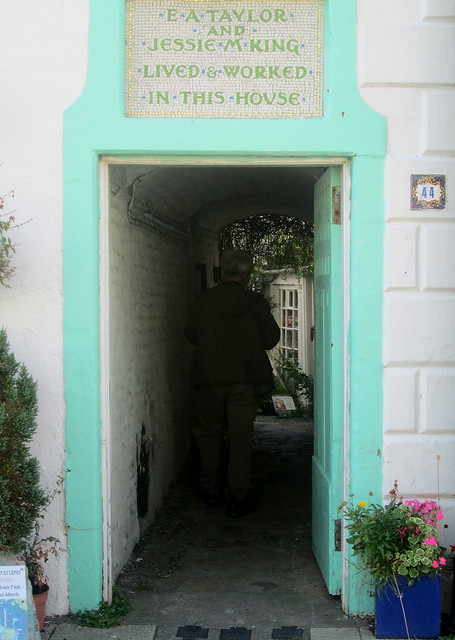
The house below belonged to the artist Jessie M. King. She’s probably best known for her book illustrations. They’re beautifully delicate and ethereal. She lived there with her husband fellow artist E.A. Taylor.

aTaylor and King 2

Taylor and King 1

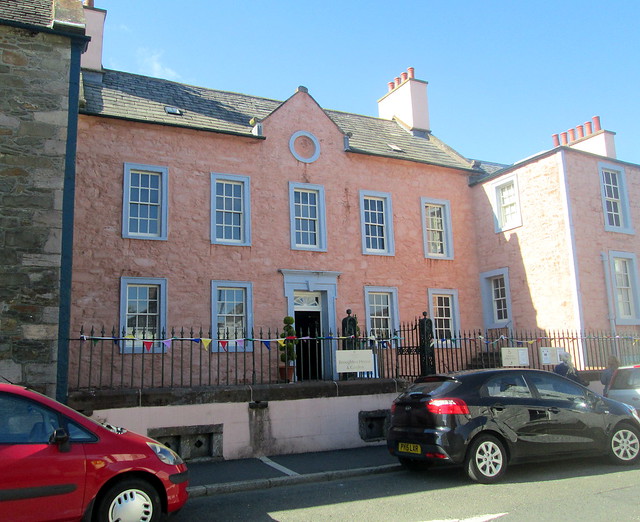
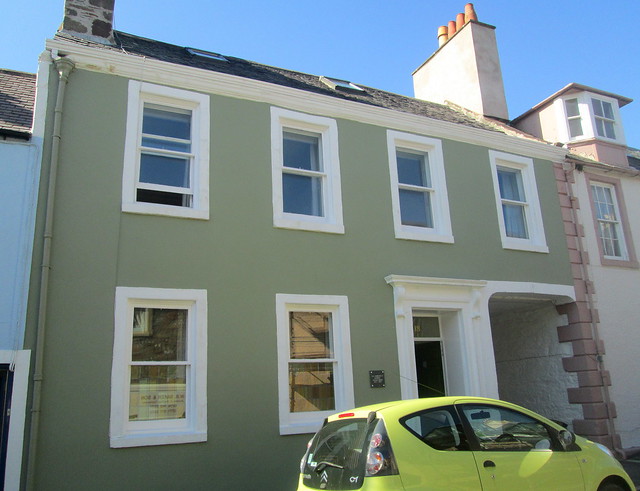
There’s a mixture of building types in the town, from teeny wee medieval cottages to quite grand Georgian villas, and just a stone’s throw from the main street the streets are amazingly peaceful.

Broughton House

Below is the artist A.E. Hornel‘s house which is open to the public I think.

Hornel 2

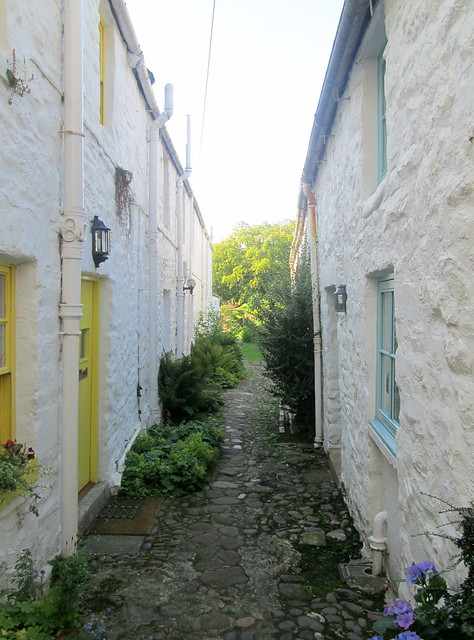
And there are closes like the one below leading to much older wee medieval houses.

a close 2

a close

Dorothy L. Sayers was one of the many artistic people who frequented Kirkcudbright and she actually set one of her books there – Five Red Herrings – when it was dramatised for TV they filmed it in and around Kirkcudbright.

It’s a fairly remote part of Scotland, but it’s a pretty wee place and it’s worth a visit if yoy find yourself in that area.

Edinburgh and the Turner Watercolour Exhibition

Well, yesterday was Burns Supper day and I was so busy at a Burns Supper which was hosted by Duncan and his lady Alex – that I didn’t manage to do a Robert Burns blogpost, nor did I take any photos, we were too busy eating haggis pakora for our starter – a fusion of Scottish and Indian food which is very popular nowadays. Then the traditional haggis, turnips and potatoes (haggis, neeps and tatties) and cranachan for dessert. Lovely!

At the end of last week we were in Edinburgh visiting the lovely Turner watercolour exhibition which is only on in January at the National Gallery, it was quite busy. You can read about it here. It is of course a free exhibition but it’ll only be on until the end of January.

You can see a lot of Turner watercolour images here. You really have to get up close to them to see the details.

I have to say though that the gallery’s cafe has gone right downhill from what it used to be. I was seduced by a piece of coffee and walnut gateau, I love those flavours, but so often with these things it looked a lot better than it tasted. Admittedly it was thick with buttercream and I’m not the biggest fan of the stuff, too cloying for my taste really, but this lot somehow managed to seem oily too.

It came on a paper plate!! I really object to that and also the only type of fork available was a wooden one which had a very woody smell, so I had to make sure I wasn’t breathing in as I put the fork up to my mouth. When I moaned to Duncan about it later he thought that it was supposed to be an improvement on using plastic cutlery as the wood biodegrades. That’s true I suppose but why they have to have disposable plates and cutlery is beyond me, it’s not as if the cafe is cheap. The name is Victor and Carina Contini which I’m told has some sort of Valvona and Crolla connection.

Worse than all that though was that we noticed that there were drips of coffee down the outside of Jack’s mug, the mug was actually ceramic, not paper, but it seems that they aren’t washing the mugs properly. Why didn’t we complain? We should have, especially as I would hate to think that foreign tourists might think that is normal service in Scotland. Mind you the people working in the cafe were foreign, presumably from some country where washing mugs properly is a difficult skill to master.

Jigsaw time

For me winter is jigsaw time, so over the Christmas holidays I completed my first jigsaw of the year. At times I almost gave up on this one as sometimes I sat there for over an hour and only placed a few pieces of the puzzle. It’s the most difficult jigsaw that I’ve ever done. It’s an ArtPiece Puzzle made by Pomegranate. It’s the first one I’ve done by that maker and I have to say that the pieces fit together so tightly that you can actually lift the whole thing up off the table, with no fear of any pieces falling out, it’s a solid sheet. Sadly the colours haven’t come out quite as well as I had hope they would in the photograph below.

A Pomegranate Jigsaw

It’s called Plum and Peach Bloom by the American artist Gustave Baumann, although I didn’t realise he was American at first, well look at the name! he was born in Germany and went to America when he was ten years old apparently. When I first saw it I thought it was a puzzle made from something painted by the Swedish artist Carl Larsson, they have quite similar styles I think.

The peach and plum tree blossom just about did me in, but as ever it was really satisfying when I placed the last piece into it.

You can see more images of Gustave Baumann’s work here if you’re interested.

I really like his work, he seems to have been keen on painting woodland areas, and as I love trees, that’s fine by me.

On a completely different subject – we haven’t been anywhere interesting over the last couple of months, mainly because it has hardly stopped raining. But Jack has done a post on Bladon which we visited during the summer. If you want to see what Churchill’s resting place looks like, you can see it here.

Another Golden World

We were at the Edinburgh Art Fair last month, just before that bridge was closed for repairs, and I didn’t really intend to buy anything, we were just going to have a wee keek at what was on show. But I fell in love with some etchings by Kit Boyd who hand- tints his etchings using inks. Jack said I could have one for my Christmas present, and I couldn’t resist the one below. It’s called Another Golden World. Sorry about the flash.

Another Golden World

The artist is Kit Boyd and his artworks are set in a fantasy world. He follows in the British Romantic tradition of Samuel Palmer and the Neo-Romantics of the 1940s.