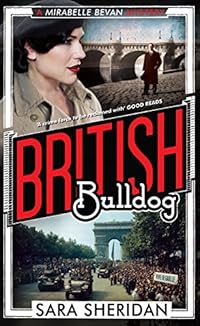
British Bulldog by Sara Sheridan

British Bulldog by Sara Sheridan was published in 2015 and it’s the third book in the Mirabelle Bevan series which is set in the early 1950s. In this one Mirabelle is told by a solicitor that she has been named in the will of a man that she barely knew. A Major Bradley, better known as Bulldog Bradley has just died and in his will he asks that Mirabelle tries to track down a wartime colleague of his. They had both been prisoners of war and had escaped together in 1944, but had been split up somehow and although Bradley had got back safely to Blighty his escape partner Philip Caine hadn’t. Mirabelle has been left 10,000 guineas in the will if she will take on the job of looking for Caine. That’s £10,000 plus 10,000 shillings, a huge amount of money, as you can imagine Major Bradley’s widow isn’t amused, she thinks the worst of Mirabelle.

Mirabelle sets off for Paris, as her mother was French she speaks the language fluently and knows the city well. It’s not long before she’s drawn into dangerous situations and discovers that Caine and Bradley had known her beloved Jack Duggan during the war. There’s a different enemy now with the Cold War gaining momentum and Mirabelle finds herself in the thick of it.

I think this one is my favourite of the series so far, the Paris setting was a nice change and it was good to be there without actually having to travel.
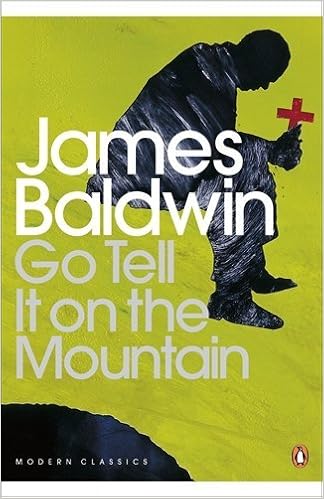
Go Tell It on the Mountain by James Baldwin – Back to the Classics Challenge

Go Tell it on the Mountain cover

Go Tell It on the Mountain by James Baldwin was first published in 1954. The author’s name seemed to be popping up all the time some months ago and I realised I hadn’t read anything by him, it was time to rectify that.

Sadly I can’t say that I enjoyed this book much, it’s obviously well written but the subject matter didn’t appeal to me. I’m not keen on religion of any type, and the type depicted in the store-front church in the book, The Temple of the Fire Baptized, even less so. The hysteria and speaking in tongues really puts me off, so I was never desperate to get back to the book whenever I put it down. I realise that that must seem beside the point as after all the book is about horrific racism and its effects and charismatic religion was probably a balm for some. The book was no doubt a trail blazer in its day, and must have been painful for Baldwin to write as it is semi-autobiographical and features a lot of child abuse in the shape of beatings – beating the devil out.

I’ll definitely be trying something else by Baldwin though.

I read this one for the Back to the Classics Challenge 2021 which is hosted by Karen K at Books and Chocolate.

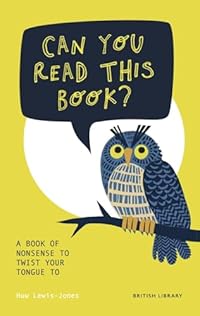
CAN YOU READ THIS BOOK? by Huw Lewis-Jones

CAN YOU READ THIS BOOK? by Huw Lewis-Jones and published by British Library is subtitled A BOOK OF NONSENSE TO TWIST YOUR TONGUE TO.

I must admit that I had my doubts about this book when I was told by British Library that I was being sent a copy of this book for review, but actually it is a really entertaining read – or should I say speak.

It starts off with fairly simple and well-known tongue twisters such as red lorry yellow lorry, and progresses to twisters such as: The sixth sick sheikh’s sixth sheep’s sick. Try it – I dare you, mind you I have a bit of a lisp so it’s an impossibility for me.

It strikes me that this book will appeal to children and adults alike and would make a good Christmas stocking filler, especially if your family enjoys post Christmas dinner games which will become more hilarious as the day goes on, or should I say as the booze goes down?

Anyway, it’s an attractively produced book with colourful illustrations, and is full of silly fun.

England Expects by Sara Sheridan

England Expects by Sara Sheridan was published in 2014 and it’s the third in the author’s Mirabelle Bevan series. The setting is mainly Brighton during a summer heatwave in 1953.

Joey Gillingham has just arrived in Brighton on an early train from London, he’s a sports journalist and is in the town to report on a series of boxing matches, but he’s also keen on horse-racing. The people who inhabit those sporting worlds can be ruthless, and it seems that Joey has upset someone as he is murdered in the prologue!

Obviously Mirabelle is interested in the case when she reads of it in the local newspaper, and she and her side-kick Vesta become involved in a very dangerous investigation. I can’t really say they are aided by Superintendent McGregor, because the boot is really on the other foot, and although I found the plot which involves Freemasons to be rather unlikely I did enjoy being in the company of Mirabelle, Vesta and their friends.

In general Sara Sheridan does a fairly good job of capturing the atmosphere of the early 1950s, however she doesn’t always get it right. At one point Mirabelle and Vesta have to travel by train to Cambridge, changing trains at King’s Cross London where they buy bottled beer from a packed station bar. During the journey they sip the beer!

No, that just would never have happened in 1950s England. Women would never have drunk beer in public and the only thing acceptable would have been cups of tea from a tea trolley. Despite that glaring incongruity I still really liked this book. I think I’m enjoying this series because I like being in the company of the characters – as much as anything else.

The Love Child by Edith Olivier

The Love Child by Edith Olivier was first published in 1927 and has just been reprinted by British Library.

The tale begins with the funeral of Agatha Bodenham’s mother. Agatha is an only child, a 32 year old spinster, and she hadn’t really been particularly close to her mother. They had both been rather introverted and had led fairly solitary lives, so Agatha finds herself thinking of the imaginary friend Clarissa that she had had throughout her childhood, but a disdainful governess had caused Agatha to give up on her imaginary friend at the age of 14.

Now in her loneliness Agatha’s thoughts go back to those days when she had had the companionship of Clarissa. Agatha’s imagination runs riot as she becomes so enamoured with the thought of Clarissa and begins to play with her as she did. Others are perplexed when they see her dashing around in the garden for no apparent reason, they can’t see her playmate. Eventually Clarissa begins to appear in front of other people which is a bit awkward as Agatha has to pretend that she has adopted the little girl. The relationship that Agatha has with Clarissa works wonders for Agatha’s personality as Clarissa is popular with servants and staff wherever they go and the popularity is reflected back on Agatha, her life has expanded and been enriched – but will it last?

This is a strange story but I did enjoy it although I found it to be quite a sad read, dealing as it does with a solitary woman, one of many in those post Great War days. As ever with this British Library Women Writer’s series the story is accompanied by a short but interesting timeline of the 1920s, some information on the author and various other bits and pieces including an Afterword by Simon Thomas.

Thank you to British Library for sending me a copy of this book for review.

The Return by Anita Frank

The Return cover

This is a dual time tale beginning in June 1939 Tyneside which Jack Ellison has had to leave quickly and unexpectedly after a fight, he reaches Berkshire and feels lucky to be given work on a farm, but war is in the air and he has decided to join the army as soon as he can. Meanwhile he has fallen for Gwen his employer’s daughter, but she has a complicated love life and isn’t much interested in Jack, but he could be of use to her.

Gwen is the farmer’s daughter and the tale from her point of view begins in May 1945 when everyone is waiting for sons and husbands to be demobbed – the ones that have survived anyway. But Jack has told Gwen that he will never be back even if he does survive the war.

There’s supposed to be a bit of a mystery about Jack’s background but to be honest I found it all to be very predictable, it seemed obvious how things were going to resolve. The book is far too long and has too much in it about the farming methods of the time. I’m all for authors doing research but it doesn’t ALL have to be added to the book.

Also from my own family history I have knowledge of exactly what happened to the soldiers who had taken part in the Dunkirk debacle, and they were kept well away from the D-Day landings, but were deployed to the ‘cleaning up’ operation a couple of weeks later, a form of punishment really as they were seen as tainted by failure and possibly psychologically not fit to have another go at the German army. It was years before it dawned on me that what my father-in-law meant by ‘cleaning up’ was that they had to deal with all the dead bodies that were lying around the countryside. In this book the Dunkirk survivors take part in D-Day though, and that makes me question how correct other facts are, such as the scanty shipbuiding details which I suspect are wrong, it’s another subject I have some knowledge of as the sister of Clydeside shipbuilders and a viewer of historic films on shipbuilding. Yes I might be nit-picking.

Anyway, this is yet another book which would have benefitted with being edited – a lot. However, that’s my thoughts on the matter, others may thoroughly enjoy the long and slow tale. I really couldn’t find much to like in Gwen’s personality, which is always a problem for me. It is I suppose a re-write of Far from the Madding Crowd, including the rural life, but nobody can write rural society as well as Thomas Hardy could. However, if you haven’t read Hardy and you don’t mind a lot of padding then you might enjoy this.

Thank you to NetGalley for sending me a digital copy of the book for review via HQ.

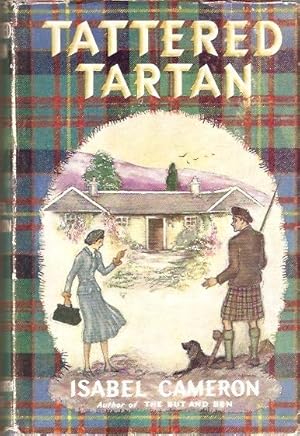
Tattered Tartan by Isabel Cameron

Tattered Tartan cover

Tattered Tartan by the Scottish author Isabel Cameron was first published in 1950 and I only realised after I had finished it that it is actually a sequel to her earlier book But and Ben. I’ll have to find a copy of that one.

The setting is the Scottish Highlands where Dr Grizel Gillespie has settled in well after a year in Glen Craigan, where the locals have accepted the ‘leddy’ doctor. Things are changing in the glen though as there’s a rich new ‘laird’ who is English and he’s shaking things up a bit.

There’s also a hydroelectric scheme being built which means that the inhabitants will have electricity in their homes and also water will be brought into their homes. This will be a boon, especially for the women and young girls of the area as it’s their job to carry in the water in buckets. In fact the older girls in families are often kept off school by their mothers who think it’s more important that the girls help in the house than get an education.

There is of course jeapordy and romance, it’s an entertaining read but for me it was the social history aspect that interested me most.

It seems hard to believe now but in the mid 1960s when I was a five year old living in Glasgow, the family who lived above us came from the Highlands, and even at that time they didn’t have running water in the house they had had on the Isle of Skye. On Saturday night they had to get lots of buckets of water from the well and stood them all under the kitchen table as they weren’t allowed to do anything on Sunday/the Sabbath except go to church and read the Bible, they couldn’t even cook anything, that had to be done on Saturday. So being able to just turn on a tap to get water would have seemed almost like a miracle. How times have changed. They went back to live on Skye anyway so that lifestyle didn’t put them off.

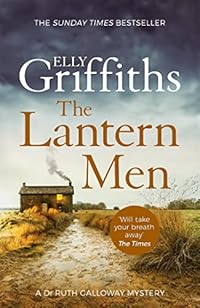
The Lantern Men by Elly Griffiths

The Lantern Men by Elly Griffiths is the 13th book in her Dr Ruth Galloway series. Somehow I missed it out and went on to read the 14th The Night Hawk which annoyingly kept referring to things that had happened in the previous book.

Anyway, in this one Ruth has left Norfolk where she had been a lecturer at North Norfolk University, but when Cambridge offered her the post of Head of Archaeology she couldn’t turn it down. She has a whole new life now including an American partner called Frank. She has been surprised that the students at Cambridge University seem no cleverer than those in Norfolk, however they are more confident presumably because of their mainly private education. I love it that Griffiths wrote that. Over confidence can be dangerous, just look at our prime minister!

To the book, Nelson is investigating getting to the end of a court case and he’s delighted when the man that he had charged with multiple murders is found guilty. But Ivor March is adamant that he didn’t kill the women, he does however admit to killing another woman and tells Nelson where she’s buried, but before that March makes Nelson promise to get Ruth to do the excavation, he doesn’t trust Phil Trent’s work. So Ruth finds herself back in her old stamping ground of Norfolk and meeting up with her old friends again – including Nelson of course.

This is a good read, Elly Griffiths was inspired to write it after reading about the Lantern Men in a book on Norfolk folklore. Annoyingly there are quite a few typos in this book, repeated words and even phrases, surely someone should have proof read it.

The Eleventh Orphan by Joan Lingard

The Eleventh Orphan by the Scottish author Joan Lingard was published in 2008 and she dedicated this one in memory of her grandparents who inspired her to write the characters of Ma and Pa Bigsby.

They have a pub in Victorian London called The Pig and Whistle where they have a very full home due to the ten children that they’ve adopted. When the local policeman turns up with another homeless child in tow Ma Bigsby isn’t keen to take her in, she always said she wouldn’t take on any more than ten children at a time. Elfie, short for Elfrieda is eleven years old, and has been in trouble with the police for thieving, another thing that puts Ma off, but when she is told by PC O’Dowd that Elfie has a painting of The Pig and Whistle in her bag Ma decides to take her in. Elfie knows nothing about her parents, not even their names, but she does have a bag full of clues that might lead her to her father anyway, she knows her mother is dead.

Ma sets to work cleaning up her newest waif and Pa begins to educate Elfie as she can’t read, teaching the children is Pa’s main job, but he also has to keep Elfie and Ivy apart as they hate each other at first sight. But there’s a lot of love within this blended family which is nurtured by the wisdom and common-sense of the parents.

This is really well done, an entertaining read for adults as well as children. It’s the first in a trilogy.

The Fair Botanists by Sara Sheridan

Previously I’ve read some of Sara Sheridan’s mysteries and enjoyed them so when I saw that she had written a book called The Fair Botanists with an Edinburgh setting, I requested it from the library.

The year is 1822 and Edinburgh is agog, King George IV is supposed to be visiting the city, the first visit from a Hanoverian king. Sir Walter Scott has the job of organising the whole thing and he’s not helped by not knowing exactly when or even if the visit will take place – such are the whims of royalty.

Meanwhile others are busy transporting mature trees and plants from where they have been growing in Leith Walk to their new home in what will be the new botanic gardens at what was the Inverleith estate. Inverleith House still has some of the family living in it. The elderly Clementina has recently been joined by Elizabeth, her nephew’s widow who is feeling lucky to have been taken in by her husband’s family as her husband left her poverty stricken. She’s a talented botanical artist so she’s very interested in all the planting that’s going on, particularly the rare Agave Americana which is due to flower soon.

In fact lots of people are interested in that plant, for various reasons, all determined to get a bit of it, but Bella is the most determined. She has befriended Elizabeth who is just about the only person in Edinburgh who doesn’t know what Bella’s profession is.

I did really enjoy this one but it’s not perfect. It should have been edited to expunge mention of ‘the elephant in the room’ as that’s a modern phrase, and I was really annoyed by the constant use of ‘quite the’ instead of ‘quite a’ by what seemed like every single character in the book, it’s just something that I dislike but dozens and dozens of uses of it by different characters drove me mad. Otherwise it’s entertaining and informative with interesting characters and situations both fictional and actual.