Goodnight Mister Tom by Michelle Magorian – 20 Books of Summer 2021

Goodnight Mister Tom cover

Goodnight Mister Tom by Michelle Magorian was first published in 1980 and a new 40th anniversary edition has been published. I hadn’t read it before although I had seen the film. It’s a great read.

Willie Beech is a 9 year old who has been evacuated from Deptford in London to the rural community of Little Weirwold. He has been allocated to Tom Oakley, an elderly widower who has been a bit of a recluse since the death of his wife and child 40 years previously. It doesn’t take Tom long realise that Willie has suffered terrible abuse at the hands of his mother. All his life Willie has been told that he is wicked and has never heard a kind word from his mother. Tom Oakley copes with the bed-wetting and tends to the multiple bruises and scabs on Tom’s emaciated body.

Slowly Will or William as he is called now gains confidence and even learns to read and write helped by Tom. But it isn’t only Will who blossoms, Tom becomes more involved with the other villagers who are surprised at the change in him. He had cut himself off from people after the death of his young wife and was a bit of a curmudgeon until he had another human being to nurture and protect.

Of course Will’s mother writes to say he must go back home to London as she needs him. Tom and Will are both devastated, but after horror comes happiness, all’s well that ends well! I was sent a digital copy of this book by Penguin/Puffin via NetGalley. My thanks to both.

This is a great read. This 40th anniversary edition also contains the short story which the author wrote which inspired her to write the book. I also enjoyed the 1998 film which featured John Thaw as Mr Tom, it looks like you can watch the whole film on YouTube.

Henrietta’s House by Elizabeth Goudge

Henrietta’s House by Elizabeth Goudge is another reprint from Girls Gone By Publishers. I enjoyed this one more than her book Smoky-House which I read fairly recently. The book was originally published in 1942 and it’s a sort of fantasy. At the beginning of the book the ten year old Henrietta is excitedly waiting at a railway station for the arrival of a train carrying her adopted brother Hugh Anthony. He’s a bit of a handful, older than Henrietta and has been sent to boarding school in an attempt to make him more civilised. The setting is Torminster, a cathedral city which was apparently based on Wells.

Most of the tale takes place over one afternoon. It’s Hugh Anthony’s birthday and he’s having a birthday picnic with some relatives and adult friends. The setting is the forest and the various guests are making their way there in separate vehicles, mainly horse drawn carriages – a victoria, a landau, a governess cart and one car which has shocked the country folk and would terrify the horses. They split up and everyone gets lost on the way to the forest, some even ending up underground. During the journeys the characters of them all are improved as they realise what the important things in life really are. This book was just a bit too churchy for my liking, I suspect that that will be the same with all Goudge’s books, but it definitely has its charming moments.

For me this one was very much of its time with heavy emphasis on the food being prepared for the picnic. Well if food is strictly rationed as it was in the UK during World War 2 and right into the 1950s, people fantasised about what they couldn’t have, and feasts featured heavily in books of that era, especially children’s books such as C.S. Lewis’s Narnia series.

Neither Five Nor Three by Helen MacInnes

Neither Five Nor Three by Helen MacInnes was first published in 1951, but the setting is New York in 1950, and the book reflects what was then the beginning of the ‘reds under the beds’ era which was taken far too far by McCarthy.

It begins with Paul Haydn on an aeroplane travelling home. He had stayed in the army after WW2 but now intended to get back into civilian life, maybe back to his old job on Trend magazine as they said that his job would be kept open for him. He had been engaged to Rona a work colleague at the beginning of the war but she had broken it off. It turns out that she’s still working at Trend and has just got engaged again, and Scott is a jealous fiance.

Rona has worked hard at her new relationship but it all seems to be on her side, Scott seems to spend all his spare time going to ‘discussion’ parties and it has taken him ages to get around to proposing. It seems that Scott has been wooed by communists who are trying to undermine American society.

This was different from the previous books that I’ve read by MacInnes as her books often feature espionage in WW2, Nazis or post war Nazi hunting. I believe that she got a lot of the ideas for her books from her husband who worked for MI6 and they did move to the US where he took up a post at Columbia University, while still working at MI6, so basically he was a spy.

This was a good read which probably reflected the atmosphere of the US at the time, in common with the UK it seems that people were expecting another war to come along soon. It was interesting that at one point Rona says ‘we don’t execute traitors any more’. Well she was wrong about that and it seems that the authorities ended up executing people who weren’t really traitors at all, such as the Rosenbergs.

The Corn King and the Spring Queen by Naomi Mitchison

he Corn King and the Spring Queen cover

The Corn King and the Spring Queen by the Scottish author Naomi Mitchison was first published in 1931 but my copy is a Virago reprint from 1989, I think I might have owned it since then, the chunkiness of it put me off reading it. I think this book would have been improved if it had been edited down to about 500 pages instead of the 719 that it is. It dragged terribly at times.

The setting is Marob, a small state on the Black Sea, and Greece, the story switches between both places – between the years 228 BC and 187 BC. Some of the incidents are fictional while others are historical. In Marob the society revolves around the Corn King and Spring Queen as they and their ceremonies are most important in making sure that there will be a good harvest. Tarrik, the Corn King chooses Erif Der to be his wife and Spring Queen. Her father doesn’t want Tarrik to be Corn King as it’s a position he wants for himself. Erif in common with many of the women can perform magic and her father expects her to use it against Tarrik.

When Tarrik rescues Sphaeros a Greek philosopher from a shipwreck he is wooed by all the new ideas that Sphearos has and decides to sail with him to Greece. In Greece they meet King Kleomones of Sparta, he has decided that he wants a more equal society and so the rich are persuaded to give up their jewellery, money and possessions and to free their slaves. They will be given some land of their own. But everyone becomes poor and eats black soup as the peasants had to before. The previously rich people aren’t happy. King Kleomones seems to have kept all the wealth that had been given up so that he could pay for wars against his neighbours, using the money to pay the wages of mercenaries.

This is very much just the bare bones of the book which goes into detail about the ceremonies, particularly the fertility ones which end up with the Corn King ‘ploughing’ the Corn Queen and everyone else joining in in what was basically an orgy, to ensure a good harvest of course! It struck me that this was very racy for the original publication date of 1931. No doubt the mythological aspect of the book helped in that regard.

The book is split up into nine sections and at the end of every section there’s a shortish summary of what happened in that section. Just in case you didn’t understand it I suppose. I don’t think there’s anything particularly difficult about the writing style, it’s just rather wordy, but it is mainly an interesting read.

Mitchison came from a fairly aristocratic family, she was born in 1897 and had a long writing career, as you will see here. She died in 1998. I read a Virago edition of the book which was first published in 1983 and has an afterword from Mitchison.

Jack read this a few years ago. His thoughts are here.

Mamma by Diane Tutton

Mamma by Diane Tutton was first published in 1956 but it has recently been reprinted by British Library.

The book begins with Joanna Malling travelling to the house she has bought, it’s moving in day but nothing seems to be going to plan, she’s even having second thoughts about the house. Joanna has had quite a sad life, widowed at just 21 with a small daughter to look after, Libby. It’s now twenty years later, Joanna hadn’t expected to remain a widow all those years but only one man had proposed to her and he was so much older she regarded that as an insult.

Now it’s Libby’s turn to get married, and her husband is 15 years older than Libby, so there’s only a six year age gap between Joanna and Steven. Joanna just can’t understand what Libby sees in him, they seem such a mismatched couple, but as she gets to know him better Joanna realises that she has much more in common with Steven than her daughter has and things get a wee bit awkward.

In an era when 41 year old women were regarded as being over the hill and fairly superfluous members of society this book has some rather uncomfortable moments with the horribly immature but pushy Libby not seeming to regard her mother as a human being at all. This was a good read.

Thank you to British Library for sending me a copy of the book for review.

There are No Ghosts in the Soviet Union by Reginald Hill

There are no ghosts in the soviet union by Reginald Hill is a compilation of short stories, the first of which is the title story and could be described as being a novella. The collection features various different styles, the title story being set in the Soviet Union was one of my favourites and surprisingly I really enjoyed Hill’s continuation of Jane Austen’s Emma, Poor Emma. I’m usually not at all keen on Austen ‘rip offs’ but this one was entertaining and surprising. Reginald Hill’s tale takes us to 20 years or so after the marriage of Emma to her Mr Knightley, the marriage has not fared well as over the years Knightly has turned into a ghastly man, but Emma has learned a lot over the years and is driven to actions which would have shocked her younger self, and so survives in that very male dominated society.

I’m way behind with my book review writing, but Jack decided to read this book too. If you’re interested you can read Jack’s far more detailed thoughts on this short story collection here.

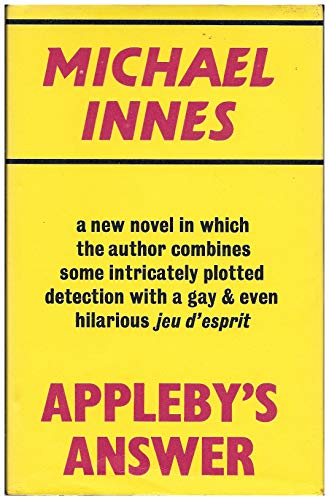
Appleby’s Answer by Michael Innes – 20 Books of Summer 2021

Appleby's Answer cover

Appleby’s Answer by the Scottish author Michael Innes was published by Gollancz in 1973 so I suppose that means it’s vintage crime now although that seems a bit strange to me, however in some ways the book seems even older than that. It begins with Miss Pringle sharing a railway compartment with a strange man. Miss Pringle is a crime writer with a penchant for ecclesiastical settings and she’s travelling to London to attend a dinner with a group of fellow crime writers.

Captain Bulkington is the other traveller and strangely he’s reading a copy of one of her books, when he recognises her from the photo on the dust jacket the two get into conversation. Bulkington has a private school, a crammer which coaches young men to pass the entrance exam for top drawer universities. It’s a business that he has taken up since retiring from the army, but he has a proposition for Miss Pringle. He wants to collaborate with her in writing a book and invites her to stay at his establishment, but Miss Pringle has her suspicions about him and just agrees to correspond with him instead.

However she decides to travel to Bulkington’s village to do a bit of detective work and discovers that there are only two students enrolled in the crammer, and neither of them seem to be university material. It seems that Bulkington has some sort of hold over them.

Appleby and his wife have travelled to the same Wiltshire village to visit friends and so become embroiled in the affair.

This isn’t a murder mystery but is an entertaining read with quite a lot of humour thrown in. My copy of the book is an old Gollancz one and I couldn’t help thinking of Diana Athill who would have been working as an editor there when this one was published, I don’t think she mentions Michael Innes in any of her books though. This was one of my 20 Books of Summer.

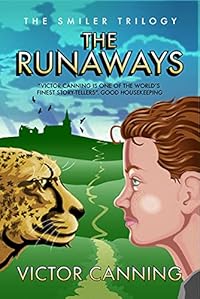
The Runaways by Victor Canning

The Runaways by Victor Canning was first published in 1972 and it’s the first part of his Smiler trilogy. It was made into a film for US television in 1975. The book is about 15 year old Samuel Miles, his mother is dead and his father is away at sea most of the time, so his older sister and her husband look after Samuel while his father is absent. ‘Smiler’ as he is known is a bit of a handful for his sister, but there’s no malice in him.

However, he ends up being wrongly convicted of stealing an old lady’s handbag and is sent to a borstal for young offenders, he manages to escape only to be recaptured by the police on a stormy night. On the way back to the borstal he takes a chance to escape again and manages to fend for himself in the barn of a house which has nobody living in it.

Smiler isn’t the only one being hunted down. A cheetah has escaped from the famous Longleat Wildlife Park. It was the storm that gave Yarra the opportunity to escape when a tree was blown over. She heads for Salisbury Plain, much of which is used by the army for training. Unknown to the two escapees they take cover in the same barn, with Smiler being in the loft and so begins a wonderful relationship between the two.

This was a great read, aimed at older children or Young Adults as they say today in publishing. It’s very well written with some really likeable characters and I’m very much looking forward to reading the other books in the series.

I was sent a digital copy of this book by Farrago Books via Netgalley. Thank you.

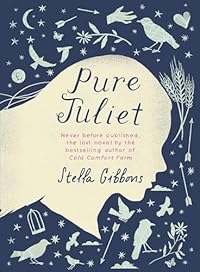
Pure Juliet by Stella Gibbons

Pure Juliet by Stella Gibbons was published posthumously in 2016 which was 27 years after her death.

Juliet Slater has just left school at the beginning of the book, she has done really well in her A levels but her father has decreed that she must get a job instead of going to university. Even a letter from the headmaster can’t persuade him to change his decision.

But unknown to her parents Juliet had struck up a friendship with an elderly and wealthy spinster and she takes herself off to live with Mrs Pennecuick – ‘Aunt Addy’, packing a case full of maths and science books so that she can continue her studies in the large house which has a bevy of Spanish servants. As you can imagine Juliet’s intentions are suspected by just about everyone, especially as she’s a very strange character. Nowadays she would probably be described as being quite high on the Autistic or Asperger’s spectrum but neither of those words appear in the book. Juliet has no interest in anything but mathematics and becomes obsessed by coincidences. It’s a word that she has to look up in a dictionary, helped by a library assistant as Juliet’s knowledge of anything outside maths and science is scanty. She’s not interested in any relationships with people and isn’t even grateful for all the help she gets from Aunt Addy, but Addy’s great-nephew Frank sees Juliet as his project, he thinks she might be a genius, and over the years he attempts to help her further her studies and to make her less self-obsessed and a bit more ‘normal’.

I enjoyed this one despite Juliet being so strange and unlikeable. There were plenty of other characters whose company I did appreciate, but if you’re expecting another Cold Comfort Farm you might be disappointed, I remember so many laugh-out-loud moments in that one, but Pure Juliet is quite different. The ending was very abrupt though, almost as if the author just got fed up writing it.

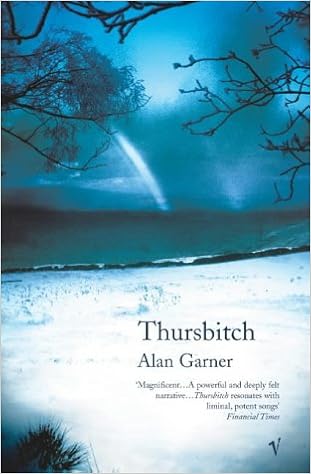
Thursbitch by Alan Garner – 20 Books of Summer 2021

Thursbitch cover

Thursbitch by Alan Garner was first published in 2003, I just noticed after I had bought it that my book is a signed copy. I’ve read quite a few of Alan Garner’s books over the years, they’re always a bit strange and this one is stranger than usual. To begin with it was just too weird for my taste but I did end up liking it, and it’s a difficult one to describe.

The setting is 18th century northern England – and contemporary. John Turner is a packman, carrying goods all over the country, anything that needs to be taken elsewhere, and sometimes he’s away from his home in very rural Cheshire for quite a long time with his horses and cart. It’s a time when most people hardly strayed from the neighbourhood that they were born in, so John/Jack is quite cosmopolitan compared with the locals.

I was more interested in the 21st century relationship between Ian and Sal though as they traversed the same hills that Jack had travelled through, albeit 200 years or so later.

This was one of my 20 Books of Summer.