Blackness Castle – part 2 – Fort William in Outlander

We’re back at Blackness Castle which is apparently in Clackmannanshire, the smallest county in Scotland, it’s not far from Stirling. From the photo below you can see how solid and high the towers are. The gateway that you can see is where there’s a we drawbridge that leads out to the river walkway where supplies used to be unloaded for the castle, directly from ships.

Blackness Castle , River Forth

All of the rooms in this castle seem to be barrel vaulted, no doubt for strength. I’m sure that some of the rooms were used in filming Outlander most recently.

Blackness Castle Clackmannanshire, Scotland

There are stairs all over the place as you can see below. It was an incredibly blustery day as it almost always is at the River Forth but strangely as soon as we got inside the castle it felt very safe, quiet and – warm! Some of the walls are around nine feet thick, where they were in most danger of getting attacked by cannon I suppose.

Blackness Castle, Scotland

It could feel quite cosy with tapestries on the walls and heavy curtains and maybe a nice carpet underfoot, or at least rushes. I’m not sure if the room below originally had a low ceiling in it. On the right hand and above the window it looks like the remains of a fireplace.

Blackness Castle , Scotland

As is often the way with old castles a lot of the rooms have a medieval ‘en suite’ off the main rooms as you can see in the photo below. All mod cons, well it’s a long way up and down to the ground floor. No ‘garde looing’ here! But it does look a bit cold to be dangling your ‘bahookie’ over the hole.

Blackness Castle , latrine, Scotland

Below there’s even an alcove where you can wash your hands, but I don’t think it’s within the toilet area, maybe a good thing.
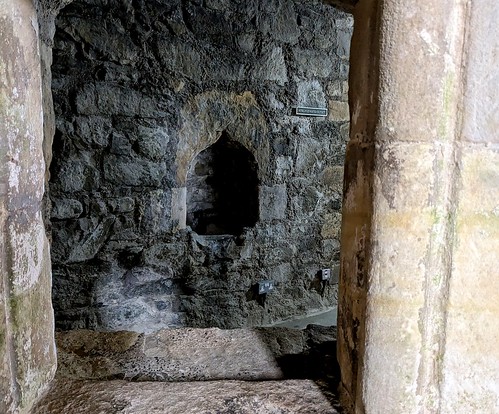
Blackness Castle, Scotland

I particularly like the windows, the shutters open if you need fresh air.

And I can just imagine this as a good place to read – if there were plenty of cushions on the window seats.

Blackness Castle , Scotland

Blackness Castle  window, Scotland, Outlander

The castle has been modified a lot over the centuries and the photo below show what was the original entrance, which is now blocked up. It’s much bigger than it looks in the photo.

Blackness Castle original entrance, Scotland

The garden, below was the last bit which we visited, as you can see the weather had cleared by then. It looks quite industrial on the other side of the river, because it is. The blue crane thing to the right of the middle is actually at Rosyth, the naval dockyard. So this area of the River Forth is still about defence!

Blackness Castle garden River Forth

Blackness Castle became Fort William in Outlander, and it was where Jamie received the lashes from the dastardly Captain Randall – ooh err!

Dirleton Castle, North Berwick, East Lothian

A couple of weeks ago we decided to knock a few more Scottish castles off our list of places we hadn’t visited yet. So we headed for North Berwick in East Lothian, it’s maybe 20 miles from where we live as the crow flies but it’s over 60 by road since the Firth of Forth is in the way. It was our 47th wedding anniversary (I know!!) and we felt the need to get out of the house and do something different. Dirleton Castle was our first port of call. It’s a 13th century castle and at some point the English Edward I captured it – for a while.

Dirleton info Board , North Berwick, East Lothian

As you can see it has taken a bit of battering over the years. It’s now owned by Historic Environment Scotland.

Dirleton Castle, North Berwick, East Lothian

Dirleton Castle, North Berwick, East Lothian, Scottish castle

Like many castles it has been built onto an area of rock, a strong foundation.

Dirleton Castle, North Berwick, East LothianCastle 6

Dirleton is one of the many historic buildings which had been closed to the public for a few years while they were inspected for safety, there are some areas that you aren’t allowed to go into. The photo below is of the kitchen/storage areas and it was a wee bit unnerving as I could hear and see small bits of masonry falling from the ceiling near a fireplace! I’m sure it’ll be safe though.

Dirleton Castle Interior , North Berwick, East Lothian

The decorative alcove below was where the silver plate would have been displayed when there was entertaining going on. Really it’s not all that different from the stone ‘dresser’ at Skara Brae.

Dirleton Castle Interior, display area,North Berwick

Below is the dovecote, or doocot as they are named in Scotland. This is where the pigeons roosted, they were an important source of meat for the castle during winter months.

Dirleton Doocot , dovecote, North Berwick, East Lothian

Below is the interior of the doocot. I’ve been told that pigeons, (or doves if you want to be genteel) breed all year round which is why there are so many of them. All of the wee niches would have contained  pigeons sitting on eggs. Castles had a lot of people living in them although I doubt if the workers ever got to taste much in the way of meat.

Dirleton Doocot, dovecote, Dirleton Castle

But the poor souls who were in the dungeon which is below would have been on a bread and water diet if they were lucky.

Dirleton Castle dungeon, North Berwick

Within the dungeon there’s a hole in the floor which prisoners were thrown down, if you were down there I doubt if you would survive for long!

Dirleton Castle info Board , North Berwick

Dirleton Castle is surrounded by greenery, as it probably always has been.

Dirleton Castle Garden , North Berwick

Below is the Victorian garden, very formally planted, very pretty.

Dirleton Castle Gardens stitch

Elizabeth I and her world by Susan Watkins – 20 Books of Summer 2023

Elizabeth I and her world by Susan Watkins is a lovely book with sumptuous photographs by Mark Fiennes. I borrowed this one from the library just last week, I must admit that it was the photos that really attracted me and I had intended just drooling over all the Tudor portraits, grand buildings, jewels, gardens and paintings of various scenes, but when I began to read it I quickly realised that I wanted to read it all. Despite knowing quite a lot about the Tudor courts and Elizabeth there was still a lot to learn from this book. Elizabeth may have made some mistakes as a youngster but she certainly learnt from them and seemed to know intuitively how to stay on the right side of her people.

This was a great read. It was first published in 1998 and then again in 2007 in paperback.

Falkland, Fife

Falkland, Pond, Fife

This year is going by in a flash and it’ll be September soon, but I’m casting my mind back to a sparkling day in March when we visited nearby Falkland. The photo above is of the lodge house at Falkland House. This used to be a favourite haunt of ours when we had wee ones in the family, before we even had our own kids to take there it was loved by our niece because at that time the pond was full of ducks and all sorts of water fowl. For some reason you never see any at all nowadays. The lodge house looks idyllic, but the water flows underneath it so that will be noisy and chilly I imagine. Below is a photo I took of crocuses but they’re dark purple so quite difficult to see.

Falkland Crocuses ,Fife

From Falkland Pond, Fife

To the left of the field above the ground slopes up to the Lomonds, I’ve never gone up that way, it looks too steep.

But walking over to the right from there you get onto a woodland path which leads eventually to Falkland Palace orchard. The wee waterfall below and the bridge are close to a popular children’s play park.

Falkland Waterfall , Fife

The view below is looking over towards the villages of Auchtermuchty and Dunshalt  from the footpath which leads to Falkland Palace orchard. Nowadays Falkland is probably best known for being used as a  location in the TV series Outlander.

Fife Hills, near Falkland, Fife

In this post that I did way back in 2016 you can see the village when the film people converted the shops to look like they were in the 1950s.

Oxburgh Hall, Norfolk, England

We stopped off at Oxburgh Hall in Norfolk on our way to the ferry that was taking us to the Netherlands last month. It’s now owned by the National Trust but originally it was built for Sir Edmund Bedingfeld’s family in 1482, but over the years it has been reconfigured a lot with each generation wanting to pull bits down to add whatever was fashionable at the time. The moat is only about three feet deep so it wasn’t really ever meant to be for defensive purposes, but it adds to the grandeur of the place. We had a guided tour of the outside of the building before going inside. I recommend doing that if you visit as it’s very interesting. Although the front of the hall (below) has been changed over the years it is basically original.

Oxburgh Hall Entrance Gate, Norfolk

From the side you can see the quite elegant bridge to the doorway. There was a bit of consternation while we were there as there was a ‘drowning’ teddy bear at the other side of the bridge and two worried looking wee girls waiting for help to get it out.

Oxburgh Hall , Norfolk

The photo below is of the back of the hall. It has been demolished and rebuilt a lot over the years to suit the prevailing fashions, I don’t think it was ever an improvement.

Oxburgh Hall ,Norfolk

Oxburgh Hall , Norfolk

The Bedingfelds were a prominent Catholic family with links to Mary,Queen of Scots and the Oxburgh Hangings which were worked by Mary and Bess of Hardwick are on show too as you can see below. People can be rather scathing about the amount of needlework purported to have been done by Mary, Queen of Scots, but she didn’t have much else that she could do over the years she was imprisoned, and of course she had the help of her ladies in waiting too

Oxburgh Hall Tapestry , Norfolk

You can read more about the history of the hall here.

Haddington, East Lothian, Scotland

A couple of weeks ago we stopped off in Haddington in passing. A friend had told us that St Mary’s Church there was worth seeing. Unfortunately it wasn’t open that day, but it was still worth a visit.

St Mary's 1 and 2 stitch

The photo doesn’t give the idea of how large it is. The church was founded in the 1380s but was more or less a ruin by 1548, a victim to the ‘Rough Wooing’ by King Henry VIII, his attempt to persuade the guardians of the infant Mary, Queen of Scots to allow him to marry his son Prince Edward to Mary, thus securing Scotland for himself and England.


St Mary's Church, Haddington, East Lothian, Scotland


St Mary's , Haddington, East Lothian, Scotland

The setting is lovely with the River Tyne running right past the church grounds.

River Tyne, Haddington, East Lothian

I know that people love to have a river view from their homes but I always wonder how often the river pays you a visit!

River Tyne, Haddington, East Lothian

I love old stone bridges too, so it might be worth being flooded out every now and again for this view – or maybe not! There’s a swan just in view if you look closely. If you’re in the area Haddington is well worth a visit, it’s really historic and has some eclectic shops. We had a lovely lunch there.

River Tyne, Haddington, East Lothian

Elizabeth and Mary edited by Susan Doran

Elizabeth and Mary – Royal Cousins, Rival Queens – which is edited by Susan Doran is a lovely book and I was lucky enough to be sent a copy of it by British Library for review. Among many things the book contains contributions in the shape of essays by 14 academics, mainly historians, as you would expect.

This is a really sumptuous book with beautiful photographs of historic portraits, jewels and religious works, maps and drawings of castles, but by far most of the photographs are of letters sent by and to Elizabeth I and Mary, Queen of Scots to each other and to many of the prominent people of the times.
It’s not all letters though, there are also poems and speeches written by Elizabeth and Mary and even John Knox makes an appearance.

My only gripe is that most of the documents are not big enough to be able to read, but as many are in French or Latin possibly it was thought that readers wouldn’t want to read them for themselves. I must admit that it’s quite some time since I was sent this one for review, but it isn’t really the sort of book that you sit down and read quickly from cover to cover, it’s the sort that you dip in and out of and savour over quite some time.

This book was produced by British Library to accompany an Elizabeth and Mary exhibition, which I so wish I had been able to go to, but this book is the next best thing I suppose.

Thank you to British Library for sending me a copy of the book.

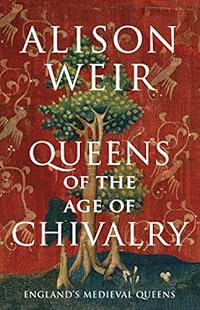
Queens of the Age of Chivalry by Alison Weir

Queens of the Age of Chivalry by Alison Weir is subtitled England’s Medieval Queens and it tells the stories of the lives of the five queen consorts in England in the 14th century, the Plantagenet period from 1299 to 1399, but inevitably it’s a lot more than that as while writing of the experiences of the women and their husbands, the history of their era and how it affected them also has to be written about.

The five Queens are: Marguerite of France (Edward I’s second wife), Isabella of France (Edward II’s wife), Philippa of Hainault (Edward III’s wife), Anne of Bohemia (Richard II’s wife), Isabella of Valois (Richard II’s second wife).

These Planatgenet wives were far from being shrinking violets, it was quiet an eye-opener how much power and influence they could have. Reading this book you learn an awful lot about English history but also the history of Scotland and the various European countries that become embroiled in English history. It’s a painless and entertaining way of learning. I’m constantly amazed by how many documents and personal letters are still in existence from so far back in history. What a thrill it must be to be able to see and possibly even touch them.

This was a really enjoyable and interesting read. I received a digital copy for review from the publisher via Netgalley, for which many thanks.

My Snowy Garden

Snowy Garden

The temperature in Fife hasn’t got above freezing for days now and we’ve had snow all week, which wouldn’t be so bad on its own but when all the ruts and footprints ice over it makes for an interesting walk for the Guardian in the morning! The garden looks quite pretty though.

Next week it’s supposed to be very mild for the time of year again, but it does mean that I should be able to get to some far-flung shops, something I really need to do.

Dumfries House, Ayrshire, Scotland

I’ve been meaning to visit Dumfries House for absolutely ages and last week we got around to it at last. I thought it would have taken us longer to get there, it was about a two hour drive from Fife, but we stayed in the area overnight so we would have plenty of time to look around. The house is part of the Prince’s Foundation, does it have to be called the King’s Foundation now? Anyway, the fine Georgian mansion was due to be auctioned off piece by piece and some furniture was actually in a London auction house, when the then Prince Charles stepped in and organised a financial rescue package for it. The name of the house is somewhat confusing as it isn’t near the town of Dumfries, it’s actually in Cumnock, Ayrshire. It was designed by the Adam brothers – Robert, John and James.

Dumfries House, Georgian mansion, Ayrshire, Scotland

Sadly they don’t allow people to take photos inside, suffice to say that it’s well worth a visit, it has all sorts of bits and pieces in it and glorious furniture, including Chippendale pieces, one cabinet is valued at £25 million! But I loved the clocks and the huge orrery which is 260 years old, so of course isn’t correct now.

Below is the back of the house, where the guided tour begins.

Back of Dumfries House, Georgian mansion

The whole place is incredibly vibrant with all sorts of things going on educationally with lots of apprenticeships available, and it is now the second largest employer in the county.

The Lugar Water runs through the estate and there are some lovely bridges spanning it. But I’ll leave that and the grounds for another blogpost.
Adam Bridge, Dumfries House, Georgian mansioen, Lugar Water    tr

You can see the Education Tour in the You Tube video below.

If you’re interested in the history of the house you can read about it here.