Love At All Ages by Angela Thirkell

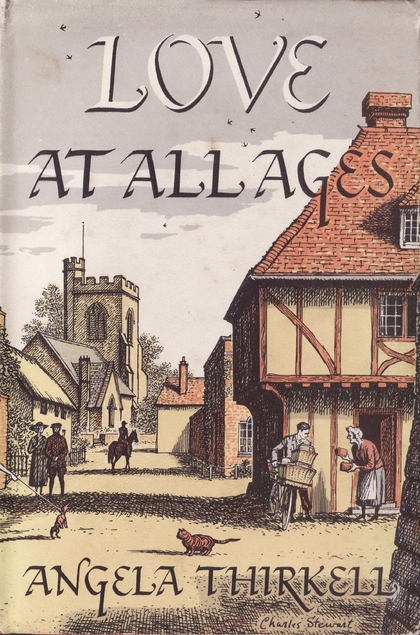
Love at all Ages cover

Love At All Ages by Angela Thirkell was first published in 1959 and it’s everything that you would expect from a Thirkell book.

The government’s tax regime has caused the one time wealthy of the county of Barsetshire to have to economise, so most of the large houses have been rented out to private schools and various businesses. This sounds like a dire drop in their status but in truth they are all very pleased with the situation, most of them didn’t like the massive homes that were so uncomfortable, impossible to heat and the distances between kitchen and dining-room so vast that their food was always cold by the time it reached them.

This one features mainly the Pomfret and Towers families and as you would expect there are the usual hatches and matches all very satisfactory. Sadly this book doesn’t feature Mr Adams, one of my favourite characters although Mr Wickham is present, he’s a sort of one man booze supplier who feels an affinity with anyone with a similar fondness for the demon drink. (Kamarade!)

Editorially Thirkell’s books could be described as being a total mess. She rambles madly and goes off at tangents, but it’s all obviously contrived. She’s madly snobbish and she freely admitted to nicking stuff from many authors – Trollope and Dickens obviously, but I’ve just realised that she nicked things from E.F.Benson’s writing too. I read Trollope but avoid Dickens so I’m sure that I’m missing a lot of allusions to his writing, not that that would spoil the books for anyone. There are a couple of mistakes in this book, but by this time Thirkell herself was obviously getting confused with all the many inhabitants of her Barsetshire, something which she admitted within this book.

I do think that Thirkell’s best books are those that she wrote during and about World War 2 and the subsequent years when Britain was struggling under austerity and the never ending ration. It gave her so much scope to have rants against those who were in power and gives a window into life as it was lived and the changes in society, always entertaining and informative.

Several other readers have mentioned on Goodreads that Love At All Ages is the last in her Barsetshire series but I have Three Score Years and Ten which was published two years later. Although it was unfinished at her death, and was finished by C.A. Lejeune who apparently had often spoken of the characters with Angela Thirkell, so hopefully she was able to replicate the same atmosphere of the books. I intend to read it soon-ish.
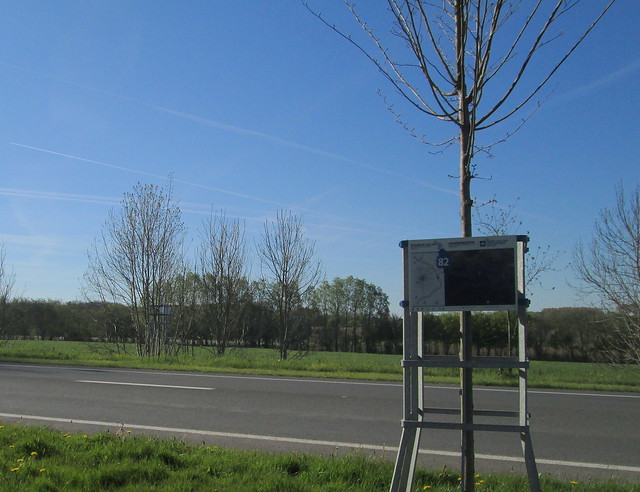
Remembrance Trees, Ypres, Belgium

Remembrance tree

I think they started planting these Remembrance trees just outside Ypres in 2014, to commemorate 100 years since the beginning of World War 1. As you can see there is a framework around the tree and it has a map showing you exactly where the tree is and the trench lines as they were in 1914 with the British marked in blue while the Germans are in red.

I had always known that the trenches were close together but I had imagined them being maybe around 50 yards (metres) apart at the closest, but if you look carefully at the above photo you can see another tree with a framework around it, that was the British trench. So it’s just at the other side of a very narrow road, supposedly 20 metres away but I don’t even think it is that far. It looks to me like the soldiers could have almost leaned forward and shaken hands with each other, had they been so inclined. They wouldn’t even have had to raise their voices to speak to each other.

There’s something really crazy and awful about it, there couldn’t be anything anonymous about killing someone under those circumstances.

The Hooge Crater Cemetery is just across the other side of the road, and as it is just a two minute walk from our hotel we went there straight away to have a walk around it. We counted up the graves and the rows and thought that there must be over 1,000 men buried in it, but when we went to sign the register at the memorial it said there were nearly 6,000 men laid to rest there.

Often they have no names and say Known Unto God and often it says five soldiers rest here. Presumably they could only find bits and pieces of the poor souls who had been blown up.

Hooge Crater Cemetery Communal Graves

It’s not exactly an enjoyable experience but if you are interested in that period of history then it’s something that you feel you must do. Looking at the graves made me think that we really can’t afford to leave the EU – flawed as it is (what is perfect) – if only to stop anything like that war ever happening again. You have to jaw jaw as Churchill said – not war war.

If you’re intersted you might like to click over to Jack’s Menin Gate post.

Nine Spectacular Scottish Walks – from the National Trust for Scotland

I’m already a member of the National Trust for Scotland so I have no idea why they are sending me emails asking me to join, anyway I thought I would pass on the nine walks also on the email as you can take a virtual walk, a very good idea if you are too far away to contemplate going up a Scottish hillside or your legs are no longer up to the job. I’m not sure mine ever were – apart from Ben Lomond as I know that’s an easy one, and the Grey Mare’s Tail near Moffat of course.

I quite fancy trying Goatfell on the Isle of Arran sometime in the future though, if I can manage it. It looks gorgeous there, doesn’t it.

Goatfell

Flambards Divided by K.M.Peyton

Flambards Divided cover

Flambards Divided by K.M. Peyton is the last book in the Flambards series, published in 1981 and aimed at older children, teen readers I suppose they would be described as nowadays.

It seemed apt to be reading it while I was in Belgium looking at World War 1 cemeteries and such, because the setting is towards the end of the war. Christine is of course a young widow with a small daughter and after spending lots of her inherited money on improving Flambards as a farm and trying to make it pay her cousin Mark has come back home from the war where he was very badly wounded.

Christine has married Dick who was a servant at Flambards before the war. Their marriage isn’t popular because everybody disapproves of her marrying so far below her station and Dick is too stubborn to want to get on with the neighbouring landowners. Christine isn’t happy that Dick has taken over the running of the farm and wants no input from her at all.

When Mark arrives back at Flambards the atmosphere is poisonous as Mark and Dick have a lot of animosity, with good reason. Christine finds herself in the middle of two warring men and everything begins to fall apart for all concerned.

This book shows how World War 1 changed everything in social terms and also how the death of so many young men made it necessary to change laws to take account of the imbalance of the sexes.

This is an enjoyable series which of course was made into a TV serial but I’m sure that the TV series only dealt with the first two books. It’s a shame that nobody thought to make a new series of the whole set as it would have been ideal viewing during these centennial years.

As it happens Jack has just done a blogpost about the Menin Gate in Ypres and if you’re interested you can see it here.

Ypres (Ieper) in Belgium

Ypres Buildings

In Britain we say Ypres (Eeprr) in the French fashion, I’m not very good at that French ‘r’ rolling thing. Anyway, that was how it was pronounced locally at the time of World War 1. The British troops of course decided that it was much easier to call the place Wipers. After the war the Flemish people of the region decided that it was about time they dropped the French way of doing it, after all it isn’t in France it’s Belgium. So now it’s called Ieper (Eeyeper) well that’s what it sounds like to me. The whole town was flattened as it was right on the front line, and it had been such a lovely mediaeval town too.

Ypres Building

After the war there was a discussion about what should be done about the place. Churchill was keen to keep the whole area in ruins as a memorial to the dead. Understandably that didn’t appeal to the locals who just wanted to get back home and get on with normal life. So the decision was taken to re-build as close as possible to what had been there before, and I think they made a good job of it.

Cloth Hall fountains

The fountain above is obviously modern, I love fountains, there aren’t enough of them around, in Britain anyway. It was hot while we were there and in common with lots of old places Ypres has now and again a whiff of old drains but the town also smells of chocolate, very enticing.

If you go to Ypres be sure to visit The Flanders Field Museum. It’s one of the best museums I’ve ever visited – and I’ve visited a fair few in my time. Give yourself at least three hours to go around it.

Ypres is just a small town surrounded by farmland, interspersed with many cemeteries and memorials. I read somewhere that the farmland had been very poor prior to the war, but afterwards it was the most productive farmland in Europe. I don’t know if that’s true but it is an undeniable fact that it was certainly very well fertilized, what an awful thought.

It’s a dangerous job driving a tractor on these fields as unexploded shells are ploughed up all the time and sometimes they explode when they’re disturbed, killing or maiming the poor driver.

tractor

If you’re interested you can see some images of The Wipers Times here.

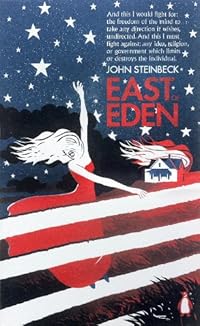
East of Eden by John Steinbeck

East of Eden cover

East of Eden by John Steinbeck was first published in 1952 and it was high time that I got around to reading it. I suspect that everybody who is a keen reader already got there long before I did, it’s probably a set book in many schools. I’ve read a lot of Steinbeck’s books and have never been disappointed and sometimes I absolutely love them, East of Eden comes into that category. It’s 714 pages and I read it in three days as I could hardly put it down.

The setting is the Salinas Valley in Northern California and Steinbeck said about East of Eden: “It has everything in it I have been able to learn about my craft or profession in all these years.” He further claimed: “I think everything else I have written has been, in a sense, practice for this.”

I must admit that the title East of Eden didn’t mean anything to me but it is of course from the Bible, Genesis – where Cain was told to go East of Eden after he killed his brother Abel and a version of that story is repeated throughout the book. The main story takes place from the beginning of the 20th century until just after World War 1 but does dip back to the 1880s at times. Mainly it’s about good and evil and how some people are just bad right through to the core whilst others are aware of their weaknesses and fight against their instincts. Many of the characters are from Steinbeck’s own family or neighbours.

As ever Steinbeck’s descriptions of the surroundings and his insight into the human condition, good and evil are a treat to read and I’ve always been slightly puzzled that he apparently didn’t have any Scottish blood in him as those are traits that are particularly prominent in Scottish literature – think Robert Louis Stevenson’s Dr Jekyll and Mr Hyde and many others.

Steinbeck’s maternal family – the Hamiltons – feature in the book and much is made of them coming originally from Ireland and their fierce Presbyterianism, so that solved my problem of how Steinbeck could seem so Scottish – because he was obviously of Scottish descent although somewhere along the way they forgot about going to Ireland from Scotland. Maybe when people migrate more than once it’s easiest to only recall the most recent past. As the Hamiltons were Protestants then it’s likely that they were amongst the Scots who were encouraged by the British government to settle in northern Ireland in an attempt to keep those Roman Catholic Irish people down.

Anyway, all the Scottish elements of writing are in his books, but wherever his talent sprang from he was a great writer and after reading Travels with Charley I came to the conclusion he was a great human being too. If by any unlikely chance you haven’t read any of his books – you should definitely give him a go.

I read this one for The Classics Club.

20 Books of Summer Challenge

It has been a silent weekend blogging wise because I was in Glasgow at a Science Fiction convention of all things. That’s Jack’s thing and I was just there to meet up with old friends. I had intended to get online – but just never got around to it, you know how it is!

Anyway as I’ve been catching up with some of my favourite blogs I’ve decided to join in with 20 Books of Summer for the first time. You have to read 20 books between the 1st of June and 1st of September. I think I should manage that. So here is my list:

1. Autumn Sowing by E.F. Benson
2. Nine Coaches Waiting by Mary Stewart
3. Touch Not the Cat by Mary Stewart
4. Madam, Will You Talk by Mary Stewart
5. A View of the Harbour by Elizabeth Taylor
6. A Place to Stand by Anne Bridge
7. The Moon King by Neil Williamson
8. Runyon from First to Last by Damon Runyon
9. Resorting to Murder – Holiday Mysteries edited by Martin Edwards
10.The Suspect L.R. Wright
11. Noble Descents by Gerald Hanley
12. Silence for the Murderer by Freeman Wills Crofts
11. Crime Out of Mind by Delano Ames
12. Kim by Rudyard Kipling
13. The Prince Buys the Manor by Elspeth Huxley
14. Headless Angel by Vicki Baum
15. The Weeping Wood by Vicki Baum
16. Justine by Lawrence Durrell
17. Fillets of Plaice by Gerald Durrell
18. Daniel Plainway by Van Reid
19. Love at all Ages by Angela Thirkell
20. A Desert in Bohemia by Jill Paton Walsh

I hope to be able to manage to read more than 20 books over the summer, but that very much depends on what the weather is like, if it’s good I’ll be spending time gardening. The books above are all from my TBR piles and I hope that this will make me concentrate on my own books, rather than those from the library. I have to admit though that I just bought about half of these books when we were down in England recently, on our journey back from The Netherlands.

They’re all fairly old apart from the Jill Paton Walsh book and Moon King by Neil Wiliamson and the Mary Stewart and Williamson books can count towards the Read Scotland 2016 Challenge.

So what do you think of my list? Are there any duds on it? Maybe you’d like to join in with a readalong, possibly with the Mary Stewarts – do tell!

Psmith – P.G. Wodehouse

I’m way behind with writing about the books I’ve been reading lately so I’m just going to mention that I really enjoyed reading P.G. Wodehouse’s books featuring his character Psmith. I can’t remember which bloggers mentioned enjoying these books fairly recently, was it you?

Anyway, I downloaded them from Project Gutenberg onto my Kindle because I suspected they might be perfect holiday reading- and they were. The first one Mike and Psmith kept me entertained on the ferry journey from Harwich to the Hook of Holland and I read the others whilst in Holland. Psmith in the City and Psmith Journalist, they’re a hoot.

P. G. Wodehouse’s books are available for download here.

Wodehouse said that he got the idea for his character Psmith when he heard that a schoolmaster had asked a pupil of his how he was and the pupil had answered that he ‘just kept getting thinnah and thinnah’ and so the character Psmith was born. I always get a clear view of anybody I’m reading about, usually completely imaginary people depending on their descriptions but as soon as I read the ‘thinnah and thinnah’ bit it was a schoolboy version of the Tory M.P. Jacob Rees-Mogg who appeared in my mind. He’s only missing a monocle as far as I’m concerned.

jacob rees-mogg

Psmith to a T – for me anyway.

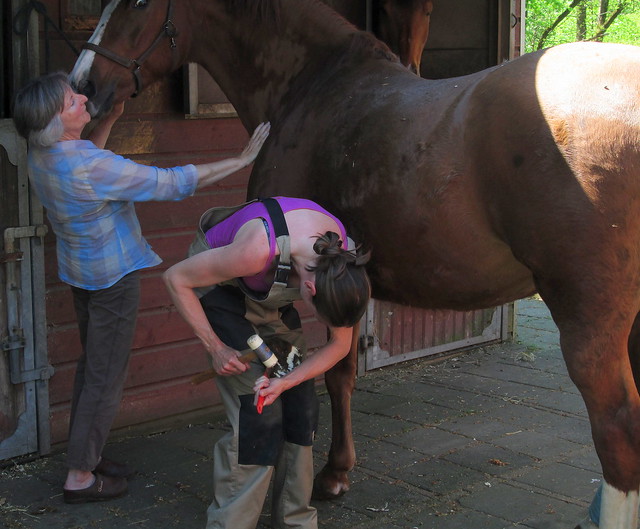
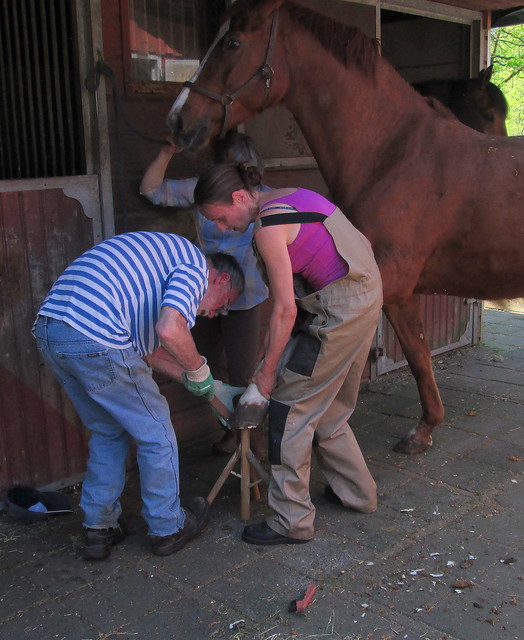
Hoof Trimming in Process

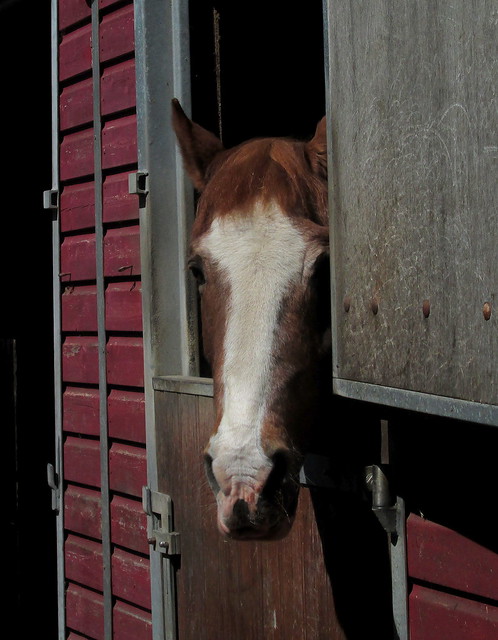
Family life in the Dutch side of my family revolves around looking after the four horses. The horses are all getting on, in fact they age between 16 and 38. The photo below is of Odin the pony, he’s the oldest and he had a bit of a cold that day but it cleared up fine. You definitely don’t want to stand too close to a horse with the sniffles!

odin

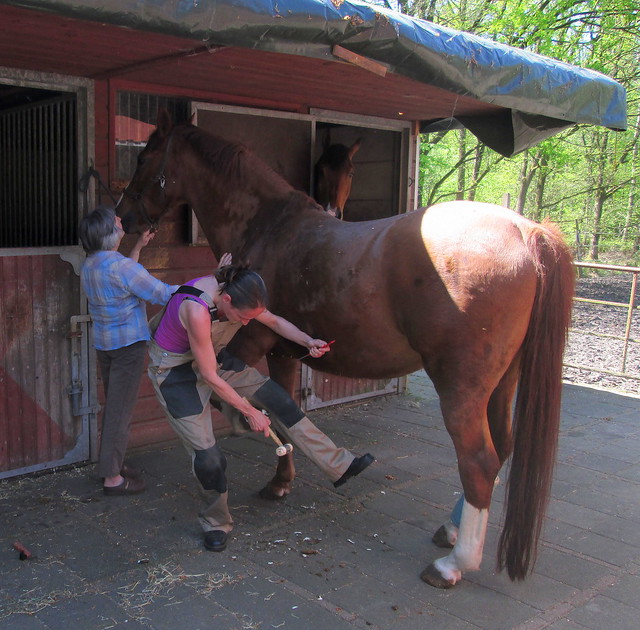
It’s unusual for horses to live well into their 30s but these ones are so well looked after that it has prolonged their lives. They’re stabled every night and whenever it’s chilly, if they had lived outside on icy fields they would have succumbed to ill health long ago. Tara, the only mare and tending to fat as mares do, needed to have her hooves trimmed and my niece Kirsty went on a course to learn how to do it herself. Unfortunately you can’t see her properly, they are action photos, it’s hard and dangerous work.

hooves

Kirsty has her mum Hanneke helping to hold Tara as still as possible, but she lost patience for a minute there.

hooves

It’s a family effort when Kirsty’s dad – my brother John – steps in to help to smooth off the edges using a rasp.

hooves

Jack and I stood well clear of it all, outwith kicking distance anyway! Those horses are really big and I have a sneaking suspicion that horses resent ‘being in captivity’ and really hanker after running free and independent. Odin makes escape bids every now and again, despite his great age and the life of Riley that he leads.

The Chelsea Flower Show 2016

Amazingly it’s that time of the year again, The Chelsea Flower Show, for me that means the beginning of summer. It always creeps up on me and yet again I’ve neglected to get organised and actually go to it instead of just watching on TV. Mind you I suspect that you probably see more of it on TV than you do if you are actually there, what with the crowds and everything. So I’ve been watching it on TV and deciding which are my favourite gardens from the various categories. If you haven’t been able to see any of it you should be able to view it here.

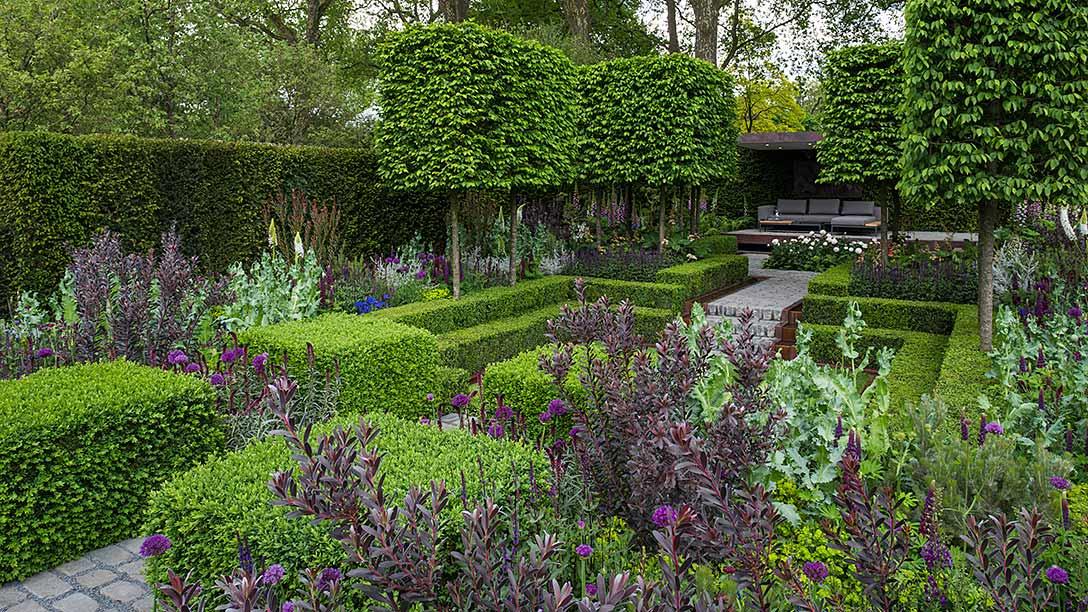
My favourite garden in the large show garden category is The Husqvarna Garden, designed by Charlie AlboneChelsea garden You can read about it here. Sadly it only got a silver gilt medal.

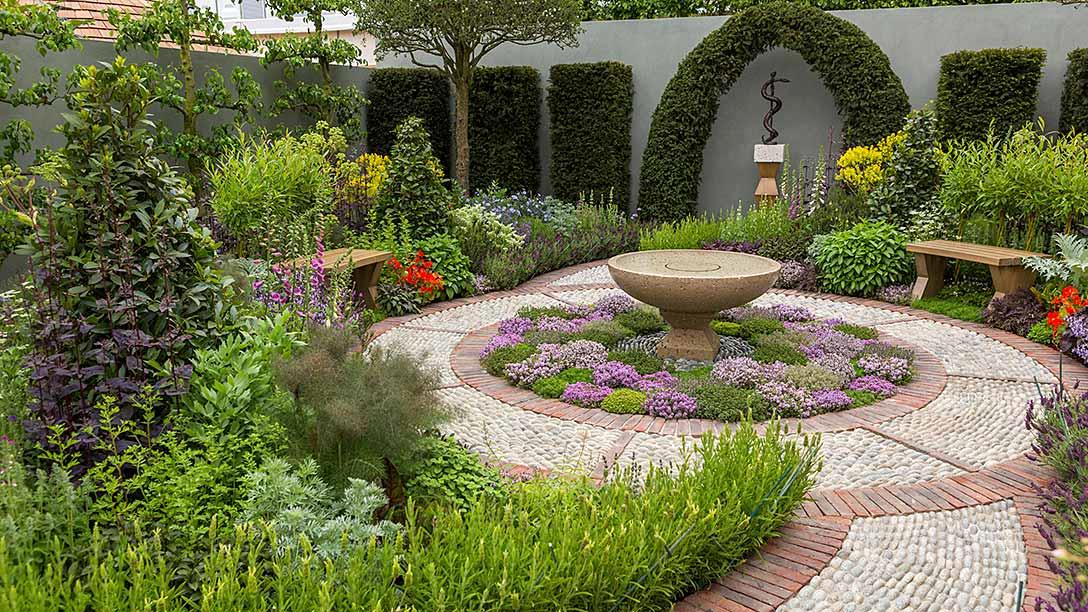
I also love Jekka McVicar’s A Modern Apothecary which you can read about here. Can you believe she didn’t get a gold medal?

Chelsea garden

You an look at all of the large show gardens here.

I also like Ishihara Kazuyuki’s garden in the artisan garden category. It got a gold medal although to me it isn’t as lovely as his gardens from past years. I just love acers (Japanese maples) and his designs always feature them.

Chelsea garden