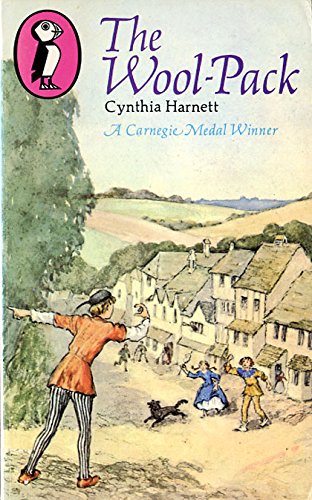
The Wool-Pack by Cynthia Harnett

 The Big Music cover

The Wool-Pack by Cynthia Harnett was first published in 1951 and it won the Carnegie Medal which I think it definitely deserved.

The setting is the English Cotswolds in the late 1400s. It’s a very rural area and sheep and wool are the mainstay of the local economy. Nicholas is in his teens and he’s the son of a successful wool merchant, but he mucks in with the other boys helping out with the sheep. When some men from Lombardy make their way to his family home to do some business with his father Nicholas is worried. He had seen the men earlier and there is something he doesn’t like about them. But his father pays no attention to Nicholas. He is convinced that he can make a good deal with the Lombards.

This is a really good read which is aimed at older children I suppose, but is well worth reading whatever your age. There’s a lot of history in it but it never feels like a history lesson and the author also illustrated the book which adds interest. Her drawings are charming with details of the fashions of the day, weaving looms, dyeing cloth, spinning and all sorts. The author had studied at the Chelsea School of Art, she wrote six books of historical fiction and I will definitely look out for the others.

Horned Helmet by Henry Treece

Horned Helmet by Henry Treece was first published in 1963.

This is the story of Beorn (Bjorn) a young Icelandic boy who has had a rough time as his mother has been kidnapped by Viking raiders and enslaved, and then his father jumped into the sea rather than face a fight with Glam whose barn he had burned down. The upshot of his suicide is that Beorn now belongs to Glam, but Beorn decides he would rather do anything than be Glam’s slave. He manages to escape and is taken on board a Jomsviking ship when he befriends Starkad. The Jomsvikings are a notorious band of mercenaries and at times Beorn regrets getting on board, the ship isn’t in the best of condition and it looks like they’ll all drown.

This one is written in the style of a Viking saga, so it seems a bit stilted to modern ears, or eyes at times, but I enjoyed the adventure anyway.

Mullion by Mabel Esther Allan

Mullion cover

Mullion by Mabel Esther Allan was first published in 1949.

The story begins in Liverpool where Mullion has just been accepted for the high school. She is an only child and things have been tough for her and her parents who had married against the wishes of Mullion’s great-grandmother and had subsequently been estranged from her despite the fact that Mullion’s mother had been brought up by her grandmother due to her own parents’ death. But now Mullion’s great-granny has sent a letter inviting them all to her the Island of Polmerryn for the summer, not only Mullion and her parents but her cousins too.

Great grandmother is a sort of Queen of Cornwall, very wealthy and proud, an utter snob who has fallen out with all her relatives over the years, but now she’s over 90 and frail, it’s time to gather her family around again, but the adults decline the invitation and send the children who are thrilled to be visiting a place which has featured in their imagination and dreams, especially for Mullion. It’s a twelve hour train journey from Liverpool to Cornwall, and that is an adventure in itself for Mullion especially as she meets up with her cousins for the first time on the train. They have all been named after places in Cornwall, but have never been there before.

Mullion has heard plenty of tales from her mother about the castle that she had grown up in and her unsuccessful search for a smuggler’s secret tunnel. Obviously the cousins want to continue with the search.

This was an enjoyable read, I love a Cornish setting and the cousins were all likeable – eventually – and everybody learns lessons, even the great-grandmother.

Mabel Esther Allan wrote over a hundred books and I have a feeling that I read some when I was a youngster. I will read more if I fall over them in a secondhand bookshop!

Strangers at the Farm School by Josephine Elder

Strangers at the Farm School cover

Strangers at the Farm School by Josephine Elder was first published in 1940 but the setting is September 1938, the new academic year for The Farm School. There are a lot of changes, the school has become very popular and has almost doubled the amount of pupils that they had. The original pupils aren’t too happy about that, and the new people aren’t terribly impressed with the place at all. Most of them are locals but there are also two Jewish refugees from Germany, a brother and sister.

Johanna and Hans have had to leave their parents in Germany, and in recent years they had had a horrible time because of Hitler’s attitude to Jews, people they had formerly thought of as friends had turned against them, and their father is now in a concentration camp. Their mother had managed to get them on a Kindertransport train to England. But Hans in particular isn’t happy about being at the Farm School and he struggles with the lack of rules after the rigidity of what he has been used to in Germany.

Annis is voted head of the school, and Arthur is not happy about it, he thinks the head should be a boy – him.

“I rather think he’ll want watching,” Kitty said. “He’s the sort of person who thinks it’s all wrong for a girl to be in authority over boys. Kicked up a fuss at first because he had to have lessons from mistresses as well as masters, and in his family the girls have to make the boys’ beds for them, and the boys don’t do anything at all in return. There would be some sense in it if they cleaned the girls’ shoes for them, but they don’t, they loll about in a lordly sort of way.”

I think this is my favourite of the three books in this series. Josephine Elder was so forward thinking for the time the book was written in. Thirty years later my mother still thought that education was wasted on daughters because they “ended up pushing a pram anyway”. My brothers were treated like little household gods while I did all the housework! Can you tell I am still bitter about it?!

Anyway, I suppose the subtext of this book is that people shouldn’t be judged too quickly as often they have talents that are unexpected, particularly the teachers.

I was slightly disappointed that at the beginning of the book young Kenneth’s death (in the previous book) is written as being almost a blessing, because he was mentally handicapped. That attitude was rife in Germany at the time with such people being killed in hospitals as they weren’t deemed to be useful in a country which was fashioning itself as the ‘master race’. But I don’t think most people in Britain would have thought like that.

The Eleventh Orphan by Joan Lingard

The Eleventh Orphan by the Scottish author Joan Lingard was published in 2008 and she dedicated this one in memory of her grandparents who inspired her to write the characters of Ma and Pa Bigsby.

They have a pub in Victorian London called The Pig and Whistle where they have a very full home due to the ten children that they’ve adopted. When the local policeman turns up with another homeless child in tow Ma Bigsby isn’t keen to take her in, she always said she wouldn’t take on any more than ten children at a time. Elfie, short for Elfrieda is eleven years old, and has been in trouble with the police for thieving, another thing that puts Ma off, but when she is told by PC O’Dowd that Elfie has a painting of The Pig and Whistle in her bag Ma decides to take her in. Elfie knows nothing about her parents, not even their names, but she does have a bag full of clues that might lead her to her father anyway, she knows her mother is dead.

Ma sets to work cleaning up her newest waif and Pa begins to educate Elfie as she can’t read, teaching the children is Pa’s main job, but he also has to keep Elfie and Ivy apart as they hate each other at first sight. But there’s a lot of love within this blended family which is nurtured by the wisdom and common-sense of the parents.

This is really well done, an entertaining read for adults as well as children. It’s the first in a trilogy.

The Dolls’ House by Rumer Godden

The Dolls’ House by Rumer Godden was first published in 1947 and it was the first book that she had written for children, but my copy is from 1963 and it has some lovely illustrations by Tasha Tudor.

The setting is just after the end of World War 2, when there was a chronic shortage of toys, and the dolls which belong to Charlotte and Emily Dane are having to live in draughty shoe boxes. They dream of living in a proper dolls’ house, especially Mr Plantaganet the father of the family of dolls.

They’re quite a mixed bunch of dolls, some broken and drawn on and Mr Plantaganet has had to put up with the most abuse over the years. He had been a Scottish doll originally, but years ago a child had ripped his bagpipes off him, causing damage. Tottie is the cheapest doll, she is a tiny wooden farthing doll (you got four of them for a penny) and she is the oldest of them and can tell them all of the original owners who were great-aunts of their Emily and Charlotte.

When there’s a death within the extended Dane family there’s the inevitable house clear out and Mr Plantaganet’s wishes come true as Emily and Charlotte are given an old dolls’ house which had been languishing unloved for generations in an attic. The girls set to work and make the house fit for the dolls, everything is wonderful until a very conceited doll arrives from a specialist cleaners, her name is Marchpane and she upsets everything and everyone. She thinks she is above everyone else as she’s made of kid leather and china.

This is a lovely tale which was obviously written to teach children what are the important things in life. There are quite a few adults who could learn a thing or two from it!

I love the cover of this book with its beautiful Georgian house, which even has a dog kennel for the toy dog in the story.

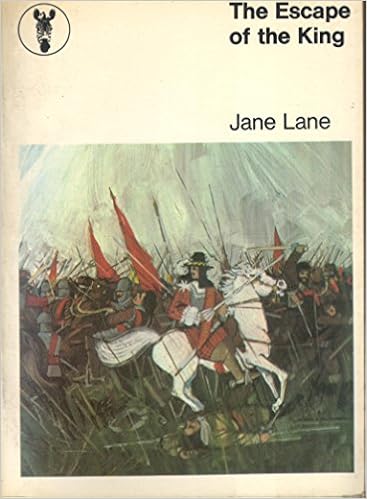
The Escape of the King by Jane Lane

The Escape of the King cover

The Escape of the King by Jane Lane was first published in 1954. I read some of her historical fiction back in the 1970s, but hadn’t read any which were aimed at children as this wee one is. It’s a quick but fairly entertaining read at just 156 pages. Jane Lane started writing books for children when her young son asked her to tell him stories from history.

In The Escape of the King she fills in the gaps between the known history of King Charles II’s flight after his army was defeated at the Battle of Worcester when the much larger rebel army of Oliver Cromwell’s Roundheads trounced the Royalist Cavalier army. Apparently all the events in this book are true and the characters are real. Jane Lane says that she just invented the conversations thoughts and feelings of the people involved.

All the Roundheads are looking for Charles, and when a £1,000 reward is put up for Charles alive or dead it seems like his escape from Worcester is an unlikely prospect, but well disguised as Will Jones – a peasant – and walking by night from safe house to safe house, when necessary hiding in holes that had previously been used by Catholic priests in houses owned by people who had been sticking to the ‘old religion’. He had some very close calls but of course did manage to reach the coast and hitch a ride on a ship to France and safety.

I must admit that I only recently realised that I had imagined his escape wrongly, as in that well-known part of the story when Charles II hid in a tree to avoid capture, I had assumed that it was a hollow tree he was in as it was supposed to be an oak tree, and they can be hollow. Now of course I realise that he was hiding up a tree, within the branches! It’s a mystery to me why teachers always said he was in a tree. In fact I’m sure I even asked a teacher about that at the time and she was the one who thought it might have been a hollow oak – oh well – you live and learn!

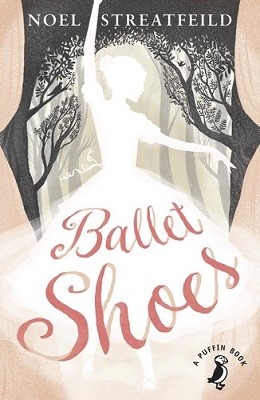
Ballet Shoes by Noel Streatfeild

Ballet Shoes by Noel Streatfeild was first published in 1936.

 Ballet Shoes cover

Matthew Brown is an elderly palaeontologist who spends most of his time travelling the world collecting fossils which he sends to his home in London which is run by his great-niece Sylvia and her old nanny. He manages to pick up three young girls over some time in differing circumstances, the last one being a small baby, and takes them home with him where Nana and Sylvia have the task of bringing them up.

It’s a difficult state of affairs for Sylvia as her uncle, known as GUM, leaves her some money and takes off on his travels again. As the girls (Pauline, Petrova and Posy) grow up the financial situation is very precarious as GUM stays away for years and doesn’t send any more money, for all they know he might be dead as they haven’t even had a letter from him for years.

The girls are all determined to help Sylvia and when they are enrolled in a stage and dancing school they are able to contribute to the family budget. Bizarrely it’s never mentioned that Sylvia might be able to get a job to help out!

I enjoyed this one, the character of Petrova was especially good as she was so different from the usual girls of that time, she was keen on cars and how they worked and was happiest when up to her ears in oil and car parts. Despite having little interest in the performing arts she was still keen to pull her weight and earn money for the family.

I think this is the fifth or sixth children’s book that I’ve read by Streatfeild and she does seem to have been slightly obsessed with the stage and performing. The only one of her books that I have unread in the house is Saplings, one of her books for adults, it’ll be interesting to see what that one is about. Have any of you read it?

My copy of Ballet Shoes is a modern Puffin book. Although these editions have nice clear print I must admit that I generally prefer the designs of the old Puffin books.

The True Confessions of Charlotte Doyle by Avi

The True Confessions of Charlotte Doyle by Avi was published in 1990 and has won several children’s book awards. You really have to suspend your disbelief while reading this book in order to enjoy it as the whole thing is most unlikely, but that didn’t stop it from being an enjoyable read.

It’s 1832 and thirteen year old Charlotte Doyle is in a crowded dock in Liverpool where she is to board a ship bound for America. Her father had arranged for her to be in the company of two families who would also be passengers and would look after her, but when Charlotte boards the Seahawk she discovers that those families have changed their plans, and she is alone on the ship, apart from a crew of mainly ragged ruffians.

Captain Jaggery is a cruel master and it isn’t long before Charlotte witnesses his harsh command. The only person that Charlotte befriends is the ship’s cook, but he is the target of Jaggery’s cruelty, with disastrous consequences.

Charlotte ends up becoming a member of the crew, casting off her dainty frocks in favour of the more practical clothing of a sailor boy and in no time she’s crawling up the masts to the crow’s nest as if she has been born to do it – you see what I mean about having to suspend your disbelief!

Things go from bad to worse when Charlotte is accused of murder – but all’s well that ends well. I can imagine this one being very popular with young girls hankering after adventure – vicariously.

Henrietta’s House by Elizabeth Goudge

Henrietta’s House by Elizabeth Goudge is another reprint from Girls Gone By Publishers. I enjoyed this one more than her book Smoky-House which I read fairly recently. The book was originally published in 1942 and it’s a sort of fantasy. At the beginning of the book the ten year old Henrietta is excitedly waiting at a railway station for the arrival of a train carrying her adopted brother Hugh Anthony. He’s a bit of a handful, older than Henrietta and has been sent to boarding school in an attempt to make him more civilised. The setting is Torminster, a cathedral city which was apparently based on Wells.

Most of the tale takes place over one afternoon. It’s Hugh Anthony’s birthday and he’s having a birthday picnic with some relatives and adult friends. The setting is the forest and the various guests are making their way there in separate vehicles, mainly horse drawn carriages – a victoria, a landau, a governess cart and one car which has shocked the country folk and would terrify the horses. They split up and everyone gets lost on the way to the forest, some even ending up underground. During the journeys the characters of them all are improved as they realise what the important things in life really are. This book was just a bit too churchy for my liking, I suspect that that will be the same with all Goudge’s books, but it definitely has its charming moments.

For me this one was very much of its time with heavy emphasis on the food being prepared for the picnic. Well if food is strictly rationed as it was in the UK during World War 2 and right into the 1950s, people fantasised about what they couldn’t have, and feasts featured heavily in books of that era, especially children’s books such as C.S. Lewis’s Narnia series.