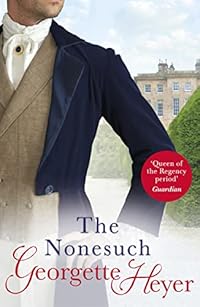
The Nonesuch by Georgette Heyer

Blood and Beauty cover

The Nonesuch by Georgette Heyer is one of her Regency romances – a bit of a romp, but perfect holiday reading. It was first published in 1962 and this one has a lot of similarities with Jane Austen, more so than others of Heyer’s books I’ve read.

Sir Waldo Hawkridge is a wealthy, handsome and fashionable bachelor of thirty-five or six. In his younger days he was well known as a great athlete and he’s still held in high esteem by the younger males in society. In fact they are still emulating the somewhat crazy fashions that Hawkridge made popular years before, although he himself is dressing with much less fussiness in his old age. He was given the nickname of The Nonesuch meaning he was a paragon, nothing and no-one could better him.

In fact most people don’t realise quite what a paragon The Nonesuch is. Although he is wealthy he has an interest in orphans and the poor and when he inherits an estate from a miser of an uncle he decides to turn the house into another orphanage, but it’s all very secret as he doesn’t like to advertise his philanthropy.

Throw in three young male relatives and a bit of love interest, just when The Nonesuch thought he was past such things, it all adds up to an amusing and entertaining read.
Why Shoot a Butler? by Georgette Heyer

Why Shoot a Butler by Georgette Heyer was first published in 1933. As you would expect from such a title it’s one of her thrillers, rather than her more well known fare of historical romances, although in my experience she never could resist writing some romance into any book that she has written.

This is only her second thriller I believe and for me it’s main problem is that it’s about 100 pages too long for a 1930s thriller/murder mystery, which makes for a fair amount of tedium along the way.

Her amateur detective is a barrister called Frank Amberley. On his way to a weekend in the country he comes across a young woman standing by the roadside, next to a car. It’s foggy, but she doesn’t seem to have been in an accident, on closer examination there are bullet holes in the car windscreen.

So far so good because I much prefer a thriller to get going early on, but it doesn’t half slow down over the 312 pages. This one was written very early on in her writing career and I think she improved a lot later. There isn’t even so much of her trade mark witty repartee between the characters. I’m glad I read it though, I think I only have Envious Casca to read now – of her thrillers – it seems I have bucketloads of her Regency romances to read though. I think I’ll be choosier about reading them, and stick to those that are highly recommended by bloggers.

Penhallow by Georgette Heyer

Penhallow by Georgette Heyer was first published in 1942. I’ve read almost all of her crime novels and so far this is the one which I’ve liked least.

At one point I thought that it was a complete departure from contemporary crime to one of historic crime fiction, because the setting is really a 19th century one. It mentions at the beginning that the master of the Penhallow estate won’t have electricity in the house and so it’s all candles and oil lamps, servants and stables which gives it an ancient ambience. So it comes as a bit of a shock when a character gets into his car to go into town.

Penhallow, the master rules his estate and family with tyranny and there are almost 300 pages of showing how ghastly he is to everyone, making all the characters, family and servants alike into suspects when his inevitable murder takes place.

Call me old fashioned but I like my murder victims to be done to death quickly, preferrably before I even know who they are, so for me this one dragged along and there wasn’t an awful lot of witty repartee, which I’ve come to expect from Georgette Heyer.

I struggled on to the grim end, then wondered why I had bothered. I read recently in Martin Edward’s book The Golden Age of Murder that Georgette Heyer’s husband had plotted her crime books for her so possibly he didn’t do this one, there’s definitely something sadly lacking compared with the other ones I’ve read – despite it being about double the page count of the others.

The Foundling by Georgette Heyer

The Foundling by Georgette Heyer is quite different from the other romances which I’ve read by her. For one thing it isn’t really a romance as close to the beginning the young Duke of Sale is pushed into agreeing to marry an old childhood friend and cousin, Lady Harriet. The Duke was orphaned at a very young age and his guardian and uncle Lord Lionel has molly-coddled him all his life as he was a rather weak and sickly child.

Lord Lionel likes to be in control of everything and his over-bearing attitude makes Sale wish he wasn’t an aristocrat so when a relative gets into some woman trouble, Sale jumps at the chance to help out, leaving his aristocratic trappings behind and travelling as an ordinary chap.

He finds himself in all sorts of adventures and serious scrapes which he manages to extricate himself from and his experiences end up giving him the confidence which he needed to stand up for himself against all the relatives and staff who are so keen to control his life.

The character of Belinda, a young woman who has also run off from her former life makes for quite a lot of comedy as she agrees to go off with any man who says he will buy her a purple silk gown. It’s quite a task for the Duke to save her from her daftness.

It’s an enjoyable romp.

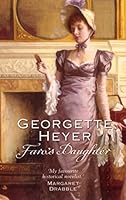
Faro’s Daughter by Georgette Heyer

Faro's Daughter cover

Faro’s Daughter by Georgette Heyer was published in 1941 but of course the setting is Regency England.

I must say that this book was so predictable that I knew exactly how the storyline was going to turn out from very early on, I think it was page 3. I’m not such a big fan of romances for that very reason.

Anyway, Max Ravenscar is a very rich bachelor, but he has no interest in getting married, unlike his much younger cousin Adrian, who is determined to marry an older woman who happens to be a hostess at a gaming house. Adrian’s mother recruits her nephew Max to save her son from such a disastrous marriage.

The predictability didn’t detract from my enjoyment though as it was a good romp through London’s society and I learned a lot about the sort of gambling which was going on there.

Apart from that I also found quite a lot of humour in the book with some snappy dialogue between Ravenscar and Miss Grantham, the gaming house doxy.

I read somewhere that Heyer just made a lot of the historical facts and words up, but I took the time to look up words which I didn’t know, even when it was obvious what they meant from the context, and they were all in my ancient dictionary. Heyer was very fond of Regency slang, it all adds to the ambience I suppose. Did you know that a Mohock was one of a class of aristocratic ruffians infesting London streets at night in the 18th century?

I’m not a morning person and I found that reading a couple of chapters of this book after my breakfast porridge and tea, and allowing it all to settle, is a good way of starting the day off. What a luxury it is not to have to dash around in the morning nowadays.

Behold, Here’s Poison by Georgette Heyer

Behold, Here’s Poison was first published in 1936 and it was just the second crime/mystery book which she wrote, she ended up writing a dozen of them. You can read more about Georgette Heyer’s vast output here.

As a vintage crime fan I enjoy these books more than her Regency romances although there are similarities in that all of her books are witty and she had a great knack of writing natural sounding and snappy dialogue.

I think possibly she hadn’t quite got into the swing of them in this early one. I did enjoy it, especially once I had got into it but at the beginning I did find it a wee bit less entertaining because although there were plenty of characters there was only really one who was close to being likeable.

This is a Superintendent Hannasyde mystery and it involves a large and argumentative extended family. When the head of the family is found dead at his large home, The Poplars, it’s assumed that he has died of natural causes, but of course – he didn’t and there’s speculation amongst the family about the will and who was most likely to gain from the death.

They are a ghastly bunch of people but at the same time amusing in their nastiness to each other and as always with Heyer there has to be some romance, it wasn’t as obvious as they usually are – which was a plus for me.

I think I only have a couple of her crime books to collect now, I’ll be sorry when I’ve read them all, I wish she had written as many mysteries as she did romances, but heigh-ho, such is life, and at last I’ve got around to beginning Alan Bradley’s Flavia de Luce series and I’m really enjoying the first one, but more about that later, luckily there are a fair few more for me to get my hands on too, I can’t wait!

Frederica by Georgette Heyer

Frederica Merriville is the eldest daughter in her family and has been thrust into a position of authority due to their mother’s early death. Frederica is only in her 20s but has absolutely no ambitions for herself, beyond looking after her younger siblings. She’s determined to get her beautiful young sister Charis married off successfully and with this in mind she takes her off to London to launch her into high society.

The Marquis of Alverstoke is their very distant cousin, he’s in his 30s and very much the man about town, wealthy and fashionable and has had more than a few affairs but has managed to dodge marriage.

To Alverstoke’s astonishment he finds himself being charmed by his young relatives, particularly the youngest Merriville boy, Felix who is obsessed with steam and the technological advances of the day.

The story is heavily littered with Georgian slang and has plenty of humour. It reminded me of an English upper class version of O.Douglas’ books, which almost always feature a managing but young mother figure of motherless children, and particularly a cheery and lovable lad aged about ten.

A comfort read.

Arabella by Georgette Heyer

I’ve only read a few of Georgette Heyer’s regency romances but so far I’ve enjoyed them all, although as a keen vintage crime reader it’s her detective books which are my favourites.

Arabella was first published in 1949 and the storyline is very similar in parts to Pride and Prejudice, but there are enough differences and twists to make it a successful read.

Arabella is the eldest daughter of a family of five daughters and three sons belonging to the Reverend Henry Tallant and his wife who live in a country parsonage. There’s great excitement when Arabella’s godmother, Lady Bridlington invites her to London for the season. As a wealthy woman she knows all the ‘right’ people and can take Arabella about Town and introduce her to them. It’s important that Arabella takes the chance to get a wealthy husband which would make it much more easy for her younger sisters to find good husbands, when their time comes. The Darcy equivalent is Robert Beaumaris who seems to be London’s Alpha male of his generation, with – dare I say it, more charm.

This is a really good read, packed full of Regency period atmosphere. I did read somewhere that Heyer made a lot of it up, then I read somewhere else that she researched the period meticulously, now I don’t know what to believe. She was very keen on having the bright young things of the day using all sorts of slang words, some of which I had heard of but bumtrap sounds to me like one which she just made up for a laugh, expecting it to be edited out – or maybe it was real slang. (I looked it up in my elderly dictionary and it isn’t in it but online I found it’s an old word for bailiff).

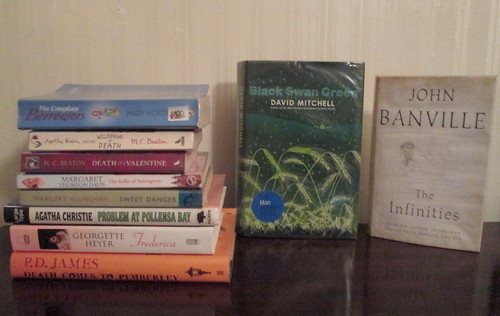
Library Sale Haul

books

Last Saturday my local library had another booksale. The last couple of sales I was really lucky to get some good history books but no such luck this time, in fact the selection of non-fiction was poor so I didn’t buy any.

I did end up buying plenty more fiction though, and honestly I need more books like a hole in the head but we can’t pass up a library booksale as we would be wondering what gems we had missed out on.

So my haul was:

Death Comes to Pemberley by P.D.James. I know that a lot of people have been disappointed with this book but I like P.D. James and I thought that at a cost of 50p I’d give it a go anyway.

Frederica by Georgette Heyer. I really prefer Heyer’s murder mysteries but I’m reading her regency romances too, although I already have about half a dozen unread ones in my pile.

Problem at Pollensa Bay by Agatha Christie. This is a collection of her short stories which I think will be interesting.

Sweet Danger by Margery Allingham. This is an Albert Campion book from 1933, my favourite crime fiction era.

Death of a Valentine by M.C.Beaton. I’ve just realised that this is a Hamish Macbeth murder mystery and I’ve only tried one of those and I gave up on it fairly early on, oh well, I might give it a go anyway.

Agatha Raisin and the Wellspring of Death by M.C.Beaton. Sometimes Agatha is exactly what I want to read, daft but somehow comforting.

The Kellys of Kelvingrove by Margaret Thomson Davis. I don’t think I’ve read anything by this author before, if I ever did it was way back in the mists of time. My mother was a fan of her books though, it was the title which caught my eye as the Kelvingrove/Glasgow Uni area of Glasgow is our old stamping ground and it’s also set in the 1970s which is exactly when we were there.

The Complete Borrowers by Mary Norton.
I bought this to give to a young friend of ours. I have a hardback copy but I loce children’s classics and I don’t want to part with my own copy, hope she likes this one too.

So those should keep me busy over the coming winter along with my ever growing pile, and I bought more today in Edinburgh, but I’ll tell you about them another time.

As ever, Jack bought far fewer books. He came away with: Black Swan Green by David Mitchell. and

The Infinities by John Banville. Looking at the blurb I might give these ones a go sometime too.

Duplicate Death by Georgette Heyer

Because we were away in the Lake District it took me much longer than usual to read this book. I usually like to read detective fiction in 3 or 4 big chunks over a couple of days, but this must have taken me about a week in dribs and drabs. Because of that I only gave it 3 on Goodreads but I suspect it would have been a 4 if I had been able to read it as normal.

First published in 1951 and set in London, two similar murders are committed in the same house just two days apart, as you would expect given the book title. The house belongs to Mrs Haddington, a ghastly social climbing sort of a woman with a spoiled little madam of a teenage daughter, named Cynthia.

There are several possibilities as to the culprit or culprits and Chief Inspector Hemingway and Inspector Grant have the job of investigating the crime. Grant is of course Scottish and as he has just come back from a holiday in Inverness his speech is more Scottish than it would be normally, in fact he speaks quite a lot of Gaelic phrases, thus proving that Heyer went to the trouble of learning more Gaelic than I have. But then I’m a Lowlander and I know nothing much beyond sgian dubh.

Anyway, it kept me guessing to the end which is always a plus and there is the usual witty dialogue which Heyer is so good at writing, especially between the love interest which she always has to have, even in her murder mysteries.