Moffat and no books

We stopped off at Moffat on our way down to the Lake District, it’s a pretty area and it has a second-hand bookshop. The author D.E. Stevenson lived there and is buried in the town. We parked the car in the High Street and within three seconds of getting out of the car we got into conversation with a local. This is something which would never happen in Fife – it taking a lang spoon and all that. Anyway, after the usual weather observations – well we are British – which included the info that we had come from Kirkcaldy, the chap said that he had been to Kirkcaldy once and it had been shut! Queue laughter!

However, I felt like tracking him down to tell him that Moffat was shut – as indeed it was! Apparently Wednesday is half day closing, but a lot of the shops hadn’t bothered opening up at all, including the bookshop. What a disappointment.
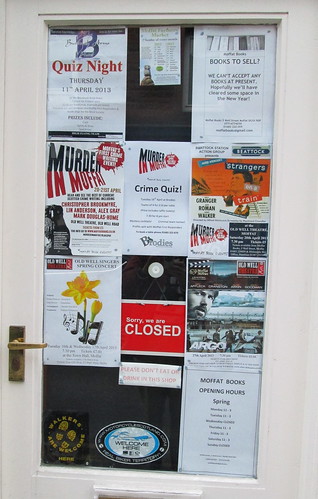
Moffat Book shop door

But as you can see from the notices on the door, there’s quite a lot going on in the wee town. Well they have a murder evening and a quiz night anyway.

In fact we should have taken this as a bad omen because there were hardly any bookshops in the Lake District, it would seem that hill-walking and outdoor pursuits don’t go hand in hand with reading books.

There was a big bookshop in Whitehaven, which is quite off the tourist beaten track but although there were loads of books I only found one which I wanted to buy, and it wasn’t one I even knew about, but it was a D.E. Stevenson as it happens, called The Musgroves. I think that it isn’t one of her amusing ones though, it looks like a slushy romance, but it may just be that it has a terrible cover.

Apart from a book for one of my sons which I bought at Grasmere, that was it bookwise. Absolutely pitiful as I usually come home with an armful of treasures. When we got home I did manage to buy an old copy of J.B. Priestley’s Faraway, which I found in Kirkcaldy High Street of all places. The wee tobacconist at the east end has loads of books at the back of the shop, it was a complete revelation to us as we thought that he only had the few which he has in the window.

I don’t know why I’m complaining because I have hundreds of books at home, waiting to be read and I’ve just picked up Raven Black by Ann Cleeves and Losing Ground by Catherine Aird. I’ve also requested a couple of books by Joyce Dennys – Henrietta’s War and Henrietta Sees It Through. I haven’t read anything by any of those authors before, they’re all blogger recommendations.

Meanwhile my reading rate has slowed right down, I’ve been reading Georgette Heyer’s Duplicate Death for about a week now, that’s what happens when you go away.

Detection Unlimited by Georgette Heyer

This book was first published in 1953 which is one of my favourite eras for vintage crime but I didn’t enjoy this one as much as I’ve enjoyed some of Heyer’s other crime novels. It was the last of her mysteries/thrillers to be published.

The setting is the up-market village of Thornden and it’s the sort place which has prominent inhabitants vying to be the most important people in the district. Nobody likes Sampson Warrenby, a newcomer who has only lived in the village for 15 years and has spent his time getting into positions of power in all the local clubs and committees.

When he is found dead at his desk the villagers aren’t exactly bereft, but it’s murder and Chief Inspector Hemingway has 10 suspects to work his way through. All the suspects spend their time pointing the finger of blame at each other and being otherwise disagreeable. Hemingway and his side-kick Harbottle are the best characters in the book and their banter with each other just managed to save it from being a book which I really didn’t care about at all, just because I didn’t like any of the villagers so would have been quite happy for any of them to have ‘swung’.

I have really enjoyed some of Heyer’s other crime novels but I think she was at her best when she had male and female characters which she gave a lot of snappy dialogue and humour, that wasn’t really a feature of this one.

I’m glad I read it though as I want to complete all of her mystery fiction, I think I only have two left to read now. On the other hand I’ve only read two or three of her Regency romances and I don’t know if I have the energy to plough my way through her long list.

The Unfinished Clue by Georgette Heyer

This book was first published in 1933 and for some reason seems much more like an Agatha Christie book than the others which I’ve read by Heyer. So if you’re a fan of Christie you’ll probably really enjoy this one. I didn’t dislike it but I was just a wee bit disappointed that there wasn’t much of the witty repartee in it which I’ve come to expect of Heyer. Maybe her humour was more a feature of the later books, it’s a shame really because as far as I’m concerned there’s always a place for a bit of fun, even when there’s been a murrrderr!

It’s a classic country house whodunnit, a favourite setting of mine and it’s a plus that I didn’t guess who the culprit was until very late on in it. Either my brain wasn’t in gear or it was more of a puzzle than the last P.D. James book which I read.

It wouldn’t be a Heyer without romance, she seemed to be incapable of leaving it out of any of her books. It’s daft how quickly it all happens though – certainly no problems with her men being incapable of commiting!

The blurb on the back of the book says:

‘Miss Heyer’s characters are an abiding delight to me… I have seldom met people to whom I have taken so violent a fancy from the word “Go”.’ DOROTHY SAYERS

I’m pleased that good old Dorothy was generous with her praise of another crime writer, it wasn’t always the case, especially with female crime writers. I believe Margery Allingham was a bit of a bitch where Sayers was concerned which must have been a bit awkward as they both lived just one train stop from each other and were often on the London train at the same time.

I do love vintage crime but feel that there are far more crime writers I should be giving a go. Any recommendations vintage or modern?

Library book sale

You know what it’s like when you look forward to something for ages, you can almost guarantee that you’re going to be disappointed. Well that’s how I felt when I got to the library sale at the Adam Smith Theatre last Saturday.

Mind you after having perused my haul again – I’ve got a bit of a cheek not being happy with it, it’s just that I didn’t get anything which I had really been looking for.

So this is my haul:

The Borley Rectory Incident by Terrance Dicks
Morning Tide by Neil M Gunn
Faro’s Daughter by Georgette Heyer
The Foundling by Georgette Heyer
The Nonsuch by Georgette Heyer
Arabella by Georgette Heyer
Middlemere by Judith Lennox
Flambards by K M Peyton
Right Royal Friend by Nigel Tranter
Gertrude and Claudius by John Updike
To the Lighthouse by Virginia Woolf

I must admit that I prefer Heyer’s detective stories to her romances but I’ll get around to these ones sometime.

Nigel Tranter is a Scottish writer who writes good historical fiction.

I can hardly believe that I’ve not read To the Lighthouse yet.

I enjoyed Updike’s Rabbit series so I thought I’d give this one a go although it seems to be very different being about the king and queen of Denmark before the action of Shakespeare’s Hamlet begins.

Neil Gunn is another Scottish author of the 1930s.

I had meant to borrow something by Judith Lennox for a while now but hadn’t got around to it.

Flambards was a bit of pure serendipity because I had seen the book somewhere on the internet just a few days before and I hadn’t even realised till then that it was a book. I really enjoyed the series of that name when it was on the TV years ago. This was in the childrens section and I left it until late on before picking it up in case a kiddywink should want it – but it was left there looking forlorn so I didn’t feel that I was depriving anyone of it.

The Borley Rectory Incident is another junior library book and it’s written by the chap who wrote a lot of the Doctor Who books. Gordon went through a phase of wanting those books as bedtime stories and I just want to know what this one is like compared with them.

Now that I look at them all carefully I don’t know what I was moaning about at the beginning of this post, I’m quite pleased with my haul. Now I just need the time to read them all.

Death in the Stocks by Georgette Heyer

Time for some more vintage crime, this book was first published in 1935. I think this is the third or fourth detective story by Georgette Heyer which I’ve read and the big mystery for me is – Why is she not better known for these books?

Whenever Heyer is mentioned it always seems to be her historical romance which is focused on but I think she is every bit as good as the more well known crime authors. I think maybe she should have used a different name for the two different genres – as Agatha Christie did.

In Death in the Stocks the wealthy Arnold Vereker is found dead with his feet in the stocks of an English village. He has been murdered and the knife is still sticking in his back. As Arnold wasn’t exactly popular amongst those who knew him there are a few people who would be happier with him dead.

It’s another case for Superintendent Hannasyde to sort out.

As always Georgette Heyer manages to get plenty of witty repartee into the dialogue and she can’t resist a wee bit of romance too. An enjoyable bedtime read.

South Bridge, Edinburgh, and Books

It’s been ages since I had a mooch around a bookshop because there wasn’t any point in doing it due to the fact that I’m not supposed to be buying books until I whittle away at my unread book piles. But today, despite the horrible rain we just felt the need to get out of the house for a while and as I have loads of books that I really want to track down I thought – Edinburgh, Perth or St Andrews?

There’s flooding around the Perth area so we thought it best to give that a miss and as the weather forecast said that the rain was going to clear up in the afternoon around the Edinburgh area – we plumped for capital punishment!

The forecast was wrong and it rained all day plus it was very windy so we were buffeted going over the Forth Road Bridge – not nice. We decided to go to the South Bridge area for a change instead of our usual Stockbridge haunts. It wasn’t very successful, we must have been in about 7 book shops and charity shops and my haul was:

Behold, Here’s Poison – Georgette Heyer.
Duplicate Death – Georgette Heyer.
The Empty House – Rosamunde Pilcher.
Can You Forgive Her? – Anthony Trollope.

and my husband bought :
Ordinary Thunderstorms – William Boyd.

I’d been looking for Can You Forgive Her? because I wanted to read The Palliser series, and I thought that I’d better buy the Heyers in case I don’t see them again for ages. I really like Heyer’s detective novels because they’re very witty too, quite an unusual combination I think, and I’m on a Rosamunde Pilcher kick at the moment, this one is very short at only 182 pages, very unusual for her.

I was looking for books by Angela Thirkell, D.E. Stevenson, Janet Sandison, E.M. Delafield, Jane Duncan – all very retro but I haven’t read them before and much to my amazement they are being read now, I have to see what I’ve been missing!

Now that I’ve tried the shops and been unsuccessful I can order some on-line with an unblemished conscience because I always like to give my custom to small bookshops when I can. Plus it’s nice to have a poke around lots of books but none of the Edinburgh shops are anything like as good or crazy as Voltaire and Rousseau in Glasgow. It looks like you couldn’t possibly find anything you want amongst the piles, but I always do. Must get back there again soon.

After parking the car we had to walk past this hairdresser’s to get to the bookshops today. This place intrigues me because it’s such a throw-back to the 50s. It looks like nothing has ever been changed since then and I’ve never seen it open. What sort of hairdresser is closed on a Saturday afternoon? I know that you always think of Edinburgh for history and Glasgow for style, but I think they’ve taken this a bit far here. Who would use a place like this?

For all I know it might be a fantastic resource for the ladies of Edinburgh of a certain type. Stout tweed skirts, Fair-Isle jumpers and Lisle stockings. Not forgetting the blue rinses.

Anyone for a shampoo and set?!

No Wind of Blame by Georgette Heyer

This book is a murder mystery and I must say that I prefer these ones to Heyer’s romances, but I’m not a huge fan of romances anyway. I didn’t read the blurb on the back of this book until I had finished it, and I’m thankful that I didn’t as it gives away part of the mystery. Why do they do that? The main detective in this book is Inspector Hemingway but as he doesn’t really have a huge personality I found that he didn’t contribute much to the flavour of the whole thing.

Heyer manages to combine murder mysteries and humour successfully which is a nice dimension to her books and I can’t think of any other crime novelist who attempts comedy. Well, I suppose Dorothy Sayers did but not to the same extent.

At 348 pages this is quite a thick book as vintage crime goes, and I had put off reading it for a while for this reason. But it was actually a really quick read and enjoyable. It was first published in 1939.

I wouldn’t call the first paragraph an interest grabber: “The Prince is coming by the one-forty-five. That means he’ll be here in time for tea. Well, I do call that nice.”

This is a classic country house mystery, usually a good start for any thriller. The house, called Palings, is owned by Mrs Ermyntrude Carter who had been a chorus girl in her day, and she has a husband who spends his time squandering his wife’s money and is a general liability. His cousin Mary is also part of the household.

The rest of the characters consist of the neighbours, the local doctor
and Vicky who is Mrs Carter’s daughter and fancies herself as a bit of an actress.

The crime doesn’t occur until about a third of the way through the book so part of the mystery is figuring out who the victim is going to be, as well as who is the culprit.

Georgette Heyer seems to be unable to write anything which doesn’t have a dollop of romance in it but it doesn’t descend into the gloopy, schmalzy sort.

Dorothy L. Sayers said Miss Heyer’s characters and dialogue are an abiding delight to me… I have seldom met people to whom I have taken so violent a fancy from the word “Go”.

One thing I must mention is that the only other Ermintrude that I have ever come across before is of course the cow in The Magic Roundabout. O.K. the spelling is different. But at the beginning I couldn’t help thinking of Ermintrude the cow whenever the character of Ermyntrude Carter was speaking.

If you want a reminder of that iconic BBC programme for children of all ages, have a look here.

A Blunt Instrument by Georgette Heyer

This is the second murder mystery by Heyer which I have read and I must say that I found it to be entertaining reading. It was first published in 1938. She managed to combine mystery and comedy and she just couldn’t resist the temptation to throw in some romance too.

Ernest Fletcher is murdered whilst sitting at his desk and as there had been a lot of coming and going of visitors via the low window that evening within a short time of each other, Superintendent Hannasyde has trouble with the very tight timing involved in the case.

As with the other Heyer mystery which I have read, Footsteps in the Dark, I guessed the culprit early on in the book, but it didn’t detract from my enjoyment. In fact I quite enjoy getting it right.

It’s definitely what I would call light reading, but sometimes that is just what you need.

I read this book as part of the Thriller & Suspense Reading Challenge 2010.

Library Book Sale

There was another mad withdrawn library book sale at the Adam Smith Theatre today. Surely they will have to re-think the book buying policy soon. There are so many cuts going on in other council departments, especially education. Anyway, I shouldn’t really complain as I bought another 5 fiction books plus a pasta cookery book.

I’ve only read 2 of the books that I bought in last month’s sale though, so the TBR pile is growing at an alarming rate.

This month, I couldn’t say no to:

Not the End of the World – Kate Atkinson
The Shipping News – Annie Proulx
Life Class – Pat Barker
April Lady – Georgette Heyer
The Popular Girl – F. Scott Fitzgerald.

No doubt I’ll get around to reading them at some point. At the moment I’m reading Vanity Fair, it’s a very old copy from the second-hand book shop. Unfortunately I didn’t realise how long it is when I started it. It dawned on me as I was turning the pages that they are nearly bible thin and there are 883 pages of them.

I could be some time.

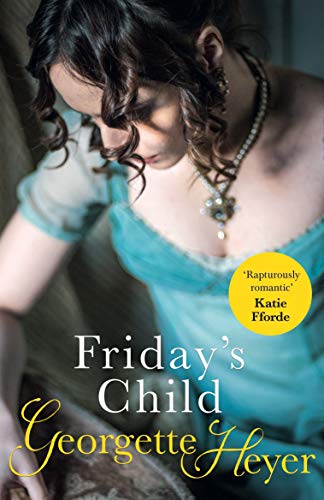
Friday’s Child by Georgette Heyer

Friday's Child cover

This is the first Regency romance of Heyer’s that I have read, the only book of hers that I have previously read is the detective book Footsteps in the Dark.

I’m not a great fan of romances, that’s probably something to do with being married for about as long as I can remember. But I was encouraged to start reading one after seeing the reviews on the Classics Circuit.

The main characters in Friday’s Child are Lord Sheringham (Sherry) and Hero Wantage (Kitten) who decide to get married. Sheringham has just proposed to the beautiful Isabella and been ‘knocked back’ and quickly marries the very young Hero, mainly so that he can get his hands on his money which is being held in trust until he is 25 or married.

The book is about the scrapes that Kitten gets herself into because she isn’t ‘up to snuff’ as they say. She is too innocent and naive. Although Sherry had expected to be able to continue with his bachelor life-style unimpeded by his wife, he soon finds that keeping her out of trouble is a full time job.

About a third of the way through this book I suddenly heard a very strange sound, I got quite a fright until I realised that it was just a big sigh from me. I was finding the book a tad tedious and I did wonder about giving in on it, but I thought of my granny who was a big Heyer fan, and ploughed on.

Half-way through, I really started to enjoy it. I think you have to be in a frivolous, frothy frame of mind for this book. It is a very light romp through the Regency period.

Some people have complained that she uses too much period slang. Well she certainly does throw it all in but I didn’t find it to be a problem as it is always obvious from the context what is meant by it.

I’m hoping to read one of her more history heavy books next.