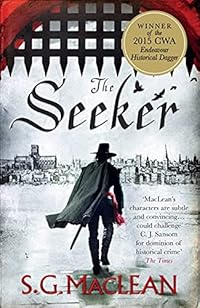
The Seeker by S.G. MacLean

The Seeker by S.G. MacLean was published in 2015 and it’s the first in her series which is set in Oliver Cromwell’s England.

The setting is London 1654 and there are spies everywhere, especially in the coffee houses that have become popular. Damian Seeker is an Intelligence Officer in Oliver Cromwell’s government and everyone is terrified of him. If you’re arrested by Seeker, it’ll probably be the end for you, his men are brutal.

It’s the sixth year of the English Commonwealth and Oliver Cromwell is king in all but name. He’s just not quite brave or mad enough to have himself crowned and all of the hopes for a more equal society have come to nothing. The Royalists haven’t given up their hopes of reinstating the monarchy and Cromwell lives under the threat of assassination.

But it’s one of Cromwell’s captains who is murdered. John Winter had been a popular officer in the New Model Army, and a young lawyer is found standing over his still bleeding body and holding a knife. It seems obvious that the lawyer is guilty, but The Seeker isn’t convinced, and he is honest enough not to want just anyone as the culprit, it must be the guilty person who pays the price.

Slavery comes into this book with Londoners being grabbed off the streets, sold off and transported to plantations in Barbados. Even children were abducted. The poet John Milton makes an appearance as a spy for Cromwell, something that I certainly didn’t know about, but apparently he was.

This was a good murder mystery with plenty of atmosphere and I think there’s also a lot of history which isn’t often written about. Oliver Cromwell isn’t a popular figure, even among Republicans. It’s quite surprising that the Commonwealth of England lasted as long as it did – just over ten years in total – because just about everything was banned, including Christmas, theatres, bright clothing and make-up. Such a dismal existence was bound to get people down. After Cromwell’s death his son only lasted nine months in power, then Charles II was invited back from his exile and the monarchy was restored.

However, I’m sure there’s still a lot to be written about in this series, so I hope to be reading the next one The Black Friar – soonish.

Hue and Cry by Shirley McKay

Hue and Cry cover

Hue and Cry by Shirley McKay is the first book in the author’s Hew Cullan series. It’s a murder mystery with a 16th century Scottish setting.

It begins in St Andrews in 1579. The town’s cathedral has long been wrecked by the religious reformers and many of the town’s newer buildings have been built using the robbed stone from it.

Hew Cullan has just returned home after studying law in Paris, he’s keen to catch up with some of his old friends before travelling on to his father’s house. But he gets caught up in a search for a young boy who has disappeared from his father’s shop. It’s thought that his father has probably beaten the young lad for some mistake he had made, but things take an ominous turn when his body is found.

Hew’s old friend Nicholas had been tutoring the victim as the father was hoping to get his son into the university, and suspicion falls on Nicholas. There’s been gossip about Nicholas and as we know, mud sticks, especially in the atmosphere of strict Scottish Presbyterianism. Hew has been shocked by the corruption at the university and also within the law courts, with nobody seeming to care if the actual culprit has been found, or just a handy fall-guy.

This makes it all sound quite grim but there’s a lot more to it of course. Hew is a great character, as is his sister Meg and there’s even some humour with Hew buying a ‘characterful’ horse. The very young King James VI makes an appearance and given the date and location witches are mentioned.

I was however perplexed by mention of ‘a bishop’ on page 257 as the religious upheaval of the Scottish Reformation was to get rid of bishops – which they did.

Otherwise this was a very enjoyable read, enhanced for me because all of the locations are very familiar to me. I think that it would have been a good idea to have a map of St Andrews and environs, as Hew does a lot of stravaiging around the streets and it would have been useful for people who don’t know the area I’m sure.

I’m really looking forward to reading the next book in the series, it’s called Fate & Fortune.

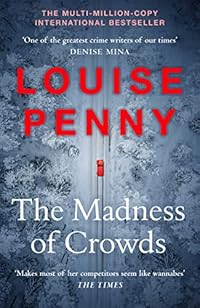
The Madness of Crowds by Louise Penny

The Madness of Crowds by Louise Penny was published in 2021 and the Covid pandemic does feature in the book although it’s assumed that it’s all over and done with as there is a vaccine – if only that were the case – it’s still around in 2023 and people are still dying, with variants able to dodge the vaccines.

Anyway, I was happy when I realised that in this book the Quebec village of Three Pines is the setting. I’ve read all of these books apart from the most recent one and it just about always seems to be winter in Three Pines. I suppose that all adds to the cosiness of the Bistro with all of those sugary pastries and hot chocolate – mention of which always makes me feel slightly icky!

To the book: Chief Inspector Armand Gamache has been given the job of organising the crowd control at a lecture which is being given by a controversial speaker. Gamache is keen for the lecture to be cancelled as its subject of euthanasia is so objectionable and divisive. The speaker believes that killing off anyone who is a drain on society is the only way of getting the country’s economics back on an even keel post Covid, and worryingly some people in the government seem to be taking the idea seriously. It’s all very close to the hearts of the Gamache/Beauvoir families, given that a supposedly imperfect baby is the latest addition to the families, and of course with Penny’s late husband having had dementia of some sort it’s something that presumably she would have been completely against.

As you would expect murder ensues! It’s a good read with moral and psychological questions as usual.

More Work for the Undertaker by Margery Allingham

More Work for the Undertaker by Margery Allingham was first published in 1949 and it’s an Albert Campion mystery. I find that Campion books can be hit or miss, unfortunately this was a miss. It was so confusing, or maybe I just shouldn’t have had it as bedtime reading.

Anyway, I’m just going to copy the blurb on the back of the book, something that I’ve never done before, and it’ll give you an idea of the story.

Albert Campion finds himself entangled in an unseemly imbroglio at the eccentric Palinode household, where there have been two suspicious deaths. And if poisoning were not enough, there are also anonymous letters, sudden violence and a vanishing coffin.

There was very little of Lugg in this one and really nothing of Amanda. I’ve always thought that Campion’s character was very much improved after his marraige to Amanda, but she just appears in a letter at the end of this one.

Oh well, onwards and upwards, I’m now reading The Corner That Held Them by Sylvia Townsend Warner, and I’m enjoying that one so far.

The Chestnut Man by Soren Sveistrup

The Chestnut Man by Soren Sveistrup was first published in 2019 and it was translated from Danish by Caroline Waight. I think it’s the first Scandi Noir book that I’ve read and I borrowed it from the library so that I could take part in a Scandi meme which involved reading five books, I already have books at home by Finnish and Icelandic authors and I thought this would spur me on to read more over 2023, then I realised that the project was just for January! Oh well, I’ll be doing my own wee Scandi reading project over this year anyway.

The setting is Copenhagen where the body of a young woman has been found, minus one hand. It seems that the killer has left his calling card in the shape of a little ‘man’ made from chestnuts and matchsticks. More of them turn up at crime scenes and it’s obvious that there’s a serial killer around. It seems that the killer might be somehow linked to the disappearance of the young daughter of a politician the previous year, her body had never been found, but the police think they have solved the case, did they get the wrong man?

Naia Thulin has been assigned to the case and she has been given a new partner. Mark Hess has just been thrown out of Europol for some mysterious reason, and nobody is impressed with him, as far as they’re concerned he’s damaged goods.

I’m not sure if ‘enjoy’ is the correct word to use in relation to this reading experience. I like the plot and some of the characters, but it was just a wee bit too gruesome for me, – but then that was no real surprise, having watched The Killing on TV, and that was written by this author.

Death Goes on Skis by Nancy Spain

Death Goes on Skis by Nancy Spain was first published in 1949 but it was reprinted by Virago Modern Classics in 2020. This edition has an introduction by Sandi Toksvig.

The story begins at a railway station in Calais where people are waiting to board the Winter Sports Express. The train is travelling to the fictional country of Schizo-Frenia, and that silly (Thirkellish) name lets you know that this murder mystery is very much on the frivolous side, despite the murders.

Sisters Kathleen and Toddy Flaherte are amongst the tourists, they’re very wealthy having inherited a famous perfumery business. Also among the hotel guests are a famous actress, a supposedly Russian ballerina, a nightclub owner and various other odd bods.

If you are looking for a classic whodunnit then you might find this one disappointing, however if you just want a bit of light entertainment then this one just might hit the spot, I quite enjoyed it but I didn’t really think much of any of the characters, and that’s always difficult for me.

It was interesting that one of the tourists had stocked up with stockings and chocolate to take home to ‘Blighty’. Obviously those supposed luxuries were just about unobtainable in 1949 Britain which was stil very much in ration mode, but strangely they were easily obtained in mainland Europe. As ever our politicians were punishing the ordinary people just for existing – nothing changes!

Nancy Spain was apparently a very well-known, journalist and broadcaster in her day, and like one of the female characters in this book she wore ‘mannish’ clothes as a way of ‘making a wee statement’ although her sexuality was not spoken of, as it wasn’t in those days. Obviously this is why Sandi Toksvig was chosen to write the introduction. Sadly Nancy Spain was killed in an aeroplane crash on her way to see the Grand National (horserace) in 1964.

Have His Carcase by Dorothy L. Sayers

Have His Carcase by Dorothy L. Sayers was first published in 1932 and it was a re-read for me. I first read it when I lived in Essex and worked in a building which overlooked what had been the author’s home in Witham. My copy of the book is a lovely Folio edition.

Harriet Vane has just been on trial for murder and had been pronounced not guilty. All the publicity has done wonders for her writing career and money is no problem for her. She has travelled to the south-west of England for a holiday, planning to get lots of writing done while there. But while she’s on a coastal walk she discovers a dead man, it looks like he has committed suicide, but maybe it has just been made to look like a suicide and is really a murder. With Harriet finding the body and even getting blood on her the local police are a bit suspicious of her, but Lord Peter Wimsey arrives to help out, and constantly proposes marriage to Harriet of course.

Eventually the body is discovered to be that of a male dancer/host at the hotel where Harriet is staying. He was of Russian descent and he seems to have been a bit of a dreamer, thinking that he was related to Russian royalty. Was it murder or suicide? He had just been 20 years old, but had been going to marry a wealthy middle-aged widow in a few weeks, he had been her favourite dance partner at the hotel.

Things look a bit dicey for Harriet – again, but Lord Peter helps with the investigations.

I think I enjoyed this one a lot more the first time I read it. This time around I was annoyed by the minutiae of the evidence, secret codes and timetables are involved. I suspect that the author wrote those into the tale to prove that women could do that sort of thing as well as male crime writers. In fact at one point Harriet says:
‘You men have let yourselves be carried away by all these figures and timetables and you’ve lost sight of what you’re really dealing with’

Well, she proved she could write that sort of plot, but for me it’s just as tedious whether written by a male or a female. Thankfully that part of the story didn’t last too long.

It must be about 30 years since I last read her Gaudy Night which I loved, I wonder if I would love that one as much nowadays. Sadly I can’t read my old Gollancz copy of it as the ghost in my old house got it. I was in the attic where I had books shelved right under the eaves and when I spotted Gaudy Night I threw it up to the doorway so I didn’t have to crawl out with it in my hand, it’s quite a thick book. A few minutes later as I was crawling out I expected just to pick it up at the doorway but it was nowhere to be found, and as the attic was all lined and even carpeted it can’t have slipped down anywhere. Several years later as we packed up the whole house to move out I expected to find it but still no luck. Now that IS a mystery which will never be solved!

Sheiks and Adders by Michael Innes – 20 Books of Summer 2022

Sheiks and Adders cover

Sheiks and Adders by the Scottish author Michael Innes was first published in 1982, by Gollancz. Whenever I see those yellow Gollancz covers nowadays I’m just about grinding my teeth, since I read about how badly Victor Gollancz treated his editor Diana Athill, paying her paltry wages for years. Anyway, to the book.

Sir John Appleby has retired from Scotland Yard, and he’s very happy to be out of it, but when he visits a summer charity fete which happens to be a fancy dress do, he gets involved in a murder. Appleby is dressed as Robin Hood and he’s amused to bump into his replacement at Scotland Yard, as he’s also dressed as Robin Hood! It seems that the fete is being held in the grounds of a house which belongs to a businessman who has recently moved there, and Scotland Yard has had a tip-off that there’s going to be trouble.

A wealthy Arab sheik is going to be attending, is his life going to be in danger? To add to the difficulties lots of men have decided to dress up as Arabs, it’s impossible to figure out who is the real sheik. One thing that Appleby knows for sure – for some reason the owner of the house had forbidden his daughter’s boyfriend to come dressed as an Arab!

This was quite an amusing read. Michael Innes was also an academic and he liked to make sure that his readers knew that, so there are a lot of literary allusions as usual, I know that some people find that annoying, I just find it quite funny!

Swing, Brother, Swing by Ngaio Marsh

Swing, Brother, Swing by Ngaio Marsh was first published in 1949. It’s an Inspector Alleyn mystery.

Lord Pastern is a well-known member of the English aristocracy, notorious for his outrageous behaviour, which all seems to be aimed at embarrassing his long-suffering wife. He lurches from one obsession to the next and in this tale it’s jazz that has grabbed his attention. He fancies himself as a jazz drummer and is part of a band called Breezy Bellairs and his Boys.

The band members seem to have been chosen for their eccentricities, they all like to make a big noise but the music isn’t enough for them. They plan to put on a bit of a show with a gun firing blanks being
used as part of the entertainment, of course, nothing goes to plan.

One of ‘the boys’ is Carlos Rivera and he has his eyes on Felicite de Suze, Lord Pastern’s step-daughter. She’s quite keen on him, but it’s not going to go down well with the family. Rivera is obviously not the sort that they expect to marry into the family.

This was an enjoyable read which kept me guessing.

In a Lonely Place by Dorothy B. Hughes

In a Lonely Place by Dorothy B. Hughes was first published in 1947 but as you can see it has been reprinted by Penguin. From the cover the book was obviously made into a film, starring Humphrey Bogart and Gloria Grahame. If I ever saw it it must have been back in the year dot.

Dix Steele had been in the American Air Force during World War 2, he was based in England but civilian life is difficult for him, he has serious mental problems, can’t stand any sort of noise and has been living off the hand-outs from a wealthy uncle. But now he has moved to Los Angeles and is staying in the apartment of Mel Terriss an old wartime acquaintance. Dix is supposedly writing a book and Terriss has moved to Rio for a while, leaving Dix with the use of everything of his, including his car and clothes!

Unknown to Dix another old wartime friend is living in the neighbourhood and when he bumps into Brub Nicolais Dix is surprised to discover that he is a detective. Brub is under quite a lot of stress as it seems there’s a serial killer operating in the area!

I really liked this one, particularly as the plot took a few unexpected turns – for me anyway.

I imagined all of the characters as being quite a bit younger than the people who were cast in the film. Much as I love Bogart he wouldn’t have been my choice to play Dix, he would have been too old, but that was common in Hollywood at that time, the male actors seemed to have much longer careers than the women and so were given parts that they were about 15 years too old for – or maybe the guys just looked older in those days!