St Andrew’s Day in Scotland

I’ve always thought of it as quite a healthy thing that people in Scotland really don’t do anything to celebrate St Andrew’s Day. I can understand that if you are a Scot but you aren’t lucky enough to be living in Scotland then you would want to do something to mark the day. Scots always become much more Scottish when they aren’t in Scotland, have a look here if you want to see some news about up and coming events and Scottish music, recipes, pipers, Alex Salmond and the like.

The year 2014 is apparently a Homecoming year, when people of Scottish descent are encouraged to visit Scotland, this is a fairly new concept I think there has just been one previous Homecoming year. I find it a wee bit strange as I think people should be encouraged to visit Scotland any time.

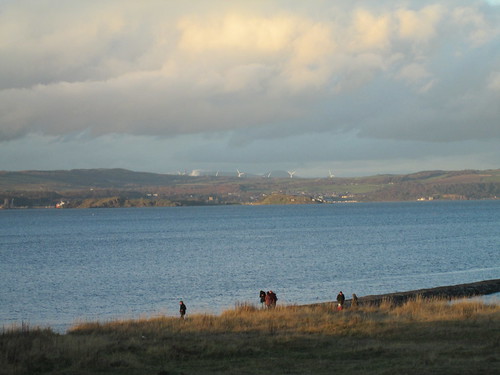
Anyway, it was a quiet day in Kirkcaldy, no doubt there were ceilidhs in Dubai!

A Tree Trunk at Studley Royal, Yorkshire

I love stone walls and stone in general and trees too, so when I saw this tree growing through a wall in the grounds of Studley Royal/Fountains Abbey in Yorkshire I just had to snap it for posterity.

a tree root

I ‘collect’ organic textures with the intention of converting them into some sort of textile at some point in the future. Embroidery, needlepoint, collage or maybe I’ll just try my hand at drawing it. It’s the first thing like this which I’m putting on to my organic textures Pinterest board but I have lots more to add when I get around to it. Maybe other people will find it interesting too.

I’m impressed by the tree’s determination to survive in a hostile atmosphere, and its problems have just made it more beautiful. I should have turned the camera up and snapped the actual tree – but I didn’t, silly me!

Screwtop Thompson by Magnus Mills

I wasn’t supposed to be looking at the books in the library as I have so many of my own to read, I was just taking some back, but you know what it’s like, I saw an interesting looking book by an author that I know a lot of bloggers had been reading – and I was caught. Well it’s a slim volume of short stories and I like those, they’re especially good at bedtime.

Even better I thought as I read on the front page

‘Like P.G. Wodehouse, Mills has created his own deeply English world, rich in comic possibilities’ Independent

Like all adverts there’s always one word which is the operative one and in that case it’s ‘possibilities’ – but they never materialised.
I read the first four of the stories and gave up, that’s almost unheard of for me, but they were annoying me too much. I complained to Jack that the stories didn’t do anything, say anything, no twists, no humour, no entertainment, just words which ended abruptly and left you with nothing to mull over.

Ah! That’s modern short stories for you. Have you not read A.L. Kennedy’s? Hers are the same – said Jack.

Dear God said Moi – what’s the world coming to, where are the W.Somerset Maugham, D.du Maurier, Saki, Wodehouse, Diana Athill, E.F.Benson, Katherine Mansfield or Sarah Orne Jewetts of today?

I’ve always admired short story writing, it seems to me that a lot of skill is required to tell an interesting story with engaging characters concisely and have a surprise or two towards the end. Is it a dead art? Are all modern short story tellers pointless? I hope not.

As my friend Joan would say ‘What fresh hell is this?’

I just say ‘Modern life is rubbish!’

The Making of a Marchioness by Frances Hodgson Burnett

This is Persephone Book no 29 and as I recall I bought it from a charity bookshop in St Andrews more than a year ago but I read recently on a blog (which one?) that it was a great read so I got down to reading it at last.

Frances Hodgson Burnett is of course well known to us through her books The Little Princess and The Secret Garden but this is the first of her books for adults which I’ve read and I really did enjoy it.

Emily Fox-Seton has the knack of finding good in everyone, her character is so sweet and good that she should really be a bit of a sickener but amazingly she isn’t. She’s not a fool or a prig but has great common sense and is stoical about her situation. She is a 34 year old woman of good breeding but without money and she has to earn her living by being a bit of a dogsbody for ladies who will pay her to help them, securing good cooks for them or tracking down bargains at sales, anything which will enable her to keep life and soul together.

At 34 she’s deemed to be not only on the shelf but positively dusty and she seems never to have any hopes in that direction for herself, but as this book is a bit of a fairy tale for adults, and given the title of the book it’s obvious that things are going to take that turn for her. Like all good fairy tales though, there is a dark period of danger around the middle of the book. Will it all fall apart for Emily? Well what do you think!

If you want to read this book you can download it from Project Gutenberg it’s under the name of Emily Fox-Seton there.

There are lots of Frances Hodgson Burnett books to choose from, have a look here.

Cragside, Northumberland – again

I just managed to get this photo of the kitchen at Cragside with nobody in it, there must have been 40 people milling about the place, and there’s certainly plenty to see in the way of Victorian gadgets jelly moulds and copper. As you can see there are two kitchen ranges to deal with all the entertaining that they had to cope with, not to mention all the servants who would have been getting fed there too.

a Cragside house kitchen

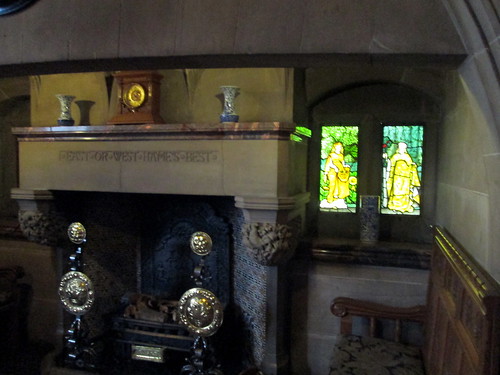
I can’t remember what this room was called but I would call it the living-room, the inscription above the fireplace is EAST OR WEST HAME’S BEST – which is fair enough I suppose. The fire is in a lovely comfy alcove with stained glass panels either side of it, as you can see, all very Arts and Crafts design.

Cragside stained glass 2

And here is the other side of it, there are wooden settees either side of the fireplace too and I imagine that the place would have been full of dogs when the house was a home.

Cragside glass

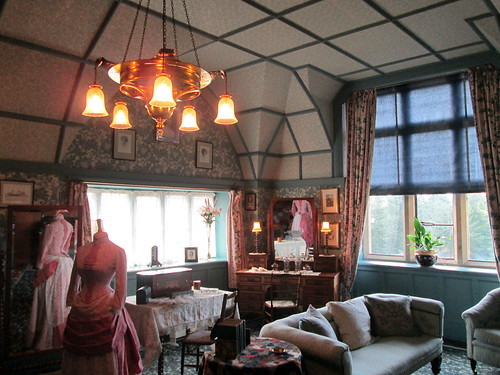
Another bedroom, this time with some of the clothes which would have been worn in the house’s Victorian heyday. On the table there were bits and pieces of sewing, just as if the original owner had left the room for a short time and was going to be coming back and taking it up where she left off.

Cragside interior bedroom 3

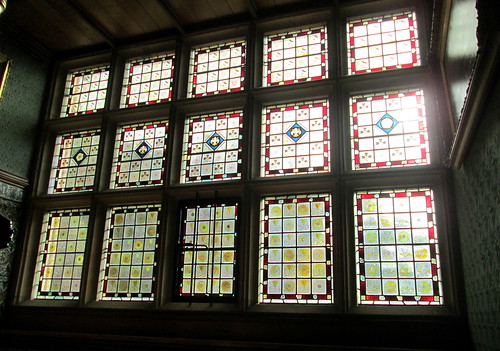
Yet more stained glass, this time it was situated on a wide landing.
You can just see the very Victorian heavily embossed wallpaper, the bottom of the walls are covered with tiles.

Cragside interior glass 3

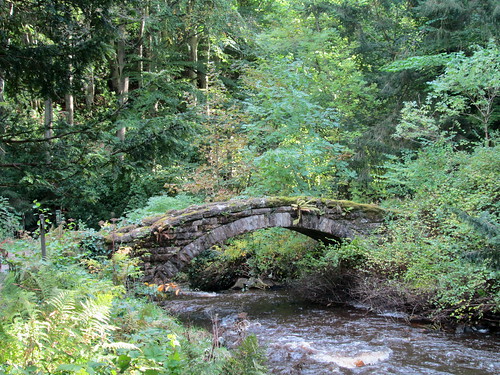
And just as a wee taster, here’s a bit of the beautiful gardens, the burn running through it is quite a torrent and I can see why Armstrong decided to harness all that energy and use it to light the house. You can read about Lord Armstrong here.
Cragside gardens 6 + old bridge

Cragside, Northumberland

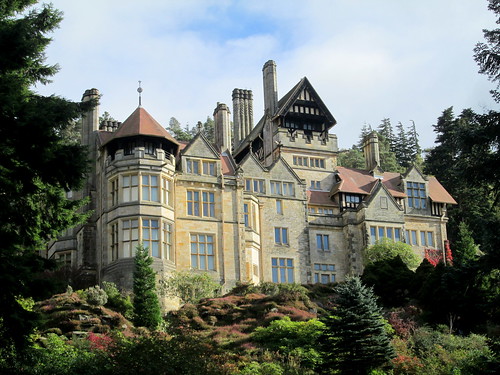
On our way back up to Scotland, after our short break in Yorkshire a few weeks ago, we stopped off at Cragside in Northumberland, another National Trust property. It was the first house in the world to be lit by hydroelectricity. Thanks again to Margaret @ Booksplease for pointing us in its direction. We were lucky with the weather, although it had been raining most of the week which meant it was a bit muddy underfoot in the gardens. We got a great day for viewing it all, it’s a very popular destination so it was fairly crowded in parts but most people stayed close to the house. I think it’s best described as quirky, I’m glad I don’t have to worry about all those roof angles but the inside is full of Arts and Crafts details.

Cragside house from gardens

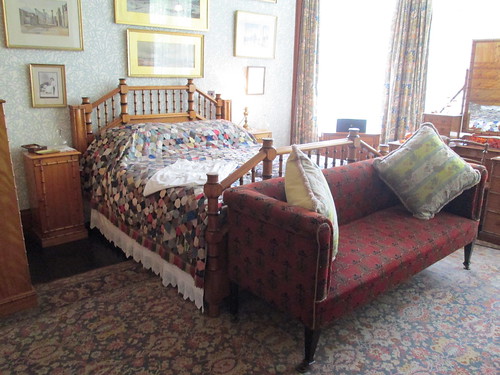
It’s a very homely place though, despite being huge, as it’s Victorian, the furniture isn’t too precious, lots of us own bits and pieces of Victorian furniture and knick knacks, so most of it doesn’t seem grand, especially the bedrooms. I’d love to own a patchwork quilt like this though.

A bedroom in Cragside.

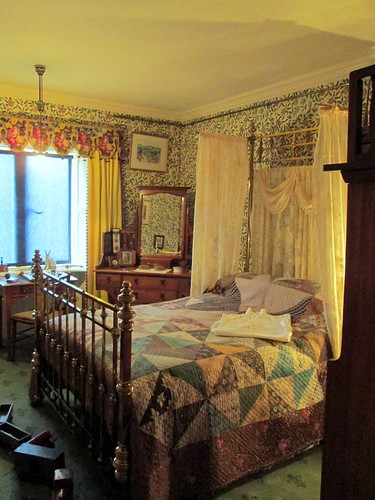
I love this quilt too, as you can see, this room has William Morris wallpaper, one of his brighter designs, they can be a bit dark sometimes. I have absolutely no idea what the boxes on the floor at the bottom of the bed are, I don’t even recall seeing them!

Cragside interior bedroom 1

I took lots of photos of the interior as it was such a nice change to be able to, for some reason the National Trust for Scotland still don’t allow photos inside. So I’ll probably show more of Cragside again soon, it’s a real delight for anyone interested in Arts and Crafts design.

Cramond again

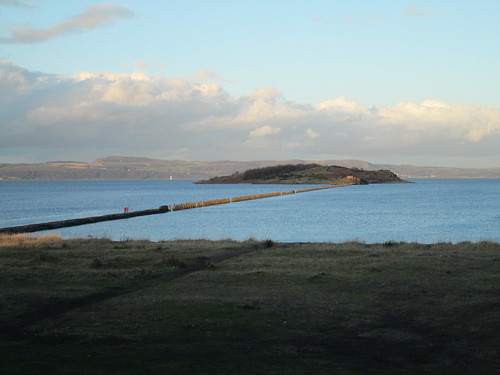
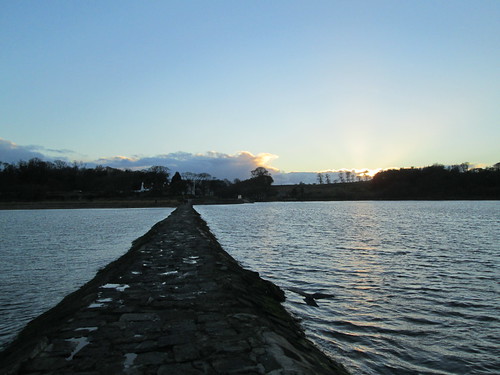
For some reason I couldn’t add these two photos onto my Flickr yesterday, but could today so, this one is of Cramond Island, just off the village of Cramond. There’s a causeway which leads out to it and if the tide is right you can get down onto the shore and walk out to the island, making sure that the tide isn’t going to change whilst you are there as it would be quite embarrassing to have to be rescued by a life boat crew. The hills you can see on the other side of the river are in the county of Fife, where I live, and it looks quite scenic from this location.

Cramond Island

We walked out right to the end of the causeway and I turned and took this photo of Cramond village but most of it is obscured by the trees. The tide was in so the Forth was lapping all around the causeway, we’ve never actually got here at the right time so more planning is required as I would love to get on to the island sometime.

As you can see last Saturday was a blue sky day but after we had gone for a walk along the shore for about half a mile it started to chuck it down with rain and the wind was painfully cold. I don’t think we’ve had many days this year when it hasn’t rained.

The Causeway, Cramond

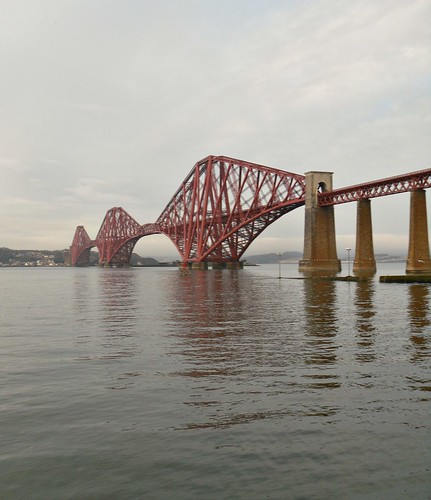
I think all of the islands were inhabited by soldiers manning gun emplacements during both world wars as this area was obviously a target for the Germans. The naval base of Rosyth is nearby as is the iconic Forth Bridge which was attacked by enemy aircraft as it would have been a great propaganda coup for them to destroy it. Of course they didn’t succeed and it’s still doing a good job of carrying trains over the River Forth every five minutes or so – I kid you not, it’s amazingly busy, I can’t think where they’re all going.

Here it is again, not visible from Cramond, this is one of the photos I took from South Queensferry a while ago.

The Forth Bridge

Cramond village, near Edinburgh

Last Saturday we stopped off at Cramond after spending the afternoon at Ingliston Antiques Fair, near Edinburgh. Cramond is a wee coastal village near Edinburgh and we pass it on the way home to Fife. It was a favourite destination when our boys were wee.

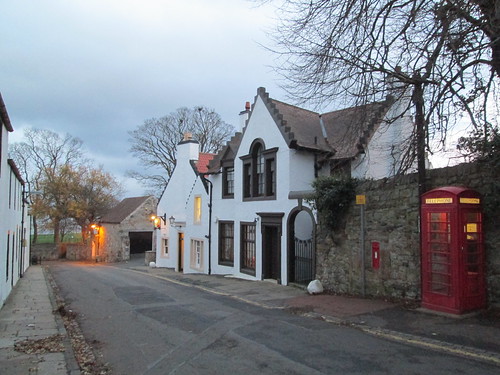
A street in Cramond, Scotland.

The photo above is of the hotel at Cramond, the village is almost a suburb of Edinburgh now but at one time it was apparently popular with Edinburghers looking for a weekend getaway from the city, of the ‘dirty weekend’ variety. I haven’t read Muriel Spark’s Prime of Miss Jean Brodie, mainly because I’ve seen so many different dramatised versions of it, but I remember distinctly the actor Gordon Jackson in the 1969 film trying to persuade Jean (Maggie Smith) to go away with him for the weekend to Cramond – so naughty!

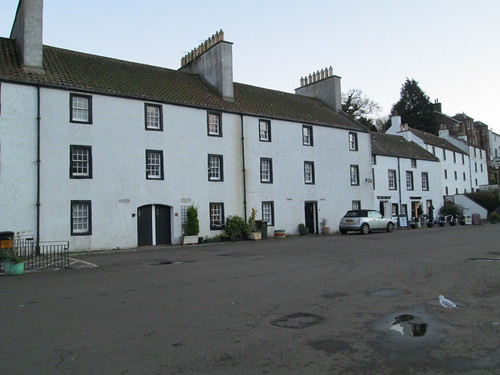
Cramond, near Edinburgh

Most of the buildings have been whitewashed, as is traditional with coastal houses. These buildings are actually by the harbour just where the River Almond flows into the Firth of Forth. Cramond is thought to have been first inhabited in 8500 BC which makes it the oldest settlement in Scotland. The Romans settled there around about the year 142 but only stayed for 15 years or so, after which they retreated back to Hadrian’s Wall.

The Firth of Forth

The photo above was taken from Cramond, looking over the Firth of Forth to Fife, the village of Aberdour is more or less in the middle of the photo but most of it is obscured by an island, the bigger island is called Inchcolm and we had a great afternoon out there last year, if you want a closer look at it take a peek here.

You can clearly see some wind turbines which have been popping up in quite a few locations. They’re controversial but I quite like them although I don’t suppose I would want one on my doorstep. That well known pain in the neck Donald Trump has been trumpeting on about them just today on the news as there are plans for some turbines to be built in the sea near his golf course north of Aberdeen. Apparently he hates them and thinks they will kill tourism in Scotland, and he would have built his golf course in Ireland if he had thought that his view was going to be blighted by turbines. If only we had known then and we could have waved him cheerio as he departed in high dudgeon for Ireland, and the people in Aberdeen wouldn’t have to put up with yet another golf course!

Journey Into Fear by Eric Ambler

I had forgotten about Eric Ambler despite the fact that he was one of the authors that my Dad enjoyed reading, along with the likes of Alistair MacLean and Dennis Wheatley. But yet again I was in the kitchen, making soup I think, and listening to Radio 4 extra when a dramatised episode of one of Ambler’s books came on and jogged my memory. So when I was at the library recently Journey Into Fear jumped out at me from the edge of one of those book carousel thingys, it was obviously time to give him a go.

It’s a Penguin Modern Classic which was first published in 1940 and as always with these books I avoid the introduction until I’ve finished the book because they always give crucial details of the storyline, right to the very end, which I would rather find out for myself as I read the book – why do they do that? It’s SO ANNOYING!

It’s World War 2 and Mr Graham is an engineer and an arms expert and because of his quiet and amiable personality he has become useful to his employers as a negotiator of contracts abroad. He has just been having high-level talks with the Turkish government in Istanbul and it’s time for him to make the journey back to England.

Unfortunately someone has a different idea and is determined to kill him before he can leave Istanbul. How can Graham get back home in one piece?

I did enjoy this one and I’ll read more of his books. If you like reading John Buchan then you’ll probably like this too, it’s quite similar in style. In fact the introduction, which I read after I’d finished the book does mention that Ambler is a sort of combination of Buchan and Ian Fleming, but I’ve never read anything by Ian Fleming, other than Chitty Chitty Bang Bang.

It was made into a film in 1943, which you can read about here. In the film Mr Graham’s nationality is changed from English to American, as often happened in films.

Pear and Ginger Pudding

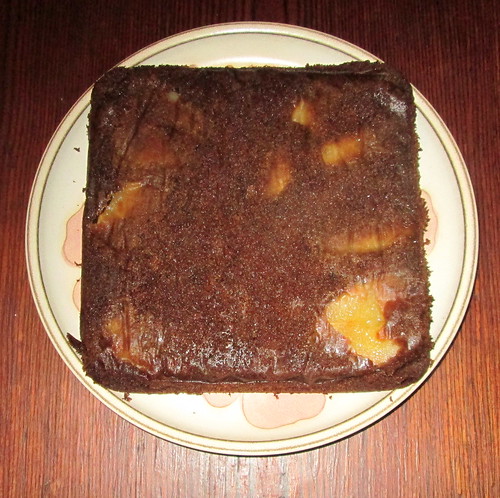
The supermarkets have plenty of nice pears at the moment so I thought I’d try this recipe.
Pear and Ginger Pudding

As you can see from my photo, I must have been having a wee bit of a senior moment when I took it because the pudding is upside-down on the plate, I did peel the greaseproof paper off the bottom of it, although it looks as if it’s still on. I know what was going through my head when I did it, I was thinking it was the upside-down pear pudding I sometimes do, but that is really quite different. I’ll be doing this one again as it went down very well with some cream, but as usual Jack thinks it would be even nicer with custard!

You need:

5 small pears, peeled, halved and cored
100g or 4 oz butter, plus extra for greasing
100g or 4 oz light brown muscovado sugar
100g or 4 oz black treacle
125ml or half a cup of whole milk
140g or just under 6 oz plain flour
1 level teaspoon ground ginger
a few shakes of cinnamon
1 level teaspoon bicarbonate of soda
1 medium egg, beaten

1. Heat your oven to gas mark 2 or 150 C (130 C fan assisted oven)
Grease an 18cm square cake tin (I think mine is actually a bit bigger)Line the base with baking parchment or greaseproof paper.
Arrange the pears cut side down in the bottom.

2. Melt the butter,treacle and sugar gently on a low heat until the sugar has dissolved. Stir in the milk and leave to cool a little.

3. Sift together the flour, spices and bicarbonate of soda. Beat it into the melted butter mixture along with the beaten egg, I just used a hand balloon whisk to do this.

4. Spread the mixture evenly into the prepared cake tin, giving it a bit of a ‘dunt’ on the worktop to make sure there are no air pockets.

5. Bake for about 1 hour, using the usual skewer method to make sure the centre is cooked through. If it isn’t cooked but the top is browning too much then cover the top with some baking parchment or foil to prevent burning.

Eat!

There is a metric/imperial measurements site here.