The Foundling by Georgette Heyer

The Foundling by Georgette Heyer is quite different from the other romances which I’ve read by her. For one thing it isn’t really a romance as close to the beginning the young Duke of Sale is pushed into agreeing to marry an old childhood friend and cousin, Lady Harriet. The Duke was orphaned at a very young age and his guardian and uncle Lord Lionel has molly-coddled him all his life as he was a rather weak and sickly child.

Lord Lionel likes to be in control of everything and his over-bearing attitude makes Sale wish he wasn’t an aristocrat so when a relative gets into some woman trouble, Sale jumps at the chance to help out, leaving his aristocratic trappings behind and travelling as an ordinary chap.

He finds himself in all sorts of adventures and serious scrapes which he manages to extricate himself from and his experiences end up giving him the confidence which he needed to stand up for himself against all the relatives and staff who are so keen to control his life.

The character of Belinda, a young woman who has also run off from her former life makes for quite a lot of comedy as she agrees to go off with any man who says he will buy her a purple silk gown. It’s quite a task for the Duke to save her from her daftness.

It’s an enjoyable romp.

Winter Pansies

Winter Pansies

Above is a photo of the winter pansies and ivy which I planted before Christmas, in the hope of having some cheery colour in the garden during the winter.

But it wasn’t to be, the pansies hardly flowered at all until we got a wee bit of heat and quite a lot of sunshine recently. This always happens with me and winter pansies, they seem to be a misnomer in my neck of the woods anyway, perhaps our winters are too cold and dark.

What is more annoying though is the state of the jute liner of the wrought iron basket which has been nicked by blackbirds as nesting material. I’ve been looking at other people’s jute basket liners and they seem to be intact. I must just have particularly badly behaved birds in my garden.

The Heat of the Day by Elizabeth Bowen

If you read my recent review of Elizabeth Bowen‘s book The Little Girls you’ll be surprised that I decided to read another of her books. It was a shock to me, in fact when I logged on to My Library Account I was aghast to see that I had requested this book. That’s what happens when you look at blogs late at night and it’s just too easy to click and request books which other bloggers have enjoyed. Luckily I did like this book as much as the other blogger did, sadly I can’t remember which blog it was, do let me know if it was you!

Anyway The Heat of the Day which was first published in 1948 did turn out to be a far better read than The Little Girls, in fact it seems that it was Elizabeth Bowen’s most successful book, I imagine that’s because of the subject matter. The book is based mainly in London during World War 2 which is where Bowen herself was based at the time and she seems to capture the atmosphere of the place perfectly as you would expect from someone who lived through the bombing.

The main character, Stella is a middle aged woman who is having a relationship with Robert who is a few years younger than her. She works for the government. Robert was wounded at Dunkirk, and it seems to have had a psychological effect on him. Depending on his mood his limp can be bad or almost completely unnoticeable.

Stella is divorced and has a son Roderick in the army, his father died soon after the divorce and eventually Roderick inherits an estate in Ireland on the death of a cousin. Ireland was a neutral country and it wasn’t possible for him to travel there as he was in the army. Stella travels there to see to his business affairs, back to the place where she had spent her honeymoon. It’s suffering from the same deprivation as Britain with candles and even matches being in short supply.

Harrison is also working for the government, he’s a counter spy and he’s haunting Stella whom he has fancied from afar for years. He tells her that Robert is suspected of being a spy.

Nothing is as it seems in this book as you would expect from a spy story. Looking at Bowen’s own life it’s easy to see that she used a lot of her own experiences to write it, with a character who suffers from mental infirmity (supposedly) and she herself inherited an estate in Ireland.

This book is regarded as one of the best portrayals of London during the bombing raids of World War 2, when people lived for the moment, never knowing if they were going to wake up in the morning or not.

The book was adapted for TV in 1989.

McNulty the cat

McNulty + cushion

I’m not in any hurry to become a granny, as some women often are, which is just as well because McNulty the cat which belongs to my youngest son and his partner is as close as we get to having a grandchild!

I’m not really a cat person myself and McNulty isn’t really a people person, he won’t sit on your lap, you have to feel honoured if he sits beside you on a sofa.

Anyway, when the large cat cushion appeared on his sofa McNulty had a staring contest with it, that’s one he was never going to win, but at some point McN decided that that cat was no threat to him and he’s now quite happy to sit beside the cushion.

We have no idea what McN had been up to while we went out to visit a garden centre, but he came back with very muddy paws and was absolutely shattered. He didn’t even get up to see us out as he normally does, in a very gentlemanly way. Mind you I think he is just making sure that we do indeed leave the premises and he doesn’t have to put up with those interlopers any more!

Cockburnspath Parish Church, Scottish Borders

Cockburnspath Parish Church 1

We went to visit friends in the wee historic village of Cockburnspath in the Scottish Borders recently and from their house I could see the round tower of this church, so I had to go and investigate. In fact this whole area is steeped in history. King James IV gave the land around this area to his wife Margaret Tudor (sister of Henry VIII) to celebrate their marriage in 1503.

There are a few of these really old gravestones with a skull on them, they are usually from the 16th century. The one below also has tools carved onto the stone, hammers and chisels and pincers. I wonder if he was a stonemason and if he carved his own stone!

a skull gravestone

I noticed that there was a sign on the church gate saying that there were war graves in the graveyard. There are four I think with a few other gravestones mentioning men who had died in wars but hadn’t been buried there. Most people chose to leave their loved ones where they had originally been buried, with all their comrades, but obviously some chose to have their bodies returned home. Although as you can see from this gravestone he was from Australia but must have been originally from Cockburnspath. I like the fact that the powers that be allowd their loved ones to add a personal message at the bottom of the stone. I suppose it was the least they could do though, given the sacrifice. He was a pilot in the RAF and died in 1941 aged 21, he must have been one of ‘the few’.

war grave

It might seem odd but I love mooching around old graveyards and this one is particularly interesting. This church which dates back to the 1500s is also called St Helen’s Church, presumably the change of name to Cockburnspath Parish Church came about after the Reformation.
It would originally have been a Catholic church I think.

Cockburnspath Parish Church

You can see more images of Cockburnspath here.

Linlithgow Palace, West Lothian, Scotland. Part 2

Linlithgow Palace is of course the birthplace of Mary Queen of Scots.

from Linlithgow Palace

Above is a photo of Linlithgow Loch from the top of the palace, not a bad view to look out on.

Linlithgow Palace

It’s a long way down and it was very windy, you need a good head for heights!

Linlithgow Palace

Huge fireplaces abound in the palace, I dread to think how much wood and coal they must have got through.
Linlithgow Palace

Linlithgow Palace

The fireplace above is the grandest in the palace, I think it is in the great hall.

Linlithgow Palace

The photo above is of a small room at the top of the palace, it has a stone seat wrapped around it and with the addition of some cushions it would be a great place to sit and read or just gossip. Probably that would be the best place to go for some privacy, away from the prying eyes and flapping ears of servants. That would have been my favourite place to sit if I had been around in those days, but I don’t think I would have had a chance to sit there, I would probably have been one of those servants!

Anthony Trollope – from the Guardian

To mark the 200th anniversary of Anthony Trollope’s birth the Guardian Review has asked some writers to select their favourite of his works. If you’re interested you can read the article here.

I’ve already read a lot of the books mentioned as favourites but I haven’t read Orley Farm so I think I’ll be choosing that one for my next Trollope read.

Faro’s Daughter by Georgette Heyer

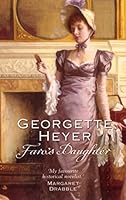
Faro's Daughter cover

Faro’s Daughter by Georgette Heyer was published in 1941 but of course the setting is Regency England.

I must say that this book was so predictable that I knew exactly how the storyline was going to turn out from very early on, I think it was page 3. I’m not such a big fan of romances for that very reason.

Anyway, Max Ravenscar is a very rich bachelor, but he has no interest in getting married, unlike his much younger cousin Adrian, who is determined to marry an older woman who happens to be a hostess at a gaming house. Adrian’s mother recruits her nephew Max to save her son from such a disastrous marriage.

The predictability didn’t detract from my enjoyment though as it was a good romp through London’s society and I learned a lot about the sort of gambling which was going on there.

Apart from that I also found quite a lot of humour in the book with some snappy dialogue between Ravenscar and Miss Grantham, the gaming house doxy.

I read somewhere that Heyer just made a lot of the historical facts and words up, but I took the time to look up words which I didn’t know, even when it was obvious what they meant from the context, and they were all in my ancient dictionary. Heyer was very fond of Regency slang, it all adds to the ambience I suppose. Did you know that a Mohock was one of a class of aristocratic ruffians infesting London streets at night in the 18th century?

I’m not a morning person and I found that reading a couple of chapters of this book after my breakfast porridge and tea, and allowing it all to settle, is a good way of starting the day off. What a luxury it is not to have to dash around in the morning nowadays.

Linlithgow Palace, West Lothian, Scotland

One day last week we grabbed the best day according to the weather forecast and travelled to Linlithgow in West Lothian to visit Linlithgow Palace, which is where Mary Stuart – Queen of Scots was born, in 1542. Most of the town was burnt down by the English in 1424 and rebuilding started the next year which I suppose is when some parts of the palace date back to. It’s quite strange to be standing reading a notice which says that the doorway to your right was blocked up around the year 1500. The building and refurbishment would have continued all the time that the palace was occupied I suppose, people always seem to have wanted to change the places they lived in.

Linlithgow Palace
The view below is of the loch at the other side of the palace. I think it’s fair to say that this palace was well appointed. There were people in small rowing boats enjoying themselves on the loch, I imagine that that was a favourite pastime in the palace’s heyday too.

from Linlithgow Palace

It’s really just a shell but it’s a very grand shell and well worth a visit, we were given Historic Scotland memberships at Christmas so we didn’t have to pay to get in but if you aren’t a member then it costs £5.50 which I think is a bargain, compared with charges for some other tourist attractions.

Linlithgow Palace

Linlithgow Palace

Sadly the fountain in the courtyard is under wraps at the moment as it undergoes refurbishment but you can see photos of it here. Through the window above you can just see the white wraps encasing the fountain.

We had been to the palace before but it was way back when we had young children so we weren’t able to traipse all over the place as there are a lot of stone spiral staircases which aren’t really small child friendly.

Linlithgow Palace

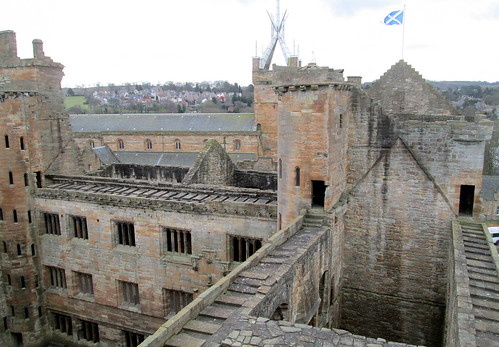
Nearly at the top.

Linlithgow Palace

Got there, but it was windy so we didn’t hang around up there too long. I’ll show you more photos soon.

Linlithgow Palace

You can see more images of Linlithgow Palace here.