The Peacock Spring by Rumer Godden

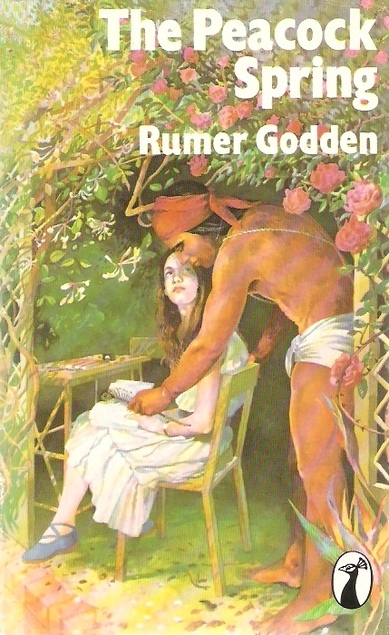
The Peacock Spring cover

The Peacock Spring by Rumer Godden was first published in 1975 and the setting is mainly post independence India, but it begins in England where 14 year old Una and her 12 year old sister Halcyon are at boarding school as their father is based in India, he’s a diplomat and has custody of the girls after his divorce from Hal’s mother. Una is good at mathematics and is hoping to be able to go to Oxford to study maths there, eventually. So she’s dismayed when her headmistress calls her in to her office and tells her that her father has decided to take them out of school and they are to continue their education in India, with the help of a governess. Halcyon is thrilled by the prospect though, the sisters are opposites in character and Hal lives for pretty things and socialising, she’s a very precocious 12 year old.

As soon as they get to India Una realises that Alix the so-called governess, can’t teach them anything as she knows nothing of maths at all. She is however a very pretty Eurasian, half Indian and half European and as such is despised by the Indians and the British. Except for the girls’ father, who is obviously besotted by her and doesn’t see how manipulative, greedy and bad tempered Alix is.

I’ve always admired Godden’s writing and I really liked this book, although I’m sure it’s aimed at teenage girls as a warning as to what can happen if you get too involved with the opposite sex. Suffice to say that Una discovers that she is quite similar to her father in some ways.

It’s about prejudice, snobbery and class systems with a bit of Indian politics thrown into it and of course as Rumer Godden grew up in India, I’m sure she captured the atmosphere of the place as it was back then.

Beneath the Abbey Wall by A.D. Scott

Beneath the Abbey Wall by A.D. Scott is the third in this murder mystery series which is set in Inverness in the 1950s.

Again we’re back at the offices of a local newspaper – The Highland Gazette. Mrs Smart is a mainstay of the organisation and when she is found dead – murdered – the whole place is thrown into confusion. Mrs Smart more or less ran the place, without them really realising it.

Joanne Ross, one of the reporters, is now separated from her abusive husband, it’s a big step for a mother to have thrown her husband out, in a community where women are supposed just to put up with things.

The police are pretty useless and it’s left up to the newspaper staff to investigate Mrs Smart’s murder. During their probing all sorts of secrets come out, in fact nothing is as it seems, not even Joanne who seems so strong and sensible, it now looks like she is going to make the same mistake she did before. There’s no doubt that her brains turn to mush at the sight of a handsome man, no matter how he behaves towards her.

I enjoyed this mystery and the setting. There are quite a few likeable characters, I had an idea who the culprit was but these books are about more than the crime. They’re about how women were viewed in 1950s Scotland and how attitudes began to change, slowly. I’m looking forward to the next book and finding out what happens with McAllister and Joanne.

Although A.D. Scott doesn’t live in Scotland now she is very definitely a Scot and I read this one for the Read Scotland 2016 Challenge.

Scottish Book Trust

If you’re at all interested in Scottish books you might find these links from the Scottish Book Trust interesting.
27 Scottish novels to look forward to in 2016 as well as:
Why fairy tales aren’t just for children.
21 book-to-film adaptations coming soon.
Don’t be shy, give sci-fi a try.
Down with reading resolutions.
Robert Burns is for life, not just for Burns Night

You might know that Fife Council planned to close 16 libraries in April but we have now discovered that they can’t actually just make that decision. Apparently they have to take it to a ‘scrutiny committee’ (I know – who knew?! – not them obviously). So the upshot is that the libraries have been given a reprieve, I think for a year. But it looks like this will just be a delay of the closures, although we live in hope of the library at Glenwood remaining open permanently.

Foodie Friday – Tomato and Bean Soup

tomato and bean soup

I’ve blogged about this soup recipe before, it is based on a Greek recipe and it’s a favourite with my family. I almost always have a pot of soup on the go in fact last summer was so miserable that I was even making soup in July! Anyway, this is one that I throw together fast and cook up in my pressure cooker. I’ve taken to leaving out the celery as neither of us are very keen on it and it means that I’m left with a load of celery which is unlikely to be used now that we are empty nesters.

1 mugful of dried haricot beans soaked overnight
3 tomatoes, quartered or about 12 cherry tomatoes
2 onions
4 carrots
3 sticks of celery (optional)
2 200g tins of chopped tomatoes
2 tsp dried oregano
1 tbsp tomato puree
chopped parsley and thyme (to your taste)

Roughly chop the onions carrots and celery and whizz up in a blender with water. You will have to do this a few times to deal with it all. Reserve some of the carrot and celery just roughly chopped if you like chunky bits in your soup as we do. Add all of this to a large pan with the haricot beans and tins of tomatoes. Then. add the tomato puree, dried oregano and chopped parsley and thyme. Lastly, add the quartered tomatoes and more water. I use my pressure cooker for this recipe as then you don’t have to bother about soaking the beans first, just cook at pressure for about 20 minutes. I add enough water to make about 12 bowls of soup. If you don’t have a pressure cooker then just boil it all up for about 1 hour. Season to taste. Try it, you’ll love it. If you can’t be bothered with the dried beans, try using ordinary tinned beans at the end. Obviously you will only have to boil the soup until the vegetables are cooked. I’ve never tried it with tinned beans but I think it will work fine. The photo above is from an older post, you can see the celery in it as I was still putting it in back then.

The Ladies of Grace Adieu by Susanna Clarke

 The Ladies of Grace Adieu cover

The Ladies of Grace Adieu and other stories by Susanna Clarke has been in my bedroom for years, waiting for me to pick it up and start reading it. I know I mentioned it on ‘pining’ yonks ago and Michelle from In the Silver Room wondered what I would think of it as she had read the book. But I have no idea what Michelle thought of it, Jack read it before I did, it’s more his sort of thing really – a bit weird. But as it happens he wasn’t a big fan either. It’s fantasy – which he isn’t as keen on as compared to Science Fiction.

If you watched Jonathan Strange and Mr Norrell on the TV recently you’ll get an idea of what this book is like. The blurb on the back from the Spectator says “These tales read as if Jane Austen had rewritten the Brothers Grimm…. wonderful”

Each to their own but for me these stories don’t really have anything particularly magical about them. I like fairy tales, they’re usually about warnings of how to stay safe and avoid the bad guys, but I obviously prefer things to be more traditional with proper fairies including wands and wishes, the ones in these stories don’t really seem to be much different from the humans. However, it’s about a week since I finished reading the book and I have to say that none of it has stuck in my mind, so I think it’s fair to say that it just wasn’t for me, but it might be just the thing for you – you never know!

Have you read anything by Susanna Clarke, if so what did you think of it and has the story stayed with you?

Edinburgh and the Turner Watercolour Exhibition

Well, yesterday was Burns Supper day and I was so busy at a Burns Supper which was hosted by Duncan and his lady Alex – that I didn’t manage to do a Robert Burns blogpost, nor did I take any photos, we were too busy eating haggis pakora for our starter – a fusion of Scottish and Indian food which is very popular nowadays. Then the traditional haggis, turnips and potatoes (haggis, neeps and tatties) and cranachan for dessert. Lovely!

At the end of last week we were in Edinburgh visiting the lovely Turner watercolour exhibition which is only on in January at the National Gallery, it was quite busy. You can read about it here. It is of course a free exhibition but it’ll only be on until the end of January.

You can see a lot of Turner watercolour images here. You really have to get up close to them to see the details.

I have to say though that the gallery’s cafe has gone right downhill from what it used to be. I was seduced by a piece of coffee and walnut gateau, I love those flavours, but so often with these things it looked a lot better than it tasted. Admittedly it was thick with buttercream and I’m not the biggest fan of the stuff, too cloying for my taste really, but this lot somehow managed to seem oily too.

It came on a paper plate!! I really object to that and also the only type of fork available was a wooden one which had a very woody smell, so I had to make sure I wasn’t breathing in as I put the fork up to my mouth. When I moaned to Duncan about it later he thought that it was supposed to be an improvement on using plastic cutlery as the wood biodegrades. That’s true I suppose but why they have to have disposable plates and cutlery is beyond me, it’s not as if the cafe is cheap. The name is Victor and Carina Contini which I’m told has some sort of Valvona and Crolla connection.

Worse than all that though was that we noticed that there were drips of coffee down the outside of Jack’s mug, the mug was actually ceramic, not paper, but it seems that they aren’t washing the mugs properly. Why didn’t we complain? We should have, especially as I would hate to think that foreign tourists might think that is normal service in Scotland. Mind you the people working in the cafe were foreign, presumably from some country where washing mugs properly is a difficult skill to master.

Christmas Books

Christmas books

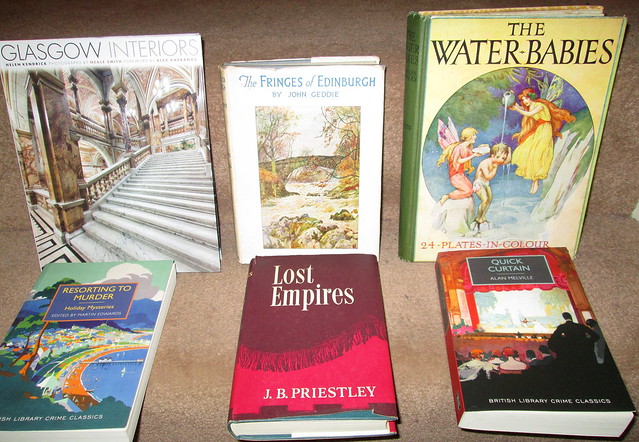
Above is a photograph of the books that I was lucky enough to get at Christmas.

Glasgow Interiors by Helen Kendrick is a book which I had actually just borrowed from the library and I had been thinking how nice it would be to actually own a copy of it, so I was thrilled when I got it as a present.

The Fringes of Edinburgh by John Geddie is an old travel guide from 1941, it has lots of drawings and painted illustrations in it. I suppose we are living on the fringes of Edinburgh but this book mentions lots of places I have never been to, I hope to go and visit some of them.

The Water Babies has 24 plates in colour by Harry G Theaker. I have a thing for lovely childrens books and illustrations so when I saw this in a secondhand bookshop not long before Christmas I asked Jack to get it for me and give it to me on the big day. I do believe in getting what you want and not leaving it up to luck! If you’re interested you can see some of the illustrations here. I think it was published around 1930.

Lost Empires by J.B. Priestley. I like Priestley’s writing but I haven’t read anything of his for ages, this one was first published in 1965.

The last two are from the British Library Crime Classics series – Quick Curtain by Alan Melville and Resorting to Murder which is a collection of short stories. I’ve already read Quick Curtain and enjoyed it, but I bought another couple of books in this series at the weekend – no, there’s no chance of me ever catching up with my TBR pile!

Of Mice and Men by John Steinbeck

Of Mice and Men by John Steinbeck is one of those books that I was pretty certain I had read as a youngster, but recently realised that I hadn’t, so I rectified it fast. In fact my copy of the book is in a volume of Steinbeck which contains this one and Cannery Row. I got Cannery Row in the Classics Club spin, so more on that one early next month.

Of Mice and Men is a quick read, just a novella really, it was first published in 1937 and the setting is close to Soledad and the Salinas River, California. It’s the American Depression and is based on Steinbeck’s own experiences of being a bindlestiff in the 1920s, a sort of itinerant farm worker.

George and Lennie are travelling towards their next job on a farm, they’ve had to leave their previous one due to a misunderstanding involving Lennie and a young woman. Lennie is a big man who has the mind of a small and simple child and it gets him into trouble, especially as he doesn’t have any idea of just how strong he is.

George is really Lennie’s carer, trying to stop him from getting into trouble, no easy task. Lennie loves to feel soft things, and he had a piece of velvet which someone had given him to stroke, but sadly he lost it. A teeny mouse was fulfilling his tactile needs, but due to having no idea of the fragility of a mouse and what his manhandling it will do to it, it isn’t long before the mouse is dead. Lennie just can’t understand it.

When they reach the farm where they have some work, they’re looked on suspiciously, it’s unusual for men like them to travel around in pairs, they’re usually loners, and it’s thought that George might be taking advantage of Lennie and taking his pay from him. It’s not true of course, although they both share a dream to own some land and a home of their own. They have it all planned out. They begin to get to know the other workers and Lennie is ecstatic when he is given a pup from a newly born litter on the farm – oh dearie me!

This is a sad tale, you know it’s just not going to have a happy ending and Lennie ends up suffering the same fate as an ancient farm dog.

Of course, Steinbeck took the title Of Mice and Men from the Robert Burns poem – To a Mouse

The best laid schemes o’ Mice an’ Men gang aft agley. The best laid schemes of mice and men go often awry/askew.

Foodie Friday – Oatmeal Biscuits

I like baking things with oatmeal in them because I can ‘kid on’ to myself that they are really quite healthy, but if you look at the amount of sweet stuff in the ingredients list you will realise that I am of course deluding myself. Och well, THEY do say that porridge oats bring your cholesterol down so these biscuits are maybe not too bad for you! Yes it does look like a cake, it’s a sort of inbetweeny texture, perfect if you don’t want anything too hard against your teeth!

oatcake biscuits

100g/ 4 oz of flour/ 1 cup (with plain flour add 1 level tsp of baking powder)
half a level teaspoon of salt
100g/ 4 oz/ 1.5 cups oatmeal or porridge oats
50g/ 2 oz/ a third of a cup of sugar
75g/ 3 oz black treacle (molasses)
100g/ 4 oz / 1 stick of butter or margarine
oatmeal to sprinkle on top

Put the flour, baking powder if used and salt together into a bowl. Stir in the oatmeal. Put the sugar, black treacle and butter or margarine into a saucepan and heat gently until just melted. Cool slightly and then add to the dry ingredients and mix well. Press the mixture into a round cake tin, I lined mine with greaseproof paper, but you could just grease the tin. Sprinkle the surface with some oatmeal. Bake in the centre of the oven at 350 F / 180 C or Gas Mark 4 for 20-25 minutes. Cool slightly, cut into wedges, then lift out carefully and complete cooling on a wire tray.

This is a recipe which you can play around with a lot, if you aren’t too keen on the flavour of black treacle then you could substitute golden syrup, which I think is called corn syrup in the US. You could also add some spices like ginger, cinnamon or nutmeg, or add some dried fruit. In future I don’t think I’ll bother to sprinkle the oatmeal on top. I also think that the next time I try this recipe I’ll leave out the 2 oz of sugar as although this is tasty I found it to be very sweet.

The easiest way to measure the treacle is of course to put the tin on your scales and take spoonfuls out of it until the weight has gone down by the required amount, 3 ounces in this case. You’re best to err on the side of underbaking I think as if you overbake it will be really hard, definitely best with custard poured over it to soften it! This batch is quite soft, almost cakey in texture, certainly not crunchy, which with my teeth is a bonus!

I had intended having a Foodie Friday last week and baked shortbread for the blogpost. I’ve made plenty of shortbread in my days, but I was given a new shortbread mould as a Christmas present, one of those pottery ones with a lovely thistle design on it, but the shortbread just refused to come out of it, despite the fact that I did as instructed and dusted it with icing/powdered sugar. Obviously I didn’t put enough sugar into it so I’ll have to have another go at that soon.

Jeeves in the Offing by P.G. Wodehouse and a Cathedral Courtship by Kate Douglas Wiggins

Just a couple of quickies: After the shocking news of David Bowie’s death which was swiftly followed by Alan Rickman’s, I was in need of something a bit cheery to read. Luckily I had got Jeeves in the Offing by Wodehouse from the library a few days before. It was published in 1960 and sometimes it’s titled – How Right You Are, Jeeves.

Bertie Wooster is amazed to read in The Times that he has become engaged to Roberta Wickham. She is a young lady with bright red hair whom he had previously had a dalliance with, but she was too much for him to handle. Jeeves had cautioned him: Miss Wickham lacks seriousness. She is volatile and frivolous. I would always hesitate to recommend as a life partner a young lady with quite such a vivid shade of red hair. (Jack might well agree with him on that!!) Bertie is perplexed, but worse than that – Jeeves is on holiday in Herne Bay, so Bertie is going to have to sort it out himself. This was the usual Wodehouse fare and went some way to lightening my mood, but not much.

When you were wee, did you read the Rebecca of Sunnybrook Farm books by Kate Douglas Wiggin? I certainly did, but more recently I’ve read her Penelope’s Experience books.

A Cathedral Courtship

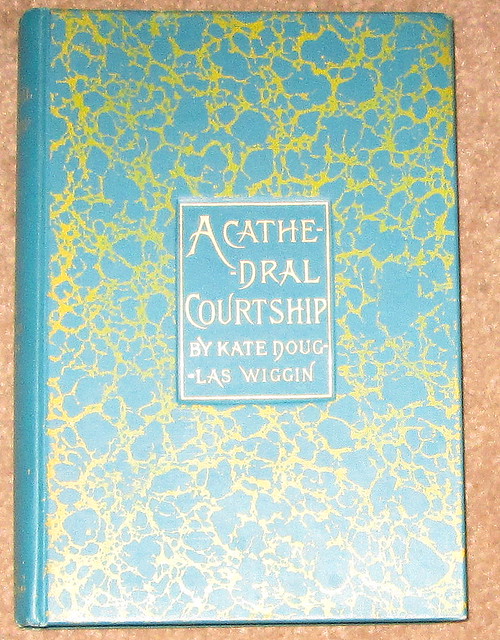
My edition of A Cathedral Courtship is from 1893 and it’s in astonishingly good condition, has very thick pages which are completely pristine, it looks like nobody has ever read it. Katharine Schuyler is a young American girl and she goes on a tour of English cathedral cities with her Aunt Celia. It’s quite entertaining and amusing, my copy also contains Penelope’s Experiences in England, an enjoyable read. You can obtain a lot of Kate Douglas Wiggin’s books from Project Gutenberg here if you’re interested.