The Bent Twig by Dorothy Canfield (Fisher)

The Bent Twig

The Bent Twig by Dorothy Canfield (Fisher) was first published in 1915. I had only read one book by her before this one and that was Home Fires in France about her experiences in France in World War 1, and The Bent Twig is very different from that. The setting is mainly La Chance, Vermont.

The Marshall family is an unusual one. The father is a college professor and the mother works the land in her large productive garden, they’re an unconventional lot, having no servants, being determined to do their own dirty work. But their home is a popular meeting place for all the more interesting teachers and professors, which is an advantage for the children although they don’t know it.

Sylvia Marshall is the eldest daughter, she has a younger sister Judith and a much younger brother Lawrence. The beginning of the book reminded me so much of Louisa M. Alcott’s books, maybe it was just because it’s about a US family and it’s now historical, but when this book was written it must have been quite revolutionary as Canfield makes it plain that she is dead against separate schools for black and white children. She’s not at all happy about the way that her friends are treated when it gets to be known that they have a teeny amount of black blood in them.

The Bent Twig is about the importance of education for young girls and also the redistribution of wealth, with one very wealthy character feeling seriously uncomfortable about all the money which is earned for him by coalminers.

I really enjoyed this book although I felt it palled a bit towards the end, it wasn’t quite as interesting after the girls had grown up. Canfield was obviously keen to point out what she saw as unhealthy aspects of Edwardian society as far as women were concerned. A time when for a certain section of society money was all and some people, men as well as women were marrying for money and status. What changes?!

Sylvia has always been drawn to clothes and high society but in her heart she knows there’s more to life, but can she pass up the chance to marry for money rather than for love? With that and the subjects of equality for women and people of a different ancestry/colour, The Bent Twig must have been quite a shock for some people when it was first published.

For me it was interesting to see that colleges in the US were way ahead when it came to female education as they were giving degrees to women at a time when women students in the UK were not awarded degrees, although they were allowed to sit the exams.

I read this one for the Classics Club Women’s Classic Literature Event 2016.
Guardian Review links

This week’s Guardian Review section has a few articles that you might find interesting.

The books interview features Liz Lochhead, she’s a Scottish poet, just in case you didn’t know. She says: ‘You’re stuck writing something until the point where you go. To hell with it, I’ll tell the truth’ You can read the article here.

If you’re interested in Oscar Wilde you might enjoy this article about a new book on Wilde’s Women: How Oscar Wilde Was Shaped by the Women He Knew.

If you’re into gardens and art you might like to read The green rooms.

And last but definitely not least from the Review The man who read the world is an article about David Bowie, the now late great, but I still can’t quite get my head around that. You can read the article here.

Obviously there has been a lot of stuff about Bowie in the Guardian this week, you can read some of it here.

My Grandmother Sends Her Regards and Apologises by Fredrik Backman

My Grandmother Sends Her Regards and Apologises by Fredrik Backman was published in 2015 and after reading and loving A Man Called Ove recently I just had to get this one from the library too. I gave Backman’s first book five stars on Goodreads – quite rare for me. I’ll be giving this one four I think because it was just a wee bit too crazy and fantastical, especially at the beginning – or maybe I just got used to it.

I did think that it was very different from A Man Called Ove but by the time I reached the end I realised that Backman was again writing a book which brought a lot of very disparate human beings together in one small neighbourhood.

Elsa is a seven year old whose parents are divorced but they both have different partners now and her mother is expecting Halfie, her half sibling. It’s a time of stress for Elsa as she’s sure that she is going to take second place to Halfie and to make matters worse she is a bit of an outcast at school, she just doesn’t fit in and nobody likes her. She’s bullied, but she isn’t exactly a shrinking violet herself. In fact she has learned quite a lot from her weird and frankly outrageously rude Granny. But mind you, if you can’t be outrageous when you’re 77 – when can you be?

The one bright spot in Elsa’s life is her eccentric granny. Granny is a storyteller and she has kept Elsa entertained for years with her tales, in fact they have their own secret language together and when life gets too much for Elsa she takes herself off to the lands of Granny’s tales.

Granny and Elsa have a common adversary, Elsa’s Mum. Mum has a high-powered job at the local hospital and she spends very little time with Elsa, something which Granny doesn’t like. But as Mum says – Granny was never there for her either when she was growing up as Granny was a doctor who had chosen to go to war zones to help other people’s children.

They live in the same apartment block which houses a cast of eccentric characters, some of whom seem really awful in the beginning, but Granny has worked her magic and despite this being at times a very sad story, it has a happy ending, which is good because I was in need of a happy ending!

One other thing, this book was translated from Swedish by Henning Koch and he made a great job of it.

Jigsaw – The Homecoming by Thomas Kinkade

If it’s winter it’s jigsaw season and this is the second one we’ve done this winter, well it hasn’t really felt cold enough until recently.

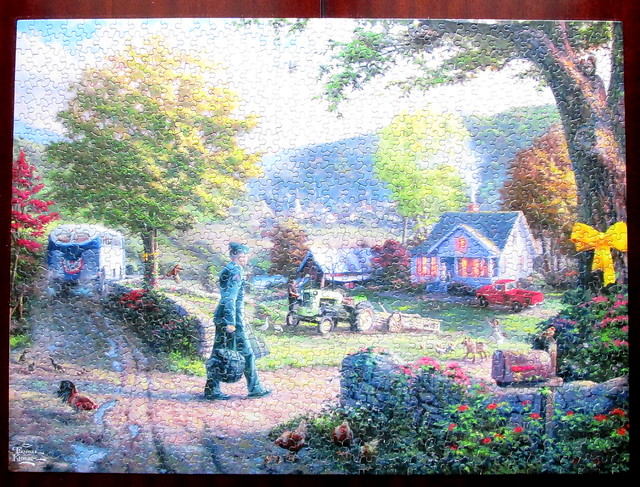
The Homecoming jigsaw puzzle

This one is called The Homecoming, and it’s by Tomas Kinkade. It’s very American, a soldier having come off a bus draped in flags/bunting, and a yellow ribbon tied to the tree.

It was a gift from Peggy Ann when she came over to visit us last year. It’s the first US puzzle we’ve done and it seemed quite different to me as there were quite a lot of very odd shapes to deal with, but when you look closely at it now, they don’t really look all that different.

It was the usual thing with me and jigsaws – 15 minutes after beginning it I was cursing myself for doing so, then I found myself still up at 1 am – absolutely obsessed by it! It ended up being good fun although when it was finished there seemed to be one piece missing – nightmare!

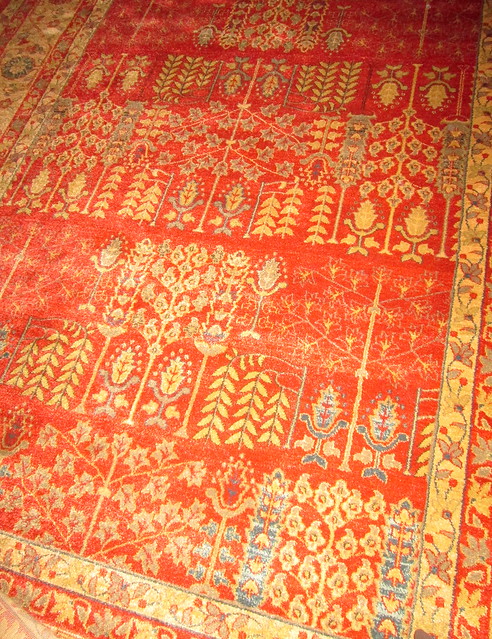
After crawling all over the rug several times I found it, completely hidden in the pattern, I only found it by touch, the photo below is of our new rug which covers most of the living room laminate, I’m just not a fan of laminate in my living room and a large rug was easier than getting a fitted carpet in there, I couldn’t face moving all the furniture out again.

rug

I love the rug, but if you drop something small on it, it’s very difficult to find it again!

Mount Vernon Love Story by Mary Higgins Clark

mount vernon love story

Mount Vernon Love Story by Mary Higgins Clark was first published in 1968 and it was the first book which Mary Higgins Clark wrote. She has since written a lot of crime novels but I haven’t read any of them so far. This was one of the many books which Peggy Ann brought for me from the US when she came to visit us last year.

As it says on the cover, this is a novel of George and Martha Washington. I knew nothing about Washington, beyond that he had made a wonderful estate called Mount Vernon which I would definitely go to visit – if we had that ‘beam me up Scottie’ gadget – but we don’t – so I won’t.

I have no idea how much is actually known about Washington and his private life, but I did think that this book wasn’t all that well written, I’m sure the author must have improved her writing skills since this one was published. I think maybe it was a lack of hard facts and imagination which led the author to say at one point that Washington appreciated that his wife always kept the house so clean and the furniture so well polished. I found that a bit bizarre, given the fact that it was a large household of slaves who did the housework!

I also found it hilarious that at meetings such as Continental Congresses he was very careful to put on a uniform, in fact being the only one there in uniform. I think despite that we were supposed to believe that Washington wasn’t personally ambitious, but of course – he was.

I was left wondering why Washington had such a bad relationship with his mother, and why he seemed only to be interested in women who were already married to his friends. A psychologist would have had a field day!

A Smattering of Snow

Balbirnie snow

After what seems like a couple of months of almost non stop rain we were promised dry but colder weather. I was quite surprised when it snowed though, just an inch or two lay, which is enough for me. I hadn’t had a decent walk for ages due to all the rain, so I took myself out the back gate this afternoon and took the camera with me. Come and join me on my walk!

Below is the edge of a golf course so it’s a bit more manicured looking.
Balbirnie in Fife

What do you call these golf things, water traps maybe? Anyway today it was well frozen over.

Balbirnie

Yes, that is actually the sun shining on those trees, amazing.

Balbirnie in Fife

Balbirnie snow in Fife

I had the whole place to myself. I saw plenty of dog and dog walker tracks but no sign of actual people or animals, and sadly no deer, even though I went off piste and walked through the woods and rough grass.

Balbirnie, Fife

It was great to see the sun at last.

Balbirnie in Fife

I hope that wee stroll blew some of your cobwebs away – it certainly got rid of mine!

Life After Life by Kate Atkinson

Life After Life cover

Life After Life by Kate Atkinson was published in 2013. I haven’t read anything by Atkinson since I slogged to the end of When Will There Be Good News – and really there was no good news at all, I found it very depressing, so I’m a bit late in getting to this one.

One thing you can say for Life After Life is that it is definitely different. The main character Ursula Todd is first born in 1910, but that life doesn’t last long as she is stillborn. Not to worry though as in this book Ursula is reborn again and again, with different outcomes each time, and many different ends to her life.

In fact Ursula is a bit like a cat with nine lives, although I lost count of how many different deaths she suffered. I must admit that I found it all a bit annoying as I was happily getting into yet another of her existences, sometimes featuring bits of a previous life, and sometimes a premonition or feeling of deja vu changing an earlier story – when suddenly she was dead again and it started all over again. I think I prefer fiction to be a bit more straightforward.

I really liked quite a lot of the characters, which is always a plus. One of them says: ‘What if we get a chance to do it all again and again until we finally did get it right? Wouldn’t that be wonderful?’

Probably not wonderful, because apparently most people just keep repeating the same mistakes throughout their lives.

I just thought that it was a bit of a waste of so many story ideas, but it kept me entertained during the awful wet weather that we’re still suffering here in the east of Scotland.

I think that Atkinson managed to portray London during World War 2 at the height of the Blitz very accurately, going from what I’ve been told by people who witnessed it all first hand anyway, including one man who had been a conscientious objector and ended up driving ambulances through London. The job seemed to consist mainly of gathering up body parts.

As Kate Atkinson lives in Scotland I’m counting this one as my first read for the Read Scotland 2016 Challenge.

Kelvingrove organist’s Bowie tribute

The organist at Kelvingrove Art Gallery and Museum in Glasgow played Life on Mars today as a tribute to David Bowie and a chap called Gordon Wilson was smart enough to film it on his phone. The organ obviously isn’t the best instrument to play it on, but he makes a good job of it I think. The organ is played every day at the same time, but the last time we were there, when we had Peggy from the US with us, we weren’t lucky enough to hear it.

David Bowie 1947 – 2016

I blogged about David Bowie once before, early on in ‘Pining’s’ career, but I can hardly believe that I woke up to the news of his death this morning. So sad, for me he was much more important than John Lennon and streets ahead of Elvis Presley. Bowie was an all round genius as well as a being a good guy, those two things aren’t often found wrapped up inside the one body.

It was T.Rex and Marc Bolan who first got me interested in music as a real fan. As an eleven year old my bedroom wall was plastered with posters of them, mainly pulled out from the middle pages of Jackie magazine. But I grew out of T.Rex fairly quickly and moved on to Bowie. It helped that my older brother is a Bowie fan so he was playing his music full blast a lot of the time. It would have been murder if I hadn’t liked the music.

So I’ve been a fan since the early days, and I’m so glad that I was there to witness Bowie’s early years. It would have been awful if I had not been able to witness the development of his career first hand, mainly through his performances on TV. In fact I never did get to see him live, my mother wouldn’t let me go to his Ziggy Stardust gig in Glasgow when I was 13. I was desperate to see him then and in later years we didn’t live close enough to any venues, and probably couldn’t afford it then, way back in the days when people paid for everything with cash, and did without if they didn’t have the cash.

Suffice to say that in the grey days of early 1970s Britain, when we had political strife and umpteen strikes leading to regular power cuts, Bowie and the Spiders from Mars were something to behold when they exploded onto our TV screens.

Unlike T.Rex, there was no danger of growing out of Bowie as he was ever changing, constantly developing and maturing, like all the best things.

I still can’t believe that he has gone.

Starman is an early favourite.

When I came out of hospital with my first son in 1986 it was Absolute Beginners which was in the charts, which is exactly what we were, new parents and clueless, but we managed to muddle through!

Another of my early favourites is what I call Tactful Cactus from the Hunky Dory album, but it’s called Eight Line Poem.

And from 1974, Lulu Singing The Man Who Sold the World which was written and produced by David Bowie, who also sang the backing track with Mick Ronson.

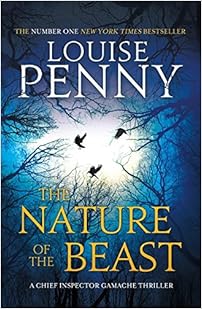
The Nature of the Beast by Louise Penny

The Nature of the Beast cover

Well, I can hardly believe it but I’ve managed to catch up with Louise Penny’s Armand Gamache series. The Nature of the Beast is her latest and it’s set in Three Pines, that seemingly idyllic location which is actually quite dangerous to live in – given the murder count over recent years.

Armand Gamache and his wife Reine-Marie have retired and have chosen to settle in Three Pines. They are well known in the village and in turn they know the villagers well, so when a wee boy known for his wild imagination and tall tales rushes around shouting about a huge gun and a monster in the woodland surrounding Three Pines, nobody is particularly bothered, it’s just what he does.

So everybody ignores him, and that’s something that they live to regret. I really enjoyed this book although it is quite a bit darker and more unsettling in atmosphere than I usually go for.

In fact at one point I did think that the plot was maybe just a wee bit far-fetched, so I was completely flabbergasted to read in the author’s note at the end of the book that it was based on truth, with Gerald Bull being a real person, who was involved in weapons design and was happy to design and build weapons for anyone who would pay him. He designed Project Babylon for Saddam Hussein. I certainly didn’t hear anything about it in the news at the time. But if you’re interested you can read a New York Times article from 1990 about it here.