The Chestnut Man by Soren Sveistrup

The Chestnut Man by Soren Sveistrup was first published in 2019 and it was translated from Danish by Caroline Waight. I think it’s the first Scandi Noir book that I’ve read and I borrowed it from the library so that I could take part in a Scandi meme which involved reading five books, I already have books at home by Finnish and Icelandic authors and I thought this would spur me on to read more over 2023, then I realised that the project was just for January! Oh well, I’ll be doing my own wee Scandi reading project over this year anyway.

The setting is Copenhagen where the body of a young woman has been found, minus one hand. It seems that the killer has left his calling card in the shape of a little ‘man’ made from chestnuts and matchsticks. More of them turn up at crime scenes and it’s obvious that there’s a serial killer around. It seems that the killer might be somehow linked to the disappearance of the young daughter of a politician the previous year, her body had never been found, but the police think they have solved the case, did they get the wrong man?

Naia Thulin has been assigned to the case and she has been given a new partner. Mark Hess has just been thrown out of Europol for some mysterious reason, and nobody is impressed with him, as far as they’re concerned he’s damaged goods.

I’m not sure if ‘enjoy’ is the correct word to use in relation to this reading experience. I like the plot and some of the characters, but it was just a wee bit too gruesome for me, – but then that was no real surprise, having watched The Killing on TV, and that was written by this author.

The Stolen Lake by Joan Aiken

The Stolen Lake by Joan Aiken was first published in 1981 and it’s the fourth book in her ‘Wolves’ series.

This one begins with Dido Twite on board H.M.S. Thrush, a British man-o’-war which has a new Captain. Reading the logbook Captain Hughes discovers that Dido is on her way back to England, sailing from Nantucket after having been instrumental in uncovering a Hanoverian plot against His Majesty King James III. Captain Hughes can hardly believe it and he’s less than happy about Dido being onboard, he orders her to stay in her own quarters. Dido’s unimpressed.

Just before casting off Captain Hughes receives instructions to sail to Roman America – New Cumbria where the queen apparently needs help from her oldest ally – England. Someone has stolen her lake. On reaching their destination it’s obvious that that isn’t the only thing that has been stolen, most of the girls have disappeared too!

This book is part of Aiken’s ‘Wolves’ series’ and comes after Nightbirds in Nantucket, but it can be read as a standalone book. It’s an enjoyable read, described as a mixture of history, legend, fantasy, humour and adventure.

Liza of Lambeth by W. Somerset Maugham

Liza of Lambeth is W. Somerset Maugham’s first foray into authorship, well the first one published anyway. He was a medical student at the time and was able to use those experiences in the story.

The year is around the middle of Victoria’s reign and the setting is Lambeth, a working class area of London and it begins with the inhabitants of Vere Street enjoying themselves on a hot afternoon in August, with the children playing cricket and the women sitting at their doorsteps gossiping. It’s an area where a lot of the women are at various stages of pregnancy and the men are too handy with their fists, but that’s all seen as being normal.

Eliza is young and single, and living with her mother who apparently suffers from ill health, but in reality she’s an alcoholic. Liza is the life and soul of the street though, she loves clothes and dancing and is very popular, especially with Tom who is besotted with her, but Tom is too quiet and boring for Liza’s liking. She’s got her eyes on Jim who is twice her age and has just moved into the street with his wife and five children, soon to be six. It isn’t going to end well.

I really enjoyed this one although it was quite predictable, but after all it was his first book. It’s quite grim in parts, however I’ve no doubt that the setting is very authentic with domestic violence hard drinking and early deaths being more likely than not. Maugham must have seen plenty of evidence of both when he was working as a student doctor in a London hospital.


Five for Sorrow, Ten for Joy by Rumer Godden

Five for Sorrow Ten for Joy by Rumer Godden was first published in 1979 and it’s one of her three books centred around a Roman Catholic convent, not the most exciting of settings you would think, but this is a really good read.

Elizabeth is a young and rather naive army driver who is in Paris for the first time, just as the city has been liberated by the allies in World War 2. She’s allowed to join in the wild celebrations and is picked up by Patrice, an older man. He’s obviously well-off and influential, he manages to get Elizabeth who is now known as Lise released from the army and Lise throws caution to the wind and begins to live with Patrice in his luxurious flat. Too late Lise eventually realises that she’s actually living in a brothel and many of the ‘girls’ have been living with Patrice previously, it’s only a matter of time before Lise is also cast aside and put to work in the brothel.

I really enjoyed this one, I suppose it’s meant to be an eye-opener regarding convents and nuns, as in this book nuns who visit female prisoners sometimes inspire a vocation in women who have presumably led a sinful life, although in truth many have been more sinned against than anything else. They’re welcomed into that religious world to begin a long journey towards acceptance as a nun, if they continue to feel that need.

I am not sure how realistic that is because the one young woman that I knew who became a nun was accepted immediately. She had been the ‘naughty’ one of a large Catholic family, drinking smoking and partying wildly, and when her father died very suddenly she felt so conscience stricken that after a few weeks she walked to the nearby Carmelite Monastery – and that was that!

Anyway, Five for Sorrow, Ten for Joy was an entertaining read. Rumer Godden seems to have found plenty of material in the Catholic religion after her conversion to it as she wrote two others with convent settings I believe. By the time she wrote this one she had moved to the Scottish borders to be near her daughter, and she lived in Dumfries and Galloway until her death? Can I count her as a Scottish author – hmm – maybe not. She did immerse herself in Scottish culture though and even wrote at least one children’s book in Scots dialect. It’s called The Dragon of Og and you can read my thoughts on that one here.

The Mirror and the Light by Hilary Mantel

The Mirror and the Light cover

The Mirror and the Light by Hilary Mantel is the last book in her Thomas Cromwell trilogy which was published in 2020 and this was a re-read for me as I had been waiting impatiently for years for its publication, unusually for me I bought it as soon as it hit the bookshops. At 882 pages it’s a tome and a half. I think that Mantel said that she was putting off the inevitable execution of Thomas Cromwell as she had become so close to him.

However there’s a lot to fit in from 1536 to 1540 – three of Henry VIII’s marriages, one annulment, unrest within the population due to many of them not wanting to give up their Roman Catholic saints and holidays, and wanting to cling on to the comfort of their beliefs, things get violent. I think that the book should probably have been edited to slim it down a bit, but that was never going to happen. Although I enjoyed this book I don’t think I loved it as much as I did at my first read of it, but that’s possibly because I had been anticipating it for years. You can read my original and more detailed blogpost here.

There is a mistake of sorts on page 561 when it’s written that Madame de Longueville (Mary of Guise, the mother of Mary, Queen of Scots) has landed at the town of Fife. In fact Fife is a county and it was the village of Crail in Fife that she sailed to after her proxy marriage to the Scottish king James V.

The Pleasure of Reading edited by Antonia Fraser

I borrowed The Pleasure of Reading edited by Antonia Fraser from the library, it’s a collection of the thoughts of 43 writers, about discovering reading and the books that inspired them. The book was originally published in 1992 and then again in 2015 with five new authors having been added to the list of contributors, all of the proceeds from sale went to the charity Give a Book.

As ever with books like this it’s good in parts. One problem is that for me anyway quite a lot of the writers were not known to me, but then I’m not really into the theatre so I don’t know of that many playwrights. It always helps if you know of the person who is writing their thoughts on books. Having said that, the piece that I enjoyed reading most was by Gita Mehti who described her early life in India and the secondhand booksellers who shouted about their wares from pavements and even on the steps of trains.

Quite a few of the writers were at pains to slag off Blyton, as if they were above all that nonsense, but I’m quite happy to admit that I adored being a part of The Famous Five – so to speak, and I went straight from reading them to going onto Agatha Christie. That was the only downside really as I missed out on so many books for children, and I’m still trying to catch up with those ones nowadays.

Lots of the contributors are dead now, I think it’s probably time that a new edition was compiled, I’m sure that the book charity could use the money well.

Dumbarton Castle – Tom Weir

On TV recently I’ve been watching a lot of programmes which feature people walking in the countryside. I do enjoy walking but mainly in good weather not so much in the winter, that’s armchair travelling time. The first such programmes I watched would have been those by the late great Tom Weir, but I hadn’t realised that there are a couple of his films on You Tube featuring Dumbarton Castle, my old stamping ground. The photo on my header was taken from the top of the castle and the film shows Tom making his way up there.

If you’re interested you can see a previous blogpost of mine about the castle here.

After Harry and Meghan’s wedding (or maybe just before it) it was announced that they had been given the Scottish titles Earl and Countess of Dumbarton, and apparently everyone in the town got quite excited because that would normally mean a royal visit from them, but it was not to be. It seems that the historic name of Dumbarton which means fort of the Britons was seen as an insult because the word dumb is in it. Well – what can I say?!
You can read more about the town here.

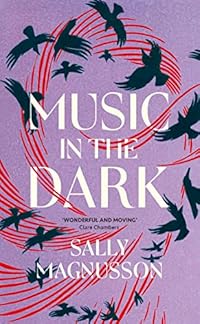
Music in the Dark by Sally Magnusson

Music in the Dark by Sally Magnusson begins in 1884, Rutherglen which is close to Glasgow. Jamesina Ross moved to Rutherglen from the city after all but one of her children had died because of the poor living conditions in Glasgow, her doctor had said it was the only hope for her last child. Jamesina had had dreams of a very different future for herself as she had had a classical education, but it wasn’t to be.

This book is about the Highland Clearances, particularly at Strathcarron in 1854 when the inhabitants were brutally forced out of their homes which were then set alight and pulled down so that there was no shelter at all. Jamesina was one of the women caught up in it and the beating she took from the police has affected her whole life, now as she gets older it’s more obvious that her brain has been impaired. She was left with a dent in her head and a mashed up jaw from a police baton.

I must admit that I found the first half of this book to be rather slow, but the second half was more interesting as Jamesina and her second husband, also a Strathcarron survivor travel back to the scene of the attack.

Music in the Dark is obviously very personal to the author as it’s based on the clearance experiences of her great-grandmother. I had to laugh when she wrote. – There was hardly a man’s name in the Highlands that someone had not had the bright idea of burdening a baby girl with by adding an – ina.

When I worked in libraries in the west of Scotland I obviously knew the names of the readers, there were women called Jamesina, Hughina, Andrewina and Donaldina and of course Williamina. I thought it was just a very local thing – but apparently not.

In the 17 and 1800s landowners in Scotland decided that they could make much more money from the land by filling the place with sheep. It meant that the crofters had to be removed, sometimes they were rounded up and put onto ships bound for America or the colonies, they didn’t have any say in the matter. Others made their way to Glasgow looking for work, presumably that’s how my own ancestors came to be in Glasgow. Going by the letters written home from the colonies, the Glaswegian Highlanders were the lucky ones.

I didn’t enjoy this book as much as the author’s previous ones. This book will be published in May 2023.

I was sent a digital copy of this book by the publisher John Murray Press via Netgalley for review. Thank you.

Neuschwanstein Schloss, Germany – a jigsaw puzzle

Jigsaw, Neuschwanstein Castle Germany

Jigsaw Box, Neuschwanstein Castle

Our second jigsaw puzzle (and possibly the last) of the year is of Neuschwanstein in Bavaria. It’s a place that I almost visited because back in 1970 I was in Bavaria staying with a penpal, and we were supposed to be visiting the castle, but I was so homesick and was not having a good time so I decided to go home a week early. I’ve always wondered if I made a mistake doing that – so when the saleswoman in the shop we bought this puzzle in told us that she had visited the place with her parents in the 1970s when she was a child, and her father was furious when they got to the castle I realised I hadn’t missed much. Apparently it’s a long hard walk up to the castle and when you get there it is completely empty! The original owner spent all his money building the place and couldn’t afford any furniture. I wonder if it has been furnished now. This is supposed to be the most photographed and prettiest castle in the world but to me it looks like a barrack with a few pepperpot turrets stuck on it.

Completed Jigsaw of Neuschwanstein Castle

Anyway, this autumnal view of the castle almost did me in, the building was easy, the trees not too bad but the sky was a nightmare, after a few day’s rest we tackled it again and got there.

We still have a queue of four or five other puzzles to do but I might leave them for next winter!