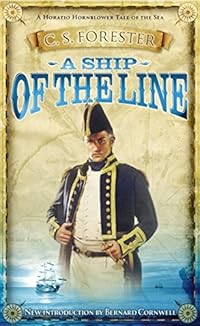
A Ship of the Line by C.S. Forester

 A Ship of the Line cover

A Ship of the Line by C.S. Forester was written in 1938 and I read it because it won the James Tait Black Memorial Prize that year, I’m trying to read my way through as many of the winners as I can. Mind you, I can’t find any mention at all in the book’s introduction (by Bernard Cornwell) or on the jacket of the fact that it did win the prize.

It is of course a Horatio Hornblower tale of the sea during The Napoleonic Wars. It begins with Hornblower taking command of a ship called the Sutherland, it was originally captured from the Dutch and it’s design isn’t really suitable as a warship, it’s described as the ugliest and least desirable two-decker in the Navy List. Hornblower is having a hard time getting enough men to man the ship, he’s having to make do with prisoners and even men who have been pressed into service.

The action quickly moves off to the coast of Catalonia in Spain, where Hornblower and his ship’s company engage in sea battles and conduct raids on shore against the French army. It is of course set at a time when Napoleon was rampaging around Europe, particularly Spain.

To begin with I really didn’t think that I was going to enjoy this book, it seemed like it was going to be far too much of a sort of ‘boys’ adventure’ tale, with lots of fighting going on, but I ended up getting really into it, and when Hornblower mentioned that he knew the area well because he had been held captive in Ferrol for two years in the past, I felt quite at home too because of course we sailed into Ferrol just a few months ago.

The only annoying thing is that it would have been better if I had read the previous books in this series first.

I must admit that I had no idea that C.S. Forester had written The African Queen (which I have seen so often I could act all the parts myself, including the leeches!) in fact quite a few of his books were made into films. I’ll probably read some more in this series, apart from anything else, it ended so abruptly that I feel I have to find out what happens next in Hornblower’s life.
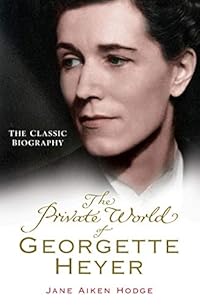

The Private World of Georgette Heyer by Jane Aiken Hodge

 The Private World of Georgette Heyer  cover

I’m not what you would call a huge fan of Georgette Heyer but I have probably read and enjoyed around ten of her books and they are a bit more than just good comfort reads as Heyer put a massive amount of effort into researching the historical periods that she wrote about. She compiled books of Georgian/Regency slang, fashions and such, including cutting out illustrations from magazines and drawing different types of carriages and even coats of arms, so that she could describe them properly in her books.

While she was actually writing her books she was inclined to be her worst critic and often described the one she was engaged in writing in letters to friends as being a STINKER. But once it was completed her opinion often changed.

To begin with she appeared to be very different from most authors in that she seemed very normal and went out of her way to avoid publicity, never gave interviews or did anything to promote her books. Even her married name was kept from the public and she wanted nothing to do with any other writers. I often judge people by whether I would be happy to have them as a neighbour or not and to begin with I would have been more than happy to have Heyer as one, but as the book progressed my opinion changed.

For one thing when she was actually writing books she wrote well into the wee small hours. I doubt if many readers would have guessed that her book writing was fuelled by Dexedrine and gin. Yes she was apparently on speed! She and her husband were obviously the type of people who always lived beyond their means, despite the fact that they must have had a huge annual income between them. During the war they took out a lease on chambers in The Albany. I watched a TV programme about that place a few years ago and it is only the super wealthy who can afford to live there, it has always been a very salubrious address. They chose not to buy property and didn’t even employ a proper accountant which led to great difficulties with the Inland Revenue over the years – stupid beyond belief! She was one of those women that don’t like other women and she was quite open about her dislike of young girls.

I suspect that the trouble was that she and her husband were very keen social climbers and for them it was imperative to own a new Rolls Royce and other such fol-de-rols. Heyer had in fact financed her husband through his law degree and he did eventually go on to become a successful QC, but before that he had run a sports shop with his brother-in-law and spent his time re-stringing tennis racquets and such. They both came from rather lowly backgrounds but that seems to have been forgotten when Heyer in later years described other lawyers’ wives she had met as being not out of the same drawer as her!!

One heartening thing was that they both loved Scotland and habitually holidayed there, but she hated Ireland, in fact she said that she had never been the same woman since visiting Ireland!

She was a wonderful letter writer though and I imagine that a book of her letters would be very entertaining, she was very witty as you would expect from her books.

Heyer was dogged by ill health for years, particularly problems with her throat so I was astonished when towards the end of the book it was mentioned that she smoked between 60 and 80 cigarettes a day. Given that – the drugs and the booze it’s just amazing that she lived to the age of 72.

All in all this is a good read. Georgette Heyer was just quite a flawed and odd character, but then most writers are and I’ll continue to read her books from time to time.

Somewhere Towards the End by Diana Athill

 Somewhere Towards the End cover

Somewhere Towards the End by Diana Athill was published in 2008 when the author was 89 and she was getting to the stage when her life was becoming ever narrower and she was realising that there were some wishes that were just never going to come to fruition, such as – she was never going to be able to own a pug, she was too old to be able to give them the walks and the care that they need, she says ‘I would so like to to begin that process all over again with a little black-velvet-faced pug – but no! It can’t be done.’ Each to their own I thought, I think those dogs are like marmite, you either love or hate them.

To begin with I thought that this book might be one of those name dropping ones because in no time flat she was mentioning Jean Rhys, but it was just that she had a close professional relationship with her as Athill was an editor at Andre Deutsch, and Rhys had a terrible fear of death and inevitably death is one of the main topics in this book. You would think that that subject could be depressing but it’s actually quite an uplifting book. She was apparently often described as “the finest editor in London”.

I found this to be a fascinating and at times really funny book. She’s quite brutally honest about her relationships with men, and she has much the same feelings about religion as I have. She had no religion, was an atheist but had a Christian upbringing, so had a clear view of right and wrong. However she was one of those people who did whatever she wanted and to hell with anyone else, so her sense of morality where relationships were concerned was pretty low.

‘So we, the irreligious, live within the social structures built by the religious, and however critical or resentful we may be of parts of them, no honest atheist would deny that in so far as the saner aspects of religion hold within a society, that society is better for it. We take a good nibble from our brother’s cake before throwing it away.’

Diana Athill might have thought she was somewhere towards the end of her life but in fact she still had another ten years of it to go and of course wrote another three books after this one. This book was nominated for the biography category of the Costa book awards. In fact I thought that she had died recently but it seems that she is still alive and kicking aged 99.

One thing that really annoyed me was that she mentions that although she had worked with the publisher Andre Deutsch from the beginning, she was very poorly paid. She said she understood that he deserved to take more money out of the company as it had been set up using his money, but she couldn’t afford to buy a house despite having worked for him for donkey’s years – and he refused to pay her any more. Honestly, publishers are just the limit. I bet he wouldn’t have tried that on if she had been a man! Of course in the 1960s and 70s even professional women couldn’t get a mortgage from a bank or building society, if they wanted to buy a house they had to save like mad for years, it’s amazing how much life has changed since those days.

I’m now looking forward to reading Diana Athill’s other books. You can read an interview with her here.

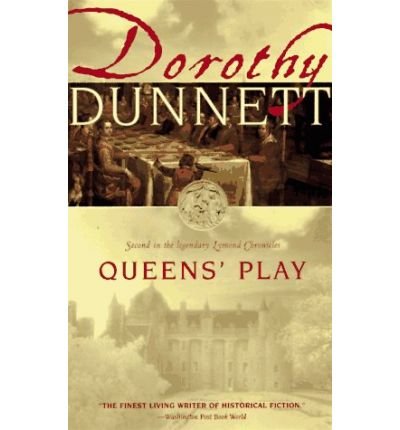
Queens’ Play by Dorothy Dunnett

Queens' Play cover

I actually read Queens’ Play a wee while ago, but I have such a backlog of book reviews to catch up with, mainly because of not blogging while we were on holiday. I use this blog to keep track and remind myself of books that I’ve read though, so here goes.

Queens’ Play which was first published in 1964 is the second in Dorothy Dunnett’s Lymond Chronicles and as I recall, I enjoyed it even more than the first one. These books aren’t really suitable for bedtime reading – well not for me anyway because they require more concentration than I can usually summon up by then.

In Queens’ Play Francis Crawford – more commonly known as Lymond is in France at the court of the seven year old Mary Queen of Scots. He has been invited there by her mother, Mary of Guise who thinks that her daughter is at risk of assassination, with good reason no doubt. The young Mary was sent from Scotland to France as a five year old, but that might have been a case of jumping from the frying pan to the fire.

As France and Scotland shared an enemy in England it was hoped that the young Mary and the young French Dauphin would eventually strengthen the alliance through a marriage. But those in power in England were obviously against that alliance. It was Lymond’s job to seek out intrigues and to protect Mary from them.

The New York Time Book Review said:

“(Her) hero is as polished and perceptive as Lord Peter Wimsey and as resourceful as James Bond.”

I read this one for the Read Scotland 2016 Challenge.

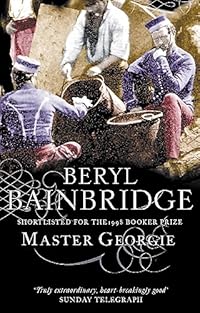
Master Georgie by Beryl Bainbridge

 Master George cover

Master Georgie by Beryl Bainbridge was shortlisted for the Booker prize, and that is printed on the cover, it was published in 1998. I read it because it actually won the James Tait Black Memorial Prize in 1998, but that is not mentioned on the cover of the book, which I think is a real shame especially considering it is the oldest literary prize in Britain, but of course it’s a Scottish prize, based in Edinburgh University, and you know how London-centric everything seems to be nowadays.

You never know what you’re going to get with Beryl Bainbridge, but this one turned out to be historical fiction, set before and during the Crimean War. I enjoyed it but I think that I made a mistake in reading it at bedtime, as it deserved and needed concentration. The last parts of the book are pretty ghastly as you would expect from a brutal war setting, but the earlier parts of the book are about Georgie, a young man interested in photography, and some of the people who make up his family household.

George Hardy eventually becomes a surgeon and some of his household accompany him to the war. They all have close relationships with him and all helped him hide a secret from his mother, which creates a bond between them. Myrtle is his adoptive sister and she adores him, hero worships him, Pompey was picked up off the streets and now assists him with his photography and Dr Potter, is the family doctor who has an interest in geology and the new sciences.

The blurb on the back say:

‘A novella-sized miracle of passion and war’ Ruth Rendell

‘It is hard to think of anyone now writing who understand the human heart as Beryl Bainbridge does.’ The Times

It’s definitely worth reading, and out of interest I looked up what did win the Booker Prize in 1998 and it was Ian McEwan’s Amsterdam, which I haven’t read, so I can’t compare it.

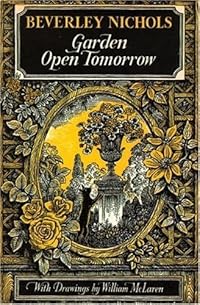
Garden Open Tomorrow by Beverley Nichols

 Garden Open Tomorrow cover

Garden Open Tomorrow by Beverley Nichols was first published in 1968 although my copy is a Country Book Club publication from 1972.

Beverley Nichols was of course a well known garden writer and he also appeared on TV but he was just a bit before my time I think, I certainly don’t ever remember him being on TV. Percy Thrower was the first TV garden presenter in my life. But I’ve really enjoyed the Nichols books that I’ve read, particularly his early 1930s series of four books about his life in the country and the making of his homes and gardens.

Garden Open Tomorrow feels very much like a series of newspaper articles to me, I know he wrote for gardening magazines so possibly it is a compilation of those articles. There’s a lot more botany involved than in his other books I think, no bad thing mind you.

By this time he was spending quite a lot of time in America, this book begins:

‘The weather in England’ – so wrote my friends with monotonous persistence throughout the cruel winter – ‘is quite indescribable.’ Whereupon they proceed in great detail to describe it.

I was out of it all, lecturing in America, where the weather so they assumed, was not ‘indescribable’. In a sense they were right. It would have been easy for example to write a description of the tornado which hit Detroit at fourteen below zero, at the precise moment of my arrival, lifting me bodily into the air and depositing me in a gutter full of slush, whence I was removed to hospital in an ambulance, x-rayed, bandaged, and inoculated against lockjaw.

This isn’t my favourite of Beverley Nichols’ books but it’s still well worth reading if you’re interested in gardening and amusing general chit chat.

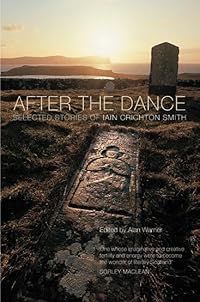
After the Dance by Iain Crichton Smith

 After the Dance  cover

After the Dance by Iain Crichton Smith is a collection of short stories by this Scottish author who wrote poetry as well as novels, writing in both Gaelic (his first language) and English, he died in 1998. He was born in Glasgow but moved to Lewis when he was two years old. Although he wrote poetry and prose he was also a high school English teacher.

These short stories have very diverse subjects ranging from the First World War and the horror of mothers seeing a church elder approaching their houses, it was his job to deliver the telegrams, to a Highland wedding in the city. The Highland father feels completely out of it but when the singing starts and he realises the youngsters don’t know the words of the Gaelic songs well he takes over, singing the traditional songs and turns the celebration into a Gaelic culture fest, to the delight of the younger generation.

There are thirty-one stories in the book and a few of them show the author’s distaste of the Free Church of Scotland’s strict Calvinism. But the existence of Calvinism has given him a chance to write with humour on the subject, every cloud I suppose….

There’s an introduction from author Alan Warner (of Morvern Callar fame), who lived near Iain Crichton Smith in the 1980s and he gives an instance of his sense of humour when he mentions that a woman has such an insistent personality that she is the sort of person that you have to say goodbye to through your own letterbox! Mind you I’m not at all sure that that translates for people who don’t have a letter box in their front door.

I really enjoyed these stories, some more than others of course, but they’re well worth reading. I must try one of his novels next year. If you’re interested you can read his obituary here.

You can read what Jack thought of this anthology here. He’s much more thorough than I am where reviews are concerned.

I read this one for the Read Scotland 2016 Challenge. I believe that’s my thirtieth.

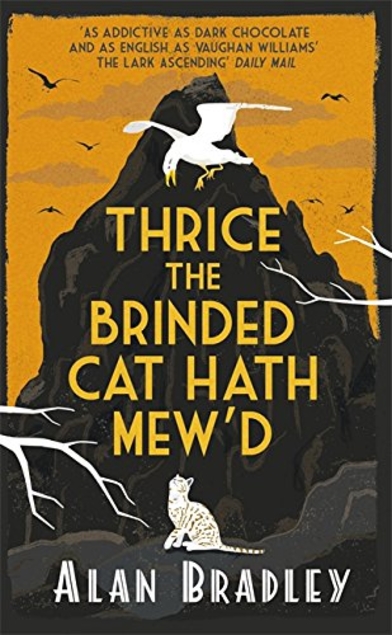
Thrice the Brinded Cat Hath Mew’d by Alan Bradley

Thrice the Brinded Cat Hath Mew'd cover

Thrice the Brinded Cat Hath Mew’d by Alan Bradley is the eighth Flavia de Luce book and of course the title is a quote from Shakespeare’s Macbeth. There’s not a lot I can say about it really except …

As ever I enjoyed this book because I love Flavia as a character but this one does suffer from a lack of family banter between Flavia and her older sisters, and even Dogger didn’t seem to appear that often. Also I didn’t appreciate the ending at all. There have been too many actual exits of ‘big’ characters in 2016 and I could certainly be doing without fictional ones too!

Don’t worry. It wasn’t Flavia.

I suppose I could take up reading Mills and Boon books – but that might be taking it a bit far.

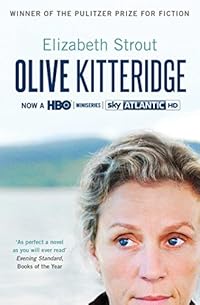
Olive Kitteridge by Elizabeth Strout

Olive Kitteridge cover

I decided to read Olive Kitteridge by Elizabeth Strout because so many bloggers that I follow seemed to have enjoyed it, and also the setting is Maine in the US which is a setting I’ve enjoyed in the past. But although I ploughed on to the end of this book hoping that it would get better – it didn’t. I found it to be a car crash of a book – a fix up. Apparently it won the Pulitzer Prize for Fiction – the mind boggles!

It’s just as well we are all different I suppose but I couldn’t find anything good to say about it. The front cover says that it is now a HBO miniseries sky ATLANTIC – and I can see why the book would be snapped up for TV as it basically lurches from one bad situation to another. Just the sort of thing that gets people watching soaps.

There were no likeable characters, particularly not Olive Kitteridge who spends her life telling people how awful her mother-in-law was, but when her son marries, Olive is an even worse m-i-l. She’s so much of a power freak that she has designed and built a house for her son to live in when he grew up, close to her house. She has a strangle hold on his life and her husband Henry is a pathetic soul living on dreams, as anybody would who was faced with Olive day in day out.

In parts of the book it wanders off and to me it felt like the author had pulled some unpublished short stories out from under her bed (all writers have them) and shoe-horned them into this book to bulk it out. Then threw the name of Olive Kitteridge into them by way of tying it in.

If you feel the need to wallow in depressing human circumstances then go ahead and read Olive Kitteridge. Given what 2016 has been like, I’m in need of something altogether more entertaining and uplifting – and less like a bad soap in search of ratings.