Julia by Cynthia Harrod-Eagles – 20 Books of Summer 2021

I read Julia by Cynthia Harrod-Eagles for 20 Books of Summer 2021. It’s a book I’ve had for years and just never got around to reading it. I hadn’t ever read anything else by the author and I’m sorry to have to say that I won’t be reading any more as I really did not enjoy it. I hate slating a book and rarely do it, especially if the author is still alive.

At the beginning Julia is a 15 year old schoolgirl, a bit of an odd bod with no friends – not that she actually wanted any – seemingly even disliked by her very strict parents and not particularly close to her sister. When she takes on a job as a baby-sitter to a local family it’s just for the money, but soon she’s a part of the family, counts Joyce the mother as a friend and is adored by the two young boys. But from the very beginning she is interested in Peter, the husband and father. Peter is a violinist with an orchestra and a serial adulterer, so it isn’t long before he’s grooming Julia to be his next squeeze. She is besotted with him.

So begins a 20 odd year long on off relationship which does involves divorce then Julia and Peter getting married, losing a child, Peter resuming his usual bad behaviour in the worst way, more divorce, another marriage for Julia, the crazy and highly unlikely death of that husband who was a high ranking army officer, which was also totally unlikely as NCOs never get promoted to colonel, they only get as far as major according to an army friend of mine. Than Julia is supposed to be short of money – the author obviously didn’t know how much Julia would have got as the widow of a colonel!

For me the whole tale was just full of holes, badly written and included far too much sex – keep it off the pages please – I’m sure that others must like that though. The ending was so unlikely, I suspect that the author was going for an unusual and shocking twist, but it just wasn’t feasible if you read the book carefully as I did, while rolling my eyes. The author had Julia behaving in a way that I just couldn’t imagine any human being behaving, given the circumstances. It’s always difficult for me when there are no likeable characters in a book and in this one there were just a couple of very minor characters whose company I could have enjoyed.

I believe that lots of people are really keen on this author, particularly a long series that she wrote but I was so disappointed with this one and annoyed with myself for ploughing my way through it in the hope that it would improve – it didn’t – it got worse.

Perhaps it was my fault for buying a book solely because of the title, it hasn’t put me off the name Julia though. I had a sneeky peek on Goodreads and nobody has written a review of this book but lots of people have rated it with just one 5 star rating I think, but mainly threes or less. I will give it two, and that’s me being generous.

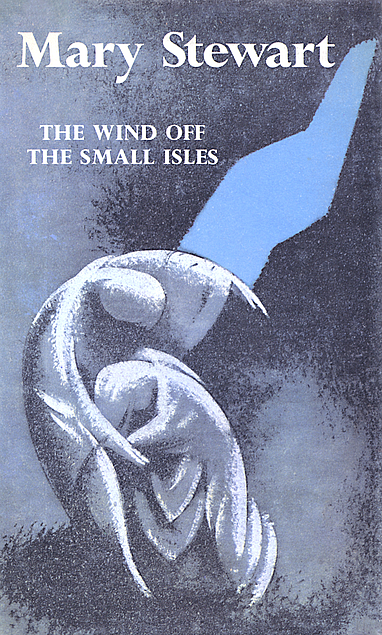
The Wind Off the Small Isles by Mary Stewart

The Wind Off the Small Isles cover

The Wind off the Small Isles by Mary Stewart was first published in 1968. The setting is Lanzarote on the Canary Islands, off the coast of Africa, and 23 year old Perdita is there with her employer Cora Gresham who is a famous English novelist. Perdita is her secretary and as Cora freely admits she half writes the books too. They’re busy seeking out settings for the books, but when Perdita drives down a country track which Cora wants to explore it leads to a house which Cora falls in love with immediately.

There are workmen outside the house and Perdita is sent to enquire about the owner as Cora wants to buy the place, but it turns out that Cora already knows the owner James Blair and he’s another English author – the house is definitely not for sale. Michael is working for James and it’s obvious that he and Perdita are interested in each other, and so begins a suspenseful adventure accompanied by the atmospheric descriptions that Mary Stewart was so skilled at.

This is a lovely little novella at just 96 pages, my copy has the original dust jacket and the beginning of each chapter has a small illustration by Laurence Irving. Unfortunately it seems to be quite expensive online but I was lucky to find a perfect copy for all of £3 in a secondhand book shop.

Lightly Poached by Lillian Beckwith

Lightly Poached by Lillian Beckwith was published in 1973 and it’s the fifth book in the author’s Hebridean series. This series came about when Beckwith moved to Skye in the 1960s from the north of England – for the sake of her mental health and she started to write about her experiences in what was a very different society from what she had been used to.

The ‘poached’ of the title doesn’t refer to eggs, but to the poaching of salmon which was far more prolific than it is nowadays – probably because of all that poaching in the past, apparently even the local minister wasn’t averse to serving poached salmon!

But it’s not all about poaching, there are ceilidhs (a get together, possibly involving dancing if there’s space) which go on all night, not to be confused with a ‘strupach’ which is just a cup of tea with a scone or something similar, and a trip to the mainland to a ‘roup’ (an auction of household goods at a house clearance).

Things are very different nowadays on Skye, in fact I’m not sure how authentic these books are, Beckwith ended up leaving the island after the locals took umbrage at her portrayal of them, but they’re quite entertaining anyway.

The School at the Chalet by Elinor M. Brent-Dyer

I know that I read some of the Chalet School books by Elinor M. Brent-Dyer when I was a youngster, maybe about 11 or 12 years old, but I had never known how the series came about – the Chalet School beginnings, so when I saw a copy of The School at the Chalet I decided to buy it.

It seems that twins Madge and Dick Bettaney and Jo their much younger schoolgirl sister had been orphaned some years before and with their guardian’s recent death they’ve been left in a difficult situation. Dick is in the army, but Madge and Jo won’t have much money to live on, especially after Jo’s school fees are paid. Jo isn’t in the best of health and Madge thinks that the fresh air of Alpine Austria would help to build up her strength. Madge is a trained teacher and she plans to open a school of her own, she loved a holiday they had had near Innsbruck and a there’s a chalet available to rent. It can be converted to be used as a school and has space for a dormitory and Madge already knows of a few girls that she could have as boarders.

Madge enjoys setting up the school and gathering together the basic requirements for it and in no time she has acquired more pupils and even some day girls from the local area. It’s an international school which some parents send their daughters to so that they can learn English.

As you would expect from a group of youngsters there’s going to be adventure and angst and it was an enjoyable read. I recall feeling quite cosmopolitan when I read some of the Chalet School books previously, there are some French and German phrases in this book, and the several contretemps with a character nicknamed Frau Berlin who is nasty to the ‘English girls’ has led to some people on Goodreads regarding this book as somewhat racist, but I think it should be remembered that this book was first published way back in 1925, so not long after the end of World War 1, and would have been read by girls who had lost fathers and other relatives in the war. That war was started by Germany and particularly Prussians as is mentioned – and for that matter even Germans don’t like Prussians – the Germans I know anyway!

The Feast by Margaret Kennedy

The Feast cover

The Reverend Bott of Cornwall is having a tough time writing a funeral sermon, so he’s unable to entertain his friend who is visiting for his annual holiday. It’s an unusual situation as it’s a multiple funeral for people who had been in a nearby hotel when the cliffs above it had collapsed on the building. With tons of stone obliterating the hotel there was no way anyone could have survived, or been extricated for a normal burial. Then the tale slips back to the run up to the disaster, featuring a large cast of characters in the shape of the hotel guests, including children.

The hotel had been the Siddal family home but with Mr Siddal’s career as a barrister having come to a halt for some reason, they just can’t afford to live in the house, so Mrs Siddon decides to turn it into an hotel. Her rather feckless husband and adult children help to run the place, along with a few locals, particularly the much put upon Nancibel (she hates her name). Mrs Siddal is a strange mother – favouring her son Duff over everyone else, seemingly because he is handsome. She has nothing but disdain for her son Gerry who is a doctor and is actually supporting his younger brothers via education fees.

This is a great read with characters that you love to hate, including Hebe, a truly ghastly child, but it did take me a while to get really into it. Given that the reader knows what happens within the first few pages I inevitably spent my time hoping that the horrible people would get their comeuppance and the ‘good guys’ would survive. It was a very satisfying read considering that I hadn’t been all that happy knowing about the fate of the hotel so early on in the book, it turned out to be a good strategy by the author, it added a lot of suspense – for me anyway.

Thank you to Faber and Faber who sent me a digital copy of The Feast via NetGalley.

This was my fourth 20 Books of Summer read.

Book Purchases from Edinburgh

Books Again

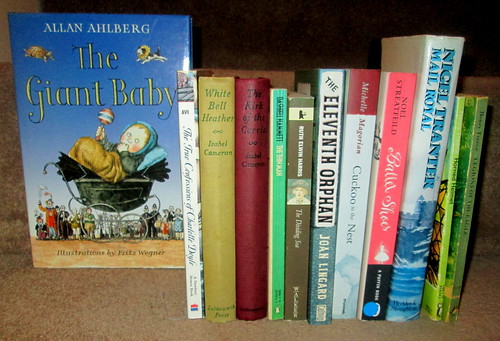
A recent trip to Edinburgh led to my TBR list expanding by twelve books – in no time – many of them could be described as being for young people or YA as they tend to be categorised nowadays, some of them I had never even heard of but I reasoned that if a book is a Newbery Medal winner it should be a good read – for all ages.

The Giant Baby by Allan Ahlberg
The True Confessions of Charlotte Doyle by Avi
The Kirk of the Corrie by Isabel Cameron
White Bell Heather by Isabel Cameron
The Thin Man by Dashiell Hammett
The Dividing Sea by Ruth Elwin Harris
The Eleventh Orphan by Joan Lingard
Cuckoo in the Nest by Michelle Magorian
Ballet Shoes by Noel Streatfeild
Mail Royal by Nigel Tranter
Horned Helmet by Henry Treece
Legions of the Eagle by Henry Treece

Have you read any of these ones?

bag and baggage by Judy Allen – 20 Books of Summer

bag and baggage by Judy Allen was first published in 1988, by The Women’s Press. It’s not a book that I bought, it was sent to me by mistake when I ordered another book from a bookseller – and they didn’t want me to send this one back. That was quite a few years ago now, and that’s why I added it to my 20 Books of Summer list.

Hilda is a pensioner who lives in a ground floor council flat. May, another pensioner lives opposite her, in a flat which is a mirror image of Hilda’s, but May’s flat is spotlessly clean, she’s completely obsessed with housework, whereas Hilda has just about given up. Whenever she tries to clean anything she just ends up making it even worse. Her flat is in a horrible state,she just can’t cope with it all. The kitchen is full of half used tins of cat food – I could almost smell it.

It’s not just her hygiene standards that have fallen though, Hilda has accumulated a pile of official looking brown envelopes, many of which she hasn’t even bothered to open. Her neighbour May does try to help Hilda but she just ends up becoming another problem as far as Hilda is concerned. She takes to staying in the park all day, then when her flat is stripped and padlocked by bailiffs the park becomes her home. She’s sleeping there with bags full of things that May had managed to rescue from her old flat, before the bailiffs struck. So, Hilda has become a bag lady, not that she recognises that fact. At times Hilda lives in a universe of her own making, where she is famous and being interviewed on TV, but in reality she’s taken to a geriatric ward which she seems quite happy about.

This is a well written book, but it’s not exactly an uplifting read, I’m sure it isn’t meant to be and I suppose the subject is an important one, people can suffer from mental illness for no particular reason, it isn’t always caused by a big trauma, and it can often lead to homelessness. There is some humour.

Judy Allen is better known as a children’s author, this is her second novel and her first December Flower was dramatised by Granada TV.

This was one of my 20 Books of Summer 2021.

White Boots by Noel Streatfeild – 20 Books of Summer 2021

White Boots by Noel Streatfeild was first published in 1951. The Johnson family live in London, Harriet has been ill, her brothers think she looks like a big daddy-long-legs as she’s all hair and eyes and although she isn’t so ill now she still isn’t well enough to go to school, her legs feel like cotton wool. Her father George Johnson has a shop which is stocked by the produce that his elder brother sends to him for sale. George’s brother inherited the family estate, but he keeps all the best produce for himself, and sends George vegetables that are really poor quality and nobody wants to buy, and animals that have been shot or trapped and are long past being used for food. They’re really poverty stricken and can’t afford the good food that Harriet needs to get her strength back.

The doctor thinks that maybe taking up ice-skating will help to strengthen Harriet’s legs and at the ice rink she comes into contact with Lalla who also doesn’t go to school. She is taught at home by Miss Goldthorpe, a successful teacher who wants a change from teaching in schools, but most of Lalla’s time is spent at the ice rink. Her parents are dead and she’s being brought up by an aunt who is obsessed with turning Lalla into a champion ice skater – just like her father was. Lalla’s famous father died when she was a baby.

Harriet and Lalla strike up a friendship but it’s in jeapordy when Lalla’s tendency to be a ‘proper little madam’ almost ruins things.

This was a good read, with lots of common-sense and morality in the storyline. Lalla, having been brought up by her ambitious, snooty and self-important aunt needs some lessons in real life, which her old nanny does her best to instil in her.

The Johnson family, including Harriet’s three brothers and her mother also add a lot to the story. I wish I had read these books first when I was a youngster myself.

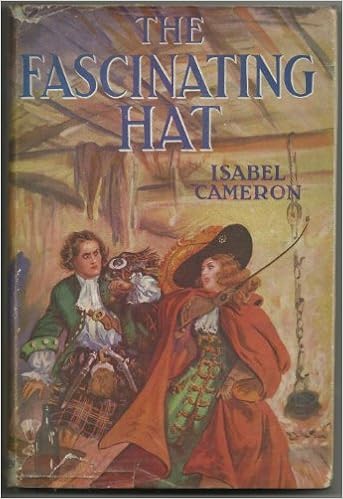
The Fascinating Hat by Isabel Cameron – 20 Books of Summer 2021

 The Fascinating Hat cover

The Fascinating Hat by the Scottish author Isabel Cameron was first published in 1941. The book begins with Jinty Campbell trimming a hat that she’s going to wear in a dramatic entertainment in the village hall the following week. She’s interrupted by the local minister who has a habit of just walking into people’s houses unannounced. With him is his nephew who is a doctor, he has come to stand in for the local doctor who is going on holiday. There’s quite a lot of snappy banter as the two young people seem to hit it off quickly, having a similar sense of humour.

The screeching of tyres in the street and a crash alert them to a taxi which has ended up on its side while swerving to avoid a child on the road. The young passenger has been knocked out, tended by Jinty who had been a VAD, and the new young doctor. But their patient has lost his memory and has no idea who he is.

Jinty is an apprentice at a firm of architects, planning to become an architect herself eventually. As far as she’s concerned it’s about time that houses were designed by women for women as men have no idea of how to design homes with women in mind, making a lot of unnecessary work for them. Cupboards too high up, the sink in a corner facing a wall, sometimes no sink at all, the dishes to be washed in a basin on the kitchen table, no cupboards for storage and unneccesary steps. Secretly her bosses have to admit that she has a point.

The architects had got a commission to build a wonderful large house locally, with no expense spared. Their client was abroad and wanted to come home apparently. As you can imagine Jinty is in her element.

This was an enjoyable read and I imagine that in 1941 it must have been very unusual to have a young woman with the ambition of becoming an architect, so that was quite a surprise to me. However the storyline took a weird turn when the patient’s memory was restored by an operation. I found the thought of that quite shuddersome as so many people in reality were damaged forever when doctor’s performed brain operations when probably what they needed was a good psychologist – or even a nice wee rest!