Whispers in the Graveyard by Theresa Breslin – Carnegie Medal winner

Whispers in the Graveyard Book CoverWhispers in the Graveyard by the Scottish author Theresa Breslin won the Carnegie Medal in 1994.

In this book the author writes about a multiple of serious problems that Solomon, the main character has to deal with. He is having trouble at school, and at home. His mother has just recently left the family home after having given Solomon a choice of staying with his father or leaving with her. He stays with his father mainly because with his mother leaving there will be nobody to look after his father when he goes on his frequent alcoholic binges. But it means that Solomon doesn’t even have clean clothes to wear, so he’s smelly and unpopular at school. His teacher Mr Frame particularly dislikes him and chooses to ridicule him in the classroom, he’s just a bully. Peter, his best friend tries to protect Solomon from Frame, and lets Solly copy his homework, but he spends less and less time at school, choosing to hide away in an old graveyard.

He has found a sort of hidey-hole that he can gain access to by climbing up a rowan tree, used in the past for keeping witches away of course. When Solomon sees strangers looking around the graveyard he realises that his peaceful haven is under threat. With work going on in the graveyard it looks like something evil has been released.

It seems that this is one of those love it or hate it books. It’s really well written, but if you don’t like a bit of spookiness, or the real problems that some youngsters have in their lives such as bullying, family break up, alcoholic parents AND dyslexia then you might want to give this one a miss. However it’s a sad fact that a lot of young people have to cope with terrible problems that would fell many an adult. So although this isn’t exactly a jolly read, I think it might have helped some readers along the way. I enjoyed it, it has some light-hearted moments.
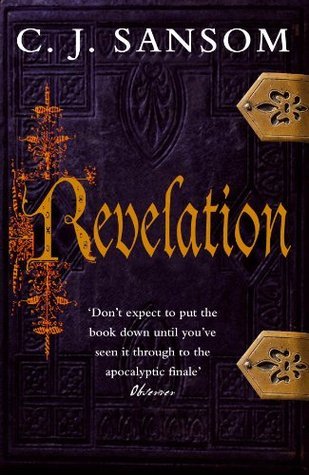
Revelation by C.J. Sansom

Revelation by C.J. Sansom is the fourth book in the author’s Shardlake series.

The book begins in the Spring of 1543. King Henry VIII is smitten by Catherine Parr whose elderly husband has just recently died, but she’s not all that keen, and who can blame her!

As the king gets older and more ill he seems to be hankering after the religion of his youth,  and all that goes with it, except the Pope of course. Catherine is a reformer, but some reformist congregations are becoming too strict, and  verging on lunacy.

When Shardlake’s friend ends up dead in a fountain, murdered horribly, and then another body is found, the circumstances lead Shardlake to believe that the murderer is a disgruntled reformist who is using the Book of Revelations to punish people that he disaproves of.

Shardlake is also trying to save a young man who has been sent to Bedlam for his own safety really as he has been drawing attention to himself with his vocal religious mania, people have been burnt at the stake for behaving like that.

This was another cracking read. If you do read it make sure that you read the historical notes at the back. I had no idea that there had been a lot of deliberation by the religious powersof the day over the Book of Revelations – as to whether it should be included in the bible or not. It does seem to have caused an awful lot of trouble over the years as it was thrillingly beloved by the Tudor Puritans, and likewise by the Christian Fundamentalists of today.

I must say that I didn’t realise that they picked and chose what they wanted to be included in the bible, so the whole thing has been manipulated, as well as being mis-translated.


The Adventures of the Little Wooden Horse by Ursula Moray Williams

Adventures of the Little Wooden Horse Book Cover

The Adventures of the Little Wooden Horse by Ursula Moray Williams was first published in 1938 but I had never come across it before when I spotted this nice hardback copy of it in a secondhand bookshop recently, it’s a reprint from 2011. Nick Park of Wallace and Gromit fame describes the book as being ‘Timeless and enchanting.’

Uncle Peder makes wooden toys to sell, it’s his way of making a living. When he makes a lovely little horse with four wheels he thinks he might get five shillings for him, but nobody wants to buy his toys now since a new cheaper toy shop has opened up in a nearby town. Uncle Peder has to sell everything he owns to try to keep body and soul together, but when Uncle Peder falls ill the little wooden horse decides he will have to go out and sell himself to help.

So begins the many adventures and scrapes that the Little Wooden Horse finds himself in, things get really tough for him, but he never gives up. He hires himself out telling people he is a very strong and quiet little horse. He works down a mine beside the pit ponies, pulls a barge, works in a circus and even gets involved with pirates.  There’s a lot of strife involved but of course it’s all character building. Through it all he is determined to earn  money to take back to his master, Uncle Peder, and of course there is a happy ending.

Did any of you read this book as a child?


Home is the Sailor by Rumer Godden

Home is the Sailor by Rumer Godden and illustrated by Jean Primrose was first published in 1964. I counted just seven full page colour illustrations, but there are lots of black and white ones, all in a charming style.

This is the story of a doll’s house, its tiny doll inhabitants and the children who play with them. There are disasters and adventures, and a moaning character named Morello, supposedly the doll maid, she’s quite bitter about something, just like the cherry of her name. Mrs Lewis is another servant, she’s a Welsh doll, made of celluloid so when she heats up she crackles almost like she is laughing.

Mrs Raleigh is the mother doll, there’s her daughter Dora, twin girls called Opal and Pearl, a boy called Curly the sailor doll and Bundle the ‘long clothes’ baby. The disaster is that the doll husband Captain Raleigh has gone, no fault of his own. Miss Charlotte is the doll governess and the children were planning a wedding for her with the doll Thomas, but another disaster befell him, so Charlotte is distraught.

This is a lovely book with the lives of the dolls and the real children intertwining. When Bertrand a young French boy arrives to stay with the family he has a lot to learn. His own parents had sent him to England hoping that the experience would cure him of his know-it-all arrogance and surprisingly it does when he ends up having Curly the sailor doll as his mascot.

Rumer Godden wrote several children’s books featuring dolls and doll houses, she was very much in touch with the lives and thoughts of youngsters.  This was a lovely relaxing read, for children of all ages. Thank you for letting me know about it Wilhelmina.


Lady Living Alone by Norah Lofts – British Library Women Writers series

Lady Living Alone Book Cover

Lady Living Alone by Norah Lofts was first published in 1945 but the setting is mainly the 1930s. It is just about to be reprinted by British Library in their Women Writers series. This is one of four novels that Lofts wrote under the name Peter Curtis.

I read quite a lot of Norah Lofts books back in the 1970s, but they were all historical romances. This one begins as a domestic novel with the usual problems of finding and keeping domestic servants.

Penelope Shadow seems to be well named, she’s quite shy and retiring, so when she bought a typewriter and started to write novels people were surprised to discover that they were being published and in fact were being very well received, making her a lot of money. This means that she will be able to buy a home of her own, in recent years Penelope had  been staying with her older half sister who was a widow with children. It’s only when Penelope tells her sister of her plans that she realises that her sister had been doing her a favour in allowing Penelope to live with her, and had really put her own plans on hold.

An old house is quickly purchased, it’s rural, a bit of a lonely situation, and as Penelope is frightened to stay in a house on her own it’s not really a good choice for her, but she loves the house. It’s only when she is left on her own in it that she realises she still has a phobia about being on her own in a house.

When she meets a young man who seems to be capable of solving all domestic problems she hires him as a housekeeper/man of all work, that should solve the problem of her being on her own in the house. Terry is a young Irishman, not much more than a boy really, and he has been drifting from job to job, he’s very happy to move in to the house, it’s well paid and he’s really his own boss. For Penelope all her problems are over – or are they just beginning?

This one turns from being a domestic tale to a thriller, albeit quite late on in the book, but it’s an enjoyable read with twists and turns. The book has an Afterword by Simon Thomas and I must say that I appreciate the extras such as the mini Lofts bio and the interesting tidbits of information on what was going on during the 1940s.

My thanks to British Library for sending me a copy of this book in return for a review.

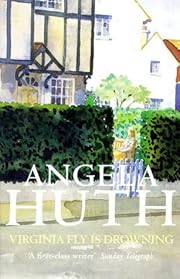
Virginia Fly is Drowning by Angela Huth

Virginia Fly Is Drowning by Angela HuthVirginia Fly is Drowning by Angela Huth was first published in 1972 by William Collins and Sons but my copy is a 1992 reprint by Abacus.

Virginia Fly is a teacher, she’s an introvert and a virgin at the age of 31, but she has a very vivid imaginary sex life and erotic dreams, she’s obviously very frustrated. The longest relationship in her life (apart from her parents) has been with her male American penfriend, they’ve been writing to each other for twelve years.

For some bizarre reason Virginia agrees to go on a TV programme to be interviewed by a ‘celebrity’ TV presenter, this has all been orchestrated by Virginia’s mother, an overbearing woman who likes to be the centre of attention. Almost at the same time the penfriend arrives in England so he and Virginia will meet up at last. It seems that her virginity isn’t going to last much longer.

This is a well written book and at times quite funny, but I found it to be quite sad and all  a bit unlikely. Also at a time when there were only three TV stations in the UK Virginia’s appearance on TV doesn’t seem to have been seen by anyone that knows her. Can you imagine what life woud have been like for any teacher of teenagers if she had announced on TV that she was still a virgin?!


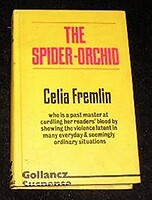
The Spider-Orchid by Celia Fremlin

The Spider-Orchid by Celia Fremlin was first published in 1977. I suppose that means it’s vintage crime – astonishingly!

This one is I suppose a psychological thriller, that means that for me it was an uncomfortable read, it’s certainly not cosy crime. Also it takes a very long time for an actual crime to take place, despite all that, it’s a very good read – at the end anyway.

Adrian has recently been divorced from his wife Peggy after she declared that she couldn’t stand it any longer. What she couldn’t stand was Adrian’s long term affair with a woman called Rita. Adrian is amazed as he didn’t even realise that Peggy had been aware of his affair, despite him flaunting Rita around the local neighbourhood and even in front of friends and work colleagues.

Living in a rented flat on his own is ideal for Adrian, with just a few visits from Rita a week, he’s happier living on his own, but Sundays are sacrosanct, that’s when his daughter spends the day with him. When Rita decides to move in Adrian is not at all happy, but he only has himself to blame as he has been agreeing with Rita for years that it would be wonderful if they could be together all the time. He’s aghast, especially when it transpires that Rita is very much against the existence of Amelia his daughter.

Ultimately I enjoyed this one because for me the ending went in the right direction, but for a lot of the time the plot was a bit of a worry!

It’s a quick read at just 176 pages.


Sovereign by C.J. Sansom

Sovereign Book CoverSovereign by C.J. Sansom was first published in 2006 and it’s the third book in the Shardlake series.

It’s 1541 and Shardlake and his assistant Jack Barak have been riding for five days, making their way to the north of England. It’s a particularly gruelling journey as the summer has been so wet, the roads are bad. Shardlake is on a mission for Cranmer, the Archbishop of Canterbury, and he wants to get to York before  King Henry VIII does. After the revolts in the north Henry is making his way there, the revolt has been quelled and this Royal Progress is to consolidate his power. He’s also expecting to meet with his nephew the Scottish King James V, but James isn’t daft enough to travel into England.

Not everyone has been forgiven though, Sir Edward Broderick is languishing in a filthy prison cell, waiting to be transferred to the Tower in London, and it’s Shardlake’s job to make sure that Broderick doesn’t die before he’s taken to London for interrogation and torture in the Tower. It’s a job that horrifies Shardlake, but he has troubles of his own, it seems that someone is trying to kill him.

This is a fairly hefty book at 658 pages, but it really doesn’t seem that long, it’s so well written the whole thing flows smoothly.  Sansom imagines the arrival of the King and his court, the army and masses of followers, and the effect that his presence has on the people who witness his arrival so well. People couldn’t even look at him, and shook in terror. At this time Henry was married to his fifth wife Katherine Howard, and her silly shenanigans come into the tale too. Sansom also didn’t ignore the problems that so many people descending on a place caused, specifically the amount of sewage involved. There’s more involved in the plot, but that’s as much as I’m going to say.

I’m so glad that I didn’t read this series as they were published because now I don’t have to wait for the next book to be published, I’ve already borrowed it from the library.


Hill Top, Beatrix Potter’s home

While we were in the Lake District last month we visited Hill Top, Beatrix Potter’s home. We tried to visit it about ten years ago but didn’t realise that it doesn’t open on Fridays for some reason – and guess who visited it on a Friday! It was very busy as you can see from the photo below. Beatrix gifted the house to the National Trust, along with a lot of land when she died.

aHill Top, Beatrix Potter, Lake District

As soon as you get through that doorway you are in the room in the photos below. These china plates were painted by Beatrix’s father, you can see where she got her talent from.

Hill Top first room, Cumbria, Beatrix Potter

This fireplace/range is on the opposite wall from the photo above. As you can see the ceiling has wallpaper on it too. The door to the right of the range is what we in Scotland call a press, a built in cupboard.

Hill Top, Beatrix Potter, Lake District, Cumbria, National Trust

Another cupboard below.

Hill Top, Beatrix Potter, Cumbria, Lake District, National Trust

The next room opens off the first room and strangely it has a door knocker on it, as if it was a front door.

cupboard Door, Hill Top, Cumbria, National Trust, Beatrix Potter, Lake District

Beatrix loved collecting pretty things, she certainly enjoyed what was the first home of her own as her parents objected to her having a life of her own. When her books became so popular she was well able to buy this house outright, at last she could do what she wanted. You can even look at what she had inside her little desk.

Corner cupboard, Hill Top, Beatrix Potter, Cumbria, Lake District, National Trust


Fireplace Hill Top, Beatrix Potter, Cumbria, Lake District, National Trust

Then we went back into the first rooom again to go up the stairs. I must say that from the photos you don’t get the impression of how dim the light is in this room, in fact the photo that I took of the dresser to the right of the clock didn’t come out at all, annoyingly. Beatrix used some of her own furniture in her illustrations.

grandfather clock, Hill Top, Beatrix Potter, Cumbria, Lake District, National Trust

I’ll do another blogpost about the rooms upstairs.

Dark Fire by C.J. Sansom

Dark Fire by C.J. Sansom was published in 2003 and it’s the second book in the author’s Shardlake series.

The year is 1540 and with Henry VIII in a mood because his marriage with Anne of Cleves had been a disaster as far as he is concerned. As Cromwell brokered the marriage he’s in a difficult and dangerous position, and Shardlake finds himself working for Cromwell.

As Cromwell has so many enemies within the court he’s desperate to get into Henry’s good books. He has heard that someone has found some Greek Fire and is desperate to track it down and then have it analysed so that it can be replicated. The formula has been long lost. With such a horrific weapon in his arsenal the king will be euphoric and Cromwell will feel a lot safer.

Possessing Greek Fire/Dark Fire would have been the equivalent of being a nuclear power in Tudor times.

At the same time Shardlake has to work to get evidence of a young girl’s innocence of a murder. She has already been sentenced to be pressed to death for the murder of her cousin, and Shardlake is sure she is not gulity.

This was a great read, Shardlake is such a likeable character, I can’t wait to get my hands on the third book in this series – Sovereign –  I’m really enjoying this historical crime fiction series.