The Wooden Overcoat by Pamela Branch

The Wooden Overcoat cover

The Wooden Overcoat by Pamela Branch was first published in 1951 but my copy is a 1961 Penguin reprint. I had never heard of Pamela Branch before I came across this book but I’ll definitely be looking for more of her books. Sadly she only wrote four of them.

If you don’t like any comedy at all with your vintage crime then this book won’t be for you, but I found it to be an absolute hoot.

It begins with a murderer getting off with it, the jury has just brought in the verdict, but the reader knows that Benjamin Cann had indeed strangled his girlfriend. When he gets out of The Old Bailey he is befriended by Clifford Flush who takes him to his house in Chelsea, it turns out that it’s the headquarters of a ‘club’ and all of the members are murderers who have got off with it. For very good reasons they’re all very scared of each other.

The house next door is inhabited by two married couples who are house sharing, they’re all artists of some sort and have decided to start taking in lodgers. Benjamin Cann is their first lodger and it isn’t long before murders ensue, but not at all as you would expect.

This book has some wonderful characters and hilarious situations. It’s a real shame that it wasn’t made into a film by Ealing Comedies, along the same lines of The Ladykillers (1955), it would have been brilliant. The BBC have dramatised it for radio apparently but it isn’t available on the iplayer at the moment.

If you enjoy comedy along with your vintage crime then you’ll love this one. I was lucky enough to pick this one up for about £1 in a local shop but the ones I’ve seen on the internet are stupidly priced. Yet again I wonder if anyone ever buys these wildly priced books.

If you are wondering what I mean by The Ladykillers you can see it on You Tube below.

The Light Between Oceans by M.L. Stedman

The Light Between Oceans cover

The Light Between Oceans by M.L. Stedman was published in 2012 and it was the first novel by the author who was born and grew up in Western Australia.

This one was a good read although at times a really tragic one.

The tale begins in 1926 and the setting is Janus Rock which is a tiny island with a lighthouse on it. Tom is the lighthouse keeper and he and his wife Izzy are the only inhabitants, they stay there for a year and get off it for a couple of weeks before returning. They get a visit from two men on a boat who bring them supplies and any letters once every three months. It takes a special sort of person to be able to cope with such an isolated location.

The action quickly skips back to December 1918 when Tom has got back from the war where he was an officer. Like many others he’s desperate to get a job, he’s glad to be in one piece but he knows that he’ll never be the same again after what he has experienced in the war. The peace and quiet of a remote island is just the sort of work he wants to heal his soul and after a few years there he meets and marries Izzy.

It seems like an idylic existence but Izzy suffers multiple miscarriages/still birth, she longs for a baby so when a small boat containing a dead man and a live baby washes up on the island, Izzy persuades Tom to allow her to keep the baby and pretend it is theirs. Izzy believes the baby’s mother must have been washed overboard so nobody would be missing the baby, it seems like an answer to her prayers but it turns out that it isn’t as simple as that.

This isn’t my usual sort of read but I decided to read it after reading a review on a blog I regularly visit but I can’t find which one it was, as often happens. I enjoyed it although I had to suspend my disbelief at times as how likely is it that a baby will wash up on your island just when you need one!

The blurb on the front says, ‘An extraordinary and heart-rending book about good people, tragic decisions and the beauty found in each of them,’ Markus Zusak, author of The Book Thief.

It has recently been made into a film and you can see a trailer for it below.

Candleshoe by Michael Innes

Candleshoe cover

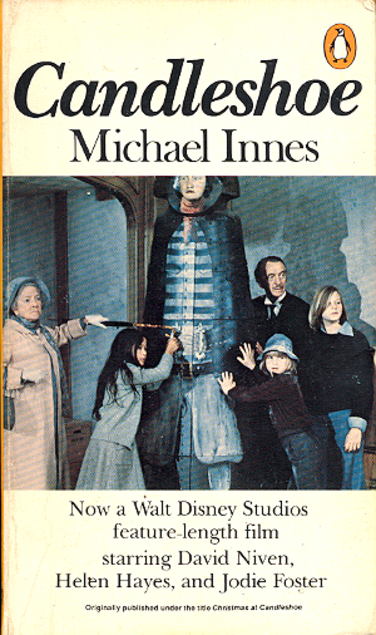
Candleshoe by Michael Innes was a very recent purchase by me. I bought it when I was down in the Scottish Borders a couple of weeks ago. I hadn’t even heard of this book before but Peggy knew about it and she has seen the film that Disney made of it. In fact the book was originally called Christmas at Candleshoe but my copy is a later tie in to the film. The book has nothing to do with Christmas the festival at all, it’s someone’s first name. As you can see from the book cover David Niven starred in the film, I don’t know how I managed to miss seeing it. Possibly it was released during one of the several times that our local fleapit in Dumbarton was closed due to fire damage. The Rialto,the last surviving cinema was forever going on fire for insurance purposes it was rumoured!

It’s a bit confusing as although the film is apparently aimed at kids, being made by Disney, the book definitely wasn’t written for children. Michael Innes had a habit of using the art world as part of the plot in his books – as he does with this one but it bears no resemblance to his Inspector Appleby mysteries.

A very wealthy American woman tourist is in Britain touring the usual country stately homes. As her son is a student at Oxford and she is very keen on all the ancient history of England, she’s on the lookout for an estate to buy and refurbish. When she stumbles across a house that has been completely bypassed by the 20th century she’s enchanted.

Her son fears that she’s determined to buy the ancient pile and Jay a teenager who seems to be keeping the whole place going is also worried that the very elderly owners would be happy to sell up. Jay believes an old story that there is treasure somewhere in the house and he’s not surprised when the house comes under attack from thieves.

The whole thing is a bit crazy and I have to say that this definitely isn’t one of Michael Innes’s best books. He was always very keen to shoehorn literary elements into his books, I suppose because for his day-job he was a university lecturer in English, but I don’t think that mentioning Meredith and numerous other literati does much for the pace of a mystery. He drops in Latin phrases in much the same way as Dorothy L. Sayers did, which is fine if like me you were lucky enough to do Latin at school, but I suspect that it’s just an annoyance for many people. At least he doesn’t switch to Greek as Sayers did at times!

This is my 21st book read for the Read Scotland 2016 Challenge. That level was originally being named ‘Back O’ Beyond’ but since visiting the Isle of Skye recently with Peggy, I think it is now going to be called Skye, or Isle of Skye – it’s up to Peggy. Any levels beyond that being named Orkney and then the ultimate – Shetland.

I think I’ll be giving this one a three on Goodreads.

The Edinburgh Book Festival – and more

It’s almost festival time in Edinburgh again, it comes around quicker every year. The Edinburgh Festival is of course made up of various festivals, not just The International Festival, there’s also The Fringe Festival and the Book Festival is one of the newer ones on the scene, but it’s always very popular, click on the links above to see if there’s anything you fancy going to see anything.

The View from Castle Rock is an event from the Festival Fringe and it’s based on two short stories by Alice Munro. I quite fancy seeing this – if I can brave the Edinburgh crowds!

Meanwhile The Power of the Dog by Don Winslow is one of many books that has a good shot of making it to the big screen. I haven’t read anything by the author, have you?

Have you been to see the movie of Ab Fab yet? I’m not sure whether I want to see it or not, having heard mixed reviews of it, but the trailer looks quite funny.

Breakfast at Tiffany’s by Truman Capote

Breakfast at Tiffany's cover

Breakfast at Tiffany’s by Truman Capote was first published in 1958 and the paperback I own has three short stories in it too. In fact Breakfast at Tiffany’s itself is really a novella and is quite different from the film.

Although I enjoyed the book I think I love the film, maybe it’s just because of Audrey Hepburn’s performance in it, but the film does have another layer of storyline to it. In the book Holly Golightly’s neighbour ‘Fred’ doesn’t have a relationship with a wealthy woman and that aspect to the film was important to point out double standards.

Truman Capote was a life-long friend of Harper Lee and I believe that Dill in To Kill a Mockingbird was based on the young Capote. It seems quite incredible doesn’t it?!

The short stories in this volume are:
House of Flowers
A Diamond Guitar
A Christmas Memory

I enjoyed the last of them the most.

Below are ten things that you may not know about the film.

http://www.vogue.com/13257887/audrey-hepburn-birthday-breakfast-at-tiffanys/

Victoria Wood 1953-2016

We were driving along happily listening to the radio this afternoon, it was a beautiful day with a promise of summer around the corner and a day and evening out in Edinburgh on our immediate agenda – when the first thing on the radio news was the death of Victoria Wood. What a terrible year this is turning out to be with the loss of yet another ‘national treasure’.

I remember Victoria Wood as far back as watching her on that TV talent show that brought her to everyone’s attention, and I know I’ve blogged about her before. It was unusual for a woman to be doing stand-up comedy back then in the 1970s, she was a real trail-blazer I think but she was just hilarious. I never tire of hearing that comedy song The Ballad of Freda and Barry (Let’s Do It)

I suppose she knew how much she was loved in the UK, she got a couple of BAFTAs I’m sure – for dinnerladies, which is one of the few sit- coms that I have on DVD. It’s unusual in that the love interest becomes seriously ill so it was always tempered with a hint of sadness, but of course he got better, it’s a pity that Victoria couldn’t write a happy ending like that for her own serious illness, and so typical of her that she kept it quiet as she was a very private person, not at all like most entertainers. She was crippled with shyness in her earlier years and she apparently only really got over that when she was in her late 40s, like many of us – saying that somehow being shy didn’t seem appropriate for a person of her age.

I watched her playing the part of Nella Last in Housewife 49 and was gobsmacked that she turned out to be such a good serious actress. It’s such a shame that she didn’t get a chance to expand on that talent.

To see what Jack said about Victoria on his blog look here.

Dad’s Army – the film 2016

I’m a big fan of Dad’s Army, I have all the DVDs but still never miss it when it’s on TV so I swithered about going to see the new film version, but given the fantastic cast I decided I had to give it a go.

We went to the nearest cinema which I hadn’t been to since seeing Gandhi there way back in 1982, we didn’t have to worry about getting babysitters then! I remember it because the cinema was completely packed out and I was sitting next to a man who smoked all the way through the film, so I saw it through a fug of smoke. It now seems so weird that people were ever allowed to smoke in cinemas and theatres. In the intervening years the cinema had changed completely and instead of normal seats it has lots of leather two seater sofas, as springy as a trampoline, but with lots of leg room for once, it was very comfy.

Anyway back to Dad’s Army. I really enjoyed it. It’s always going to be a big risk when something as legendary as Dad’s Army is updated but they did stick very much to the originals and the acting was mainly really good. Sir Michael Gambon is particularly good as Godfrey and Bill Nighy makes a good Wilson. They haven’t tried to do impressions of the originals but are similar types, the only one I thought didn’t quite hit it right was Tom Courtenay as Jones.

There are plenty of nods to the original series and also one to Braveheart which you can see if you look at the trailer below.

Sunset Song – the film

Sunset Song by Lewis Grassic Gibbon was published way back in 1932, it’s set in rural Scotland in the early 1900s and it tells of the hard life that the people had, particularly the women, especially if their husband was a brute, as Chris’s father was. Everything changes when World War 1 breaks out and so ends a way of life and life itself for so many of the menfolk. It has been dramatised by the BBC, quite successfully, in 1971. But it has been made into a film now, it’s never a good idea to try to squash a book into a film lasting a couple of hours and directed by Terence Davies. Anyway, we felt the need to go and check it out, so we took ourselves off to the Saturday matinee showing of it. The cinema was very busy, unusually so lots of people love the book and obviously lived in hope.

Almost from the beginning I was disappointed by the look of Chris, the main character who is in her last year of school. Her hair was so bouffant-ish – with the addition of a couple of plaits/braids. It looked like a very weird wig. Worse was to come though as for some unaccountable reason they chose an English actress to play the part of Chris, who is a young woman from The Mearns, a part of north-east Scotland, not far from Aberdeen. Poor soul, she tried to do a Scottish accent but really it was quite painful to the ear of an actual Scot. In fact I don’t think anybody had an authentic north east accent. Chris couldn’t even manage to say loch – never mind anything else. There must have been a Scottish actress who would have made a good job of the part, they can’t all be working on River City.

To be fair, the rural locations were lovely, it was beautifully set, as were the locations of the various houses involved in the film. I always get a lot of pleasure from looking at the furnishings in films, whether it’s a sumptuous palace or a poverty stricken cottage interior. I think the set designers did very well and to me nothing screamed out as being incongruous in its setting.

But that didn’t make up for the grating mock Scottish accent, and there were a couple of parts which I found almost embarrassingly bad. Particularly a scene when there were lots of people marching across fields, all making for – the church, whilst a very English sounding choir was singing incredibly loudly. That scene seemed to go on forever and I just kept thinking that if I had been the director it would definitely have ended up on the cutting room floor. I know that I’ve seen an almost identical scene in another film, I think it might have been How Green Was My Valley. I felt as if the director was doing a sort of daft homage to something anyway, and he really shouldn’t have, it was dire.

They eventually reached their destination, which was actually Arbuthnott Church, from the outside anyway. We visited the area with Peggy Ann of Peggy Ann’s Post when she stayed with us last May and we had a good look around the church but we weren’t able to see inside it. Anyway, the minister mounted the pulpit steps – a suspiciously new looking pulpit, and worst of all, he was wearing a surplice, one of those white smocky looking articles of clothing that English people seem to think are worn by all religious ministers/vicars/priests. They certainly aren’t and never have been worn by Church of Scotland ministers. Honest-tae-god, if there had been a wall handy I would have been banging my head off it!

To be fair there was some decent acting in the film, it just wasn’t being done by the main character and although there was a lot to fit into the film, considering the book, it still managed to be slow. The woman sitting beside me kept heaving huge sighs and peering at her watch!

I suspect that just about everyone in the cinema was there because they had read and loved the book, and in those circumstances it’s always going to be difficult to pull off a glorious success, but if you just love things Scottish, beautiful countryside and horses – as some people do, then you’ll probably find it worth watching.

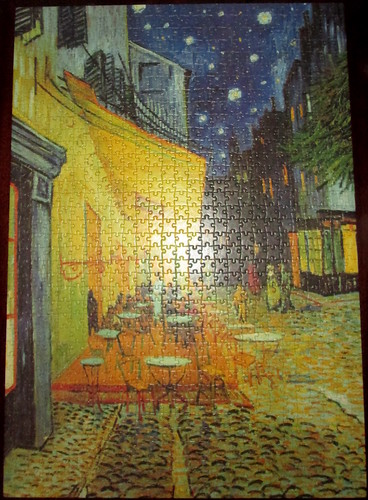
Not Starry Starry Night – Vincent van Gogh

As it’s Burns Night tonight I made the vegetarian haggis from the recipe which was in the Guardian earlier in the week. You can see it here. I’m not inflicting a photo of my version as haggis is never appetising looking but it tasted good anyway. I changed it slightly, substituting soy sauce for the Marmite as I hate the stuff and I added more pulses in the shape of haricot and cannellini beans. I also halved the quantities as there are only the two of us around the table nowadays, but I still have plenty leftover – so no cooking required tomorrow, luxury!

Below is a photo of the 1000 piece jigsaw puzzle which we began about a week ago when the weather was really cold and we were just semi hibernating. It didn’t take us as long as I thought it would. The worst part was definitely the road/pavement at the bottom of the picture, the cobble stones. I originally thought it was Starry Starry Night (or The Starry Night) but it isn’t. It’s The Cafe Terrace at Night.

jigsaw puzzle

Now when you are reading or saying van Gogh remember to pronounce the ‘gh’ properly – a lovely guttural sound as in the word ‘loch’ – none of this Vincent van Go nonsense! In fact the first G should be guttural too.

I’m now searching for another jigsaw puzzle which I bought recently, it’s of a British Rail poster of The Trossachs. I tidied it away before Christmas and now I can’t find it, don’t you just hate when that happens. That’s my excuse for preferring clutter, at least then I know where everything is!

Have you seen the Laurel and Hardy film which is about a disaster which befalls Ollie when Stan starts a jigsaw puzzle – hilarious.

Whisky Galore by Compton Mackenzie

This is just the second book by Compton Mackenzie which I’ve read. I started off with Keep the Home Guard Turning and this one is its sequel. World War ll is having more of an impact on the islanders than before. Disaster has struck and there is no whisky to be had anywhere. Previously they had been rationed to one ‘nip’ every other day but now the islands of Little Todday and Great Todday are completely dry and the boat is eagerly awaited, hoping it’ll be loaded with whisky supplies but the islanders are always disappointed. All of the whisky which is being produced is being sent to America to help pay for the war.

Sergeant-major Odd who comes from London/Nottingham has come back from Africa where he had been sent on war business and is determined to marry his Peggy. The few English characters in the book give Mackenzie the chance to have some fun with the different accents, he obviously had a good ear and although it doesn’t appear in this book, I was impressed that in the first one he wrote the Scottish characters saying amn’t I and English ones saying aren’t I, some writers who should know better don’t seem to have noticed the distinction.

Anyway, if you’ve seen the film which was made of this book in 1948 you’ll know that relief for the islanders comes in the shape of the ship the SS Cabinet Minister. When she runs aground on some rocks it isn’t long before the men of the two Toddays come to the rescue and they’re thrilled to learn from the crew that the ship is carrying 50,000 crates of whisky, bound for America.

Well they can’t leave it all to the tender mercies of the sea can they! I could only find a teeny wee bit of the film on You Tube, but it gives you an idea of it.

This book was first published in 1947 and the author does admit that a ship called SS Politician, with a similar cargo did come to grief off the island of Eriskay in 1945, and Mackenzie claims that that is where the similarities end!! This is another humorous read from the author who is better known for his Monarch in the Glen books.

Mackenzie based another of his books on the same islands, it’s called Rockets Galore and I’ll be reading that one next year for Peggy Ann’s Read Scotland 2014 challenge.