The Singer not the Song by Audrey Erskine Lindop

I remembered that I really enjoyed reading a few of Lindop’s books way back in the 1970s and for that reason I decided to add her to the CPR Book Group list, which is a place for neglected authors and books which deserve to be better known than they are at present. It only seems to be myself and Anne Hayes who have any interest in Lindop’s books at the moment.

Unfortunately her books are quite difficult to get a hold of but I bought The Singer not the Song in an Edinburgh second-hand bookshop and it was one which I hadn’t read before. At first I was really disappointed when I realised that the book is set in Mexico and is about the Roman Catholic church, in fact I almost didn’t read it for that reason, but I’m glad that I persevered.

Firstly I have to say that my copy is from 1954 and the blurb on the cover is wrong when it says that it is set in the revolutionary period of the 1920s and 30s. It is definitely post World War II early 1950s and a bishop is interviewing priests for an appointment in Quantana to replace the elderly Father Gomez who hasn’t exactly stuck to his vows and has lost the respect of his parishioners.

Quantana is a small village in the mountains and is very cut off from the rest of society and the whole place has been taken over by Malo, a young bandit, and his sidekicks. Basically Malo – the Bad One – runs a protection racket in that if the villagers don’t pay him ‘tax’, nasty things are going to happen to them. Malo has an affinity with cats and he has the same habit of playing with his victims.

Father Keogh, a young priest from Ireland, is chosen for the difficult position. Just about the first thing he has to do is get Father Gomez out of the village alive as Gomez believes Malo will kill him.

The whole book becomes a fight for the lives and souls of the villagers as Malo is determined to keep his evil hold on them and tries to humiliate the priest. Father Keogh struggles against Malo for the good of the people who are all terrified of the bandit gang.

It doesn’t sound like much I suppose but it is a very good read and the book was made into a film in 1961. I had already finished the book when I realised this but strangely I had imagined Dirk Bogarde as Malo so maybe I did see it when I was knee high.

There seems to be virtually nothing on the internet about Audrey Erskine Lindop. Possibly her mother or grandmother was Scottish as Erskine is a Scottish surname and place name. She was married to a playwright called Leslie Dudley and I’ve discovered that at one point she lived in a place called Chagford in South Devon. I discovered that because someone is selling a letter from her on Ebay at the moment and you can just make out the address. Does anybody have any more information on this sadly neglected writer?
Miss Marple by Disney?

I’ve just heard on the radio that Disney have bought the rights to Agatha Christie’s Miss Marple. I suppose that if I were on Twitter this is the sort of thing that people tweet about, but I’m not on Twitter so I’m moaning about it here.

What on earth were the people at Disney thinking about when they decided to cast a 38 year old woman in the part of Miss Marple? Have any of them ever seen a Miss Marple film or TV production?

The whole reason for Agatha Christie writing a character like Marple is that she is an elderly lady, a spinster of the parish of St Mary Mead and people are supposed to think that she’s in her dotage and so they don’t take her seriously.

Marple is meant to surprise everyone and triumph over them all with her superior wits and a long experience gained from observing the inhabitants of her very small village.

They are going to lose the whole essence of the Miss Marple books if they do it any other way. Poor Agatha Christie will be birling in her grave, but I suppose her family felt that they could be doing with the money.

A A Milne – Happy Unbirthday

Alan Alexander Milne was born on the 18th January 1882 and I thought about writing a birthday post on that day but then I thought that an ‘unbirthday’ post would be more appropriate.

Although he was born in England A A Milne was from a Scottish Presbyterian background, like so many other authors of childrens’ fiction. The severely strict upbringing seems to have encouraged a wild imagination in those people feeling the need to rebel against such a strait-laced background. Hurrah!!

I didn’t actually read Winnie the Pooh until I had children of my own, and I loved it, in fact I went on a bit of a Pooh binge, reading The Tao of Pooh and Pooh and the Ancient Mysteries as well as collecting classic Pooh ‘stuff’.

Everyone I know seems to be a Pooh character. I think I’m a combination of Kanga and Tigger, depending on my mood, if you can imagine that. Two for the price of one as I keep telling my husband! Which character do you resemble most?

I love the original E H Shepard illustrations and I’m not mad keen on Disney as a rule but I have a soft spot for the 1966 Disney film which you can see some of below.

New to me – Paul Auster

The great thing about the bookish blogosphere is all the recommendations that you get from other bloggers and Paul Auster is one of the writers that I’ve really enjoyed reading this year. Most of the books that I read have been written years ago, I think my theory is that if they are still in print after a long time then it’s a fair bet that they’re going to be worthwhile reading.

I’ve read three books by Auster and they’ve all been quite different but what I really like is that you never know where he’s going to go next. Reading him is like having my favourite sort of conversation, the kind that starts off with something mundane like a comment on the weather but within 10 minutes I and a friend have covered topics such as Lord Byron, English architecture, Balmoral, the racing driver Juan Fangio and then end up by setting the world to rights!

With Paul Auster he mentions in passing people like Hedy Lamarr and Edward G. Robinson – and I just thought – “How did he know?” Because as a youngster I watched a lot of old American movies, my dad was a big fan, we watched them on tv but he had seen them all in the cinema when they were first released decades before.

So at the age of about 10 if someone asked me who my favourite film stars were – my answer was always Hedy Lamarr and Edward G. Robinson! I can understand the Hedy bit now because she was so glamorous and I wanted to look like her when I grew up. Tragic really because it was never going to happen. She had gorgeous dark hair and mine is red or strawberry blonde as my mum always said. When I got my waist length hair cut for the first time I told the hairdresser that I wanted it cut like Hedy Lamarr’s. She didn’t know who I was talking about. Everybody else wanted a Purdy cut or Farrah Fawcett-Major!

Don’t ask me why I was into Edward G. Robinson, I look at him now and think that I must have been a very strange 10 year old. Happily by the time I hit 12 I was a fan of Cary Grant, Gregory Peck and of course Humphrey Bogart. If I’m honest I still have a wee soft spot for Edward G. though.

Anyway, back to Paul Auster’s writing: For some reason the fact that he mentioned those two almost forgotten movie stars really made me feel quite chuffed. It’s nice to feel that you have a sort of connection with a writer. And all that came about because one night when I was wandering around some book blogs I came across a comment from Judith (Reader in the Wilderness) which led me to visit her blog.

It’s serendipity.

Tamara Drewe (the film)

At last the film Tamara Drewe – see below – reached our local cinema so we went out to the flicks this evening, we hadn’t been for ages, not since we saw The Station in fact.

I loved the Posy Simmonds series which was first published in The Guardian newspaper years ago but is now published as the graphic novel Tamara Drewe.

I really enjoyed the film. It’s set in Dorset (Thomas Hardy country) and there is some lovely scenery. Nicholas Hardiment is a successful writer of crime fiction, but he and his wife Beth have opened their house up to putative writers and whilst Nicholas is busy being a pompous eejit his wife is doing all the hard work of baking and cooking and keeping their lovely farmhouse in order.

All is not well, because Nicholas can’t stop having little dalliances which results in a very public bust up, with much effing from the very well cast guests. Actually the whole thing was well cast, even the local schoolgirls who are so bored out of their minds from having to live in such a backwater that they take any opportunity to cause a bit of mayhem.

So when Tamara Drewe moves back into the farmhouse next door and takes up with Ben who is the drummer in a famous band the girls just have to do a bit of meddling.

Well it made me laugh anyway, I’d recommend it to anyone.

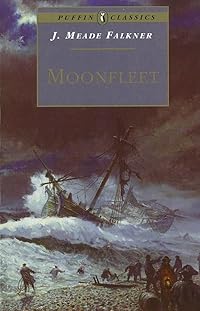
Moonfleet by J. Meade Falkner

Moonfleet cover

A classic tale of mystery and high adventure in a Dorset smuggling village.

Well that’s what it says on the back of the book and I wouldn’t argue with the description. I enjoyed this book, but I must admit that I’m drawn to smuggling tales anyway. Probably because I like the thought of the poor down-trodden souls getting one over the tax-man at a time when they were being taxed even more than we are now.

John Trenchard is 15 years old at the beginning of the book and he is living with his aunt in the village of Moonfleet, which is just half-a -mile from the sea. Both his parents are dead and his aunt has obviously taken him in as an obligation which she would rather not have.

The village has always been full of spooky tales of the ghost of Blackbeard, who haunts the churchyard looking for his treasure – a huge and perfect flawless diamond, which of course is said to be cursed.

When John discovers a secret passageway leading under the church he thinks he will find the diamond there but ends up being embroiled with a smuggling gang.

First published in 1898, Moonfleet is a classic adventure tale, suitable for young and old.

Moonfleet was made into a film in 1955, starring Stewart Granger and that lovely wee Scottish child actor John Whitely.

Durham Cathedral, Harry Potter

We moved on from Newcastle to Durham which is just a hop and a skip away. It’s a vibrant, small city and it was noticeable that they didn’t seem to have any empty shops or even charity shops in the town, which is such a nice change from most towns at the moment.

Obviously the place to visit is the cathedral and although I haven’t been keen on places like that in the past, I have to say that Durham Cathedral has a much nicer atmosphere than any other such places which I have visited.

I’ve been to Canterbury, York and Inverness cathedrals before and to me they all had quite a scary ambience about them, as if they had been built by people who had a real fear of God and they worked that feeling into the fabric of the building.

Durham on the other hand felt really comfortable and friendly. I think part of it may be that the attendants were all very welcoming and helpful. They also have a memorial to coal miners which I thought was a really nice down to earth touch. Usually such places are really snooty and elitist, but not Durham.

Obviously they don’t allow you to take photographs of the inside, it is still a working church and while we were there worshipers were actually using the place and lighting candles and such which is all very foreign to me but no doubt they get comfort from it. I think it must be quite difficult for them to have troops of tourists going around while they are trying to have their private moments.

It’s so big I couldn’t get it in the one picture as you can see. Apparently it costs a shocking £60,000 a WEEK to keep the place going. They don’t have an admittance charge, which is good but on the other hand, donate whatever you can afford.

I hadn’t realised that Durham was used to film scenes in the Harry Potter films until I got there, they must have been paid more than a bob or two for that, which must have helped.

To Kill a Mockingbird and stuff.

Judith at Reader in the Wilderness has been blogging about To Kill a Mockingbird recently, and then, as often happens, she discovered that this is a special year for it, the 50th anniversary of its publication. As it is one of my favourite books I thought I would write a wee bit about it.

I first read the book in the summer of 1971, I had just turned 12 and I was in Germany, Bavaria actually, visiting my pen-pal Jutta for the first time. Her English was not great and my German was nearly non-existent then and I was there on my own so it was quite a difficult, lonely visit.

Thankfully, an American had visited the village the year before and had left their copy of To Kill a Mockingbird behind, so I was given it to read. I absolutely loved it although it was so unfair and I hated what happened to Tom, but it is the only book which I have ever got to the end of and started reading again almost immediately.

It’s not only against racism, but about intolerance of anyone who is different. So when Scout begins to mock Walter a dinner guest, the housekeeper Calpurnia gives her a row for it. If people want syrup on their meat and vegetables, it doesn’t make them any less of a person. My mum would have skelped me into the next week if I had behaved like Scout. Boo, the neighbourhood ‘bogey man’ turns out to be the life saver and a good soul, a victim of a tormented childhood. As was Mayella, life wasn’t all wine and roses just because you were white.

The book is a lesson on how to behave towards people who are different from yourself. Treat everyone as you yourself would wish to be treated.

Some years later I saw the film starring Gregory Peck. The whole thing was so well cast, even the kids were great. Then it was a set book in high school, so it was a shock to me to find out that it isn’t taught in Alabama, apparently the excuse is that as it is the only book which Harper Lee wrote, there is no body of work to study. In my opinion To Kill a Mockingbird has more than enough in it to be getting on with.

Growing up in a small town in the west of Scotland in the 60s meant that I personally had no experience of racism, everybody in the town was white. The big problem there is religion with the Roman Catholic church insisting that they be given money to run their own schools instead of using the normal state schools like everybody else, meaning that there is religious segregation, which is not a good thing.

However, during World War 2 my dad was in the Merchant Navy and he had spent 6 months in New York when the ship he was on needed to have work done on it. It must have been between 1939 and 42, before America was in the war and dad had a very enjoyable time there, especially in Harlem because there were lots of street musicians and dancers, which he loved.

So when he was in a diner with one of his shipmates, they were surprised to be asked to leave. The problem was that they had chosen to eat in a diner which was for black people only. They hadn’t noticed that everybody else was black and apparently some of the regulars were upset by their inadvertent intrusion.

When dad told me that story I was just a wee girl and I thought how terrible it must have been for my really mild-mannered dad to be chucked out of somewhere, but they completely understood and after all it was nothing to the way black people were being treated routinely.

Racism caught up with me though when we moved to England in the late 70s and as a Scot I was not exactly welcomed with open arms. My husband worked for a Malaysian company and was treated as very much a second class citizen compared with the Malaysian workers.

On the other hand, as a Scot, when you go abroad you are in danger of being hugged in the street by complete strangers if they realise that you are Scottish. It happens in France, Norway and Holland, something to do with Scottish soldiers at the end of WW2 I believe. It’s a bit of a shock the first time it happens to you.

So racism and bigotry come in all shapes and sizes and there are laws now to help fight against such evils. In Britain it is common to be tormented by idiots if you happen to be a redhead and there is no law against that. So you go through school being picked on and judged because of the colour of your hair and there are even advertising campaigns in which the so called ‘ginger’ person is ridiculed.

Although I was never a Michael Jackson fan, I did agree completely with him when he said: “I’m not going to spend my life being a colour.” Yes, I’ve got red hair or as my mum called it, strawberry blonde.

What a long meander – back to the book – Judith is going to be buying herself a special edition of it which has been published to celebrate the anniversary.

A few years ago I treated myself to the Folio Books edition, their books are always beautiful and come with nice slip covers too.

If there is anyone who hasn’t read To Kill a Mockingbird – do yourself a favour and read it or even just watch the film.

Sorry, I know I was supposed to be writing just a wee bit but I got sort of taken over somehow.

The Last Station

For some reason we hadn’t got around to going to the flicks for more than 18 months. I think it’s probably just the thought of going out in the cold and the dark that has put us off. On the other hand, I always feel quite guilty if it’s the summertime and we emerge from the dark into bright daylight. It must be a hangover from being told to get out of the house and not waste the daylight as a youngster.

Anyway, last night we went to see The Last Station with Christopher Plummer, Helen Mirren and James McAvoy, amongst others.

It is the story of Tolstoy’s last years. He had formed a new sort of religion called Tolstoyism, which frowned on sex and fun in general. I must say it reminded me very much of the Free Church of Scotland.

Tolstoy (Plummer) is being talked into signing all his book rights over to the Russian people and as you can imagine, his wife (Mirren) is furious at the thought of her children being disinherited in this way.

Enter Bulgakov as Tolstoy’s new secretary in the shape of James McAvoy who has the difficult task of pleasing everyone involved.

I really enjoyed the film. It was well acted and had beautiful settings, lovely costumes, brooches and birch trees, and the cinema was really quiet. No gossiping and sweetie paper rustling. Amazing. What more could you want.

Now I just have to get around to actually reading some Tolstoy.

Regeneration by Pat Barker

This book was first published in 1991 and I’ve been meaning to read it since then. I’m glad that I got around to it at last as I really enjoyed it although it is quite harrowing in parts.

It is set mainly in Craiglockhart War Hospital, Scotland in 1917. It seems that just about every book I have picked up recently has a local flavour to it, sometimes to my surprise.

Army psychiatrist William Rivers has the job of treating shell-shocked soldiers and making them fit enough to be sent back to the front. We hear the stories of several of the patients as they are treated but the poets Siegfried Sassoon and Wilfred Owen are the most prominent characters.

By 1917 Sassoon had had enough of the war and the stupidity of the politicians and generals. He wrote A Soldier’s Declaration which was going to be read out in the House of Commons which would have meant that it would have ended up in the newspapers which was just what the authorities didn’t want.

Sassoon is packed off to the hospital so that the authorities can say that he has suffered a severe mental breakdown. As the train is about to leave the station the guard blows the whistle which reminds Sassoon of the whistle which was blown in the trenches signalling the beginning of an advance towards the enemy. It had never struck me how horrific such a common-place sound must have been for soldiers at that time.

The pacifists are pressurising him to join forces with them but Sassoon still feels a great loyalty to his men still at the front.

If you are at all interested in World War 1 then you will enjoy reading this book even if you have already read Sassoon’s own book Memoirs of an Infantry Officer.

Regeneration has been made into a film which was nominated for a BAFTA award. For some reason they didn’t use the real Craiglockhart in the film, but chose to use Overtoun House which is set in the hills near Dumbarton.
Overtoun
As you can see it is in the Scottish baronial style, which I don’t find at all scary to look at but that might be because I’ve known this house since I was a wee girl, when any family walks up the hills usually took us in that direction.

The real Craiglockhart is now part of Napier University in Edinburgh and I think it must have looked a lot more forbidding and daunting to any poor nerve-racked soldiers.