Some Eye Candy Books

 modernretro cover

I do love looking at home style books but they aren’t the sort of books that I would buy, they’re just eye candy and the library is ideal for searching them out.

I chose one called modernretro – living with mid-century modern style by Neil Bingham and Andrew Weaving. You can have a wee keek inside it here.

Despite it being a wee book it’s full of lovely photographs of furniture, soft furnishings, lighting, accessories, all sorts in fact – all beautifully designed, and no doubt horrendously expensive if you were ever able to track any of it down. Ah well – we can all dream!

Apart form the photographs there’s a lot of information on the designs and designers.

 modern PASTORAL cover

Another one I chose is modern PASTORAL Bring the tranquility of nature into your home by Niki Brantmark.

This one features homes in Scandinavia and the USA, mainly second homes, for people who want and can afford a weekend place when they are stuck working in a city during the week.

The author is a blogger, originally from London but now living in Sweden. Her blog is called My Scandinavian Home and has bucketloads of followers. It’s interesting but I think this is an English woman’s idea of a Scandinavian interior, I’m pretty sure that a Scandinavian woman would have a more colourful home. I’m not fond of all that white on white in the photos on the blog.

I enjoyed the book though and you can get a glimpse of some of the photos in it here.

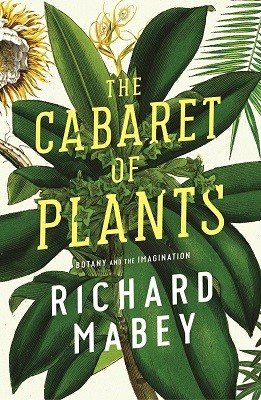
The Cabaret of Plants by Richard Mabey

Gollancz, 2014, 238 p.

The Cabaret of Plants subtitled Botany and the Imagination by Richard Mabey was brought to my attention by way of Stefanie @ So Many Books you can read what she thought of the book here.

This book is full of all sorts of details about ancient trees, when plants began to be depicted by cave artists, the part that plants played in the lives of early pagans, the odd things people in the past believed about plants, how plants inspired poets and artists, plant hunters (often Scottish) and all sorts.

I was most interested in the modern discoveries on how plants protect themselves. Such as the lima bean which gives off a volatile pheromone when it is attacked by spider mites, the pheromone attracts another species of predatory mite which feeds on the original attacker. I call that smart.

I was fascinated to read that in 1928 an Australian called Jack Trott had noticed a crack in the soil of a flower bed which had a sweet scent coming from it. It turned out to be coming from a type of orchid that flowers underground, it lives entirely underground and is pollinated by insects such as termites.

Plants are able to communicate via chemicals, warning their neighbouring plants of an imminent predator attack. This book is full of interesting facts, some you might already know if you’re into plants as I am but that won’t detract from the book.

Mind you I have always thought that plants have intelligence, it seems to be sheer arrogance on the part of humans to think that because plants don’t have bodies and brains like humans then they must be as dumb as a dead block of wood. A good read.

11 Places to Visit – The National Trust for Scotland

The National Trust for Scotland has published a list of 11 magical places to visit in Scotland. I think it’s about time I visited some of them, instead of doing road trips around England.

I’ve only visited numbers 1, 2, 4, 7, and 8. Of the six others on the list I think I would most like to visit Iona. It does look beautiful, I’m sure you’ll agree.

Iona

Reasons to be Cheerful

Let’s face it, there haven’t been many reasons to be cheerful recently in the UK anyway. But this morning I spotted a red squirrel not far from our house. He was just sitting on the grass by the edge of the woodland. That’s the third red squirrel I’ve seen since we moved to our more rural location in Fife. Or maybe I’ve just been seeing the same one each time. I hope not, they did say on Springwatch that red squirrels are beginning to move back into areas that had been taken over by those pesky US grey squirrels. Apparently it means there must be pine martens around, but I’ve never seen any of those. Of course I didn’t get a photo of the red squirrel.

So as you can see I’m trying hard to see some optimism in the world, not an easy task given the Brexit vote and the fact that the Dutch news channels are calling the UK a banana republic. That’s putting it mildly I think. I don’t think I’ll ever get over the horror of that outcome, especialy as the whole Brexit cmpaign was based on lies, it’s not what I call democracy.

Another reason to be cheerful is the fact that Michael Gove has been well and truly trounced in the Conservative vote for PM. It has long been a puzzle to me that that man isn’t in jail, given his lack of monetary honesty and nasty habit of charging his luxuries to the tax payer. It was no surprise to me at all that he knifed Boris, not that Boris is an awful lot better than Gove.

I’m always happy to spot deer out of a back bedroom window, which I did not long ago. This one was munching away in an abandoned smallholding at the back of our house. I suspect that the deer might be the reason it is abandoned as they can easily just step over the fences. Sorry the photos are a bit grainy. I had to crop them to show up the deer.

Deer 2

Deer 4

Deer 5

A Russian Journal by John Steinbeck

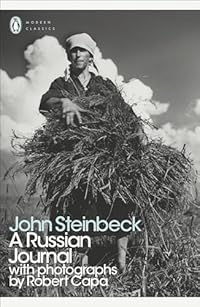
A Russian Journal cover

A Russian Journal by John Steinbeck with photographs by Robert Capa was first published in 1948, and it was 1947 when the two men teamed up to go on a tour around the Soviet Union, speaking to and photographing the ordinary people in their homes and communal farms.

The Soviet people suffered horribly at the hands of the German army and whole areas were piles or rubble with people living underneath the ruins, in what had been the cellars of their homes.

I find it quite amazing that they were allowed the freedom to visit people in their homes and of course they did realise later that the authorities were keeping an eye on their movements. The people were universally welcoming, particularly in the countryside where food was easier to come by and massive feasts were arranged for them and of course an awful lot of vodka was drunk.

They noticed that the people in Moscow didn’t seem to have much in the way of a sense of humour but outside that area and particularly in Ukraine and Georgia the people were very different, I suspect that that has something to do with the different climates as much as anything else.

So many men were killed during the war that it was unusual to see any men of working age at all, and any there were had often had amputations. The women had to take over the heavy work, but they were just glad that the war was at last over and peace was what was on their mind. They longed for a lasting peace but seemed to fear the west wanted to make war. This book shows that the ordinary Soviet people are like people everywhere, living in hope that things will improve and fearing they might get even worse. They are/were just like the rest of us.

Steinbeck mentions that he and Capa missed the mascara and lipstick that the women back home wore, no such fripperies adorned the faces of the Soviet women. I’m fairly sure that make-up was very much frowned on from the beginning of the Russian Revolution. That’s something that was very different from the attitudes in Britain, especially during World War 2 when Churchill said it was a woman’s patriotic duty to make the best of her appearance, for her own morale as well as the men.

This book is a really interesting read but I was quite disappointed that it has comparatively few photographs, considering that Robert Capa took thousands of photos. Sadly Capa died in 1954 when he stood on a landmine when he was covering the First Indochina War.

When I was growing up in the 1970s the Iron Curtain was very much still drawn and it seems to me that over the years from just after the war to the late 1970s things must have got harder and harder for the Soviet people instead of improving. Certainly we were always reading of food shortages and when Jack visited Leningrad in the 1960s he noticed that all the children wore clothes that were far too big for them, obviously they were expected to grow into them over the years.

I did quickly flash a photo of a tank and asked him if it was Russian and he instantly said – It looks German, but it’s probably a self-propelled gun. Is it a bloke thing? or is it a war history buff thing? I wonder.


The Chequer Board by Nevil Shute

The Chequer Board cover

The Chequer Board by Nevil Shute was first published in 1947 and it was my friend and one time neighbour Christine who pointed me in its direction, and I’m glad she did as it was a really good and interesting read.

John Turner, a flour salesman has been having health problems for a while, he had been badly wounded during the war and it was thought that he wouldn’t survive his wounds. He does get better but the fragments of shrapnel still lodged in his brain years later have started to give him problems, the upshot being that he is given around one year to live.

John married just before the war but over the years he and his wife have grown apart, his prognosis brings them together again and when John decides to track down the men he feels had given him the will to live again when he was in hospital, his wife helps him track them down.

It was a very disparate bunch of chaps who talked to John when he was unable to move and having to lie flat in a hospital bed. One was a very snobby RAF pilot, another was a young black GI who had been based in Cornwall, and a young corporal charged with murder. Their stories and experiences have been in John’s mind since the war. He feels they saved his life and before he dies he wants to know what has happened to them over the years.

I think the most interesting story is the one about the experiences of black GIs in Cornwall. The black soldiers were given the task of setting up camp before the white GIs turned up in Cornwall and the black men caused quite a sensation in the small town, making themselves very popular as they were very obliging, helping people to fix things that had been left neglected and broken due to the fact that most of the local men were off at war.

Everything changes though when the white GIs turn up and take exception to having to share the local pub with ‘niggers’. The US high heid yins decide that the pub will be off limits to the black GIs but the pub owner objects to that and bans the white US soldiers.

According to this book there had already been trouble in two other English towns where there had actually been shoot-outs between black and white US soldiers.

The Chequer Board goes some way to explaining Daphne du Maurier’s attitude towards the US in her book Rule Britannia. (1972)

This is the first book I’ve read by Nevil Shute and I’ll definitely be reading more.

Breakfast at Tiffany’s by Truman Capote

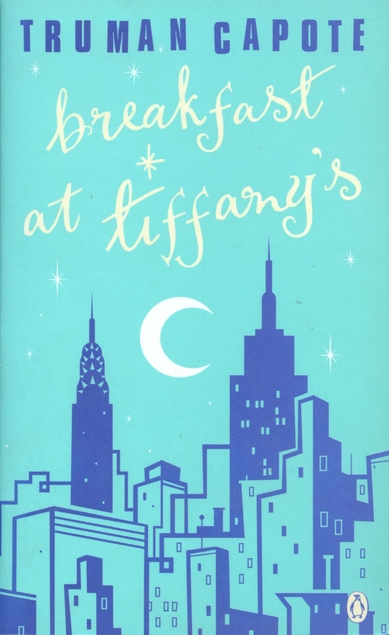
Breakfast at Tiffany's cover

Breakfast at Tiffany’s by Truman Capote was first published in 1958 and the paperback I own has three short stories in it too. In fact Breakfast at Tiffany’s itself is really a novella and is quite different from the film.

Although I enjoyed the book I think I love the film, maybe it’s just because of Audrey Hepburn’s performance in it, but the film does have another layer of storyline to it. In the book Holly Golightly’s neighbour ‘Fred’ doesn’t have a relationship with a wealthy woman and that aspect to the film was important to point out double standards.

Truman Capote was a life-long friend of Harper Lee and I believe that Dill in To Kill a Mockingbird was based on the young Capote. It seems quite incredible doesn’t it?!

The short stories in this volume are:
House of Flowers
A Diamond Guitar
A Christmas Memory

I enjoyed the last of them the most.

Below are ten things that you may not know about the film.

http://www.vogue.com/13257887/audrey-hepburn-birthday-breakfast-at-tiffanys/

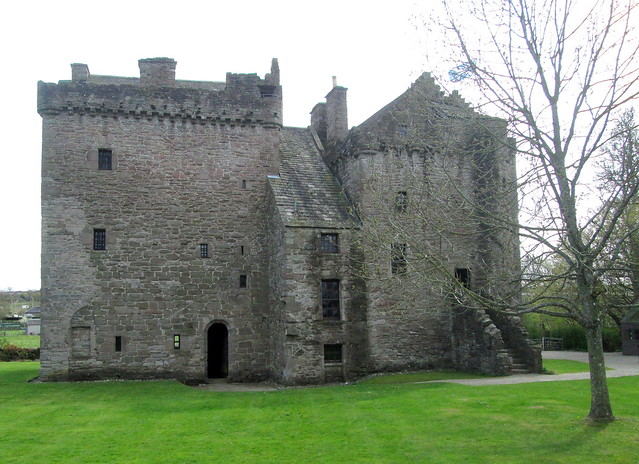
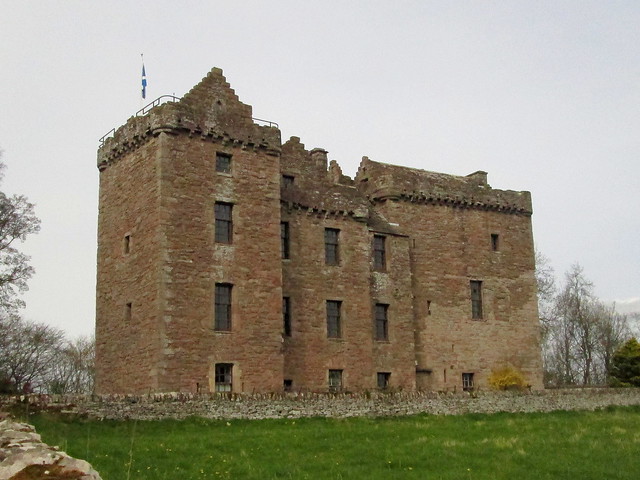
Huntingtower Castle, Perth, Scotland

Huntingtower from north

It’s a couple of months since we went to visit Huntingtower Castle near Perth and I had forgotten that I hadn’t blogged about it until Joan of Planet Joan mentioned that she had just finished reading John Buchan’s book Huntingtower. I read it a while ago and you can read what I thought of it here. You can read Joan’s thoughts on Huntingtower here.

Actually I’m not at all sure now if it is the same Huntingtower as the book was set mainly in the south west of Scotland, but I imagined they moved the action here, I can’t see anything linking this place to the book though.

Huntingtower from south

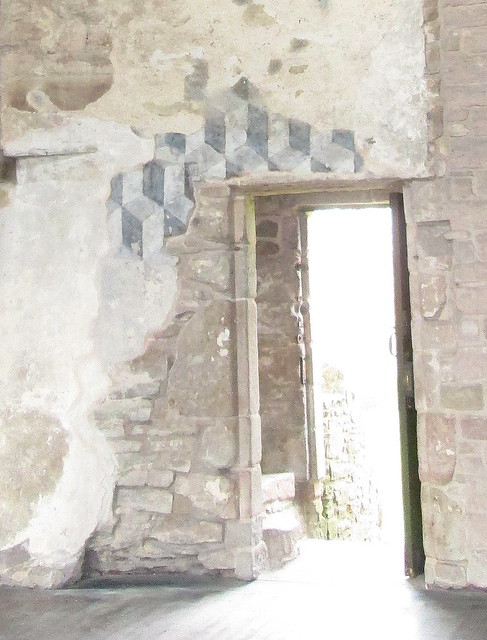
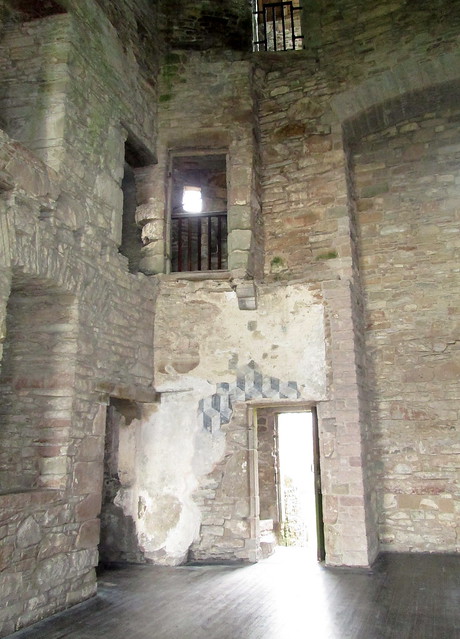
Parts of the tower have windows and other bits are quite open to the elements. Below is a doorway which still has some of the original painted decoration around it, I think it’s quite modern looking.

Hall close; painted door lintel

aHall

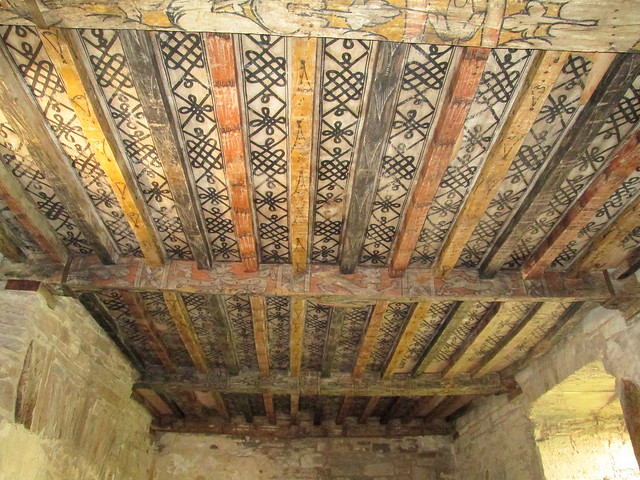
And what do you think of the painted ceiling? A few of the rooms had designs like this painted on the roof beams. This ceiling dates from around 1540.

painted ceiling 1

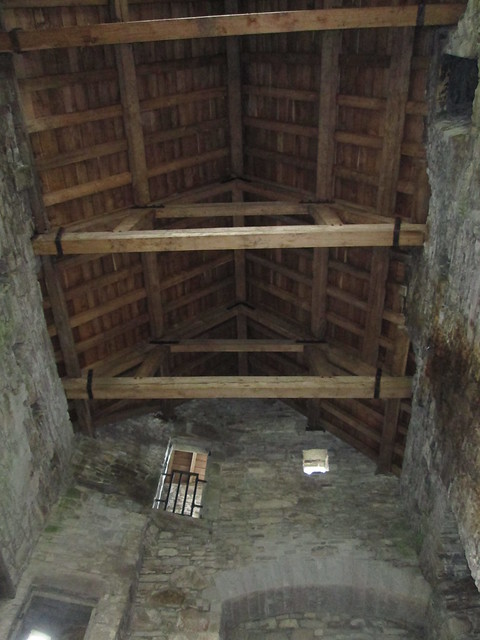
Below is a vaulted ceiling on the top floor.

ceiling +

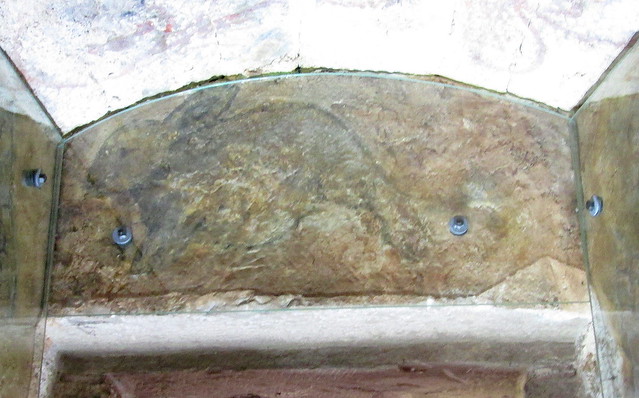
Can you see the rabbit painted on this wall? It has been covered with thick perspex to protect it from the weather.

painted rabbit

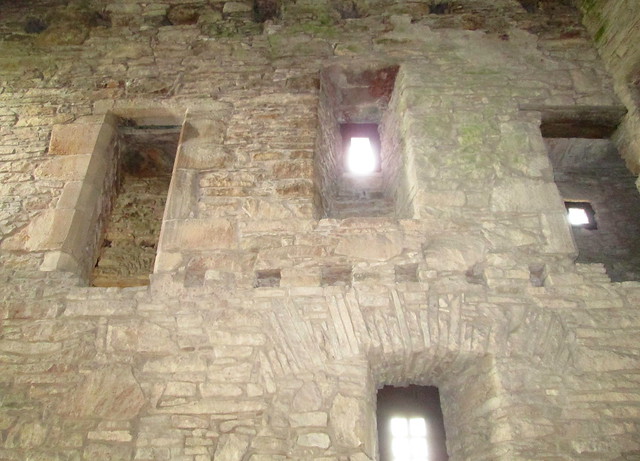
Below you can see the holes where the wooden beams of the floor/ceiling were originally.

upper windows

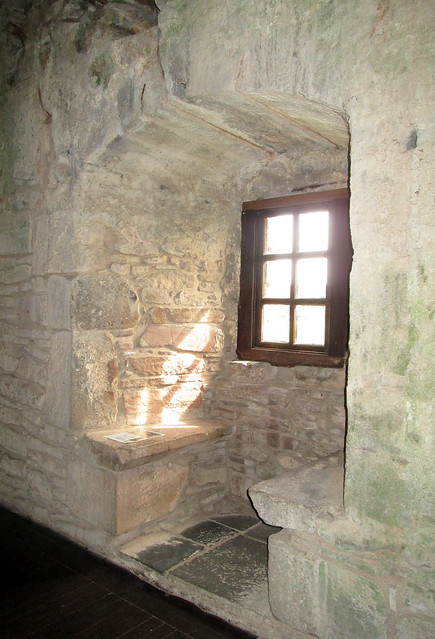
Most Scottish castles/tower houses seem to have these cute wee window seats, they must have been lovely to sit in in the summer anyway, a perfect spot for reading or sewing. You have to imagine the rooms would have been hung with tapestries and cushions or fur would have been on the seats.

window seat

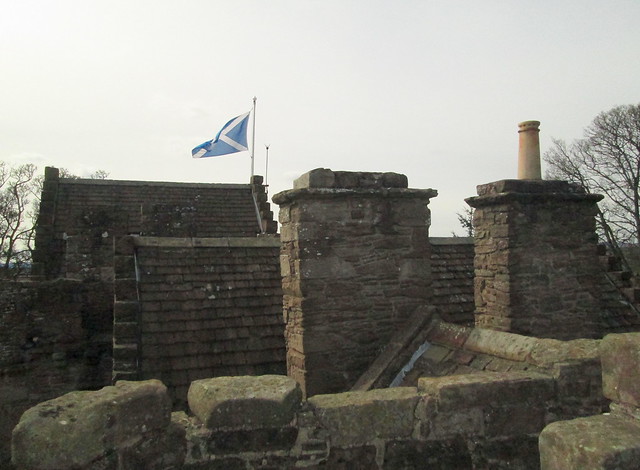
There are loads of spiral staircases to investigate in Huntingtower and one of them leads up to this part of the roof.

a view from roof 3

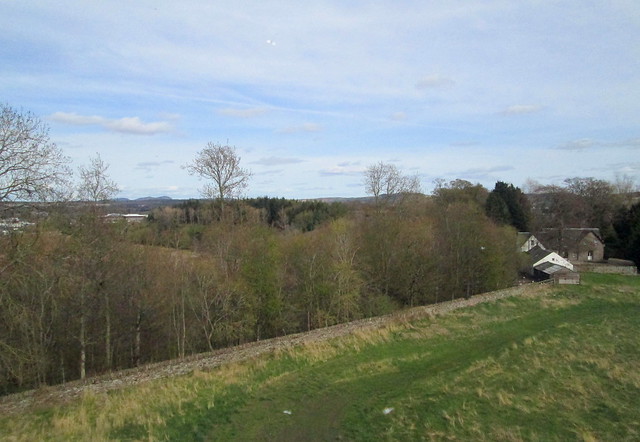
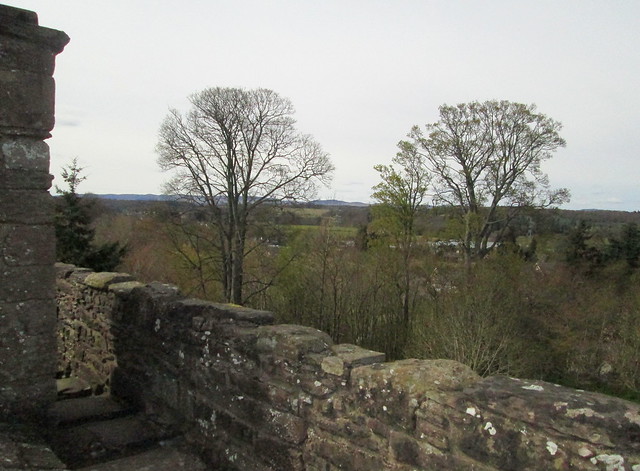
Although there’s now a shopping centre very close to Huntingtower most of the surrounding countryside is still farmland, so not too different from how it would have been when John Buchan set part of his book Huntingtower here.

a view from Huntingtower roof in Perth, Scotland

a view from roof 2

The castle is now home to a large colony of pipistrelle bats, but we didn’t see any evidence of them, it was too early for them to be out and about.

Mary Queen of Scots lived here for a while with her husband Lord Darnley, she seems to have been in just about every castle in Scotland, often as a prisoner. She was a woman who should have copied her cousin Elizabeth of England’s style and stayed well away from marriage!

The Suspect by L.R. Wright

The Suspect cover

The Suspect by L.R. Wright was published in 1985 and it’s the first book I’ve read by this author. She’s known as Laurali Wright in the US.

The setting is a little coastal town in British Columbia, the Sechelt Peninsula otherwise known as the Sunshine Coast. The police force there is of course the Canadian Mounties but disappointingly Karl Alberg doesn’t wear that distinctive uniform as he carries out his crime investigation. Karl has only recently moved to Sechelt, it’s thought of being a bit of a cushy job within the police force, it’s a quiet backwater. Or is it?

This is quite an unusual murder mystery as there is no mystery as to who the culprit is but there is plenty of mystery about why the victim was murdered and how such a likeable chap could commit the murder.

I really liked this one, everything about it, the writing, the setting and the characters. It is the first in a series so it looks like I’m going to be seeking out books from yet another crime series, I have so many on the go! I’m wondering if it is necessary to read these ones in order, I prefer to do that but I don’t think all of  the books will be easy for me to track down.

Sadly the writer Laurali Rose Wright died in 2001. Have you read any of her books?

The only other Lauralis I have ever heard of are the mother and daughter in The Gilmore Girls, a TV show that I really enjoyed, although I’m not even sure their names were spelled the same way. Maybe it is quite a common name in some parts of the world, have you ever met any?

The Somme Centenary

Today is the centenary of the beginning of The Battle of the Somme.
Quite a few years ago we visited part of The Somme Battlefield, unfortunately it was before digital cameras. My maternal grandfather was at the Somme and survived so I was glad to be there and see just a wee bit of the area. It was wet when we were there and so we got a bit of that muddy experience and disconcertingly the mud at the Somme is very red, it must have a very high iron content.

My grandfather was one of those crazy lads who lied about his age to volunteer for the war and I was only two years old when he died in 1961, having lived his whole life dealing with ill health due to being gassed. But one thing has been handed down from him to me and that is the fact that he told his family never to believe any British government, and I certainly have always heeded that warning. In fact I would go further and say – never trust or believe any British politician.

Thiepval Memorial

The Thiepval Memorial has 72,246 names on it of missing men who were killed in the Battles of the Somme and have no known grave.