The House on the Hill by Eileen Dunlop

The House on the Hill by Eileen Dunlop was published in 1987 and the setting is Glasgow.

Philip is an only child and his father has died recently, his mother is having to leave their home to take up a nursing course so that she can support them both in the future. Although Philip’s parents hadn’t had anything to do with old Aunt Jane who lives nearby his mother has decided that she will have to swallow her pride and ask old Aunt Jane to look after Philip for the duration. Aunt Jane hadn’t even bothered to go to Philip’s father’s funeral and that really rankles, but Aunt Jane agrees to look after Philip, she already has another young relative staying with her. Susan is close to Philip in age, but her father is in Kenya, he’s well-off but uncaring, she goes to a posh private school in Glasgow.

The Mount in Wisteria Avenue is a large mansion, but is very much down at heel as Jane doesn’t have the money or energy to refurbish it, or tackle the rampant garden. It’s a big change for Philip and Susan and although they dislike each other to begin with they warm to each other and start to investigate the old house and its strange quirks. It’s all a bit spooky. At times the past is all too present.

Aunt Jane has had a sad life at the hands of her over-bearing father and until Susan and Philip arrived she was stuck in his ways, but a more rosy future beckons for her.

This was another enjoyable read from this Scottish author who apparently taught at Dollar Academy, near Stirling.


Alcester, Warwickshire

I can hardly believe that it’s 12 years since we first visited the small town of Alcester in Warwickshire for the first time. We have a grandfather clock which was made there according to its face, and as we had never heard of the place we decided to go and have a look at it.

Alcester , Warwickshire, Tudor houses

We really liked the town, it had a lovely atmosphere so we weren’t surprised to discover that it had made it to the top of a survey of best places to live in in England. It’s full of chocolate box Tudor houses, which all seem to lean into each other as if they are holding each other up.

Alcester, Warwickshire, Tudor houses

Sadly on our recent visit the pub had obviously had a very serious fire in its roof space as you can see below, but it was being fixed, not pulled down as so many much more recent buildings have been. The building to the right of it looks much more modern but it might just have been modernised over the years, I suspect that originally most of the buildings in the centre of Alcester would have had thatched roofs.

Alcester , Warwickshire, Tudor houses

We had a look at St Nicholas Church. Some people had been hard at work creating this tapestry/needlepoint of some of the local buildings. I’m not sure what it had to do with religion but it’s very attractive anyway.

Alcester Church Tapestry

Alcester (pronounced Aulster) is quite close to Stratford-upon-Avon.

I have posted about it previously, here and here.


The Wild Coast by Lin Anderson

The Wild Coast by Lin Anderson was published in 2023. It’s the first book I’ve read by the author, but she has written lots which feature Rhona MacLeod as a forensic scientist.
It begins in Arisaig, an idyllic setting in the North-West Highlands of Scotland, a very remote area. A young woman has driven there in her camper van and it transpires that she has taken the chance to leave her violent partner while he is out of the country. She has the bruises to show for it, but is attempting to cover them up with make-up. Stopping at a small camp site which is mainly used by just a few wild campers she’s reticent about communicating with the few other campers around, so when she disappears overnight nobody even knows what her name was.

But just before that happens a shallow grave has been found in the machar (grassland) on the edge of the camp. It’s the body of a young woman and bizarrely there’s a figure of a stick man alongside her in the grave. There’s also a stick man figure in the campervan, but the grave is around two months old, so it’s not the missing woman from the campervan. Rhona MacLeod is called in to dig up the body in the grave and gather as much forensic evidence as possible.

The setting changes to Glasgow where there are rumours of corrupt police officers sexually assaulting young students and it looks like Rhona’s close colleague McNab is involved – or is he?

Most of the male characters in this book are truly obnoxious and at one point I wondered if it would ever feature any men who weren’t monsters, although if I’m recalling correctly the reader is never actually in the room when women are being physically abused.

As ever I enjoyed the Scottish setting and it was good to have so many mentions of my old stomping ground of Glasgow’s west end. I’ll definitely read more in this series, but I imagine that if you have suffered from abusive and coercive men in the past then you probably won’t want to read this one.


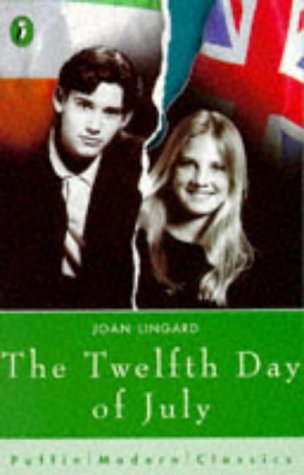
The Twelfth Day of July by Joan Lingard

The Twelfth Day of July by Joan Lingard was first published in 1970, so it was probably written just as ‘The Troubles’ of Northern Ireland started to become really serious.

The book begins on the 7th of July, just five more days to go until the Glorious 12th,  in the Jackson’s Belfast  home they’re all counting the days until the members of the Orange Lodge bands will be marching wearing their smart purple and orange uniforms and playing their instruments, it’s the highlight of their year, commemorating the anniversary of the Battle of the Boyne. This year Sadie is taking part for the first time.

But the night before the big day the huge mural of King Billy on his white horse which is painted on the gable end of the Jackson’s house is daubed with green paint by some  Catholic youngsters who live in a nearby neighbourhood.  Sadie and her brother Tommy are incensed, and so begins a tit for tat battle between them and the boys they know to be the culprits. The youngsters are able to move quite easily between the two areas, something which was stopped by building a massive wall between them, to keep the two factions apart. It was still there when I visited Belfast in the mid 1990s, I suspect it might still be there.

Sadie Jackson is a great character and Kevin is obviously an admirer. This is the beginning of a series featuring them as a couple who are caught up in the religious sectarianism of the divided and violent Northern Ireland. I’m looking forward to reading the others.

Young Mungo by Douglas Stuart

Young Mungo by Douglas Stuart was published in 2022. Previously I have read Shuggie Bain by the same author, he won the Booker Prize in 2020 for that one.

To begin with I had my doubts about reading this one because I wasn’t totally enamoured with the premise which is the awakening of gay sexuality between the main character Mungo and his friend James. But there’s an awful lot more to the book than that. I really liked it, my only quibble is that it is very similar to Shuggie Bain in that it features a family of two young boys and a sister, with a totally out of control alcoholic mother. Jodie the sister is the smart one, she wants to make something of herself, and thinks that Mungo could too, if he gets away from the family.

The setting is mainly Dennistoun in Glasgow’s east end (where I was born – it has changed a lot since then!)

Mungo is the youngest in the family, but they’re all very close in age. Hamish is a bit of a wee hardman, he’s a small time drug dealer and general bad lad, incredibly violent and a proud and bigotted Protestant. He wants Mungo to be just like him, part of a family firm. Mungo really isn’t interested in the violence and mayhem that surrounds Hamish, but Hamish makes him take part in an attack on the Fenians, the Roman Catholic lads in a nearby neighbourhood.

Mungo is much happier spending time with James at his racing pigeon doocot/dovecot, but James is a Catholic. Hamish isn’t going to let that relationship flourish.

Meanwhile Mo-Maw as they call their mother is steeped in self pity and like all addicts the only really important thing to her is alcohol, so she’s often absent from home for weeks at a time. From time to time she goes to Alcoholics Anonymous meetings and it’s there that she meets two men who she happily hands Mungo over to so they can all go on a fishing holiday to the Highlands, with the idea that they will help Mungo to ‘man up’.  Mungo just wants to be with James.

I ended up enjoying this one a lot more than I thought I would, but I hope that the next book by the author has moved away from a three child family with an alcoholic mother.


Leens, farm worker’s house, Netherlands

Way back in June last year we visited my brother and his wife in the Netherlands. Their neighbours suggested that we should visit the Burg at nearby Leens, so on a lovely sunny and warm day we did just that. You can see my previous posts on the Burg here and  here.  After visiting the rather grand house we went for a walk around the surrounding farmland and decided to visit the farm worker’s house which we could see in the distance. I’ve been to loads of stately homes in the UK but I don’t ever recall any of them also having a farm worker’s house that you could look inside. I suspect that most of the small estate houses in the UK have been modernised and rented out to holidaymakers.

labourer's cottage , Leens, Netherlands

Leens, labourer's cottage , Netherlands

labourer's cottage , Leens, Netherlands


labourer's cottage, Leens, Netherlands

Honestly, I would quite happily have moved in. The rectangular box in front of the chair in the photo below is lined with metal and you put hot coals in it and put your feet on it with your long dress draped over it, too keep your feet and legs toasty!

labourer's cottage , Leens, Netherlands

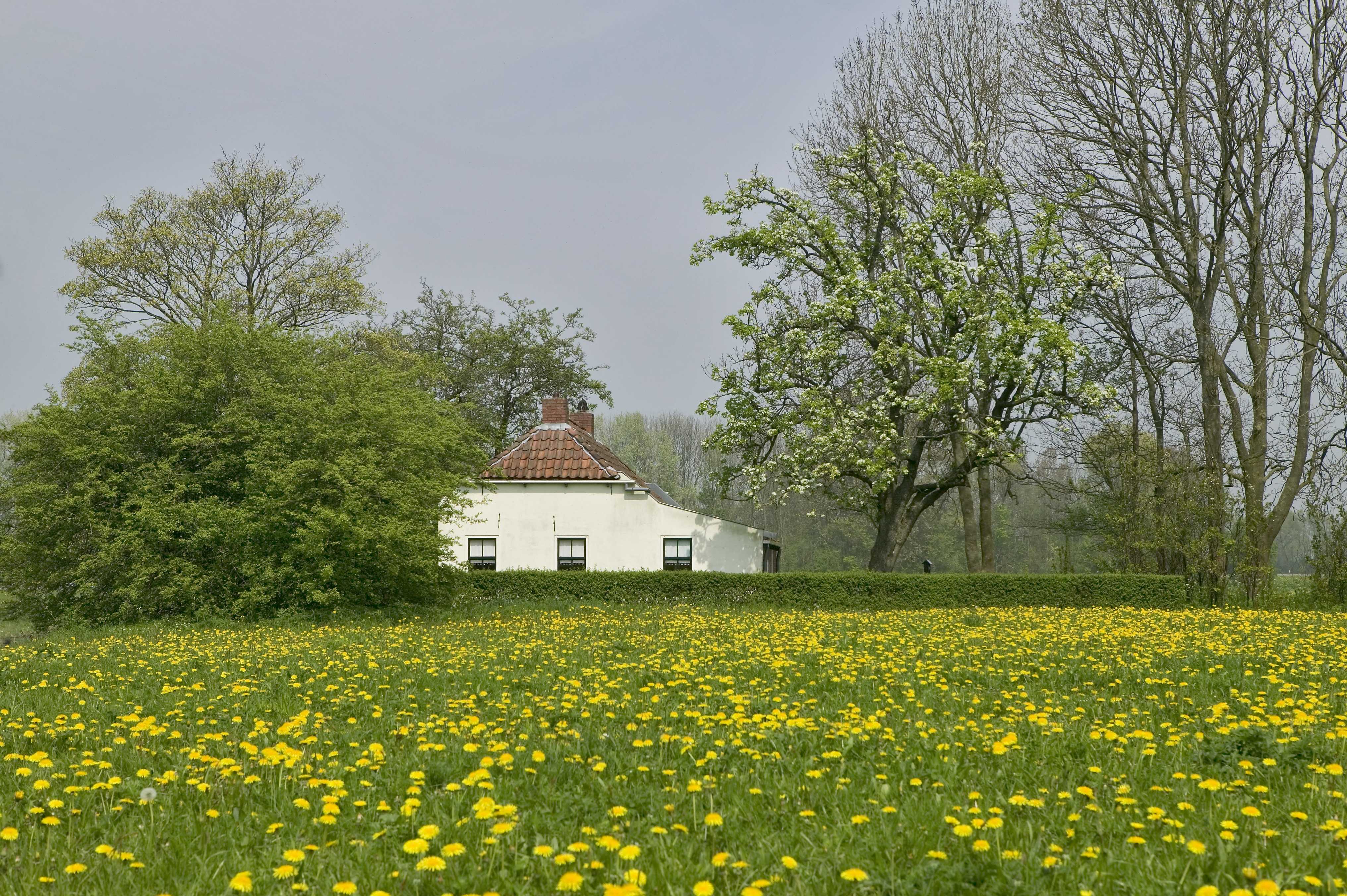
The wee house is surrounded by farmland, and the formal gardens of the Burg, as you can see below. It’s a beautiful area, despite there being no hills!

Burg, Leens, Topiary, Netherlands

This is a photo of the outside of the worker’s cottage. (Copied from the Burg’s website.)


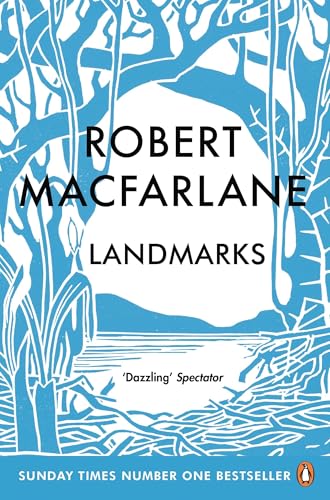
Landmarks by Robert Macfarlane

Landmarks by Robert Macfarlane is one of those books which increases your wish list of books to read as he makes so many of the books that he mentions sound so interesting.

As the author says on page one, it’s a book about the power of language and each chapter ends with several pages of glossary, descriptive words for natural landmarks, sounds, plants, beasties, weather and more which are local to places all over the UK, and sometimes having roots further afield.

I’ll just mention some of the people who appear in this book: Nan Shepherd, Roger Deakin, John Muir, Richard Jefferies, Kenneth Allsop, J.G. Ballard, John Ruskin, Jacquetta Hawkes, Clarence Ellis and many more.

Chapter 11 is titled Childish and Macfarlane writes about the lack of experience that the children of today have of playing outdoors in nature. Their play worlds have shrunk to their garden (if they’re lucky enough to have one) and a bit of pavement. When they do get the chance to sprachle about in the wild it unleashes their imaginations and they enter another world entirely. I can completely empathise  with that feeling as I was born in a city flat and moved out to ‘the country’ when I was five years old, for the first time I had a garden that I could just daunder out into via the back door and poke around in, and see sheep in the distance whenever I felt like it. I can clearly remember that feeling of freedom, and not too many years later I was able to walk in those not too distant fields on my own. Such was life for children in the 1960s and 70s.

At the end of the paperback edition of the book Robert Macfarlane writes that people from all over the world have written to him to tell him of words that are still used in their locale to describe weather, landmarks and such. I won’t write to him but the word that I love is Xirimiri,  which the way it was pronounced sounded like smirimiri.) I’m not sure if that is how it should be spelled because it was just given to me by a tour guide when I was visiting the Basque country in Spain. Anyway, I love it because it’s so close to the Scots word smirr and they both mean that very fine rain which you can barely see but soaks you through to the skin. The word must surely have a Celtic background, as the Basques and Scots share that heritage.

The Years by Virginia Woolf

Previously I had read three of Virginia Woolf’s novels and I had decided that she really wasn’t my cup of tea, but I found The Years to be much more enjoyable, probably because it’s a bit of a family saga.

The chapters are headed with a date, beginning with 1880 and continuing to 1891, 1907, 1908, 1910, 1911, 1913, 1914, 1917, 1918 and ending with The Present Day (which of course was 1937.) The first and the last chapters are more novella than chapter length. The setting is London, where the Pargiter family live, they’re a middle class family headed by a father who had been in the army. Colonel Pargiter had been wounded in the Indian Mutiny so has a damaged hand. His wife is dying and is upstairs in her bedroom, strangely everyone seems just to be tired of the whole process, she’s taking too long to die, there seems to be no love there, even from the grown children. The colonel has a mistress, but that’s a rather tepid affair too.

Each chapter contains some of the members of the wider family, over the years some drop out of sight, and re-appear later on, just as often happens in families.

You would think that World War 1 would feature in those war years, but it really doesn’t, it’s still all very domestic.  I thought this one was like a mini Forsyte Saga, but that might just be because it was set in the same era.

Jack also read this and blogged about it here.


Suddenly at His Residence by Christianna Brand

Suddenly at His Residence by Christianna Brand was first published in 1946 but it was reprinted by British Library in 2023. It’s an Inspector Cockrill mystery. It’s subtitled A Mystery in Kent, but really it could have been anywhere in the south of England. In Americal this book is titled The Crooked Wreath.

The setting is Swanswater Manor, a large house owned by Sir Richard March. As World War 2 is still ongoing the manor is fuller than usual, Sir Richard’s family has gathered together, including his grandchildren. After the death of his wife Serafita Sir Richard had married his long-term mistress Bella, who had had a daughter by him, and she had had a son Edward. He’s an attention seeker and has concocted mental health issues which might come back to bite him.

The whole manor house is a shrine to the first wife Serafita, there are portraits of her everywhere, and small tables with her ballet shoes and other personal things on show, it’s a cross that Bella has to bear.  Sir Richard is cantankerous and uses his wealth to manipulate his family, he’s always changing his will, despite the fact that he has a weak heart and could pop off at any time.

This is an enjoyable classic country house mystery, although I did guess who the culprit was, but not too early on.

There’s an interesting introduction by Martin Edwards.

Redheads at the Chalet School by Elinor M. Brent-Dyer

Redheads at the Chalet School by Elinor M. Brent-Dyer was first published in 1964, but my copy is a very recent reprint by Girls Gone By.  This one is a bit of a departure from the usual Chalet School series as it’s more of a thriller than boarding school story.

It begins with Flavia and her step-father travelling on a train on the way to the Chalet School. Flavia has red hair and most people call her Copper for that reason, but her step-father explains she must use her real name at school and she has been enrolled under her original surname, instead of her step-father’s surname.

Flavia’s step-father is a policeman and one of his investigations has led to the hanging of a member of a vicious gang. The other gang members have sworn to get their own back on him, Flavia’s life is in danger, but to begin with she doesn’t know that.  The headmistress has been given all the information though.

From almost the beginning it’s obvious that there are nefarious characters hot on the track of Flavia, they know that they’re looking for a girl with red hair, but there are several such lucky girls at the school. Inevitably the wrong girl is nabbed! But of course all ends well eventually.

I enjoy these Girls Gone By reprints, there’s usually a short story at the end by a contemporary Girls Gone By writer.  In this case it’s  An Inspector Calls by Lisa Townsend. There’s also a few pages about the publishing history, notes on the text, and at the very beginning there’s a bit by Ruth Jolly about the apparently fairly regular appearance of girls with red hair attending The Chalet School,  there are more of them than would be expected in society. She also mentions other characters with red hair in literature, and that old chestnut that redheads are supposed to have a fiery temper, which of course had me rolling my eyes as a redhead myself, or as my mother described me – a strawberry blonde.

I almost feel a blogpost coming on about walking in a person’s shoes, because unless you have red hair you have no idea what it’s like! It is the only prejudice which is quite happily allowed nowadays, and features in TV adverts, where derogatory comments about skin colour definitely aren’t tolerated.