Hue and Cry by Shirley McKay

Hue and Cry cover

Hue and Cry by Shirley McKay is the first book in the author’s Hew Cullan series. It’s a murder mystery with a 16th century Scottish setting.

It begins in St Andrews in 1579. The town’s cathedral has long been wrecked by the religious reformers and many of the town’s newer buildings have been built using the robbed stone from it.

Hew Cullan has just returned home after studying law in Paris, he’s keen to catch up with some of his old friends before travelling on to his father’s house. But he gets caught up in a search for a young boy who has disappeared from his father’s shop. It’s thought that his father has probably beaten the young lad for some mistake he had made, but things take an ominous turn when his body is found.

Hew’s old friend Nicholas had been tutoring the victim as the father was hoping to get his son into the university, and suspicion falls on Nicholas. There’s been gossip about Nicholas and as we know, mud sticks, especially in the atmosphere of strict Scottish Presbyterianism. Hew has been shocked by the corruption at the university and also within the law courts, with nobody seeming to care if the actual culprit has been found, or just a handy fall-guy.

This makes it all sound quite grim but there’s a lot more to it of course. Hew is a great character, as is his sister Meg and there’s even some humour with Hew buying a ‘characterful’ horse. The very young King James VI makes an appearance and given the date and location witches are mentioned.

I was however perplexed by mention of ‘a bishop’ on page 257 as the religious upheaval of the Scottish Reformation was to get rid of bishops – which they did.

Otherwise this was a very enjoyable read, enhanced for me because all of the locations are very familiar to me. I think that it would have been a good idea to have a map of St Andrews and environs, as Hew does a lot of stravaiging around the streets and it would have been useful for people who don’t know the area I’m sure.

I’m really looking forward to reading the next book in the series, it’s called Fate & Fortune.
Visitors from England by Elisabeth Kyle – 20 Books of Summer 2022

Visitors From England by the Scottish author Elisabeth Kyle was published in 1941, but my copy is a 1962 reprint.

Peter and his sister Margot are having to spend their holidays in Scotland, with complete strangers. Their mother is seriously ill and is in a nursing home back in England and their father is already dead. They’re not looking forward to being away from home, but Mrs MacDonald who they’ll be staying with has a son around the same age as Peter. Alec isn’t looking forward to spending his holidays with the visitors, he suspects that they’ll ruin his holidays and that they’ll not want to do the sort of things that he enjoys doing. Basically he thinks they’ll be southern softies!

Peter isn’t any better as he tells his sister that as Alec is a Scot he’s bound to be tough. Their assumptions are quickly ‘scotched’ though as the brother and sister are more than willing to follow Alec down a cliff and on to the beach. In the distance they see old Morag. Years ago she had survived a shipwreck, The Silver Horn had been her father’s ship and Morag was the only survivor, ever since she has been talking about the treasure that’s in her father’s old cabin, and hoping that she’ll be able to retrieve it somehow.

This one’s an entertaining tale of friendship with a bit of an adventure thrown in, and some interesting characters who span the class divides.

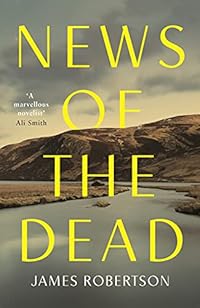
News of the Dead by James Robertson

News of the Dead by the Scottish author James Robertson was published in 2021. It has been longlisted for the Walter Scott Prize for Historical Fiction 2022. I’ve really enjoyed the previous books that I’ve read by Robertson, but I must admit that I was a wee bit disappointed when I realised that this one really has three threads to the book, I’m a wee bit fed up with that sort of narrative because I find there’s always one storyline that I much prefer and I get annoyed when that one is left off to focus on another one, however, the threads all involve one place, Glen Conach which is a remote valley in Angus, the north of Scotland.

Supposedly Glen Conach was named after an early Chrstian Pictish saint, a hermit called Conach, but the book begins in contemporary times when young Lachie, an eight year old boy visits his elderly friend Maja. Lachie’s a bit worried that he might have seen the ghost of a young girl, and he has to tell Maja about it, maybe she can explain what it was.

“To tell the story of a country or a continent is surely a great and complex undertaking; but the story of a quiet, unnoticed place where there are few people, fewer memories and almost no reliable records – a place such as Glen Conach – may actually be harder to piece together. The further into the past you go, the more you feel you are journeying into a strange, unknowable region. The hazier everything becomes, the more whatever facts there are become entangled with myth and legend. And when you return to the present, it may seem that fact and fiction were never that discrete from one another after all.”

The time loops back to 1809 when Charles Kirkliston Gibb is writing his journal at Glen Conach House. He’s a bit of a conman really, he relies on being able to talk the owners of grand houses into allowing him to stay with them while he does research in their libraries. Otherwise he would be starving or would have to live off his poor widowed mother.

This time around he’s doing research into the life of Saint Conach and needs to read the Book of Conach, one of the many books in the very good library at Glen Conach House. He plans to spin his research out until he can blag his way into another grand house, but nothing goes to plan.

This is a great read, actually I’ve just read that it has won the Walter Scott Prize for Historical Fiction, which was announced last week. I’m not at all surprised.

On a personal note I must say that James Robertson seems to be a ‘good guy’ as he took part in the campaign to stop Fife Council from closing 16 local libraries some years ago. He actually turned up at meetings, but it was all to no avail, even with Val McDermid and Ian Rankin weighing in too, the decision had already been made I’m sure.

The Monarch of the Glen by Compton Mackenzie – 20 Books of Summer 2022

The Monarch of the Glen by Compton Mackenzie was first published in 1941. I think the first thing I have to say about this one is that if you were a fan of the TV programmme then you will probably be disappointed with this book. I only saw a few bits on TV which was obviously updated to comtemporary times. It looks like they just took the character of the laird with his eccentricity, his lady wife is certainly nothing like the sophisticated and beautiful Susan Hampshire.

The laird, Donald MacDonald of Glenbogle Castle, otherwise known as ‘Ben Nevis’ is hopeful that his eldest son will persuade a rich female American guest to marry him and so solve any money problems the estate has. Kilwillie, his neighbour (in the next estate) is hopeful that he will be able to offload a very remote castle that he owns onto some other guests that Ben Nevis has staying with him.

Meantime a large group of hikers, both male and female has decided to camp out on Glenbogle land – right beside a NO CAMPING sign. The only thing that Ben Nevis hates more than campers and hikers is people wanting independence for Scotland! He’s furious and takes the law into his own hands by rounding them all up and sticking them in his dungeon!

There’s a lot of silliness, some laughing at the choice of outrageous tartans by Americans and Scots and of course some romance. The setting is the 1930s or even earlier, and although this book was published in 1941 there’s no mention of war, I suspect it was actually written in the late 30s. It’s mildly amusing but not nearly as funny as Keep the Home Guard Turning, Rockets Galore or even Whisky Galore.

This was one of my 20 Books of Summer

The Sixteen Trees of the Somme by Lars Mytting

 The Sixteen Trees of the Somme cover

Edvard is a young man living on his family farm in rural Norway, growing potatoes and farming sheep. He has been brought up by Sverre, his grandfather, as Edvard’s parents had died when he was only four years old. It’s all a bit of a mystery, Edvard can hardly remember his parents, but he knows that on the day they died he disappeared for four days and then turned up in a doctor’s surgery.

Edvard’s grandfather Sverre had been in World War 2 as had been his brother Einar, but they had chosen to fight on opposite sides, and the brothers had been completely estranged. When Sverre dies the local funeral director says that his coffin is all organised and has been waiting for him for years. It’s a very special coffin, art deco in design made using flame birch wood and had been sent to Sverre years before. Edvard knows that Einar had been in Shetland during the war and decides to go there to find out more about him. Eventually Edvard makes his way to the World War 1 battlefields and cemeteries as obviously the author did as he describes it all so well.

This was a great read which also involves a couple of young women, one in Norway and one on Shetland, so there’s a bit of romance of a sort, but mainly it’s a mystery, very well written, and it was translated from Norwegian by Paul Russell Garrett, he made a great job of it.

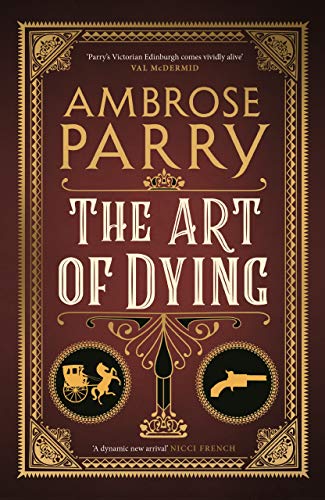
The Art of Dying by Ambrose Parry

The Art of Dying  cover

The Art of Dying by Ambrose Parry was first published in 2019 and it’s a sequel to The Way of All Flesh. The setting is Edinburgh 1849 where Doctor Will Raven has arrived after spending some time in Germany. He has returned to become assistant to the famous Professor Simpson and is looking forward to seeing Simpson’s housemaid again, he and Sarah had had a bit of a dalliance, but Raven hadn’t been able to stomach the thought of marrying a housemaid, albeit one who has a deep knowledge of medicine and herbs as Professor Simpson was happy for her to read his medical books and help him in his clinics. Raven is somewhat mortified to discover that another doctor hadn’t been so and so Sarah is now a doctor’s wife.

Raven realises that people within the city are dying, whole families within days of each other and he’s hoping that he will be able to prove that it’s a new illness that’s killing them, it would be a great thing for his reputation and career. He and Sarah team up to do some investigating. Meanwhile Professor Simpson’s reputation is being attacked by some of his colleagues, the medical profession is a dirty one with a lot of metaphorical knife sharpening going on.

Will and Sarah are determined to protect him, but Will is again in trouble with the local moneylender, something that he thought he had seen the end of previously.

I’ve really enjoyed these books which have a great atmosphere of old Edinburgh, from the lowest of the low in the Old Town to the wealthy and well-known inhabitants of the New Town.

It would seem that nothing much has changed when it comes to ambition within the medical profession – for some people anyway as I was reminded of that English doctor some years ago who was so determined to enhance his reputation and make a name for himself that he ignored anything in his research that didn’t fit in with his own theory. Which would have been harmless I suppose except he terrified some parents into refusing to get their children vaccinated against serious childhood diseases. I believe that after being dealt with in the UK he has moved on to the US to do the same thing, so endangering the lives of loads of children. Thankfully Will Raven is made of different stuff!

Clydesiders at War by Margaret Thomson Davis

Clydesiders at War by Margaret Thomson Davis is the last book in her Clydeside/Gourlay trilogy. The book begins in 1939 and the Gourlay family has just discovered that Wincey’s parents are still alive, it’s all a bit of a shock to them, but worse than that, the international news is not looking good. Surely there can’t be another war with Germany, after all it’s just over 20 years since the end of the ‘war to end all wars’.

Wincey ends up splitting her time between the Gourlays and her own parents, but everyone is busy anyway as Wincey is running the factory which has contracts to make shirts for the army, and everyone else is ‘doing their bit’ nursing, fire watching and such.

I enjoyed this series which is set in the industrial west of Scotland – Glasgow and Clydebank – which were targetted by the Luftwaffe because of the shipyards on the River Clyde. It all feels authentic as the civilians staying at home end up having a worse time of it than their menfolk who are in the armed forces do. Many servicemen survived the war, but their families didn’t.

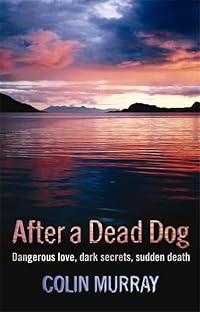
After a Dead Dog by Colin Murray

 After a Dead Dog cover

After a Dead Dog by Colin Murray was published in 2007. The setting of this thriller is the west of Scotland.

Iain Lewis is living in the small childhood home that he had inherited from his father. He makes a precarious living writing various things for TV – now and again. His earlier writing career seemed certain to point to a glittering writing career but it hadn’t come to fruition. In some ways he has been living in the past after his romance with Carole, the daughter of the local wealthy businessman (fish processing) had failed soon after her father’s death. Twelve years on from the end of that romance Iain is attending Carole’s mother’s funeral and meeting her husband Duncan for the first time. Duncan makes it clear that he sees Iain as a danger to him and tries his best to get him into trouble with the police.

Irish gangsters seem to have become involved in Carole’s family business and they’re a violent bunch, but Iain holds his own as he had been a boxer in his student days. It isn’t long before firearms feature in attacks against Iain. The bad guys think Iain has their money and drugs and Iain travels to Glasgow to get help from his old friend Dougie who is a well-known crime reporter who knows some of the gangsters involved.

This book is reminiscent of Iain Banks’s writing, which is definitely no bad thing. I really enjoyed this one. Colin Murray had worked in publishing in London as an editor for years before moving to Scotland some years ago.

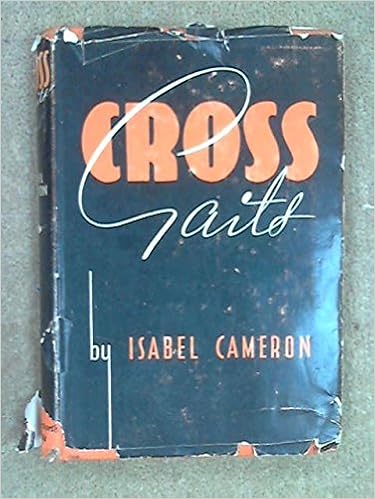
Cross Gaits by Isabel Cameron – 20 Books of Summer 2021

Cross Gaits cover

Cross Gaits by Isabel Cameron was first published in 1945. The setting is Scotland and in the beginning it’s 1904 and Margory Mackay is preparing to marry Hugh Mcgregor a church minister, but there’s turmoil within their branch of Christianity with a split likely among congregations and the so-called church leaders, the usual ‘Free Church of Scotland’ thing. They decide to go ahead with the wedding anyway.

This book isn’t as interesting or amusing as the previous book that I’ve read by this author – The Fascinating Hat. I can vouch for the authenticity of the background of the tale though as it was a hard life being a minister’s wife back in those days, unless you were lucky enough to have money of your own, or the husband had. Those huge manses that they were given as part of the very small stipend were impossible to heat and life was a struggle, especially for the wives. I had that first hand from Jack’s granny who became a rector’s wife during World War 1.

This was just too ‘churchy’ to be a comfy read for me. I’ve bought a few more of Isabel Cameron’s books, just because of the Scottish setting, I feel that they’re a glimpse into the social history of the times, so I hope those ones are more enjoyable than this one.

I read this one for 20 Books of Summer 2021. My copy didn’t have the dust cover.

Lightly Poached by Lillian Beckwith

Lightly Poached by Lillian Beckwith was published in 1973 and it’s the fifth book in the author’s Hebridean series. This series came about when Beckwith moved to Skye in the 1960s from the north of England – for the sake of her mental health and she started to write about her experiences in what was a very different society from what she had been used to.

The ‘poached’ of the title doesn’t refer to eggs, but to the poaching of salmon which was far more prolific than it is nowadays – probably because of all that poaching in the past, apparently even the local minister wasn’t averse to serving poached salmon!

But it’s not all about poaching, there are ceilidhs (a get together, possibly involving dancing if there’s space) which go on all night, not to be confused with a ‘strupach’ which is just a cup of tea with a scone or something similar, and a trip to the mainland to a ‘roup’ (an auction of household goods at a house clearance).

Things are very different nowadays on Skye, in fact I’m not sure how authentic these books are, Beckwith ended up leaving the island after the locals took umbrage at her portrayal of them, but they’re quite entertaining anyway.