Macbeth A True Story by Fiona Watson

I saw this book at my library and as I only knew Macbeth via Shakespeare I thought it would be interesting to find out about the real story. I enjoyed the book but I do have one wee gripe about it and that is that Macbeth doesn’t make an appearance until you are more than half way through the book.

The title of the book is something of a misnomer but I have to admit that it was the title which grabbed my attention. There’s an awful lot of history to read through before you get to Macbeth who reigned from 1040 to 1057. The beginnings of Christianity in Scotland, the Romans, Viking raids and ‘kings’ who murdered each other constantly.

Those so called kings would nowadays be called gangland leaders or warlords, grabbing the top slot by violence and it was only a matter of time before someone else had a go at them.

Macbeth managed to hold onto power for 17 years and was apparently popular but has just about been written out of history because as always, the history is written by the winners and the winners were the Mac Alpins.

Macbeth’s reputation was comprehensively trashed over the centuries and it was a history by Ralph Holinshed of Macbeth which gave Shakespeare the idea for writing his play. So there is no truth in the play at all, but it served its purpose.

Shakespeare had been writing and performing for Elizabeth 1, when the company of actors had been known as The Queen’s Men. On Elizabeth’s death things must have been somewhat disconcerting for them to say the least. They were basically redundant. What was this unknown quantity King James VI (I of England) going to be like? Would he want a company of actors or not?

So Shakespeare set to buttering the King up and wrote Macbeth as the bad guy because King James was descended from the Mac Alpins who had succeeded to the throne after Macbeth. It worked, and it wasn’t long before Shakespeare’s company became The King’s Men.

There were times when ‘ma heid wis fairly birlin’ whilst reading this book, because there were so many kings and murders and strange names, and it seemed a very long time before Macbeth’s story was told, but I did enjoy it.

If you are interested in Shakespeare you might like to read this article In Search of Shakespeare’s Dark Lady, which appeared in last Saturday’s Guardian review.

International Women’s Day and Sara Wheeler

O America book

It’s International Women’s Day today so I thought I would point you in the direction of Sara Wheeler’s new book: O My America – which is about middle-aged Englishwomen who travelled to America in the 19th century, to find a better life for themselves.

I must admit that I haven’t read any of Wheeler’s books but I think I’ll be trying to get a hold of her new one somehow. I especially want to read more about Anthony Trollope’s mother – Fanny Trollope. You can read a Guardian article about the book here.

From the Guardian Review – Rumer Godden by Rosie Thomas

It was my mother-in-law who introduced me to the writing of Rumer Godden, way back in the 1970s. She had loved reading In This House of Brede, and she was keen to read more. Thankfully I was able to get them all from the library that I worked in at the time. Godden had a long writing career and wrote her last novel in 1997, the year before she died at the age of 90. You can read what I thought about that book here.

If you’re interested in finding out more about her you can read the article in this week’s Guardian review here. This article is about the novels which were set in India. Quite a few of her books were made into films, including In This House of Brede and Black Narcissus, both of which are about nuns, not a favourite topic of mine, which makes it all the more surprising that I really enjoyed the books, albeit nearly 40 years ago. Yes it must be that long ago, but I can hardly believe it!

From the Guardian: My Hero – Jean Rhys

Linda Grant has chosen to write about Jean Rhys in the Guardian review section this week. You can read the article below.

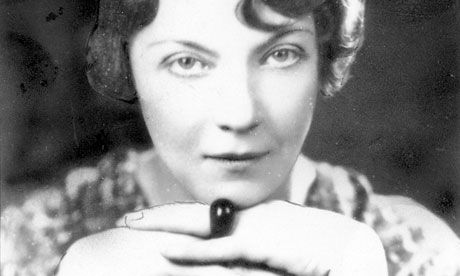
Photo of Jean Rhys

The 20-century novelist Jean Rhys
A level gaze… Rhys is mainly known for the post-colonial context of Wide Sargasso Sea, but her Paris-set 1930s novels have chilling power.

When I was in my 20s in the 1970s I read all of Jean Rhys. I have reread very little since because the first impressions were so powerful they have stayed with me.

Rhys is mainly known for her novel Wide Sargasso Sea, a retelling of Jane Eyre from the perspective of the mad wife in the attic, and I scandalised an audience at the British Library a few years ago by claiming it was a greater novel than Charlotte Brontë’s. Rhys in recent years has most often been seen her in the context of post-colonial writing, but it was the novels written and set in Paris in the 1930s that chilled me to the bone.

A woman, somewhat faded, sits in a room waiting for the post, which might contain a cheque from a former lover that will give her the money to buy a new dress so she can sit in a cafe and attract a new lover. There is a fine line between this and prostitution. I used to wonder if her female characters were simply Jane Austen heroines kicked away from Hampshire and left stranded in the early 20th century. Work is always a last option, jobs are for the defeated, there is no sense of a career leading to independence.

When I read Rhys, I lost interest in fireworks in fiction. Sentence after apparently unremarkable sentence would pass until suddenly you would feel yourself hit in the solar plexus by the accumulated tension. I would look back and ask: how did you do that?

She is the novelist of longing and yearning and rage and sexual desire, and the need for nice clothes and the fear of what happens to women when they lose their looks and become the old woman alone upstairs, drinking alone, smoking alone, dying alone. In After Leaving Mr Mackenzie, the character Julia appears to have no instinct for self-preservation. Yet her creator endures, one of the 20th-century greats. I would die to write like her.

I can’t comment on her novels which are set in 1930s Paris as I haven’t read any of them, but I do have a copy of Good Morning, Midnight – so I think I’ll bump it up my reading pile as I’m intrigued to know what it’s like now.

I have read Wide Sargasso Sea – twice in fact, and watched it on TV but I was never greatly impressed with it. I certainly don’t rate it as highly as Jane Eyre. But – each to their own I suppose.

Mainly Buffering – Pride and Prejudice – Jane Austen

For the last week to ten days our internet connection has been desperately slow, so I haven’t been hopping around visiting quite as many places as frequently as I normally do. It has just been driving me up the wall – clockwise and in a buffering motion of course. I was feeling quite dizzy watching that circle go round and round, then sometimes it stops and starts turning ‘withershins’ – or in English, anti-clockwise. Honestly it’s so slow I could probably take my knitting out and get a row done whilst I wait, and then maybe another row!

I thought that the cavalry was arriving when Gordon turned up, I was thinking that maybe he could do the equivalent of ‘oiling the system’ as he’s a computer programmer – but no such luck. BT have been doing work in our part of Fife so that is probably the reason for the delays. Fingers crossed it gets better soon.

I have been flicking through the actual Guardian as usual and thought that some people might like to read the Pride and Prejudice article. It’s 200 years since P&P was published. You can see the article here. Sebastian Falks and PD James are amongst the contributors.

That linking wasn’t quite as painfully slow as yesterday so maybe it’ll be back to normal soon.

Blandings by Wodehouse and the BBC

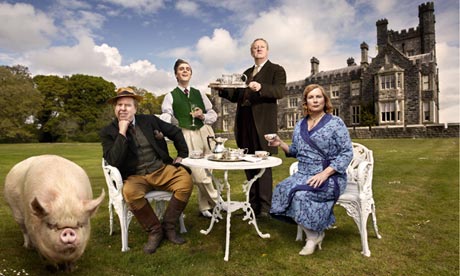
Timothy Spall at Blandings

I bought an omnibus of Blandings books last year and it almost immediately went AWOL and only surfaced when I was getting the house ready for Christmas. By that time the BBC was advertising their Blandings series which started last night, so I didn’t get a chance to read any of the book before viewing it.

I think it was well done though, and even if you just love pigs it was well worth watching just for the lovely big porkers featured in it. Jack even laughed out loud a few times, and that doesn’t happen too often!

Saturday’s Guardian review had an interesting article about Wodehouse and Blandings which you can read here.

The Guardian Review, Anthony Trollope and Thomas Wyatt.

I’ve been busy making Scottish tablet and chocolate cakes for Jack to take into work for their end of term bash, so it was only today that I got around to reading the Guardian Review section. It’s getting to be a bit of a Monday morning reading habit with me.

Anyway, just in case you haven’t seen it I’m linking to the culture section here and also to this article about Anthony Trollope for all you Trollope appreciators.

I thought that this article about a book on the poet Thomas Wyatt might be of interest to people who have read Bring Up The Bodies as he features in it, and almost came to grief along with Anne Boleyn.

What else have I been doing? Well, I was flicking through the TV channels looking for something worthwhile to watch when I came across something called The Making of a Lady. I thought to myself I wonder if that’s actually The Making of a Marchioness, the book by Frances Hodgson Burnett which I read recently, and sure enough it was a dramatised version of it. Annoyingly it was half way through when I got to it – oh well, I suppose it’ll be on again sometime. Did anyone see it? Is it worthwhile watching? It was on ITV which I don’t often watch because I can’t stand all the adverts.

Homecoming by Bernhard Schlink – and a meander

This is the first book which I’ve read by Bernhard Schlink and I don’t know if ‘enjoy’ is the word which I would use to describe my reaction to it, but as Judith, Reader in the Wilderness said, it gave me plenty to think about too. I warn you, maybe you should make yourself a cup of tea or coffee first and IF you reach the end of this meander – you might just need a drop of the hard stuff in it.

To begin with I was quite disappointed that the storyline follows that of The Odyssey because it seems quite a hackneyed one, in English anyway. There has even been a film starring George Clooney called O Brother Where Art Thou which borrows from it. That’s a personal moan though.

Peter Debauer has grown up in post war Germany with very little information from his mother about who his father was but she does send him to Switzerland to live with his paternal grandparents during the school holidays. Whilst reading one of the books which they publish he realises that the end of the story is missing and as an adult he’s still looking for the ending, it’s his quest.

In fact it’s a bit of an obsession and through it he does actually meet up with the man whom he believes is his father. He’s a man who has spent his life bending like a willow in the wind, a determined survivor who had written for both the Nazis and Communists.

I’m presuming that this book was written to try to explain how things like the Third Reich can come into being, because there is an experiment towards the end of the book which isolates people and puts them in a position where they are bullied and do things which they would not normally do.

These experiments are conducted fairly regularly in universities but they’ve always struck me as being unreal situations which have generally used young people (students) as the guinea pigs. The trouble is – I just don’t accept that everybody behaves like that. Some people might, a lot of people might, and after all the McCarthy era in the USA was a similar situation where peoeple were bullied and intimidated into denouncing friends and colleagues. For me this smacks too much of being a ‘don’t blame us – you would have done the same thing too’ situation, regarding the Nazis. I can assure you we wouldn’t, in fact we didn’t.

By coincidence I’ve been reading some travel books recently, which involved journeys by people who happened to be in Germany around 1930. One is Patrick Leigh Fermor‘s A Time of Gifts a well known book, amongst other things he writes about how people in Austria thought Hitler was something to laugh at, he just wasn’t taken seriously. The other book is Modern Germanies as seen by an Englishwoman Cicely Hamilton, published in 1931. Chapter 13 is titled Jew-Baiting. This is the opening paragraph:

The traveller for pleasure in Central Europe who confines himself to the taking of tickets, the paying of hotel bills and the sights and excursions advised by Herr Baedeker may meander through his holiday and return to his home without suspicion of a Jewish problem. But let him once get out away from his tourist beat into private houses and private lives; let him make personal acquaintance even of the slightest; and the chances are that it will not be long before it is made plain to him that here is a Jewish problem and that Anti-Semitism, in Central Europe, is a force both widespread and dangerous.

The whole problem was that Jews were despised in Germany in a way which they hadn’t been in Britain for centuries. Shakespeare’s The Merchant of Venice was written between 1596 and 1598 and it is about Jews being the same as Christians, in Scotland we would say: We’re all Jock Thampson’s bairns.

In 1930s Britain, the British Fascists led by Oswald Mosley, with close links to Hitler went around marching and trying to stir up trouble, especially in the East End of London where there was a large Jewish population. The upshot was that the barricades went up and they couldn’t march, there were running fights in the streets but in the end Oswald Mosley the fascist leader spent World War II in prison at His Majesty’s Pleasure, as did his wife. If you want to know a wee bit about the anti-fascists in London’s East End have a look here.

Anyway, back to the book. It’s about missing information, people not having the knowledge which they should have, things being hidden, and that is something which has always worried me about Germany. I have to tell you that I’ve had a German pen-pal since I was about 10 years old and I was 12 when I went to Bavaria for the first time. I went on my own (!!!) but I was well warned by my parents not to mention the war, just think John Cleese in Fawlty Towers – as if I would! So it was something of a shock to me to see the Nazi war medals and various other things proudly displayed in the living-room. My parents were the generation who went off to war, as did all of their siblings, and my husband’s relatives too, and for that matter the parents of everyone I was at school with and not once in any house did I ever see anything war related in the way of medals. In fact we didn’t find my father-in-law’s medals until after he died, they were in a cardboard box, they’re still in it but we have it now. My own father was in the Merchant Navy during the war (North Atlantic convoys, regularly being torpedoed) and at the end of it all they had to apply to get their medals and he didn’t bother doing it! In fact he hardly mentioned the war until he was on his death-bed, in common with most men who had a particularly bad time during the war. So, I thought the swastikas were weird, but thought no more about it.

Over the years though I’ve been gobsmacked by the occasional barbs at the hands of the wartime German generation, who were obviously more than miffed that they didn’t win it. Like when we happened to be walking past a Bavarian village church – Your RAF bombed our church – it apparently had suffered a tiny bit of damage from a stray bomb. Did I say – Your Luftwaffe killed my great-grandmother? No of course not, I’m too polite – don’t ever mention the war! I sometimes really wish I wasn’t so well-mannered. Then there was: why is your country the only one which calls itself ‘great’- what’s so great about Britain? I had to explain that it doesn’t mean great in that sense. If you only say Britain then it means the main island whereas Great Britain includes all the many inhabited islands which form the country too, from the Channel Islands halfway to France to the Shetlands halfway to Norway. Great means larger, not better than.

Coupled with that is the Germans that I’m related to by marriage, who bring out an enormous life-time sized photograph album, but you aren’t allowed to look at most of it, the photos that we can see are all post-war. Oh how I want to see the Third Reich photographs.

So I’m more than a bit perplexed by Bernhard Schlink’s idea of the war as a burden for Germans, it isn’t to the war generation Germans that I know and what is most worrying to me is that the younger generation, certainly the ones who are about my age (53) are fairly clueless about the whole thing. This is where the gaping whole is in modern German life and it always worried me – even as a child, that if people aren’t told about past mistakes, they can’t learn from them. History is more likely to be repeated and I couldn’t help looking at all those very strange looking guys who used to wander around in gangs in Stuttgart, dressed in leather, with large chains hanging all over them. This was pre-punk and they were in their 30s in the 1970s, maybe it’s still like that but it looked more than evil that the children of the Nazi generation were still dressing like – well Nazis.

Judges in the UK are well known for being rather outside normal society and clueless as to how the rest of us live, so I’m wondering if it’s the same in Germany. Bernhard Schlink was a judge in Germany and according to his interview in the Guardian he knows Germans who try to hide their nationality, perhaps it’s something only done by academics such as himself. The less cerebral ones don’t care. I see no reason why any German who wasn’t involved with the war as an adult should feel any burden for their parent’s mistakes. I’ve never met a German who tried to hide their nationality but I do know a chap from Texas who lives in Scotland and tells people that he is Canadian! Each to their own but I can’t imagine any situation in which I would not say I was a Scot, and woe betide anyone who calls me English – nothing against the English.

I’m glad to say that although my pen-pal of more than 40 years was brought up by strange parents who were obviously less than happy about the outcome of World War 2, she has none of their outlook. For obvious reasons Hitler doesn’t/didn’t feature on German TV, he’s never off some channels here and I think that Germans have to go out of their way to find out about that episode of their past. I used to collect ‘peace’ mugs/cups – which were sold in the UK to celebrate the end of the Great War but I also have one very small German cup which I hoped was from the first war but wasn’t sure. Yes, it’s the 14-18 war my friend said because it is so strongly patriotic!! Honestly, you have to laugh because they weren’t exactly less patriotic in the second war. It does make you wonder though, especially when she says that her father had a terrible time at the hands of the French as a prisoner of war. Not for long surely.

She’s gone a bit off her trolley I hear you say – but, neo-fascists have been rearing their ugly heads in Europe for quite some time now, and you can’t afford to ignore them! Austerity such as we are experiencing now is likely to be used by extremists to whip up support for despicable political parties. Today there were strikes and demonstrations in 25 European countries, that’s all very understandable, we just don’t want any modern day Mussolinis, Francos, Greek colonels or Hitlers taking advantage of the situation.

Well, did you get here? Yes, well then – whisky, vodka, beer or I have some lovely pear cider? Oh all right then, lets have a bit of poor Basil who has concussion and can’t stop mentioning the war.


Patrick Leigh Fermor

If like me you’ve been reading Patrick Leigh Fermor’s books recently, then you might be interested in this article which was in the Travel section of the Guardian on Saturday. It’s about Kevin Rushby’s visit to Greece’s Mani peninsula, where Fermor lived for many years.

Artemis Cooper’s biography, Patrick Leigh Fermor, An Adventure will be published by John Murray on 11 October.

Fermor’s unfinished third volume of his walk across Europe in the 1930s will be published by John Murray in 2013.

You can see an audio slideshow of the Mani peninsula here.

It looks really lovely but, even if I could be bothered with the journey there, I think it would be too hot for me.

The Guardian’s Jane Austen Quiz

I had a go at the quiz in Saturday’s Guardian Review. I was absolutely rubbish, it’s obviously long past the time when I should’ve been re-reading Jane Austen. If you want to try out your Austen knowledge, have a look here.

If you want to have a look at John Mullan’s accompanying article you can read it here.

Book-wise it has been a slowish week because I’m still reading Wolf Hall, I have about 150 pages to go.