The Glass Room by Simon Mawer

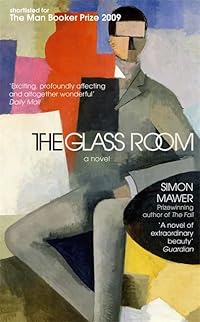
The Glass Room cover

I’m not a great one for reading prize winning books or books that have created a big hoo-ha, call me thrawn (stubborn) but I don’t ever like to be going with the prevailing fashion. So I’ve been some time getting around to reading Simon Mawer’s The Glass Room which was shortlisted for the Man Booker Prize in 2009. I know I read about it on someone’s blog recently, but I can’t remember whose. I read it in a few days and when I got to the end of it I thought to myself – who on earth DID win the prize that year then? I guessed maybe it was Wolf Hall and it turned out I was right. What bad luck for Mawer that his book was up against Wolf Hall. The blurb on the front says: ‘A novel of extraordinary beauty’ Guardian – and it is.

It is set in Czechoslovakia with the story beginning in 1928 when Viktor and Liesel Landauer have just got married. Viktor is a wealthy Jew, the family business is the production of luxury cars. On their honeymoon they meet a young architect who persuades them to allow him to design their new home. The Glass Room as the house is called is a modernist and minimalist series of boxes, all very sleek and expensive with huge plate glass windows, one of which lowers electronically like a car window ( I want it).

After almost ten years of marriage which include the birth of their son and daughter, the Landauers’ seemingly idyllic existence is shattered when the Nazis invade Czechoslovakia. As Viktor is a Jew they know that their time there is coming to an end.

That’s as much as I’m willing to say about the story as I don’t want to ruin it for anyone who like me is late in getting to this book.

I do love books that have a house at the heart of them though, like the house is as much a character as any of the humans. The house at the centre of this one does actually exist as The Glass Room was based on the Villa Tugendhadt in Brno, Czech Republic. You can see images of the house here.

This is the first book by Simon Mawer that I’ve read but I’m keen to read more. Have any of you read anything else by him? if so could you point me in the direction of my next Mawer read?

To Bed with Grand Music by Marghanita Laski

To Bed with Grand Music cover

To Bed with Grand Music by Marghanita Laski was first published in 1945. It’s a very unusual book, for me anyway because although there aren’t really any likeable characters, it still manages to be a great read. Normally that’s a state of affairs that really puts me off a book as I want to be in the company of people that I would be happy to have as friends in real life.

The book begins with Graham and Deborah Robertson in bed, Graham is in the army and he’s about to leave for Egypt. Deborah is miserable at the thought of being without him and she desperately tries to get him to promise to be faithful to her, no matter how long they are apart. Graham is unwilling to give promises that he feels he may not be able to keep, but he does promise that he will never form any relationships with any other women. In other words it would be ‘wham bam, thank you ma’am’. Deborah has to be satisfied with that but she swears she will never look at another man.

Deborah’s mother Mrs Betts knows her daughter too well though and when she sees that Deborah is taking out her frustrations on her young son Timmy, the grandmother in her puts the child’s interests to the fore. Mrs Betts tells her daughter that she believes there are fundamentally two types of women in the world, the mother type and – the wife type. She hesitated over the second epithet, unable to say the word that was really in her mind. Basically Mrs Betts knows that her daughter can’t live without a man in her life, she is completely self-centred and is uninterested in Timmy.

The upshot is that Mrs Betts is able to manipulate Deborah very easily, Deborah jumps at her hints that she might be better getting some sort of war work and leaving Timmy’s upbringing to Mrs Chalmers who is her housekeeper. A local job is not good enough for Deborah though, once she has made up her mind to do war work it’s only London that she’s interested in and she moves into her old friend Madeleine’s flat and Mady helps her to get a job.

But Mady has a bit of a reputation and Deborah knows that Graham wouldn’t be happy about her living with Mady, so she keeps quiet about that and so begins a life of deception. In no time Deborah is being wined and dined every night in posh hotels and clubs. London was jumping during the war, especially if you had money. People lived life to the utmost, knowing that they could be dead at any minute.

Deborah has turned into a ‘good time gal‘ and she is having a great time, manipulating men who are happy to pay her in designer clothes and jewels, allowing her to feel that she is doing nothing wrong, after all she’s not accepting any money. She is handed from man to man, as they are called away to various different spheres of the war. Deborah is briefly appalled at her own behaviour but in no time she is able to justify everything that she is doing. Anything is acceptable if it means that she gets all the material things she wants and is kept entertained by well off men.

She’s a snob and a social climber, in fact she married Graham mainly because she thought his family was wealthier than they actually were. She dreams of divorcing Graham and getting married to one of her gentlemen friends, she has no inkling that the fact that she sleeps with them as soon as she is introduced to them means that she would be seen as completely inappropriate as a wife. In fact, she quickly ends up going way down the social scale.

Meantime of course, Mrs Chalmers the housekeeper is looking after Timmy without so much as one day off in all that time.

So you see what I mean about there being no likeable characters, unless you count Mrs Chalmers who is genuinely very fond of Timmy. Mrs Betts set her daughter onto that path in London, knowing exactly what would happen, she knew her daughter took after Mr Betts whom she had had trouble with early on in their marriage! Still, it’s a really enjoyable book.

I believe that To Bed with Grand Music was reprinted by Persephone books but I borrowed a large print copy from my library, which was published by Isis.That word seems to pop up everywhere, and it used to have such pleasant connotations.

If you mooch around second-hand bookshops you might find a copy of the book with the author named Sarah Russell, the name she originally wrote it under. Possibly this book was seen as being a bit much at the time of its publication, the complete opposite of the sorts of books that kept people going in times of war, light and uplifting tales where women were selfless and uncomplaining, but I’m sure that for a lot of people it was more realistic, perhaps too realistic for some to contemplate.

Appointment with Venus by Jerrard Tickell

Appointment with Venus by Jerrard Tickell is the second book by him that I’ve read and I hope that I can manage to get a hold of some others as I really enjoyed both of them. I wrote about Villa Mimosa here.

Appointment with Venus is about the Channel Island of Armorel (fictional) being invaded by Nazis early on in World War 2. Some of the islanders managed to get over to England before the invasion, including the Suzerain, the hereditary leader, but those who are left, mainly older people and children are having to suffer life under Nazi rule.

Meanwhile back in England, someone realises that a very valuable heifer has been left behind on Armorel. Venus is in calf and a daring plan is hatched to rescue her and take her back to Blighty.

The German commander of the island was a farmer before joining the army and he recognises Venus as being in a class of her own. The Nazis intend to take Venus to Germany where she will be paraded before the cameras as a great prize.

This was made into a film in 1951 and it looks like you should be able to see the whole film on You Tube, if you feel like viewing it. I think I saw it donkey’s years ago, I’m not sure if I’ll watch it again. For some reason I can’t stand Kenneth More, on the other hand lovely David Niven is also in it, as the Scottish soldier hero of course!

If you enjoyed the book The Guernsey Literary and Potato Peel Pie Society then you might enjoy Appointment with Venus too.

The Heat of the Day by Elizabeth Bowen

If you read my recent review of Elizabeth Bowen‘s book The Little Girls you’ll be surprised that I decided to read another of her books. It was a shock to me, in fact when I logged on to My Library Account I was aghast to see that I had requested this book. That’s what happens when you look at blogs late at night and it’s just too easy to click and request books which other bloggers have enjoyed. Luckily I did like this book as much as the other blogger did, sadly I can’t remember which blog it was, do let me know if it was you!

Anyway The Heat of the Day which was first published in 1948 did turn out to be a far better read than The Little Girls, in fact it seems that it was Elizabeth Bowen’s most successful book, I imagine that’s because of the subject matter. The book is based mainly in London during World War 2 which is where Bowen herself was based at the time and she seems to capture the atmosphere of the place perfectly as you would expect from someone who lived through the bombing.

The main character, Stella is a middle aged woman who is having a relationship with Robert who is a few years younger than her. She works for the government. Robert was wounded at Dunkirk, and it seems to have had a psychological effect on him. Depending on his mood his limp can be bad or almost completely unnoticeable.

Stella is divorced and has a son Roderick in the army, his father died soon after the divorce and eventually Roderick inherits an estate in Ireland on the death of a cousin. Ireland was a neutral country and it wasn’t possible for him to travel there as he was in the army. Stella travels there to see to his business affairs, back to the place where she had spent her honeymoon. It’s suffering from the same deprivation as Britain with candles and even matches being in short supply.

Harrison is also working for the government, he’s a counter spy and he’s haunting Stella whom he has fancied from afar for years. He tells her that Robert is suspected of being a spy.

Nothing is as it seems in this book as you would expect from a spy story. Looking at Bowen’s own life it’s easy to see that she used a lot of her own experiences to write it, with a character who suffers from mental infirmity (supposedly) and she herself inherited an estate in Ireland.

This book is regarded as one of the best portrayals of London during the bombing raids of World War 2, when people lived for the moment, never knowing if they were going to wake up in the morning or not.

The book was adapted for TV in 1989.

The McFlannels see it through by Helen W. Pryde

The ‘it’ which the McFlannels are seeing through in this the second book in the series, is of course World War 2. The McFlannels are all doing their bit as is everyone living up the same close in Glasgow. Mr McMuslin is an Air Raid Precaution Warden (put that light out!) and is fairly enjoying himself trying to organise his neighbours. Sarah McFlannel is really only interested in seeing the inside of the McMuslin flat though and when he implies that she can’t take part in the fire watching (looking out for fires caused by bombs) because you have to be under 60, Sarah is incensed, she’s not much older than 50.

The book is full of laughs although as they’re in broad Glaswegian – especially when it’s Willie McFlannel speaking – I’m not sure how well it will go down with non Glaswegians. For me though it brings back so many phrases that I had just forgotten about, and I love the relationship between Willie and Sarah McFlannel. Their children are almost off their hands now, but Willie is still always looking for a ‘wee cheeper’ (a kiss) from Sarah, and Sarah is always being shown up by her husband’s broad Glaswegian accent. Long may it live!

In this one Willie ends up in hospital, having had an accident at work. He keeps dropping in and out of consciousness and one woman says:” Ah mind when Ah had ma operation for ma perspirated stummuck, there wis a wumman in the next bed that was aye drappin’ intae unconsciousness like that, and she was deid in hauf an hoor.” Poor Sarah isn’t amused.

There are quite a few books in this series but the first two have hit the mark with me because the first one was all about the McFlannels flitting and moving up the housing ladder, just as we were arranging our flitting. At the end of The McFlannels see it through they are thinking about downsizing as the kids have grown up, we followed the same pattern as I was reading the books. I wonder what will happen in the next one.

Whatever, I’m sure that there will still be a rivalry between Mrs McFlannel and Mrs McCotton, it’s what’s keeping them going!

I read this one as part of the Read Scotland 2014 challenge.

School for Love by Olivia Manning

I really like Olivia Manning‘s writing. Her husband was a British Council lecturer in Bucharest when World War 2 broke out and her experiences at that time led her to write a series of books which were heavily influenced by their experiences there. She and her husband evacuated to Egypt as the Germans advanced and her husband eventually ended up in charge of the Palestine Broadcasting Station.They didn’t return to England until 1946.

School for Love was published in 1951 and is set towards the end of the war in Jerusalem. Felix Latimer, a teenage boy has travelled there to lodge with Miss Bohun after the death of both of his parents. His only relative is an uncle in England, unfortunately he can’t travel there because all of the ships are being used to carry troops. Jerusalem is jam packed with people in the same situation, just waiting for the end of the war when they can escape the place.

Miss Bohun who had a very distant connection to Felix’s father’s family turns out to be one of those religious tract distributing females. She’s the leader of a Christian sect called the Ever-Readies, who are in Jerusalem awaiting Jesus’s imminent second coming. This has similarities with Stella Gibbons’ Cold Comfort Farm, although not as funny.

The whole book revolves around her personality really and how the other characters have to cope with her. She turns out to be a truly ghastly person. Money grasping, mean and mean spirited, thinking the worst of everyone and all under the guise of being a good Christian woman. I absolutely hated her which I suppose just shows you what a good writer Olivia Manning was, but it almost spoiled my enjoyment of the book.

School for Love isn’t nearly as good as her earlier works, The Levant Trilogy and The Balkan Trilogy but it is still worth reading.

I find it quite worrying that there was probably a character very like Miss Bohun in Palestine at that time as Olivia Manning got a lot of “copy” from her wartime experiences. She definitely lived in interesting times.

Anthony Burgess described Manning as “The most considerable of our women novelists.”