Guardian links

Here we are at another Saturday already, I can’t believe how quickly each week flies past nowadays, there’s another Guardian review section to read today, and I found quite a few interesting articles in last week’s that you might find worthwhile reading too.

If I find a novel features a house to such an extent that it becomes character then that’s usually a big plus for me. I love houses in books, art, crafts, bookcovers — whatever, I’m right there in that house, so I enjoyed this article about famous fictional houses, there are a lot more than Manderley. Do you have a favourite fictional dwelling? Or just a favourite house? Do tell!

I’ve never read anything by Louise Welsh but I read this article about her working day. I hadn’t realised that she lives in Glasgow, near our old stamping ground.

The American author Robin Hobb features in the interview, interesting although again I haven’t read anything by her.

There’s a good article on picture books and novels for tots to teenagers. Although I don’t have any small people in my life nowadays (well not in this country anyway) I’m still drawn to children’s books and sometimes I just have to buy them if the illustrations are particularly gorgeous.

Sarah Dunant’s article is amongst other things about how the historical research that she used for some of her books hadn’t been done 25 years ago. Mainly though she’s writing to promote a BBC Radio 4 podcast – When Greeks Flew Kites, and I believe that anybody in the world can listen to the radio programmes in general.

This Rough Magic by Mary Stewart

This Rough Magic cover

This Rough Magic by Mary Stewart was first published in 1964 and the setting is the Greek island of Corfu, where Lucy Waring, a young aspiring actress is invited to stay with her sister for the summer. Her acting career has come to a bit of a halt so it’s an ideal opportunity for her, especially when she discovers that her sister’s neighbour is a famous thespian Sir Julian Gale. His son Max is staying with him, in fact it seems that Sir Julian isn’t in the best of health.

It’s a wee bit of an English enclave on that part of the island, there’s also a photographer who is working on a book of photos of the island and its animals and a dolphin features fairly prominently. But there’s plenty of local colour and of course romance.

Corfu is apparently supposed to be the setting for Shakespeare’s The Tempest from which Stewart took the title for this and which is one that I’ve been intending to read for absolutely yonks now, and I really wish I had got around to it as there are so many quotes from it in the book. Mary Stewart was really well-read.

I enjoyed this one, there’s plenty of suspense although I don’t think it was quite as good as Nine Coaches Waiting.

I read this one for the Read Scotland 2017 Challenge and 20 Books of Summer.

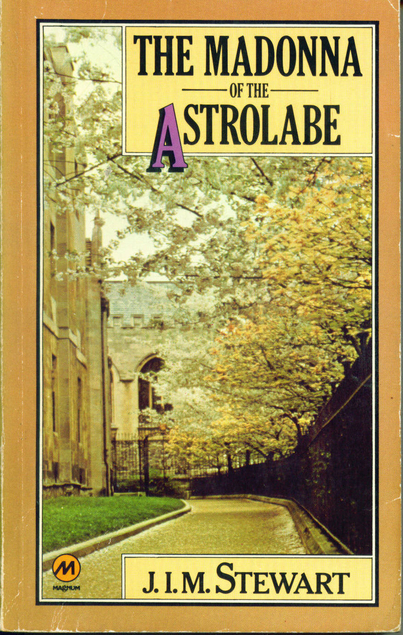
The Madonna of the Astrolabe by J.I.M. Stewart

The Madonna of the Astrolabe cover

The Madonna of the Astrolabe by J.I.M. Stewart ( aka Michael Innes) was first published in 1977 and it’s the fourth book in his A Staircase in Surrey quintet. The setting is an Oxford college, the fictional Surrey and the books follow the characters who had first met as students there. Some have never left there as they’ve stayed on and become dons.

The college tower which Duncan Patullo’s famous artist father had so admired that he decided it was the only college for his son to attend – is in a serious condition. It had been recently blasted clean, and it’s thought that that has contributed to the damage.

A large amount of money is needed to maintain the college tower and when a very old painting is discovered it seems that their problems are over – or are they?

Duncan Patullo’s nymphomaniac ex-wife has turned up in Oxford, in the past she’s been more than partial to men much younger than herself, so a male college is a dream location for her, but she’s a potential embarrassment for Duncan, particularly as she has hung on to his surname after he divorced her.

I’m really enjoying this journey back to 1970s academical Oxford. I just have one more book of this series to read and I’ll be sad when it comes to an end.

In case you don’t know Patullo is one of those more unusual Scottish surnames, at first glance people often think it’s Italian I think.

I read this one for the Read Scotland 2017 Challenge and 20 Books of Summer 2017.

Over the Sea to – Orkney

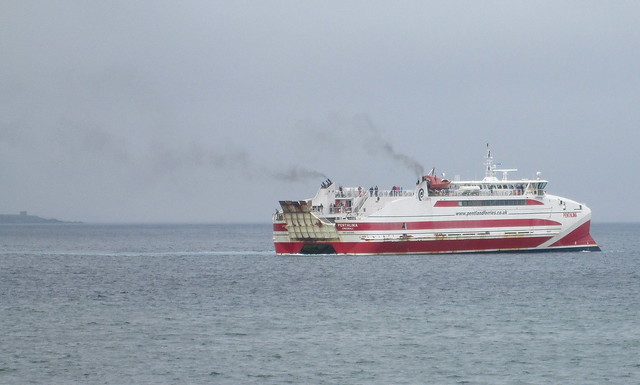
At the beginning of June we had a week’s holiday on Orkney, the first time either of us had visited those islands. Even the trip over on the ferry was quite exciting, although as usual whenever I’m on ‘wild’ water it was a flat calm! It was also a wee bit misty.

Pentalina

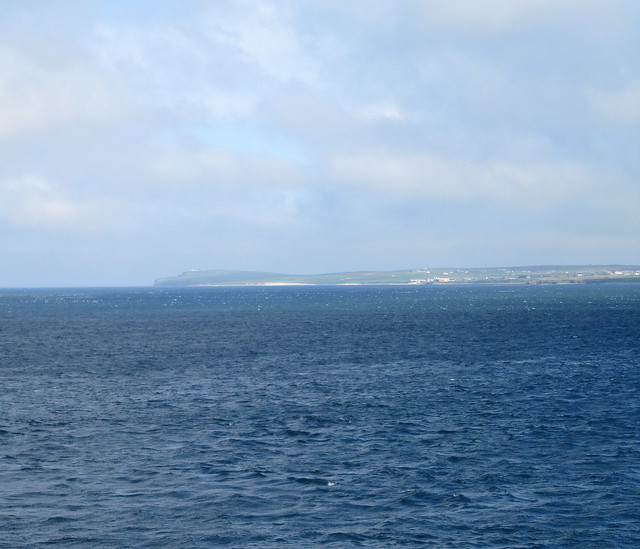
Stroma in the photo below is one of the islands between Caithness and Orkney.
Stroma

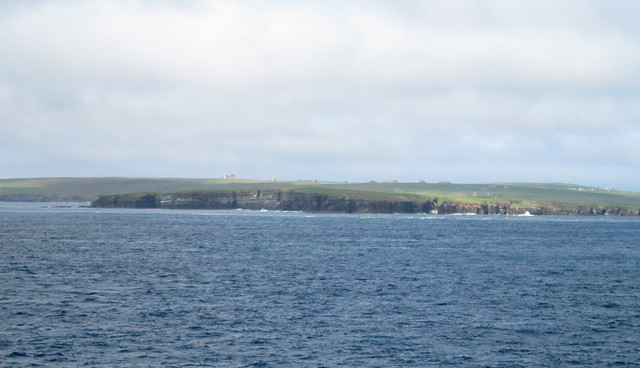
Below is a photo of Stroma cliffs and some abandoned houses.
Stroma

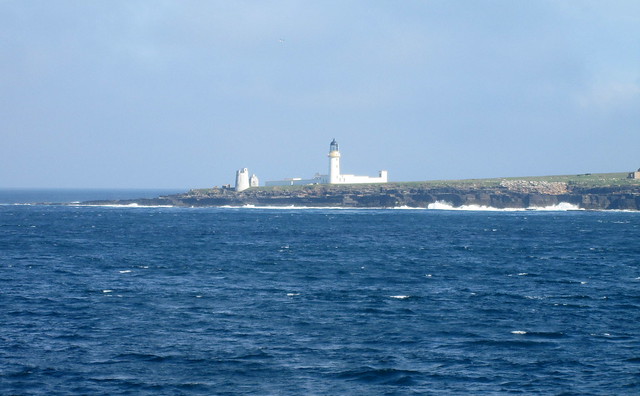
Stroma lighthouse is now automated as are all of our lighthouses nowadays.

Stroma lighthouse

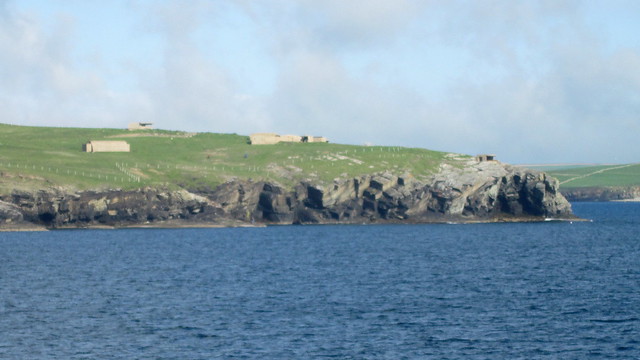
You can still clearly see the fortifications that were built on the Orkney island of South Ronaldsay below. Orkney was a very busy place during World Wars 1 and 2 due to its strategic position and relatively safe anchorage in Scapa Flow. It wasn’t a popular posting for the sailors and soldiers but the women of the islands were glad to see them, it was their passport off to somewhere ‘more exciting’ for many of them as they married servicemen!

Sth Ronaldsay Fortification

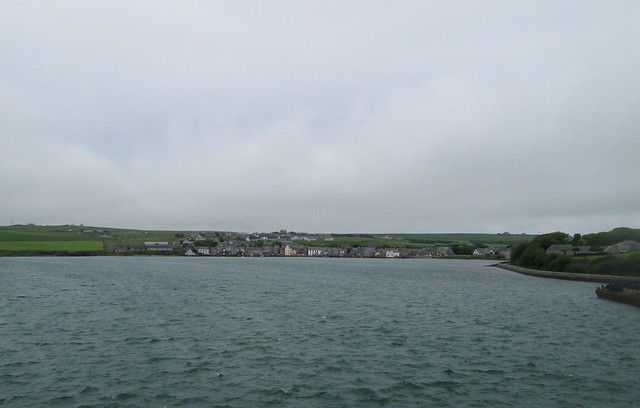
The ferry gets in at Saint Margaret’s Hope, the third largest settlement in Orkney and before you know it you’re off and driving across various islands via causeways. We were on the road to Stromness and our holiday rental cottage.

St Margaret's Hope, South Ronaldsay Closer View

Beyond Caravaggio Exhibition, Edinburgh

One day a couple of weeks ago we went to the Beyond Caravaggio exhibition in the Scottish National Gallery in Edinburgh. It’s part of the Edinburgh Art Festival. I have to say that it’s not my favourite era in art as those 16th/17th century artists were often a bit too keen on the gory side of religious scenes for my liking. But I do love Caravaggio, he was amazing dealing with light, although I was a wee bit disappointed that there are only three of his paintings in the exhibition. The others are by his pupils or by people who were trying to emulate his style, such was his influence.

I love the one below, – A Man Singing by Adam de Coster.

Adam de Coster

It was painted around 1625-35.

You can see some of the exhibits here. And some more of them here.

There are many more in the actual exhibition.

Unfortunately this is not a free exhibition. We joined the “Friends of the Gallery” earlier in the year so we didn’t have to pay. Otherwise it would have been £12 each – but there are a lot of paintings to see, five or six rooms’ worth.