Cherry Tree Perch by Josephine Elder

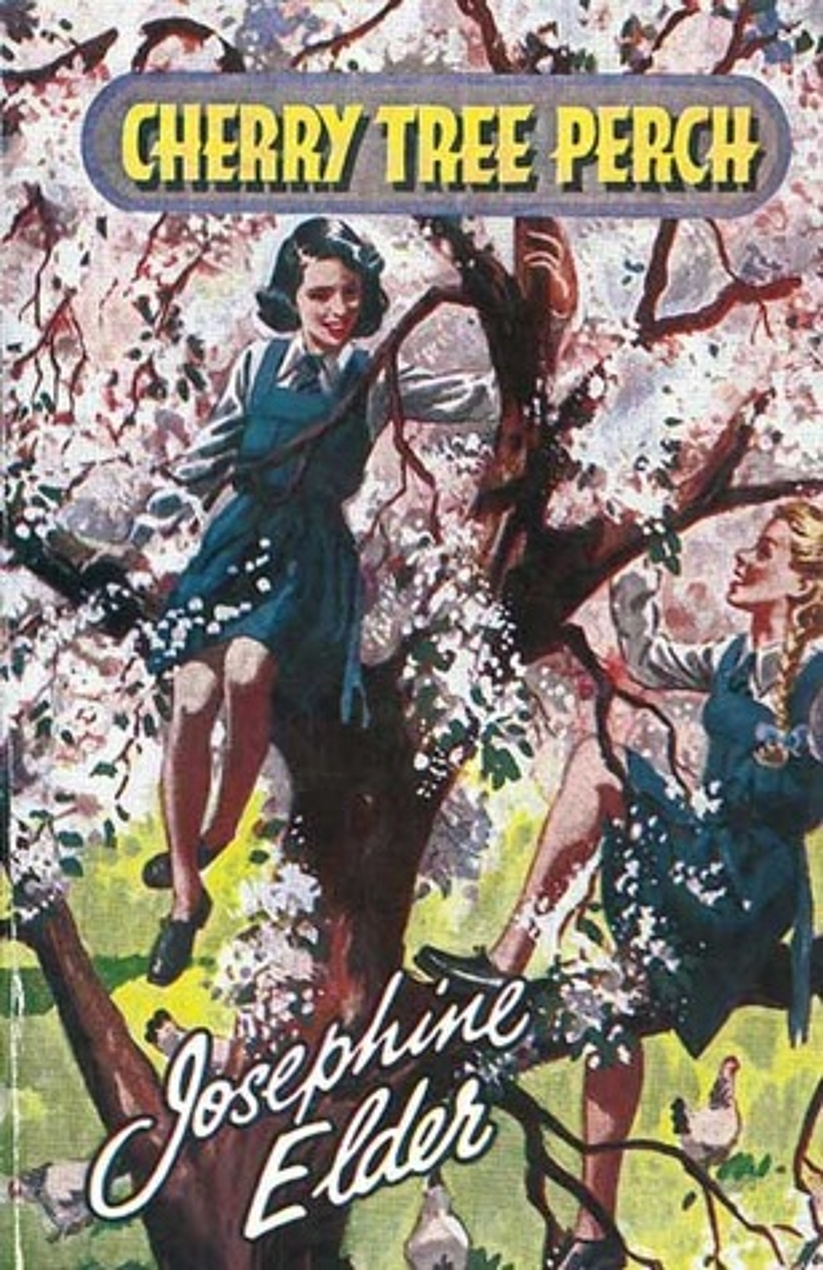
Cherry Tree Perch by Josephine Elder is the second book in the author’s ‘Farm school’ series, it was first published in 1939.

In this one Annis is back at the Farm school in April for the new term. The Farm School is run by her friend Kitty’s family and the place is a bit of a misnomer as the school is very far from being all about animals. Some children are there to concentrate on the sciences, music or art, and the easy-going atmosphere seems to make them blossom. Annis learns to ride and gets her own horse and takes part in a gymkhana at the Agricultural Show.

Annis is thrilled to be with her best friend Kitty again but things have changed as Miss de Vipon, a rather eccentric person is now living in one of the cottages and Kitty is spending a lot of time with her. Annis is frankly jealous of that relationship, but there’s more to worry about when haystacks begin to be deliberately set alight. Who would put the farm in such danger?

There’s just one more book in this series and I’ll get around to reading that one – sometime.

The idea for the Farm School might have been inspired by the Summerhill School which was founded in the early 1920s, it has a similar ethos anyway.

Storms Arwen and Malik

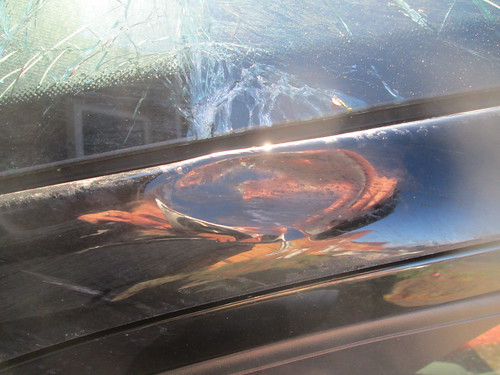
A couple of months ago most parts of Scotland and northern England were hit by Storm Arwen and loads of trees were blown down in the up to 90 miles per hour winds – and we hit two of them on our way home that night! The windscreen suffered crazing and there was a dent to the pillar beside it about 2.5 cm wide by 4 cm long. The dent looks bigger in the photo.

Windscreen Damaged by tree

Dent Caused by Collision with Fallen Trre

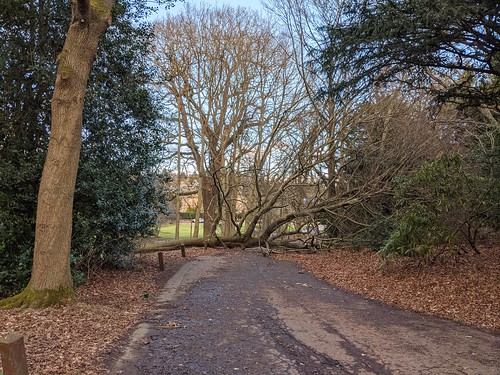
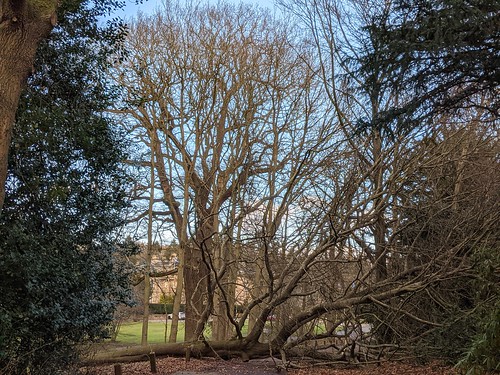
It seems no time since that huge storm but last night we were hit by Storm Malik (I thought these storms were named in alphabetical order, but apparently not). We did NOT go out in our car but walked as usual for The Guardian and saw one of my old tree friends that we pass every day had succumbed. This is one of the few deciduous trees that have fallen, they’re not usually so susceptible when they have no leaves on them. This tree lying across the road was actually enormous, but it looks like a branch here, maybe I should have taken the photo from the other side.

Fallen Tree, Balbirnie Park

Tree Fallen in Balbirnie Park, Markinch

With the Queen’s platinum jubilee being celebrated this year (70 years on the throne) the plan is for 70,000 trees to be planted this year, but at this rate that will only be replacing all of the trees that have been blown down. Sadly a few people have been killed by falling trees. Storm Corrie is due to hit us overnight!

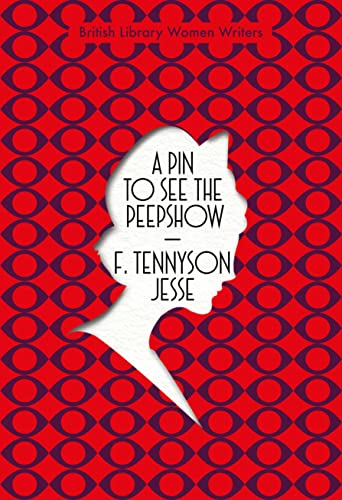
A Pin to See the Peep Show by F. Tennyson Jesse

A Pin to See the Peep Show cover

A Pin to See the Peep Show by F. Tennyson Jesse was first published in 1934 and has recently been reprinted by British Library.

The book begins when Julia Almond is a 16 year old schoolgirl, she’s rather besotted by one of her female teachers. Julia lives in a bit of a fantasy world, day-dreaming a better life for herself, that’s something that we all do from time to time I’m sure. To be fair Julia’s home life is less than ideal and as she gets older things get even worse. To get away from home she accepts a proposal of marriage from an older man, a friend of her parents whose wife had fairly recently died. There’s absolutely no romance involved, but Julia craves the comfort and lovely home that Herbert can give her, but she’s shocked that “That pleasant, rather dull looking man opposite, with that slight air of foolishness that everyone has who sleeps with his mouth slightly open, was the strange man with whom she had passed that first devastating night, who had assaulted her, apparently without any thought of her own sensations.” Her body feels battered, as well as her soul.

Julia throws herself into her career,she has worked her way up from being an apprentice in a dress shop to being a buyer for them and travelling to Paris, at work she’s still known as Miss Almond, something that she’s thankful for. At home she reads romances.

Inevitably when Julia meets a young man that she fancies she falls for him hard. Leo is a very handsome merchant sailor, and is going out with Julia’s cousin, but in no time Julia and Leo are having an affair and the cousin has been dropped. For Leo the whole thing isn’t all that serious, he’s a typical sailor, but Julia starved of the romance that she craves builds it all up into more than it really is. When she writes to Leo she does so with an excess of purple passion and her imagination running in over-drive. It doesn’t end at all well!

This tale is based on a real couple and although I enjoyed it and the writing I did find the ending a bit depressing. However I’m thankful that I was lucky enough to be sent a copy of this book for review by British Library.

The Scottish Galleries of Modern Art, Edinburgh

On Monday we went to Edinburgh to visit The Scottish National Galleries of Modern Art, there are two of them, across the road from each other, so we visited them both and had lunch in one of them. I must say that the word ‘modern’ also applies to artworks which nowadays we would see as being historic, but in their day they were modern.

If you click on the link above and scroll down you can see all of the artworks. I’ve been scrolling down their great collection of photographs, they’re so interesting from a social history point of view.

We inadvertently visited the Ray Harryhausen exhibition when we were there on Monday. He was a film animator and made a lot of SF/Fantasy films, they’re not really to my taste but he was so talented and developed special effects which were the precursor to the green screen that is used today.

It’s a large exhibition with lots of his preparatory drawings, I thought they were really good despite not being that keen on the subject matter, you can see some here.

There’s a Harryhausen film playing in one of the rooms and visitors can stand in front of it to appear in the film. Below you can see a photo of Jack and myself in front of it, I suppose we should have taken a video and run about a bit!

Ray Harryhausen, at Edinburgh Gallery

Elsewhere there’s all sorts of art, including a few by Dali and some Picassos. The ‘portrait’ below is of the famous photographer Lee Miller who was actually rather good looking. I wonder what she thought of it?! You can see her and some of her photographs here.

Edinburgh Modern Art Gallery 2

Gallery, Modern Art, Edinburgh

Due to Covid restrictions it was suggested on the website that you book up to visit. There was no problem with that as they had lots of time slots. I don’t know if restrictions have now eased at the Galleries but it’ll say on the website.

The Girl From Bletchley Park by Kathleen McGurl

The Girl From Bletchley Park cover

The Girl From Bletchley Park by Kathleen McGurl is a dual timeline tale, beginning in 2019 where Julia is running her own IT business from her home along with her business partner and a few members of staff. Life is hectic as she also has two young sons and a less than helpful husband who is often absent from the home. Hmm.

When Julia discovers that Pamela, her grandmother had worked at Bletchley Park during the war the time slips back to 1943 where Pamela has just been offered a place at Oxford University to study maths, but when her brother joins the RAF to do his bit she begins to think that she should do something to help the war effort too. Her maths teacher suggests that she could defer her Oxford place as people with her mathematical abilities are needed. Pamela passes the Bletchley interview and in no time she’s in her WRNS uniform and is billeted at the nearby very grand Woburn Abbey.

Back in 2019 Julia’s brother is moving house and has brought boxes of old family related photos and books for Julia to look through, it’s only then that they discover that their grandmother had worked at Bletchley Park during World War 2, she had kept it secret her entire life.

I enjoyed this one but as ever with a dual timeline novel there’s one that I prefer and it annoys me when the action moves away from my preferred setting. Obviously it was the Bletchley Park setting that I found most interesting, especially as we managed to visit the place in 2020 – during a brief lift of the lockdown. You can see some my blogposts about it here.

Both stories do have echoes of each other with the women suffering betrayal at the hands of their menfolk, but I found the 2019 story to be so predictable, possibly it was meant to be.

I was sent a digital copy of this book by the publisher HQ/HarperCollins via NetGalley.

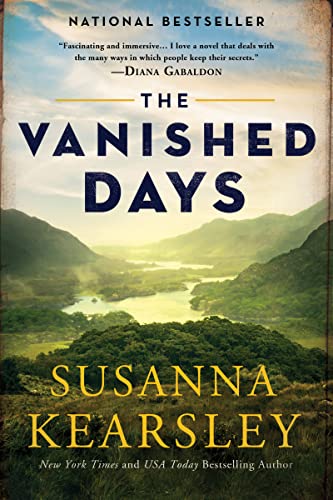
The Vanished Days by Susanna Kearsley

The Vanished Days cover

The Vanished Days by the Canadian author Susanna Kearsley is a prequel to her book The Winter Sea which I haven’t read, but I think this one can quite happily be read as a standalone. The setting is mainly Edinburgh 1707, the Union of Scotland and England, something which most ordinary Scots didn’t agree with but the ‘aristocracy’ sold the country for their own gain, so there’s discontent in the country. The tale loops back to the 1690s from time to time, and the disastrous Darien Venture which more or less bankrupted the country and led to the union with England. It’s suspected that the whole thing was an English plot. It was such a nice change to be reading about a different part of Scottish history as most authors stick to writing about the 1745 ‘Rebellion’, as if nothing else of significance ever happened in Scotland. Rebellion is in the air though with rumours of the French standing by to invade and help the Stewart King James III to regain the throne from the Dutch usurper King William.

Part of the settlement for the union is that England will provide money to pay off debts incurred because of the Darien scheme, including payments to the dependents of those who had lost their lives in Jamaica. Lily Aitcheson (Graeme) comes forward to claim her late husband’s wages, and Adam Williamson a former soldier has the job of investigating her claim, it’s suspected that she wasn’t actually married to her husband. But Adam is attracted to Lily and becomes embroiled in her life. There are lots of surprises along the way. This is not the sort of book that you could call a light read, but I loved it.

I was sent a digital copy of this book for review by Simon and Schuster via Netgalley.

The Trial by Franz Kafka

The Trial by Franz Kafka was first published in 1925, one year after the author’s death. He had left instructions to a friend telling him to burn all of his manuscripts, but his friend published them instead. The Trial is the second book by Kafka that I’ve read. I enjoyed The Castle more than this one. Kafka was born in Prague, a German speaking Bohemian. He died of TB when he was 40 and obviously never knew that his surname would be regularly in use to describe impossible and perplexing situations.

The main character K. is a deputy bank manager and one morning when he wakes up his breakfast has not been taken into his bedroom by his landlady. There’s a knock at his bedroom door and a strange man enters, the upshot is that two men have come to arrest him. K. hasn’t done anything wrong and the men can’t or won’t tell him why he is being arrested.

So begins a nightmarish time for K. as he journeys to various Courts which are always located in dark and dirty attic areas which are so hot it’s almost impossible to breathe. They’re packed out with people, most of whom seem to be also accused of – something. It’s a bureaucratic nightmare. K. is still none the wiser as to what he is supposed to be guilty of, so he can’t defend himself. But for a time life goes on much as before, with him going to the bank to work, but having to attend courts now and again and K. gets used to the situation, things could be worse. Things do indeed get worse!

The book is regarded as a sort of modern day Pilgrim’s Progress, a commentary on the idiocy and futility of officialdom. We’ve probably all been there in some way when we have felt like banging our heads against a wall in frustration – although nowadays it usually means we’re hanging on to a phone listening to muzak – hoping to get an actual human being on the other end of the line!


Bowes Museum, Barnard Castle – again – a quilt exhibition

Bowes museum, Barnard Castle,

One of the reasons we visited the Sunderland area so quickly again was because we discovered too late that there was a quilt exhibition on there, we had to go home before we could see it. So we drove back down there before the exhibition ended in late November. As you can see from the photo above the museum is very grand, and built in the French style as the architect was French.

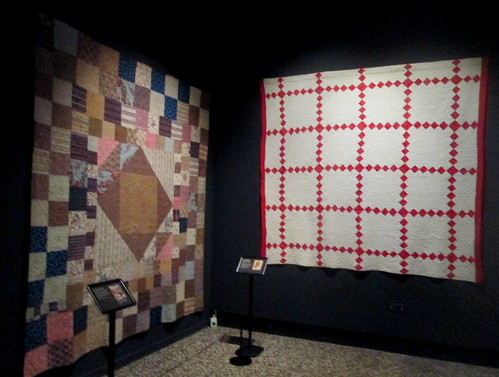
The top floor of the museum housed the quilts. When I think of quilts from the North-East of England it’s the one piece of fabric Durham quilts which are decorated with all over stitching that I envisage, so I was surprised that they also have what they call strippy quilts. The quilts date mainly from the early 20th century.

north-east Quilts, Bowes Museum, Barnard Castle

And the more traditional patchwork quilts. I must admit that I started to make a patchwork quilt about 40 years ago, using hexagons, I didn’t get very far with it and bits are still languishing at the bottom of one of my many craft baskets!

Quilts, Bowes Museum, Barnard Castle

So I am filled with awe when I see patchwork quilts, I suspect that they would be easier to make if it was a communal effort though.

Quilts, Bowes Museum, Barnard Castle

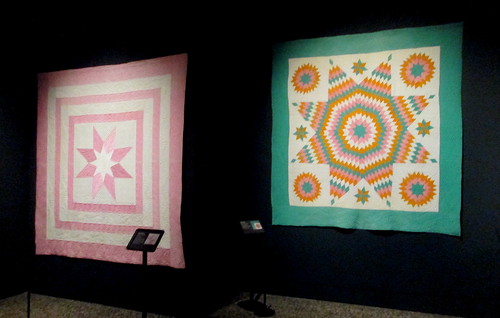
The quilts below are proper Durham quilts – I believe. No patching together but still an awful lot of sewing involved.

Durham Quilts , Bowes Museum, Barnard Castle

Below is an intricate quilt design and matching curtain. Pink,blue and orange seem to have been very popular colours, I suppose they brightened up what was otherwise quite a dark existence.

Patchwork Quilts, Bowes Museum, Barnard Castle

Patchwork Quilts, Bowes Museum, Barnard Castle

I must admit that I thought that the exhibition would have been bigger than it was, but it was worth seeing and there is an interesting permanent exhibition of period women’s clothing from the 16th century to Mary Quant and Laura Ashley. I took lots of photos of the clothes, but they have all disappeared from the camera somehow, quite spooky really.

Dimsie Moves Up Again by Dorita Fairlie Bruce

 Dimsie Moves Up Again cover

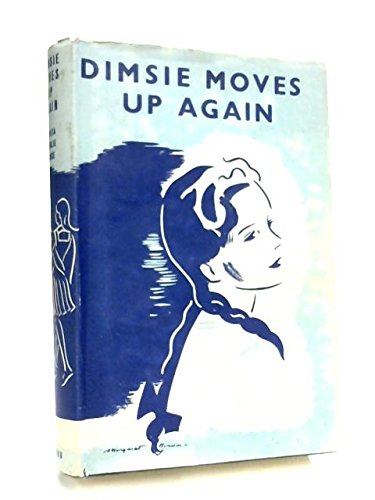
Dimsie Moves Up Again by the Scottish children’s author Dorita Fairlie Bruce was first published in 1922 and is the third book in the Dimsie series with the setting of a boarding school for girls. My copy of the book dates from 1941 when it was a Christmas gift to Joan from her Auntie Belle, according to the inscription.

The story begins on a stormy September day, it’s the first day of the new school year so it’s quite chaotic with lots of girls’ boxes and trunks piling up waiting to be emptied. Dimsie and her chums are now almost seniors, but not quite. They are however senior enough to be outraged by the behaviour of the girls in the lower forms, they had never behaved like that when they were juniors!

The new head girl is an unexpected choice as far as most of the girls are concerned, and to some of the teachers too, and it takes a while for her to get into the swing of it all, so behaviour does get a bit out of hand in a dangerous way.

The new girl Fenella, who has never been at school before having been educated by governesses, has such a superior attitude – for no good reason – and she inadvertently triggers a hair-raising adventure.

As ever though it’s Dimsie who is the central character. I feel that Enid Blyton based Darrell in her Malory Towers books on Dimsie, those books were published over 20 years later than the Dimsie books and aren’t nearly as well written although I loved them as a youngster. I’ll definitely be continuing with the Dimsie series.

The Bowes Museum, Barnard Castle, County Durham, England

When we visited Glamis Castle (childhood home of the Queen Mother who was a Bowes Lyon) a couple of months ago it led to us planning a visit to The Bowes Museum which was set up by relatives of hers.

The museum’s most famous artefact is a pure silver automaton swan which dates from 1772, it’s a replica of a female mute swan. If you just want to see her moving you can skip to 4.50 on the You Tube video below. The swan catches a silver fish and eats it, but of course swans don’t eat fish as they are vegetarians! The silver work is amazing though.

You can read more about the museum here.