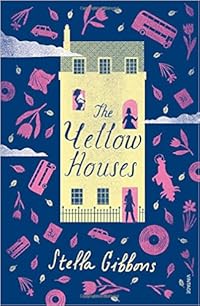
The Yellow Houses by Stella Gibbons

 The Yellow House cover

When you see the name Stella Gibbons you immediately think of Cold Comfort Farm, well why wouldn’t you? it’s such a hilarious laugh out loud book. But she wrote so many others, it’s a shame that we all automatically judge everything against Cold Comfort, because her other books are well worth reading too.

Apparently when Gibbons died in 1989 she left behind two unpublished books, you can read about it here.

The Yellow Houses is one of them, she wrote it in the 1970s and it’s well worth reading, I really enjoyed it.

Wilfred is a retired local council official and living in Torford, a town about seventy miles from London in East Anglia, and when the story begins he has been a widower for just six months. He really misses Pat his wife but when their only child Mary runs away from home, leaving just a note saying she is going to London, Wilfred is absolutely bereft. Sobbing on a park bench he realises that someone is standing in front of him, offering him a handkerchief – and so begins his relationship with Mr Taverner, an odd chap who manages to make Wilfred feel better about things.

The next morning Wilfred notices that he can see a lovely newly painted yellow house from his window and it turns out that that is where Mr Taverner lives. When Wilfred gets inside the house it’s like everything that he could ever have wanted, it doesn’t say it in the book but from the description you know that it feels heavenly to Wilfred. Everything begins to get better for Wilfred and Mary gets in touch with him. Mary has only ever wanted to get married and have three children and really her reason for going to London is to give her a better chance of finding a husband. She’s only 17 and had still been at school, but she knows her own mind.

This book has quirky characters and a house where strange things happen – is it haunted? There’s also quite a lot of humour, although it isn’t of the laugh out loud variety. I liked the step back into the early 1970s when decimalisation had just been brought in and there were maxi as well as mini skirts and smelly afghan coats.

I gave it a four on Goodreads but I might have given it 3.5 if that had been possible, it’s definitely better than a three though.
Children’s illustrated books

I still find myself eyeing up children’s books even although there are no wee ones in our family now, and sometimes I just have to add a few more to my collection. My most recent purchases have been:

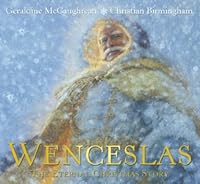
Wenceslas cover

WENCESLAS by Geraldine McCaughrean and illustrated by Christian Birmingham. It’s obviously just a re-telling of the traditional Good King Wenceslas fairy tale but the illustrations are lovely and give a real sense of the falling snow. You can see for yourself here and can also see some of the other books he has illustrated, more for me to look out for!

And another book I bought recently is:

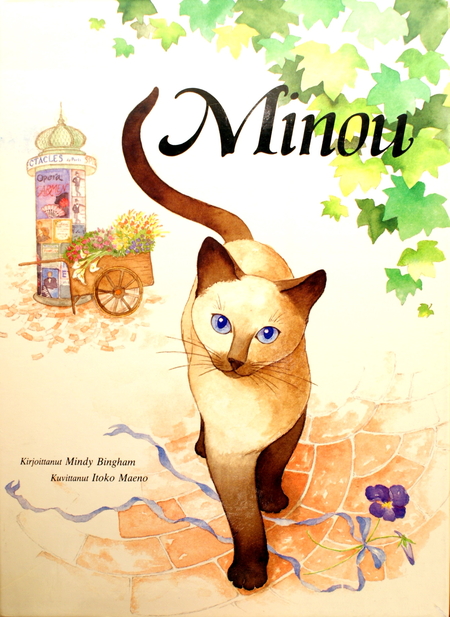
Minou cover

Minou – it’s a book about a cat called Minou whose ‘owner’ dies, so Minou ends up on the streets having to learn how to fend for herself. Minou lives in Paris and it was really the beautiful illustrations of Paris that attracted me to the book, but the story is a way of teaching little girls to be independent and confident, to rely on themselves. It was written by Mindy Bingham and illustrated by Itoko Maeno. You can see some illustrations here.

Some people on the internet are trying to sell this book for silly money – such as £88 but I bought a perfect copy (1st edition) for all of £3.

Guardian links

I didn’t find an awful lot to interest me in this week’s Guardian review, but I’ve read and enjoyed a few Michael Chabon books in the past so I enjoyed reading this interview with him.

I also enjoyed reading this article about Vanessa Bell, but I won’t be going to the exhibition of her work which is on at Dulwich Picture Gallery in London. She is of course famous as being one of the Bloomsbury Group and sister of Virginia Woolf.

I’ve gone right off doing any road trips in England for the moment, after they voted for Brexit – I think it’s fair enough that I spend money holidaying in Scotland instead and doing something for the Scottish economy – hopefully.

I read on a blog recently that the Brexit vote could be described in Austen terms as 48% voting for Sense and Sensibility and 52% for Pride and Prejudice. That just about sums it up.

The Light Between Oceans by M.L. Stedman

The Light Between Oceans cover

The Light Between Oceans by M.L. Stedman was published in 2012 and it was the first novel by the author who was born and grew up in Western Australia.

This one was a good read although at times a really tragic one.

The tale begins in 1926 and the setting is Janus Rock which is a tiny island with a lighthouse on it. Tom is the lighthouse keeper and he and his wife Izzy are the only inhabitants, they stay there for a year and get off it for a couple of weeks before returning. They get a visit from two men on a boat who bring them supplies and any letters once every three months. It takes a special sort of person to be able to cope with such an isolated location.

The action quickly skips back to December 1918 when Tom has got back from the war where he was an officer. Like many others he’s desperate to get a job, he’s glad to be in one piece but he knows that he’ll never be the same again after what he has experienced in the war. The peace and quiet of a remote island is just the sort of work he wants to heal his soul and after a few years there he meets and marries Izzy.

It seems like an idylic existence but Izzy suffers multiple miscarriages/still birth, she longs for a baby so when a small boat containing a dead man and a live baby washes up on the island, Izzy persuades Tom to allow her to keep the baby and pretend it is theirs. Izzy believes the baby’s mother must have been washed overboard so nobody would be missing the baby, it seems like an answer to her prayers but it turns out that it isn’t as simple as that.

This isn’t my usual sort of read but I decided to read it after reading a review on a blog I regularly visit but I can’t find which one it was, as often happens. I enjoyed it although I had to suspend my disbelief at times as how likely is it that a baby will wash up on your island just when you need one!

The blurb on the front says, ‘An extraordinary and heart-rending book about good people, tragic decisions and the beauty found in each of them,’ Markus Zusak, author of The Book Thief.

It has recently been made into a film and you can see a trailer for it below.

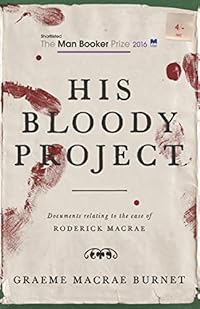
His Bloody Project by Graeme Macrae Burnet

 His Bloody Project cover

His Bloody Project by Graeme Macrae Burnet was of course shortlisted for the Booker prize, I haven’t read any of the others shortlisted or indeed the winner but I can’t imagine that they would have been as good as this one. Burnet portrays Culduie and its surrounding areas and inhabitants so well, down to the rivalry that there often is between one settlement and the nearest neighbouring one, who tend to be seen as barbarians for some reason. The book is set towards the late 1860s and it’s 1869 when everything comes to a head.

The subtitle of the book is Documents relating to the case of Roderick Macrae. More than half of the book is written by seventeen year old Roderick Macrae who is in a prison cell in Inverness, accused of the murder of three of his neighbours. Roderick has admitted to the deed, in fact he could hardly deny it as he had walked through the tiny hamlet of Culduie in the Highlands – covered in their blood.

After a campaign of bullying by Lachlan Broad – the local constable and a figure of authority tasked with seeing that the inhabitants of Culduie kept the area in order – Roddy snapped, the last straw being when an eviction order was delivered to his father.

Roddy’s relationship with his father was a strained one, which only got worse after the death of his mother who had been a bit of a buffer for him, protecting Roddy from the worst excesses of his father’s Presbyterian strictness which included beating Roddy on a weekly basis for no real reasons.

Roddy’s advocate hopes to prove that his client committed the murders when he was more mad than bad, it’s the only thing that will save him from the gallows.

But when it comes to the actual trial Roddy’s account of things doesn’t tally with the forensic evidence from the bodies. Something doesn’t quite add up.

Of course there’s a lot more to this book than that, but as ever I don’t want to give a blow by blow account of it. It’s a great read though, but not exactly an uplifting one.

I read this one for the Read Scotland 2017 Challenge. Jack has read it too.

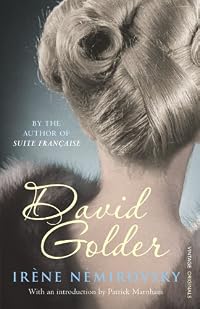
David Golder by Irene Nemirovsky

David Golder cover

David Golder by Irene Nemirovsky was first published in 1929 and it was her first book to be published.

In 1930 The New York Times said of it: The work of a woman who has the strength of one of the masters like Balzac or Dostoyevsky.

I really like Nemirovsky’s writing and although I enjoyed this one it isn’t close to being a favourite. I can see that a lot of people would see it as being anti-semitic, but I see it as just being anti shallow, grasping and self-obsessed people, and there are plenty of them around in every society – no matter what religion or tradition people have been brought up in.

David Golder is getting on in years, he’s very wealthy but he has worked hard to get to where he is, with a fabulous property in Paris and an even more beautiful one in Biarritz. His wife Gloria and horribly spoiled daughter Joyce spend most of their time in Biarritz where they spend his money as fast as he can make it, but they are never satisfied. They always want more jewellery and better cars.

But Golder’s business affairs are very precarious, not that his wife believes that, she thinks he is just being mean with his money. although her idea of mean would be anybody else’s idea of generosity.

When he begins to have pains in his chest he does his best to ignore them but the stress of his business problems make him more ill until he eventually collapses. You might think that that would shock his wife, but of course all she is worried about is the lack of money. She has been supporting her lover financially for 20 years and she knows he’s only with her for the money too. The doctor wants Golder to retire from business but Gloria insists that he can’t tell her husband to do that, she needs him to keep supplying her with money and doesn’t seem to realise that when he dies her meal ticket will end anyway.

Golder recovers – after a fashion – but he gives up business and as his possessions disappear to pay debts, so does his wife. Joyce had fallen for a pretty but penniless young man and had already left with him, expecting her father to cable money to her whenever she needed it.

After living a very simple life for some time and finding a sort of contentment, it’s Joyce’s need for money that leads her father to go to Russia to complete one last oil deal, it is of course fatal.

Obviously Nemirovsky was influenced by everything that was going on in the world stock markets around the time she was writing this book, and probably by her mother too.

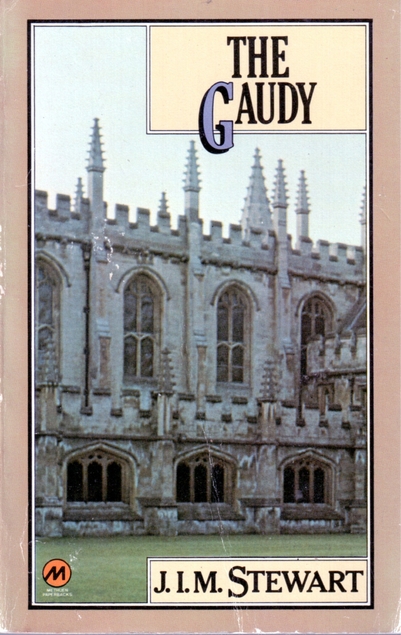
The Gaudy by J.I.M. Stewart

The Gaudy cover

The Gaudy by J.I.M. Stewart was first published in 1974 and it’s the first book in his A Staircase in Surrey quintet.

J.I.M. Stewart is of course better known as the crime fiction writer Michael Innes, but the books he wrote under the name of Stewart are supposedly more literary, he certainly sprinkles them with quotes and Latin anyway, but that isn’t too distracting. The author was also an academic working as a lecturer at Oxford as well as other universities and in these books he uses that experience and background for his settings.

The Gaudy is the annual re-union dinner at an Oxford college and the Scottish playwright Duncan Patullo has never been to one before in the 20 or so years since he graduated. Nor has he met up with any of his old friends in that time. Duncan has been busy carving his successful career over those years. He has decided to attend The Gaudy this year and has been allocated his old room in college.

Meeting up with old friends is a bit of an eye-opener as the one who was girl mad and what would nowadays be called a ‘serial shagger’ is now a bishop and has a very low opinion of the morals of the students nowadays! Another friend has just been appointed to the cabinet in government, the least likely friend seems to be a spook in the secret service.

There are still some students around as there are re-sits going on for those who failed their exams. The story involves quite a bit of snobbery with the usual differences between the state school educated students and those who were sent to posh schools at great expense. There’s definitely a them and us thing going on between the students and this ends up in disaster for one of them.

I enjoyed this book but not nearly as much as I remember enjoying the next one in the series, The Young Patullo, which I read back in the 1970s. I never did get my hands on The Gaudy back then so I can’t compare my feelings on that one.

The Financial Times said: ‘Wit, acute observation, clever plotting …. As a gallery of characters it leaves nothing to be desired.’

If you are thinking that Patullo is a strange surname – it is actually an old Scottish surname although you could be forgiven for thinking it must be Italian or something.

I read this one for the Read Scotland 2017 Challenge – my second book for that challenge.

Guardian Review links

The Guardian Review sections front page is a photograph of the author Paul Auster. He says ‘I’m going to speak out as often as I can, otherwise I can’t live with myself.’ He is of course speaking about the political situation in the US. If you’re interested in the article you can read it here. I really like Auster’s writing although I think I have quite a few books of his to catch up with.

There’s an article by Diana Athill about her friend the Irish author Molly Keane. Athill says – I admired many authors but Molly, I loved. You can read the article here.

Woodsman by Ben Law

Woodsman cover

Woodsman by Ben Law was a random choice from a local library. I had never heard of him before but apparently he is well known through being on TV’s Grand Designs after having built a house in his own woodland Prickly Nut Wood.

This book is good in parts, Law tells the story of how he started out living in Prickly Nut Wood in a bender he made himself, later upgrading to a yurt before eventually building his own home from the local wood. But in the last chapter the author zips forward to 2037 and imagines life will be more land based with people taking the place of machinery due to a lack of oil. He doesn’t seem to have heard of green energy, the renewables that will definitely take-over in the future. He imagines the future as looking like a step back in time, it’s all a bit silly.

To begin with he didn’t have much in the way of woodland skills and apparently these aren’t easy to learn as in times past those who made their living coppicing and such were keen to keep their knowledge to themselves for fear of doing themselves out of work in the future. I’m glad to say that nowadays things seem to have improved and it’s possible to go on courses to learn woodcraft. Mind you I already knew a lot of the skills involved and I’m sure I learned of them through reading Thomas Hardy’s The Woodlanders, as I recall he even explained how charcoal was made.

Ben Law started living in a bender in his woodland but decided to build his yurt when his first child was due, presumably his partner wasn’t keen to bring up a baby in a bender. But apart from that there is absolutely no mention of family life, except that he has three children.

I wish I had seen the Grand Design TV show which featured the house he built, but I gave up watching that programme because all of the ones I had seen featured enormous piles and much wrangling with banks for finances, really the programme should have been called Grand Debts.

Ben Law’s house is built more on a human scale though.

Ben Law House
As it happens there is an article in this week’s Guardian Weekend magazine about people who have bought woodland, it’s becoming very popular. You can read it here if you’re interested in it. In fact some years ago I thought about buying a small woodland – it was for sale at a bargain basement price, but the fact that there was a fairly busy road along the edge of it put me off because I suspect that it could be a place that people would fly tip their junk, instead of going an extra few miles to the municipal tip – you know how awful some human beings can be!

I’ve found the Grand Designs on Vimeo, the woodland is lovely, an idyllic place to bring up a family I think.

Grand Designs – Woodsman Cottage (Ben Law) from Nebruks on Vimeo.

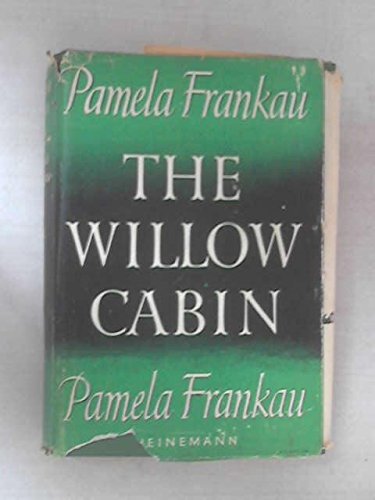
The Willow Cabin by Pamela Frankau

The Willow Cabin cover

The Willow Cabin by Pamela Frankau was published in 1949, my copy is a 1951 reprint. This is the first book that I’ve read by the author and I’ll definitely be seeking out more of her books.

The Willow Cabin covers the years from 1936 to 1948 and the settings are various but mainly London and America.

Caroline is a 22 year old aspiring actress, in fact she’s really talented at it, but she’s also rather immature. Her relationship with her mother and step-father is fraught and when she falls for Michael a well-known surgeon who is much older than her she moves out of the family home into an hotel.

Michael is unable to get a divorce from his wife (hmmm) but that doesn’t put Caroline off and when war breaks out she throws up her acting career to follow Michael around, they’ve both joined the army.

For most of the book Mercedes, Michael’s Anglo-American wife is absent, apparently in France, possibly helping the resistance or even dead. But in the last third of the book the war is over and Caroline goes to America where Mercedes has pitched up. Mercedes had been very well off before the war but she has used the last of her money to buy a farm in America and to build a small house for a family of German refugees who are supposedly her employees along with a French family of refugees.

The two families can’t get along and have absolutely no sense of gratitude for everything that has been done for them. I’m sure that that was Frankau’s way of pointing out how the UK had been bankrupted by a war not of its making and had got nothing out of it but a debt that took generations to pay off and absolutely no thanks from the rest of Europe for all that had been done for them and the sacrifices made.

The atmosphere of wartime London in particular is very well portrayed I think, of course the book was written not long after the end of the war.

The title of the book was taken from Shakespeare’s Twelfth Night and there seems to be some confusion on the internet as to what it means. However I have always understood that willow was worn by women whose loved ones were away from home – at war or at sea or whatever. It was a way of telling people (men) that they weren’t really on their own, they were waiting for the return of their lover.

All through reading this book I had the 1970s song All Around My Hat by Steeleye Span going around in my head, if you don’t know the song you might be interested in listening to it now.

I believe that Virago have reprinted this book as a modern classic so I’m counting this one towards my Classic Club Challenge, I’m not far off reaching 50 now.