The King’s General by Daphne du Maurier

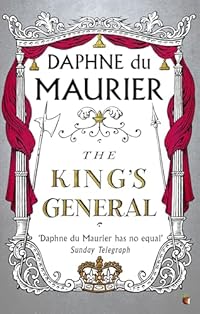
The King's General cover

Daphne du Maurier is one of a list of authors whose books I’m slowly working my way through. Rebecca is still my favourite , it’s the one I judge everything else against. The King’s General is on my 2011 Reading List.

This novel is set in du Maurier’s beloved Cornwall during the English Civil War. Cornwall was a Royalist county and she used the house which she rented from the Rashleigh family for 30 years in this story. She seems to have looked into the history of the house and the family and woven a story around them.

The story is narrated by Honor Harris and at the beginning she’s a teenager and is a bit too feisty for a female in 1653. Much to the horror of her family she starts a relationship with Sir Richard Grenvile, an arrogant, self-centred Cavalier who is feared and hated by friend and foe. He’s the King’s General in the West. (Cornwall)

An accident(?) befalls Honor and she ends up having to live a very different life from the one which she had imagined. The same can be said for everyone else too as Parliamentary forces gain control of Cornwall. The action moves back and forth across the county and Honor has to move from house to house as the enemy lays waste to the land and homes. But it’s Menabilly, with its secrets, which becomes one of the main features of the book. A lot of the characters were real people and there is a wee section at the end which tells you what actually happened to them and then an interesting postscript about the house.

As always with the books which Daphne du Maurier sets in Cornwall you get a real sense of her love for the county. Personally, I was really chuffed when the village of Gunnislake got a mention as a battle was fought near there. We had a holiday there a few years back and I really wish that I had read this book before I visited Cornwall. Although I love history, the English Civil War isn’t one of my strongpoints, and I was completely clueless about what went on in Cornwall at that time.

That’s fair enough I suppose, as I’m Scottish, but I really want to read some more books about it. This one was a good introduction to the subject. It’s not as good as Rebecca, which I think people either love or hate, but it’s certainly worth reading.

St Andrews – Golf and Books

We had a day out in St Andrews last Tuesday and as you can see the preparations for the British Open, which starts later this week are well underway.

The lawn shavers were out in force but I honestly couldn’t see any grass being trimmed off at all. Amazingly, members of the public were just wandering around the fairways, or should I say the hallowed ground. Previously I had thought that someone might have taken a pot-shot at you if you did that. Mind you, I find it very difficult to walk on grass when it is that well tended green velvet sort so I kept to the path.

This photo is from nearly the same place as the one in a previous post, showing the difference.

We had a nice lunch at The Central pub after we had been around the book shops. At first I thought it was going to be slim pickings but I ended up getting quite a book haul.

1. Police at the Funeral by Margery Allingham
2. The Harsh Voice by Rebecca West
3. The King’s General by Daphne du Maurier
4. The Man Who was Thursday by G.K. Chesterton
5. The Guernsey Literary and Potato Peel Pie Society by Mary Ann Shaffer and Annie Barrows
6. The Mystery Mile, The Crime at Black Dudley and Look to the Lady – a Margery Allingham omnibus.

I’m fairly sure that I read the du Maurier one in the year dot but possibly not, so I want to read it to complete her works.

Coincidentally I read in The Guardian on Thursday that their columnist Deborah Orr had just finished reading the Chesterton book and had really enjoyed it.

I’m probably the last person in the reading world to get around to The Guernsey Literary Potato Peel Pie Society Book but as it is set during the German occupation there, I think I’ll be reading this one soon.

I don’t want to know how many books I have in my TBR queue now, but it isn’t anything like 600 – I hope!

Not After Midnight by Daphne du Maurier

This is a book of five short stories:

Don’t Look Now
Not After Midnight
A Border-line Case
The Way of the Cross
The Breakthrough

I like to try to read my way through an author’s complete works eventually, which is why I read this book.

I do quite enjoy short stories and these ones reminded me a bit of Roald Dahl’s Tales of the Unexpected with their unpredictable endings.

Part of the reason that I started reading du Maurier again is that after reading Rule Britannia I was intrigued by her attitude to Americans and I wondered if this was something which was a feature of her later books.

I’ve come to the conclusion that she just wasn’t a fan for some reason as so far she seems to take any opportunity to be disparaging. The research continues!

Birthday books

I was lucky enough to be given a copy of The Gathering Night by Margaret Elphinstone for my birthday. This photograph of me reading it in our garden makes me look a bit weird I think, worryingly my husband thinks I look normal in it.

I was also given The Suspicions of Mr. Whicher by Kate Summerscale which is about a true murder mystery which took place in 1860 and inspired Wilkie Collins and other writers.

Last but not least is a lovely book, Plants in Garden History by Penelope Hobhouse. It’s beautifully illustrated if you like plants, flowers and garden plans.

I can’t resist visiting second-hand bookshops which are quite thin on the ground in this area but when I was in St Andrews I bought myself:

Hungry Hill by Daphne du Maurier as I am trying to read all of hers.

Moonfleet by J.Meade Falkner. It’s a classic tale of mystery and adventure in a Dorset smuggling village. For some reason I love smuggling tales.

The Best of Saki (Hector Hugh Munro) who was killed in the trenches in the First World War. It’s a book of short stories.

Last but not least School for Love by Olivia Manning. I’ve been meaning to read more of her books. I read and loved The Balkan Trilogy and The Levant Trilogy. The BBC serialised The Balkan Trilogy as The Fortunes of War in 1987 starring Emma Thompson and Kenneth Branagh. I think anyone interested in WW2 would love these books.

I was given lots of DVDs by Duncan and I was especially pleased to get The Shipping News. I read the book recently and was so immersed in it that I really missed it when it was finished, so now I can revisit the story via the film. It’s too soon for a re-read.

So, as you can see I was a very lucky birthday girl and that TBR pile just keeps growing.

Daphne du Maurier

I recently read and reviewed Flight of the Falcon and Rule Britannia as well as the book in my previous post and then realised that although I thought that I had read just about everything which Daphne du Maurier wrote, I was far from correct.

I don’t want to join any more reading challenges, but I want to keep a track of how many I have read, and I hope to add quite a few more to my list before the end of the year.

She also wrote quite a few non-fiction books but I’m going to concentrate on the fiction for the moment.

* The Loving Spirit (1931)
* I’ll Never Be Young Again (1932)
* The Progress of Julius (1933) (later re-published as Julius)
* Jamaica Inn (1936)
* Rebecca (1938)
* Rebecca (1940) (play—du Maurier’s own stage adaptation of her novel)
* Happy Christmas (1940) (short story)
* Come Wind, Come Weather (1940) (short story collection)
* Frenchman’s Creek (1941)
* Hungry Hill (1943)
* The Years Between (1945) (play)
* The King’s General (1946)
* September Tide (1948) (play)
* The Parasites (1949)
* My Cousin Rachel (1951)
* The Apple Tree (1952) (short story collection, AKA Kiss Me Again, Stranger)
* Mary Anne (1954)
* The Scapegoat (1957)
* Early Stories (1959) (short story collection, stories written between 1927–1930[14])
* The Breaking Point (1959) (short story collection, AKA The Blue Lenses)
* Castle Dor (1961) (with Sir Arthur Quiller-Couch[15])
* The Birds and Other Stories (1963) (republication of The Apple Tree[16])
* The Glass-Blowers (1963)
* The Flight of the Falcon (1965)
* The House on the Strand (1969)
* Not After Midnight (1971) (short story collection, AKA Don’t Look Now[17])
* Rule Britannia (1972)
* “The Rendezvous and Other Stories” (1980) (short story collection)

I’ll Never Be Young Again by Daphne du Maurier

This book is Daphne du Maurier’s second which she wrote in June and July of 1930, in London.

In it Dick, the sheltered only son of a famous poet, has left home and made his way to London after an unfortunate scene at home. Life in the shadow of his successful father has become impossible and Dick decides to throw himself into the Thames from Westminster Bridge.

A passerby, Jake stops Dick from jumping and they end up signing up together to work on a merchant ship bound for Scandinavia. A great friendship develops with Jake, who is a few years older than Dick taking the part of the wiser, older brother whom Dick had lacked.

They journey around Scandinavia by ships and car but Dick ends up travelling to Paris where more experiences await him, mainly in the shape of Hesta, a young student of music.

Around about the middle of the book I felt that it could have been doing with a bit of editing as there was too much meandering description but otherwise I really enjoyed this one, especially after the action moves to Paris.

Considering that du Maurier was only 23 when she wrote this book I find it impressive that she seems to have been able to put herself in the place of a young man in a relationship so successfully, writing of his feelings for Hesta and then of their changing circumstances.

I wasn’t too sure of this one to begin with but by the time I reached the end I realised that I had thoroughly enjoyed it.

Rule Britannia by Daphne du Maurier

This is du Maurier’s last novel and although it is set in her beloved Cornwall, it bears no resemblance to her other Cornish books. It is set in the 1970s and Britain’s relationship with the rest of Europe has broken down. The U.S.A. has taken over Britain, supposedly sharing power and the combination of the two countries is known as USUK.

It soon becomes apparent that the U.S.A. is in complete control and the local inhabitants are not treated well. The locals revolt.

The character of Mad (Daphne) is an 80 year old retired actress who was born in London but regards herself as Cornish. Although she has a middle-aged son and a grand-daughter, she felt the need to adopt five boys who range in age from 3 to 19.

When one of the American soldiers goes missing things take a nasty turn and the whole area of Poldrea is punished. Although the water and electricity has been cut by the invaders, the family manages to discover that all the Celtic parts of Britain are fighting back – Cornwall, Wales and Scotland. I enjoyed the book but wonder why she chose to put the boot in to the U.S.A.

During World War 2, Daphne du Maurier lived in Cornwall surrounded by American forces who were camped there waiting to take part in the D Day invasions of France. It sounds as if she didn’t appreciate their presence and nearly 30 years on she wrote about them being the bad guy invaders. Other women of Daphne’s generation that I know of adored the influx of Yanks to their neighbourhood, maybe a bit too much.

There are elements of Peter Pan in Rule Britannia. Mad’s adopted sons are the Lost Boys of J.M. Barrie fame. Barrie had been an honorary uncle to Daphne and her sisters and the Llewelyn-Davies boys (the Darlings in Peter Pan) were the du Mauriers’ cousins. Writing about her ill-fated cousins must have been like bringing them alive again for her.

In 1969 du Maurier accepted an invitation to join the political party Mebyon Kernow (Sons of Cornwall). They were (are) trying to keep Cornwall Cornish. Her last novel seems to be have been her way of protesting.

Why did she choose Americans for the baddies? – I have no idea. I think the problem has always been that rich people in the south of England have always wanted more than their fair share of everything. They are quite happy to buy what should be family homes in beautiful rural areas and inhabit them for only a few weeks a year, pricing locals out of the market and making it impossible for young people to get somewhere to live in the place that they have been brought up.

It takes place all over Britain I suppose but it just so happens that it is worse in the Celtic regions. St. Andrews, about 25 miles from where I live is more expensive than London for property and rent.

Dear Daphne wrote a book about her local area being swamped by foreigners, I just have a moan.

It is just as well that she isn’t living now because things are much worse in Cornwall than they were in her day and I’ve been told that one village only has 3 houses in it which are lived in by locals.

Having said that, if you get the chance you should visit Cornwall. I read Rebecca for the first time when I was 12 or 13, I think, and then went on to her other Cornish novels. I fell in love with the place but it took me about 30 years to get around to actually seeing it. It’s about 750 miles from Fife – a very long drive, but worth it.

Cornwall feels a lot like Scotland, the architecture is very similar with stone houses and slate roofs, and of course you can’t get any further west, so to my eyes, it’s almost perfect.

The Flight of the Falcon by Daphne du Maurier

The Flight of the Falcon Book Cover

This book was first published in 1965 and although I enjoyed it, I don’t think it is anywhere near as good as du Maurier’s earlier work. At 272 pages, it is a very quick read. I must admit that I am not a fast reader as I take the view that as someone has gone to the bother of writing every word, it is only fair that I should read them all and not skim. It is well written and I found that it hadn’t really dated that much.

It is the story of a holiday courier called Armino Fabbio who conducts coach parties of tourists from Genoa to Rome. When a male tourist propositions the young and handsome Armino and slips a 10,000 lire note into his hand, Armino decides to get rid of the money by passing it on to an old lady who is slumped on the cathedral steps.

Unfortunately, she is murdered soon after and Armino decides that the safest thing for him is to get away from the area and he ends up back in the town where he had grown up, having left it as a young boy at the end of the war.

Since then his home town of Ruffano has enlarged due to the local university expanding, with as many as 5,000 students residing there or nearby.

Nobody recognizes the adult Armino and he takes a job in the university library, becoming involved with the students and staff and discovering that there is a disturbing rivalry between the Arts and Economics faculties, creating an atmosphere of menace.

He lives in fear of being traced to Ruffano by the police, especially when he discovers that the murder victim was his childhood nanny.

The book finishes with a spectacular festival which the students take part in and draws to what was for me an unexpected conclusion.

I don’t think I would read this one again though. It’s certainly not in the Rebecca league.

Flashback Challenge

I’ve been reading about all these book challenges that are going on and thought that it was about time that I signed up for one myself. The Flashback Challenge seems like a great excuse to re-read ‘old friends’ and I’m really enthusiastic about it, so I’m planning to read 12 books again, one for each month of the year – and here they are.

Flashback Challenge books

As I’ve never participated in a book challenge before, I’m just presuming that the idea is you write a review in your blog. Anyway, that’s what I’ll be doing with these books, although not particularly in this order.

1. The Enchanted April – by Elizabeth von Arnim.
2. Lark Rise – Flora Thompson.
3. And Quiet Flows the Don- Mikhail Sholokhov.
4. The Fortunes of War – Olivia Manning.
5. Strong Poison – Dorothy L. Sayers.
6. The Railway Children – E. Nesbit.
7. The Golden Age – Gore Vidal
8. To Kill a Mockingbird – Harper Lee.
9. Scenes of Clerical Life – George Eliot
10. Peter Pan – J.M. Barrie.
11. Kidnapped – R.L. Stevenson.
12. Rebecca – Daphne du Maurier.

I’m looking forward to it.

Favourite Books

I’ve nearly finished reading The Moonstone by Wilkie Collins which I am enjoying. I had been thinking of doing a blog post about favourite books as I often find that people have one particular book which they go back to time and time again at times of stress or just to cheer themselves up. Sort of comfort blanket books. By coincidence the character of Mr. Betteredge in the The Moonstone has a comfort book and his is Robinson Crusoe by Daniel Defoe.

So I thought it was about time I got around to this post.

My mother-in-law’s comfort book was Gone with the Wind by Margaret Mitchell. I dread to think how many times she must have read it and for that reason it is a book which I would never read. Not even if it was the only book which I had on a desert island.

While there are books which I re-read every now and then like Jane Eyre, Wuthering Heights and all of Jane Austen’s, I think the one which fits the bill best as my comfort read is Rebecca by Daphne du Maurier. True it isn’t very comforting and in parts it is positively uncomfortable but there is just something about it and it grabs you in from the very first sentence – “Last night I dreamt I went to Manderley again.”

If you wanted to write a book I would say it would be a good idea to avoid doing what is basically an updated re-write of a classic, as you would think that it would be bound to be a pale shadow of the original. But du Maurier certainly managed to come up with something which is itself worthy of the description of classic.

And if you don’t feel up to reading the book the original film starring Laurence Olivier and Joan Fontaine is always a treat to watch.

So, if you have some favourite comfort reads, I would be interested to know what they are.