Murder By Matchlight by E.C.R. Lorac

 Murder By Matchlight   cover

Murder By Matchlight by E.C.R. Lorac was first published in 1945 but was reprinted by British Library in 2018.

It’s London 1945 and this story begins in a very dark Regent’s Park where 30 year old Bruce Mallaig is pleased to be, pre-war he wouldn’t have been able to visit the park after hours, but now there are no railings and locked gates to keep anyone out, the metal railings have been removed to be melted down to make aeroplanes (supposedly a morale/doing your bit thing but in reality they weren’t used for the war effort) but it seems that the park might be the venue for clandestine meetings. A sudden flare of light from a match shows Bruce that there are two men near him and in no time one of them has been murdered, knocked on the head. But Bruce hadn’t heard anything at all.

Chief Inspector MacDonald is heading the investigation and it turns out to be a difficult one as even the murder victim’s identity is a puzzle.

These British Library reprints can be a wee bit hit and miss but I really enjoyed this one with its very atmospheric wartime setting and unusual characters.

The Golden Tresses of the Dead by Alan Bradley

 The Golden Tresses of the Dead cover

The Golden Tresses of the Dead by Alan Bradley is the tenth book in his Flavia de Luce series and it was published in 2019. It’s a really enjoyable read, a good mystery well written with plenty of humour mainly via the twelve year old Flavia who is such an appealing character, it’s just lovely to be in her company again. The setting is 1950s England.

The story begins with Flavia’s sister Ophelia’s (Feely) wedding where there’s a surprising addition to the wedding cake which kicks off an investigation for Flavia and Dogger, her late father’s valet who had been a Japanese prisoner of war. They’ve set up a detective agency and there’s plenty of scope for Flavia to use her chemistry skills in this tale.

It’s a mystery, so I can’t say too much about it. Flavia’s older sisters don’t feature much in this one and those gaps have been filled by their young cousin Undine who seems to be keen to follow in her cousin’s sleuthing footsteps, and Colin whom she meets through Mrs Richardson, the unusual wife of the vicar.

The title phrase “The golden tresses of the dead” appears in Shakespeare’s Sonnet 68 which you can read here. Alan Bradley’s Flavia de Luce series titles are mainly phrases taken from Shakespeare, Tennyson, Andrew Marvell and others. My favourite of his titles is As Chimney Sweepers Come to Dust which you can read here which comes from Shakespeare’s Cymbeline. When I first read that line I didn’t realise that in some places dandelion ‘clocks’ as they’re generally called nowadays in the UK were called ‘chimney sweepers’ in Shakespeare’s time, when you know that it makes more sense.

The Turning Tide by Catriona McPherson

 The Turning Tidecover

The Turning Tide by Catriona McPherson was published in 2019, I’m glad that I’ve caught up with this series which should be read in the correct order if possible. Dandy’s family has just expanded by two as her daughter-in-law has given birth to twins.

The setting is the summer of 1936 and on the east coast of Scotland Dandy is feeling no need to shed her cardigan as there’s a keen wind, as usual! Dandy and Alec have been asked to investigate goings on at the Cramond Ferry. It doesn’t sound like their sort of thing and initially they decline to take the case on, then refuse the second plea, when the third request came along things at Cramond had deteriorated and they decided to take the case on. Apparently the ferrywoman’s behaviour was now so strange that she was refusing to ferry anyone out to the small tidal island in the middle of the Firth of Forth. There has been a tragic accident, the body of a young man has been fished out of the river and Dandy realises that she knows his family. When Dandy and Alec arrive at Cramond island the ferrywoman who goes by the name of Vesper Kemp is raving, filthy and is naked from the waist up. Alec doesn’t know where to look! Vesper claims she murdered the young man.

Various Cramond residents including the local minister don’t believe that Vesper is guilty, surely it was just an accident, but there’s no doubting that there are strange things going on in the small community. Dandy and Alec are the ones to get to the bottom of it all, assisted by Grant, Dandy’s maid who now sees herself as a key component of any investigation.

This was a good read and for me the fact that I know the settings of Cramond and Edinburgh so well added to the enjoyment. You can see images of Cramond here. However the tidal island off Cramond whih is featured in this book sounds much bigger than the actual island.

A Better Man by Louise Penny

 In a Dark Wood Wandering  cover

A Better Man by Louise Penny was published in 2019 and it’s a continuation of her Chief Inspector Gamache series, number fifteen.

As expected this was a really good read, a lot of the enjoyment is just being back in Three Pines, that off the map Quebecois village that so many of us want to live in – despite its crime rate! The odd local murder now and again would be worthwhile putting up with if you could have your coffee and pastries at Gabri and Olivier’s bistro, sitting by the fire.

It’s a time of change at the Surete de Quebec, Armande Gamache has been demoted and Jean Guy will soon be moving on with his family to a new job in Paris, meanwhile there’s still work to be done. Vivienne Godin is a 25 year old local woman and her father is worried as she’s missing. To make matters worse she’s also pregnant. Her drunken and abusive husband is under suspicion.

At the same time the police are having to deal with the fast melting snow and ice which is threatening to flood the whole area. The Riviere Bella Bella is in danger of breaking its banks, and the dams are about to burst. If that happens the flooding will stretch into Vermont. All the villagers can do is fill sandbags and watch the river rise.

As ever there’s a lot of angst as Armande has more than his fair share of enemies among politicians in power, but there’s also an awful lot of love around, not only between Armande and his wife Reine-Marie but also among the other villagers and their various animals – not forgetting Ruth the ancient poet (how old is she?) and her beloved companion the duck Rosa. I think they’re both mellowing with age.

If you do read Louise Penny’s books you should make sure that you read her Acknowledgements at the back of the book. They’re always very personal and moving. I think she should copy Elizabeth von Arnim and write a book called All the Dogs of My Life. Mind you given the shortish age span of most dogs it would be a tear-jerker.

Corpses in Enderby by George Bellairs

 Corpses in Enderby  cover

Corpses in Enderby by George Bellairs was first published in 1954 and I read it on my Kindle, the first time I had used my Kindle for ages because I much prefer actual books, for one thing you can flick through them easily to remind yourself of details, and put bits of paper in the pages. I did use the notes bit on my Kindle but now can’t get into them! Modern life – huh.

Anyway Corpses in Enderby if I’m recalling correctly more or less begins in a pub in a small English town where there’s a bit of a ‘stooshie’ because a local businessman Ned Bunn has refused to help one of his neighbours who has a dying wife and needs some money. Ned Bunn is obviously not a good guy and the neighbour swears he’ll kill him. When Bunn leaves the pub to walk across the road to his ironmonger’s shop and home he’s furious to discover his daughter and shop assistant having a bit of a canoodle. The widowed Ned Bunn is determined to keep his daughter a spinster so that she can look after him, he has seen off her previous boyfriends. As he throws the poor man out into the street there’s a huge bang and Ned Bunn is dead, but who did it?

The local police waste no time in calling in Scotland Yard in the shape of Inspector Littlejohn and his assistant Cromwell. It turns out that the Bunn family is a big one and they’re all obsessed with money and Ned Bunn had been the top of the pile. In fact there is more than a baker’s dozen of Bunns and also an awful lot of other characters with names beginning with ‘B’, it’s a bit bizarre!

I enjoyed this one, there’s more murder, quite a lot of snarky humour and some entertaining female characters. I really like Inspector Littlejohn and his side-kick Cromwell so I’ll look out for more of these books. I got this ebook free from the George Bellairs Estate. Thank-you.

A Murder of Quality by John le Carre – 20 Books of Summer

A Murder of Quality cover

A Murder of Quality by John le Carre was first published in 1962 and it features George Smiley.

Miss Brimley is an old friend of George Smiley, she’s the editor of a magazine called Christian Voice which has a very small list of subscribers. One of them – Mrs Rode – has sent a letter to Miss Brimley which says she is sure her husband is going to kill her and that she has no one else that she can turn to for help. Miss Brimley passes the letter on to her old friend Smiley, asking him to investigate.

Stella Rode’s husband is a housemaster at a prestigious English public school called Carne, but by the time Smiley gets there the deed has been done. Carne School is the sort of place that Smiley is well used to, presumably having been to such an institution himself. It doesn’t take Smiley long to discover that there’s a lot of nastiness within the school with the schoolmasters and their wives being consumed by petty jealousies and snobbery.

The Rodes seemed to be a mismatched couple and Stella went out of her way to upset her husband, choosing to side with the local townspeople with whom she was very popular, rather than with the snooty schoolmasters and their wives. There are the usual ‘town versus gown’ tensions such as you get in places like St Andrews.

This was a very quick but enjoyable read. Apparently before John le Carre found fame as an author he had been a master at Eton and he was inspired by his experiences there when writing this book. Presumably there weren’t any actual murders at Eton, but I can imagine that there were plenty of character assassinations!

This was one of my 20 Books of Summer reads, the sixteenth. I think I might manage to read all twenty of them.

The Case of the Famished Parson by George Bellairs

The Case of the Famished Parson cover

The Case of the Famished Parson by George Bellairs was first published in 1949.

Detective Inspector Tom Littlejohn of Scotland Yard and his wife have gone to the Cape Mervin Hotel on the north west coast of England for rest and recuperation, but it is not to be as it isn’t long before another guest, Dr James Macintosh, the Bishop of Greyle’s body is discovered. He has been battered on the back of his head and pushed over a cliff. The post mortem reveals that the bishop’s body was emaciated. The bishop’s wife has no idea why her husband had left their room late in the night after he received a phone call, it seems a rather strange relationship.

Littlejohn gets to work investigating. There are a number of dodgy seeming characters who are also guests at the hotel, but things really get going when Littlejohn delves into the background of the bishop and his wife. There are lots of local connections and Littlejohn himself becomes a target.

I enjoyed this one, there’s quite a bit of humour in it and I find that vintage crime just hits the spot at the moment.

Out of the Past by Patricia Wentworth

Out of the Past cover

Out of the Past by Patricia Wentworth was first published in 1955 and it’s a Miss Silver mystery.

James Hardwick and his wife Carmona are living in an old house on the south coast which James has inherited from an uncle. It’s an ugly place and they hope to sell it soon, but as it’s a very hot summer they have several house guests staying with them, then another one unexpectedly turns up.

Alan Field had been engaged to Carmona in the past but he had left her standing waiting for him at the altar, and she hadn’t seen him again. He obviously expects to stay at the house, but James isn’t going to allow that to happen and Alan is dispatched to a boarding house nearby.

When murder ensues there’s a plethora of suspects and Miss Silver who is having a holiday with her niece and staying at the boarding house ends up sorting it all out of course.

I really liked this one and as ever I appreciated the updates on Maud Silver’s knitting projects. She knitted a pink coatee for a baby and matching bootees, her knitting obviously helps her to relax and think through all the clues to the mysteries. What a woman!

Death of a Gossip by M.C. Beaton

Death of a Gossip cover

I decided to read Death of a Gossip by M.C. Beaton, in memory of the author who died a few weeks ago, it’s the first book in her Hamish Macbeth series, published in 1995.

This is quite similar to her Agatha Raisin books, but this time the murder mystery has to be solved by Hamish Macbeth who is the local Highland police constable, a bit of a lazy bones on the surface, but with the help of his many cousins who seem to live all over the world, he manages to find the culprit. I suspect that this will be a feature of all of the books. The setting is the Scottish Highlands.

The book begins with John and Heather Cartwright preparing for the arrival of their guests. They own The Lochdubh School of Casting: Salmon and Trout Fishing and are expecting a very mixed bunch of students – a 12 year old boy, a retired army major, an American couple, a London barrister, a London secretary, a debutante type and a society widow.

Very quickly the character of Hamish Macbeth is portrayed as being very lazy and a bit of a scrounger, especially where coffee and food is concerned and he seems to be a bit lacking in brain power. Of course he’s just a typical Highlander and as it turns out has plenty of native wit.

Lady Jane Winters – the society widow of a Labour peer seems determined to upset all of the other students, she’s rude and aggressive and seems to know more about them all than she should. In no time she has just about everyone wanting to kill her – or hoping that someone else does. So when she turns up dead in a loch there’s no lack of suspects.

This was quite an enjoyable very light read, but I don’t know if I’ll continue with the series although the books are the sort that are ideal reading when you don’t feel able to concentrate on anything too taxing.

There were a couple of things in it that annoyed me. The Americanism ‘collect call’ was used when of course it should have been the British ‘reverse charges’. Also Lady Jane Winters, who insists on being called Lady Jane should have been named Lady Winters as she had got her title from her husband’s peerage and hadn’t been born a Lady Jane – such as Lady Diana was. I feel sure that a Scottish woman of M.C. Beaton’s vintage would have known this although many people nowadays don’t seem to understand the difference.

The White Cottage Mystery by Margery Allingham

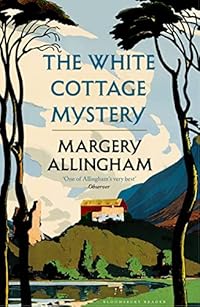
The White Cottage Mystery cover

The White Cottage Mystery by Margery Allingham was first serialised in the Daily Express in 1927 and was published as a book the following year. I read a Bloomsbury Reader paperback which I borrowed from the library.

I’ve previously only read Allingham’s Campion books which I do generally enjoy, especially the later ones, but I liked this one even more and it’s a shame that she didn’t write more books featuring Inspector Challenor of Scotland Yard, with his son Jerry as his side-kick. This one begins just as I like with the murder being committed very early on.

Jerry is driving along a Kentish road, enjoying the change from London when he turns into a good Samaritan, offering a lift to a young woman who is struggling with a large basket having just got off a bus with it. He drops her off at the White Cottage which is situated close to an ugly vast pile of a private house. As Jerry is in conversation with the local policeman they hear a loud gunshot and so begins the mystery.

The victim is Eric Crowther, owner of the ugly house, but it seems that despite there being lots of people around within the two houses, nobody can give any information as to how Crowther ended up shot in the White Cottage and certainly nobody is sorry to see the back of him. There’s an embarrassment of riches suspect-wise and as Jerry has fallen for the young lady that he helped, he’s worried that she is involved in the murder.

This book certainly doesn’t read like the first effort at a murder mystery that it is, and I really liked the relationship between Inspector Challenor and his son Jerry.

Bloomsbury has chosen to go down the same route as the British Crime Classics Library and based the book cover on the vintage railway poster below, although it seems to have been slightly changed by Emma Ewbank.

Wales