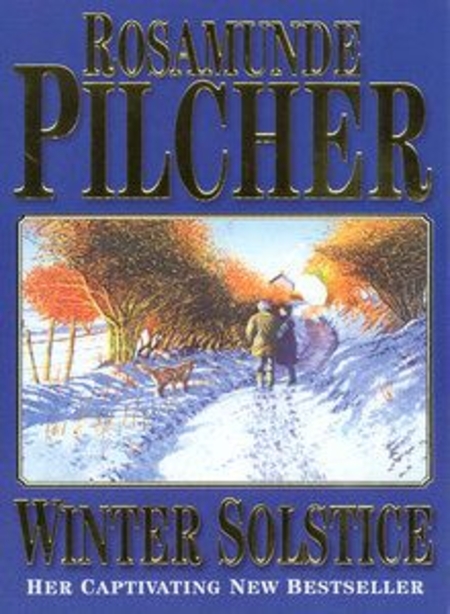
Winter Solstice by Rosamunde Pilcher

Winter Solstice by Rosamunde Pilcher was first published in 2000 and it was the last book that she wrote as she retired from writing then although she lived for for quite a few years after that.

I’ve read quite a few of Rosamunde Pilcher’s books and I suppose they come under the category of comfort read, although in this one there is a tragedy, but it doesn’t involve any characters that the reader gets very involved with.

Elfrida has retired and moved from London to a small cottage in Hampshire where she intends to supplement her income by making cushions and home furnishings and selling them on to a posh London shop. She makes a good job of settling into her new life and making good friends in the area, she has a gorgeous rescue dog called Horace as a companion, but there’s no doubt that the one person who is most important to Elfrida is her neighbour Oscar, but he’s already married with a young daughter.

Circumstances lead to Oscar having to move back to the north of Scotland where he had been brought up and Elfrida gives up her comfortable life to join him there, and so begins a sort of tour of various houses in that area. In fact I felt that it was a bit like reading one of those glossy homes magazines. Some of the properties mentioned were definitely in need of refurbishment and others were very desireable indeed.

I feel that Pilcher had decided to modernise her writing a bit for the new millenium. One of the main characters is a woman who has had a long term affair with a married man and it has come to an end. I can’t be sure, because it’s quite a while since I read any other Rosamunde Pilcher books but I don’t think she had previously had a main character who had had an affair with a married man. I think in most romances a woman like that would have been seen as a bit of a wicked witch and not the main character.

In fact towards the end of this book something happens (you know me, I don’t want to say too much) and probably a lot of people would think that it is just too unlikely but – hold on to your hats girls – some husbands/widowers DO replace their wives after only a couple of months of their death, well they do in Kirkcaldy anyway. I know, I have said too much! Anyway, Winter Solstice is an enjoyable jaunt from Hampshire via London and on up to the wilds of Creagan which is north of Inverness in the Highlands of Scotland, and you can go on a tour of the places mentioned in the book, have a look here if you’re interested. There’s romance a-plenty too.

You can see some images of Creagan here.

I read this one for the Christmas Spirit Reading Challenge 2016 and also for the Read Scotland 2016 Challenge

Kate Hardy by D.E. Stevenson

Kate Hardy cover

Kate Hardy by D.E. Stevenson was first published in 1947.

The ancient village of Old Quinings is full of gossip, it’s rumoured that Richard Morven the owner of The Priory, an historic estate, has sold the Dower House. Richard’s wife dies some years before and he sees no need to hang on to the property which has been bought by Kate Hardy, an author in search of a quiet place to write. Kate also has a flat in London but since her older widowed sister and her daughter have plonked themselves on her, with no feelings of gratitude Kate decides to leave them to it in the London flat.

D.E. Stevenson’s writing remind me very much of that other Scottish author O.Douglas – minus the religion, with both of them writing about small communities and usually a young woman moving to a new neighbourhood and having to make a new home for herself amongst strangers.

However there’s a bit more to Kate Hardy which deals with the snobbery and jealousy that some returning soldiers had to put up with when they came back from World War 2 – hoping to just pick up their lives where they were prior to joining the armed forces. It’s a bit of social history and an enjoyable read.

I read this one for the Read Scotland 2016 Challenge.

Headless Angel by Vicki Baum

Headless Angel over

Headless Angel by Vicki Baum was first published in 1949 and I believe it is sometimes titled Clarinda and it has an intriguing beginning. The prologue starts:

Now that September is blue and hazy upon the land, I like to walk up to my grave in the early afternoon and remain there until in the slanting sun the shadow of my tombstone grows long and lean and begins licking at the hem of my skirt.

It’s Clarinda who is speaking and she is a young married woman living in Weimar where the writer Goethe is a frequent visitor to her house, she has known him since she was a child and he’s a great friend. Clarinda’s husband Albert is a bore as well as a philanderer and when an astonishingly handsome young Spanish man visits the neighbourhood she is bowled over by him and they end up running off together. Too late she discovers that just about everything her beloved Felipe tells her is a lie, he’s a dreamer and a gambler, but she’s still hooked on him.

Because of the political situation in Spain Felipe isn’t able to go back there so it’s to Mexico that they go to live. He’s well known there and pins his hopes on being able to make money out of a mine he owns. It’s the boom and bust existence of a gambler and Clarinda copes with the changes in her life – whether she’s living the life of a princess or a pauper.

The setting is the 1800s around the time of the Mexican wars for their independence from Spain and I was impressed that Vicki Baum, an Austrian Jew had been able to write a book around an era in history that must have been completely alien to her, she moved to the US in the 1930s when one of her books was made into a film. It was a very lucky move for her as her books were banned in Nazi Germany. She must have been drawn to that era in history when men were men – and she could dress her hero in leather finery and a cloak, I couldn’t help thinking of Dirk Bogarde while I was reading this book. He would have been perfect to play the part of Felipe. Think Zorro and you get a picture of how Felipe liked to look, minus the mask.

I really like her writing, I suppose this book could be described as a romance, but it’s more than that and Clarinda is such a good strong character. It’s a shame that Headless Angel doesn’t seem to have been reprinted as I think it must be quite difficult to get hold of a copy, I was just lucky to pick it up in a second-hand bookshop.

Baum’s earlier books were definitely written in German and I would love to know if she eventually switched to writing in English as this book doesn’t mention a translator.

Touch Not the Cat by Mary Stewart

Touch not the Cat cover

Touch Not the Cat by Mary Stewart was published in 1976 and it must have been around about then that I first read it. I couldn’t remember an awful lot about the book (it was a long time ago after all) but I did remember that the family crest had something to do with the storyline. Judith @ Reader in the Wilderness and I decided to read this one at the same time and she plans to get her post up about it soon.

This is a light read, you might call it a comfort read, perfect holiday or summertime reading. The setting is mainly Herefordshire in England in the 1970s although the book does begin in Madeira where Bryony Ashley is working at a hotel that is owned by her father’s friend, it’s just a holiday job for her but tragedy strikes when Bryony’s father is knocked down and killed by a hit and run car in Germany. Her father wasn’t killed outright and his last words have been written down for Bryony, as the doctors know that she won’t get to his bedside before he dies. There is a tradition of a sort of telepathy within the Ashley family and Bryony has it as has one of her male relatives, but she doesn’t know which one it is that communicates with her through thought.

Bryony is now an orphan and even worse than that her family home Ashley Court is entailed meaning that it has to be passed on down the male line in the family. Ashley Court is practically a ruin, an ancient moated house which has suffered from a lack of maintenance for years. It’ll be a millstone around the neck of the eldest Ashley cousin Emory, even more than Bryony realises because she discovers that that branch of the family is equally skint when she and her father had believed them to be very well off.

The police have never been able to track down whoever killed Bryony’s father and she begins to think that it wasn’t a simple accident. Did her cousins have something to do with it? Which of her cousins is it that she has a mental link with, being able to communicate through telepathy.

Bryony is suspicious of her cousins, would they have killed her father to get their hands on Ashley Court and the land around it?

With romance thrown in and some lovely descriptions of the surroundings, something always expected in a Mary Stewart book, this was an enjoyable read. Mind you I always compare any of her books with her Merlin/Arthurian trilogy, that ended up being a series of five books. Those books are still my favourites.

I read this one for the Read Scotland 2016 Challenge, I’ve now read thirteen Scottish books so far this year.

Wonder Cruise by Ursula Bloom

I was asked by the publishers if I would like to review Wonder Cruise by Ursula Bloom, apparently because I’ve reviewed some D.E. Stevenson books in the past. I jumped at the chance because I had read and reviewed an old copy of Mrs Bunthorpe’s Respects by Ursula Bloom. I like her writing, it’s funny but also well observed. She was very prolific, apparently writing over 500 books under various names, she was 92 when she died and she started writing at a very early age.

I was a bit put off by the title. Wonder Cruise sounds a bit tacky to me and Mills and Boonish and when I saw the book cover it didn’t make me feel any better. But I did really enjoy the book which was first published in 1934.

Ann Clements is a 35 year old spinster, she was brought up in a country rectory, a very sheltered and quite boring life, her mother died when Ann was only eleven so Ann had taken over many of a vicar’s wife’s duties. Her brother is an evangelical vicar, he’s married with one daughter Gloria, Ann’s goddaughter and they live in London. When her father dies Ann realises that she has to find a way of supporting herself, the proceeds of the sale of the rectory furniture allow her to take a secretarial course. So for the past nine years she has been working in a London office, again her life is boring, hand to mouth and predictable. Then an amazing thing happens, she wins £350 in a sweepstake.

What should she do with it? Invest it at 3% bringing in a teeny amount of money a year – or splurge it on a Mediterranean cruise? Her brother is outraged by the whole thing, she shouldn’t have been gambling and she shouldn’t think of using the money for herself, he wants her to invest it for his daughter’s future. Sensibly Ann chooses the cruise which of course leads to a complete change in her life.

This is one of those wish fulfilment books, the sort of thing that legions of women must have hoped would happen to them and if it doesn’t happen then reading about it is the next best thing.

The blurb on the back of the book says:
A witty heartwarming read with great romantic and comic characters. This warm feel-good tale will make you smile, and you’ll be rooting for Ann to find lasting love and happiness.

But for fans of vintage fiction it’s more than that. It’s a real trip back to 1934, the attitudes, clothes and the amazing things that happen when you get your hair shingled. In fact I almost felt like getting my own hair shingled, but as I have never met a hairdresser yet who does what I ask them to do I thought better of it!

Why do publishers rarely get the covers of books correct? This one would have been so much more attractive if they had gone down the same road that the British Crime Classics have. Art Deco/1930s clothing, buildings or even a 1930s ship would have been so much better than the soppy effort they chose.
That aside, my thanks go to Corazon Books for giving me the opportunity to read Wonder Cruise – a good read.

Season of Storms by Susanna Kearsley

Season of Storms by Susanna Kearsley was first published in 2010. It’s only the second book by her which I’ve read but I’ll definitely be reading more because this one was really good. Her writing reminds me so much of Mary Stewart and yes, even Daphne du Maurier, this one was perfect summer reading.

A young actress, Celia is given the lead part in a play which is being staged in an Italian villa. The whole idea for it has been set up by Alessandro D’Ascanio, whose grandfather wrote the play decades earlier. The villa originally belonged to D’Ascanio the elder and when his play was about to be performed originally, the leading actress disappeared the night before the performance.

Celia’s friend is a dab hand with the tarot cards and when some worrying cards turn up whilst doing Celia’s reading she advises her not to go, the cards are disastrous. But Celia hasn’t been to Italy before and there’s a trip to Venice in the offing before travelling on to the villa’s location above Lake Garda, it’s a great experience beckoning to her and she’s not going to give up on it.

The setting is a beautiful house with wonderful gardens and with Alessandro D’Ascanio turning out to be very handsome everything should be perfect, but there are strange goings-on almost as soon as she gets there and some of the other actors are a bit on the dodgy side.

The only thing about this book which annoyed me was the fact that Alessandro, who is half Italian and half English and is mainly called Alex, is forever going into rooms completely unheard, all I can say is he must have been wearing rubber soled shoes! Oh and although the setting is Italy, there was an awful lot of bad weather, just when we were having awful weather, I could really have been doing with some Mediterranean sunshine, even if only at second hand.

According to this book Oscar Wilde described travelling in a gondola on a Venetian canal as ‘like going through a sewer in a coffin’ – before that I had been thinking I was missing out on something, never having been there, I’m not so sure now!

The Foundling by Georgette Heyer

The Foundling by Georgette Heyer is quite different from the other romances which I’ve read by her. For one thing it isn’t really a romance as close to the beginning the young Duke of Sale is pushed into agreeing to marry an old childhood friend and cousin, Lady Harriet. The Duke was orphaned at a very young age and his guardian and uncle Lord Lionel has molly-coddled him all his life as he was a rather weak and sickly child.

Lord Lionel likes to be in control of everything and his over-bearing attitude makes Sale wish he wasn’t an aristocrat so when a relative gets into some woman trouble, Sale jumps at the chance to help out, leaving his aristocratic trappings behind and travelling as an ordinary chap.

He finds himself in all sorts of adventures and serious scrapes which he manages to extricate himself from and his experiences end up giving him the confidence which he needed to stand up for himself against all the relatives and staff who are so keen to control his life.

The character of Belinda, a young woman who has also run off from her former life makes for quite a lot of comedy as she agrees to go off with any man who says he will buy her a purple silk gown. It’s quite a task for the Duke to save her from her daftness.

It’s an enjoyable romp.

The Irresistible Blueberry Bakeshop & Cafe by Mary Simses

I feel that as we are now living in a small town with a teeny library which is only open nine hours a week that I really must borrow books from it, just so that the ‘high heid yins’ can’t say that nobody uses the place and decide to shut it down completely. But it’s slim pickings most times I visit and the last time I was getting sort of desperate when I saw this book The Irresistible Blueberry Bakeshop & Cafe.

Anyway, the book is the first one by Mary Simses who grew up in Darien, Connecticut. It’s not my usual sort of reading, I’m not a big reader of romances as I find them too predictable but this one does feature a bit of a mystery and it was nice to be in coastal Maine for a while.

Ellen is a high-flying lawyer and her beloved gran asks her to deliver a last letter to an old flame of hers, with her dying breath. Ellen feels she has to carry out her gran’s last wish, so she leaves Manhattan where she and her fiance live and sets off for Beacon, Maine. Beacon is the small coastal town where her gran grew up and it’s a bit like stepping back in time compared with life in Manhattan.

Ellen’s also a keen photographer and as soon as she reaches Beacon a mishap whilst framing a shot turns her into a bit of a local talking point, much to her embarassment. Out of her comfort zone she turns into a bit of a nincompoop.

It’s all light hearted reading, good for travelling or a summer beach read, not that I ever read on a beach, never having sunbathed in my life – but you know what I mean.

I still prefer vintage crime for comfort reading but this was a nice wee change, and I got to live in Maine for a while too. There is so much mention of food in this book that it put me in mind of one of those books which were written during World War II in Britain when rationing was still ongoing, and authors indulged themselves writing about all of the food which couldn’t be obtained for years. I think a few actual recipes at the end of the book might have been a good idea, well a blueberry muffin recipe anyway. But I might just be thinking along those lines because I’ve recently finished reading the Clarissa Dickson Wright book which had a recipe at the end of every chapter. I still have not tasted blueberries, I must give them a go soon.

The blurb on the front says: ‘If you liked the Nicholas Sparks novels, you will devour this book’ James Patterson. I’ve never read anything by Nicholas Sparks or James Patterson for that matter.

Voices in Summer by Rosamunde Pilcher

Voices in Summer was first published in 1984, which seems like yesterday to me but I had to remind myself that it is actually 30 years ago – amazingly. A few times in the book there is reference to a character looking for a telephone box to call someone and things like that really date it. I don’t know about you but any mention of a phone box and I can smell one, not a pleasant memory I’m sure you’ll agree. I can imagine that some younger people will be reading Pilcher’s books for the charmingly nostalgic atmosphere, the way my generation reads books like Angela Thirkell’s, harking back to a gentler society – even in wartime!

Voices in Summer is set in Cornwall, which is where the author was born and grew up but she married a Scot and after that she lived in the Dundee area I believe. She certainly lived most of her life in Scotland and is generally regarded as a Scottish author.

This one is a light read, good for beach reading or when you’re travelling and don’t want to concentrate on much. It’s a bit of a romance with some mystery thrown in for good measure.

Laura is recently married, to Alec a well off businessman, and their story begins in London where they live. Laura is Alec’s second wife and she feels the presence of her predecessor hanging heavily in the house. Not that the first wife is dead, but she ran off with a younger man and poor Laura is having to live in her house with her choice of furniture and has even inherited the first wife’s friends.

I saw shadows of Daphne du Maurier’s Rebecca in this one, there are quite a few similarities, not that it comes up to the standard of Rebecca. I’m the sort of reader who enjoys a lot of description in books, especially of landscapes but I do feel that Pilcher takes it all just a wee bit too far and she leaves nothing to the imagination. It’s almost as if she is writing in the stage directions too.

I mention that because I think that there are times when there are just too many words and it all gets in the way of the storyline and I just want to say to her — och get on with the tale!

Never happy – I hear you say. Or pernickety besom!

Of course this is another one which I read for the Read Scotland 2014 Challenge.

Cheerfulness Breaks In by Angela Thirkell

I needed another trip with Angela Thirkell down Barsetshire way and I thought this book would hit the spot, and it did. First published in 1940, the Second World War is just beginning to change everybody’s lives with lots of the young men joining the various armed forces and the ones not in uniform feeling guilty for having reserved occupations which are keeping them safe from harm for the moment.

Rose Birkett, the beautiful but dim daughter of the headmaster of Southbridge School, is swanning down the church aisle at last, after several failed engagements which had driven her parents mad with worry and has caused mayhem within the school as she worked her way through the junior masters. At last they are going to get rid of her. Rose has met her match in the Royal Navy, in the shape of Lieutenant Fairweather, who seems to be able to take command of Rose and navigates her through her foul and dispiriting experiences unperturbed.

As usual there are quite a few romantic matches before the end of the book, some of them amazingly hasty but such was life at that time as young folks ‘carpe diemed’ like crazy in case there was no tomorrow for them.

The villages are inundated with cockney children who have been evacuated there along with their colonies of head lice!

Even in 1940 the East European refugees were obviously an annoyance to the locals, which makes it seem quite up to date, given the recent changes in Britain’s demographics and the large amounts of Poles/Lithuanians and the like which now make up part of our population.

As it says on the cover – England is on the brink of war, but the people of rural Barsetshire are not down-hearted.

There’s plenty of humour as well as romance. The only complaint I have is that the book does end very abruptly. In fact the last chapter is called – story without an end. It left me feeling that I wanted to go on and read the next Thirkell book immediately but, I don’t have that one – typical, I have about five of her later books. I’m going to have to buy Northbridge Rectory.