Bookshelf Travelling in Insane Times – 28th December

Bookshelf Travelling in Insane Times was originally hosted by Judith at Reader in the Wilderness, then I took over for a while, but this will be my last such post as I’ve just about run out of bookshelves that I think people might be interested in seeing. This has been an enjoyable meme though and I’ve loved seeing books from other people’s collections.

Books

On the left hand side there are a couple of books by the World War 1 VAD nurse Vera Brittain – Account Rendered and Testament of Experience, I gave Testament of Youth to my history teacher daughter-in-law. They’re interesting books, but Vera Brittain was a bit of a dichotomy as she was all for women’s rights, as long as the women weren’t her own servants – according to her daughter Shirley Williams.

I love Patrick Leigh Fermor’s travel writing, he began his adventures as an 18 year old, I believe after he was expelled from school. Those adventures and his knowledge of Greek were of great help during World War 2 when he joined the army and went undercover to what was then German occupied Greece. Not that he was very low profile as he ended up taking a German general prisoner!

The Little Prince by Antoine Saint Exupery is a lovely wee book. It’s beautifully illustrated by the author too.

The French dictionary is from my school days but it still comes in handy sometimes. At school I ‘did’ French, German and Latin and much more recently I’ve been trying to learn Dutch, but I don’t think I could ever get to grips well with any language unless I lived in the country for a while, well that’s my excuse anyway! Are you bookshelf travelling this week?

Staircase Wit

The Arms Maker of Berlin by Dan Fesperman

 The Arms Maker of Berlin cover

The Arms Maker of Berlin by Dan Fesperman was published in 2009. It’s the first book that I’ve read by the author and I was encouraged to do so after reading TracyK’s review at Bitter Tea and Mystery.

The action in this book begins in the US where Professor Nat Turnbull lectures on World War 2 history, specialising in the German Resistance. His one time mentor Gordon Wolfe is arrested for possessing stolen files from WW 2 archives and this sets Nat off on a dangerous investigation which takes him to Germany.

The action slips between contemporary America and Germany and 1942 Germany where some of the Nazis are beginning to realise that things aren’t going their way. Some young students have set up a resistance group called the White Rose and they’re involved with Dietrich Bonhoeffer who is under surveillance by the Nazis. Kurt Bauer, the young son of an important industrialist becomes embroiled with the young activists, not for political reasons but because he’s in love with Liesl. His father has warned him to have nothing to do with Liesl as she’s trouble, she is not careful about what she says which is a dangerous thing when there are people queuing up to denounce friends and even family to the Nazis.

I enjoyed this although I did find it quite frustrating when the action changed from one time span to the other, always at a sort of cliffhanger when I just wanted to get on with that aspect of the tale.

The Peppermint Tea Chronicles by Alexander McCall Smith

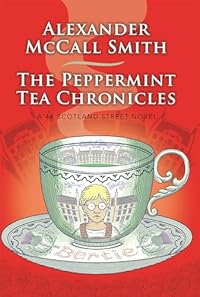
 The Peppermint Tea Chronicles cover

The Peppermint Tea Chronicles by Alexander McCall Smith was published in 2019 and it’s the latest in the 44 Scotland Street series.

This was an enjoyable read, perfect really for bedtime reading as the chapters are very short so if you suddenly get tired it isn’t far to the end of the chapter.

At the end of the last book the ghastly Irene decided to do a PhD at Aberdeen University, leaving her husband Stuart to look after their son Bertie and Ulysses who isn’t Stuart’s son, although Irene doesn’t know that we all know that! Everyone is glad to see the back of her. It’s obvious to Stuart that Irene will be continuing her relationship with the fellow psychologist and father of Ulysses in Aberdeen, so he feels that it’s the end of the marriage, even although Irene seems to think that Stuart is still very much hers to use and abuse. Will he have the guts to break free completely?

Bertie’s life has become more varied as his mother isn’t there to plan out all of his waking hours with psychology appointments and things he doesn’t want to do.

Big Lou, owner of the coffee shop discovers that having a child in her life has very much complicated matters.

Elspeth’s life out in the sticks, with a beautiful house and no money worries looks idyllic, but she’s bored stiff. I would tell her that she should try looking after her triplets herself, but I doubt if that would appeal to her!

Anyway, these books are humorous but also feature small ethical dilemmas. Not all of the characters work well for me, but probably everyone has their own favourites and might be different from mine. For me as ever it was pleasant to be in Edinburgh and the surroundings again, at a time when I haven’t been allowed to travel the 30 miles into the city from my place.

Bookshelf Travelling – 20th December

It’s Bookshelf Travelling time again, a meme which was originally hosted by Judith at Reader in the Wilderness. I’ve been gathering the posts recently but I think it’s now time to hand it on to someone else, if anyone wants to continue with it.

More Books

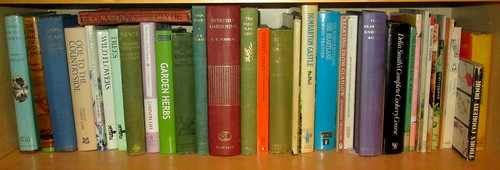
The bookshelf above is in the sun room and it’s a mixture of old travel books, cookery books and gardening/nature books.

I believe that The Glasgow Cookery book was used in the ‘Dough School’ which was the Domestic Science College in Glasgow. It was first published in 1962 and it’s a mixture of what must have seemed to be quite posh recipes at the time such as Salmi of Pheasant, and peasant fare such as Pease Pudding. It actually contains a recipe for Dressed Sheep’s Head. The recipe reads like something from a horror film!

The Companion Garden – How Nature can help your plants by Bob Flowerdew is a book about which plants should be grown together. The herb Hyssop apparently wards off cabbage white butterflies when grown near your vegetable plot. If you grow tomatoes beside your asparagus they will keep the asparagus beetle away. I’ve never had enough ground to grow asparagus so I’ve never tried that. In any case there’s practically no chance of being able to grow tomatoes outside a greenhouse in Scotland, but this is a nice wee book with lovely illustrations by Sally Maltby.

Ode to the Countryside is a book of poems to celebrate the British landscape. I must admit that I bought it for the illustrations by such artists as Frank Newbould and Walter E. Spreadberry. Unfortunately the illustrations aren’t signed and there’s no name check for the artists, but quite a lot of the images are like the 1930s travel poster art which is a style I really like.

There’s a Delia Smith cookery book there. I still use a lot of her recipes, you’re never in any danger of having a failure when you use them.

The travel books are about various areas of Scotland, pretty old but not really out of date because things don’t change that much in the more far-flung parts of Scotland.

So that’s that! I hope you enjoyed having a wee keek at many of my bookshelves over these pandemic months. As I write this blogpost the news is that we in the UK are going into another strict lockdown and Christmas as we knew it is cancelled. Worse than that though is the news that it looks as though mainland Europe has shut us off. I wonder how much food the supermarkets have in storage and how long it will take for it to be depleted as no deliveries will be coming from Europe? Just when we thought we could see the light at the end of the tunnel too.

Anyway – other Bookshelf Travellers this week are:

A Son of the Rock

Staircase Wit

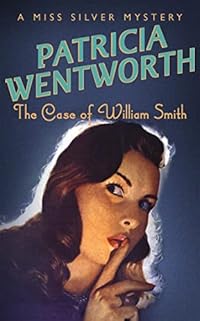
The Case of William Smith by Patricia Wentworth

 The Case of William Smith cover

The Case of William Smith by Patricia Wentworth was first published in 1950 and it’s a Miss Silver mystery.

William Smith can’t remember anything that happened to him before 1942. His first memory is of being in a German hospital, and from there he was transferred to a concentration camp. The identity disc around his neck says William Smith. In the camp he strikes up a friendship with a Czech prisoner who teaches him how to carve small wooden toys and when William eventually gets back to London after the war his talent is spotted by Mr Tattlecombe, a toy shop owner who takes William on as an employee. Mr Tattlecombe’s son had been in the concentration camp with William but he had died there and to Mr Tattlecombe William had begun to take the place of his dead son.

When Mr Tattlecombe is involved in an accident William takes over the running of the business and takes on a female sales assistant. There’s a bit of a mystery as to why she wants the job at all, but William seems keen on her and when ‘accidents’ continue to occur it’s Miss Silver with her gentle cough who comes to the rescue.

I liked this one a lot, it has likeable main characters, twists and turns and Miss Silver sorts it all out as she knits two pale blue coattees for a baby and then begins on a cherry-red cardigan for the mother. She’s some woman!

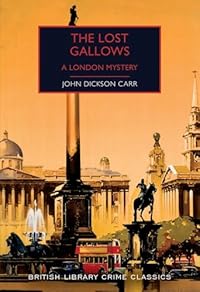
The Lost Gallows by John Dickson Carr

 The Lost Gallows cover

The Lost Gallows by John Dickson Carr has just been reprinted by the British Library but it was first published in 1931. In no way could this book be described as a cosy mystery, it’s the very opposite, so atmospheric and full of creepiness, verging on horror at times, but still a good read even if you lean towards comfy crime usually.

The setting is a very foggy autumnal London, beginning in the notorious Brimstone Club where M. Henri Bencolin and Sir John Landervorne are examining a miniature set of gallows. Sir John had been assistant commissioner of the metropopitan police and Bencolin is the head of the Paris police. The set of gallows had suddenly appeared on the desk of Mr El Moulk, another member of the club, and it has unnerved him more than just a wee bit. The rumour is that Jack Ketch, a famous London hangman of folklore is roaming around London with his gibbet, looking for people to hang.

There’s many a spooky incident, with a limousine apparently being driven by an obviously dead man. With Bencolin making frequent references to the Red Widow, in other words the guillotine, this is very far from the works of the likes of Agatha Christie who steers clear of anything as sordid as the death penalty. To be honest I’m happier with that style of writing. I’m going to be utterly sexist here and possibly entirely wrong but I think that John Dickson Carr’s style might be more popular with male readers. Having said that this is the seventh book by John Dickson Carr that I’ve read and I’ve liked them all, he’s just not a favourite. This is a good read though, especially if you lean towards horror.

I was sent a copy of this book by British Library for review, my thanks to them.

Bookshelf Travelling – 14th December

Cookery Books

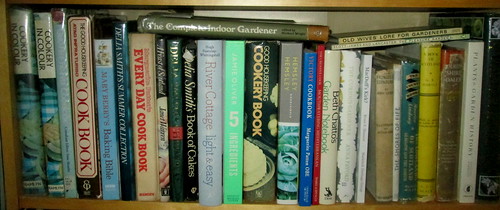
Here I am Bookshelf Travelling again, it’s the shelf above last week’s travelling and it is home to some of my cookery books. On the left hand side there are two copies of the same book –

Cookery in Colour by Marguerite Patten This is the first gift that Jack gave me – he denies this however! Well I suppose he might have bought me some chocolates before buying the book. It did make me think that he was serious enough about me to want to make sure that I could cook and therefore feed him! I bought another pristine copy of the book at a church sale some years ago as my copy has come adrift from its cover and spine, despite being used very carefully. My dad took the book to work and made a plastic cover for it to protect it, so he must have seen something important about it in the family history in the future, if you see what I mean, sadly he died a few years after we got married. The book is very much of its time but I still use quite a lot of the recipes in it. Marguerite Patten was very well known and came to the fore in Britain during the war years when she concocted recipes to help women feed their families while struggling with a lack of ingredients due to the strict rationing. She died just a few years ago.

The Victory Cookbook by Marguerite Patten was first published in 2002 in association with the Imperial War Museum. It’s subtitled Nostalgic Food and Facts from 1940-1954. Food rationing lasted 14 years in the UK and didn’t end until the 4th of July 1954. Actually it was a bit of a rebellion from women that made the government of the day realise that they were pushing their luck, having rationing long after it had ended in mainland Europe. Marguerite Patten said that the recipes in this book show how difficult it is to cook without butter or margaine. I’ve tried a few of the recipes, such as Woolton Pie and it was quite tasty.

There are a few gardening books on this shelf. Beth Chatto’s Garden Notebook is a book that I’ve just realised I haven’t read although I have read other books by her. For a few years we lived near her famous garden and nursery in Essex, just as she was constructing it all so I did see some of the work going on, before we gave up on Essex and moved back to Scotland. I really have to get around to reading this one.

There are some travel books on the shelf and A Book of Scotland by G.R. Harvey dates from 1950. It’s the sort of book that is ideal for dipping into when you are at a loose end. It’s another one that I haven’t read from cover to cover. It’s published by A&C Black. It has a mixture of black and white and colour plates. It’s older than me and is in better condition!

Are you Bookshelf Travelling this week?

Staircase Wit

The Turquoise by Anya Seton

 The Turquoise cover

I think it took me longer to read The Turquoise by Anya Seton than War and Peace or Wolf Hall, and I didn’t enjoy it nearly as much as either of those ones – and it only has 352 pages. For me the first half of this book really dragged, so I only read it at bedtime instead of during the day too as I do with books that I am really engrossed in. The book was first published in 1946.

Doctor Andrew Cameron is an estranged Scot living in New Mexico where he has travelled to after a row with his aristocratic father back in Scotland. He marries a young Spanish woman and has to stand by helpless as she bleeds to death after the birth of their daughter. The Calvinist doctor doesn’t want to call his daughter after a Catholic saint, he comes to a compromise to please his dying wife and calls her Santa Fe after the place they live. He will call her Fey. Seven years later Andrew dies while on a call to help another doctor. It’s a blow to his own patients, but they had grown to love him and one family happily took Fey into their own family, especially as it meant that they took all the doctor’s furniture and belongings too.

When Fey reaches a marriageable age she’s not interested in settling down to the life that the other young women are happy to live, she longs to be rich and have an easy life. But when Terry, a travelling medicine man comes to town she’s captivated by his charm. A quick and possibly illegal marriage follows, but of course Terry isn’t going to hang around long, the pair travel to New York City and in no time Terry has abandoned Fey.

That doesn’t hold Fey back though and she ends up marrying a very rich man, but when Terry appears on the scene again it can only lead to disaster for them all.

The second half of the book was a bit more interesting but it didn’t quite hit the spot for me anyway, despite plenty of references to Scotland and Fey’s inherited Highland ‘second sight’. Fey isn’t a very likeable character so that was a problem for me.

I still have Anya Seton’s Katherine to read, I hope it’s more enjoyable than this one. I must say though that the author was good at Scots dialect dialogue, I wonder if she got soneone else to write those parts for her. Seton is of course a Scottish surname so possibly there was Scots blood somewhere in her background.

Have you read any of her books?

Library Books

Books Again

One night a few weeks ago, it was probably some time past midnight, and for some unaccountable reason I had the urge to request several books from the library. I suspected that the winter was going to be a long hard one and the thing that would cheer me up was the prospect of plenty of decent books to read – while ‘coorying doon’. So that is why I ended up going to the library yesterday to pick up eight books! Don’t ask me why I feared I might run out of books of my own to read as that’s just never going to happen. Shamefully I don’t even recognise most of the books that I got, but I do know that several of them were recommended by fellow book bloggers – so it may well be your fault!

The first three books were completely my choice.

1. Anna, Where Are You by Patricia Wentworth
2. The Case of William Smith by Patricia Wentworth
3. The Peppermint Tea Chronicles by Alexander McCall Smith

I really enjoy Patricia Wentworth’s Miss Silver mysteries so these should be nice murderous comfort reads for me, and the Alexander McCall Smith book is a continuation of his 44 Scotland Street series, I’ve read all the others and I’m a bit of a completist so I’ll read it although a few of them have been a bit hit and miss. They come under the heading of comfort reads too.

4. The Children’s Book by A.S. Byatt. It’s a mystery to me as to why I requested this one although it was shortlisted for the Man Booker Prize, often a reason to avoid a book for me! I have a horrible feeling that I tried reading a book by Byatt before and abandoned it fairly quickly, and I rarely abandon books. I see it has a worrying 617 pages.

5. The Arms Maker of Berlin by Dan Fesserman. I have not a clue who recommended this one but I think they loved it, I hope I do too.

6. In the Light of What We Know by Zia Haider Rahman. It’s another chunkster at 556 pages. Have any of you read this one?

7. The Lotus Eaters by Tatjana Soli. I have a feeling that it might have been Helen at She Reads Books who enjoyed this one. I borrowed it a while ago but had to return it before I got around to reading it as someone has requested it. It’s a James Tait Black winner and I have a project on the go to read all of those winners. It’s a hard task as so many of the books are going to be nigh on impossible to track down, but I’m giving it a go, albeit very slowly.

8. Personality by Andrew O’Hagan. I was attracted to this one while reading some blurb or a blog, the words ‘Scottish island’ jumped out at me so I decided to give it a go. However I’m not sure about it as I believe it is loosely based on the life of Lena Zavaroni, the young Scottish singer who had such a sad and tragic life.

Have you read any of these ones?

Bookshelf Travelling – 6th December

Bookshelf Travelling is a meme which was originally hosted by Judith at Reader in the Wilderness, but at the moment I’m gathering together any other Bookshelf Travelling posts.

This week I’m featuring the bottom shelf of a Billy bookcase in my sunroom. This is a room at the back of our house looking on to the garden and it’s the main reason we bought this place. Anyway, it’s a shelf of art books this week. In normal times we visit a lot of art galleries, exhibitions and museums and of course that hasn’t been possible this year. As Friends of the National Galleries of Scotland we have been able to access some interesting talks by experts so that has been an unexpected plus anyway.

Art Books

This shelf houses books on Renoir, Tissot, Matisse – mainly well known artists, so I’m just going to feature a few lesser known artists.

James McIntosh Patrick is very well known in Scotland, he was born in nearby Dundee in 1907 and died in 1998 and studied at the Glasgow School of Art. You can see images of some of his work here. Most of his paintings are of local rural scenes in the east of Scotland, I really like his work.

I love woodcuts and Four Hedges A Gardener’s Chronicle by Claire Leighton has 88 illustrations in it, as this is a gardening book it’s doubly of interest to me. You can see images of some of her work here. Clare Leighton was the sister of the poet Roland Leighton, Vera Brittain’s fiance who was killed in World War 1.

Introducing The Glasgow Boys
was published by Glasgow museums and written by museum curators Jean Walsh and Hugh Stevenson. You can see some of the artists’ work here.

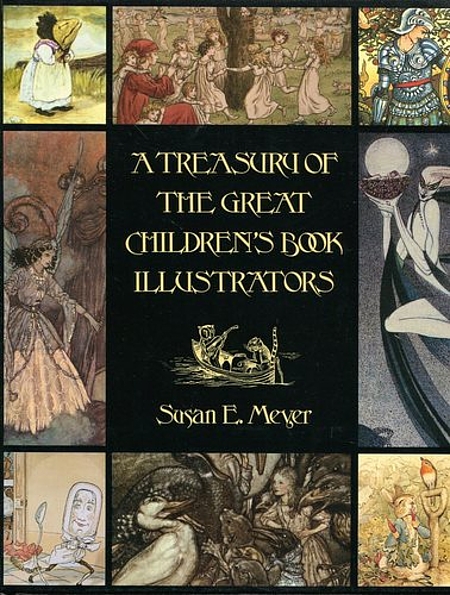
I love children’s illustrated books, not all of them of course but some are beautiful and frankly probably aren’t published for children to get their hands on, unless they’re being supervised! A Treasury of The Great Children’s Book Illustrators features works by Edward Lear, John Tenniel, Walter Crane, Randolph Caldecott, Kate Greenaway, Beatrix Potter, Ernest H.Shepard, Arthur Rackham, Edmund Dulac, Kay Nielsen, Howard Pyle, N.C. Wyeth and W.W. Denslow.

A Treasury of the Great Children's Book Illustrators cover

Other Bookshelf Travellers this week are:

A Son of the Rock
Bitter Tea and Mystery