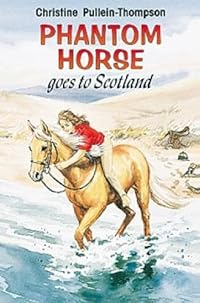
Phantom Horse Goes to Scotland by Christine Pullein-Thompson

Phantom Horse Goes to Scotland cover

I went through a phase of reading pony books when I was probably about 9 or 10 and the Pullein-Thompson family wrote so many such books, it seems it was almost a family business, so I definitely read some of theirs back then, but not this one which was written long after my childhood.

Phantom Horse Goes to Scotland by Christine Pullein-Thompson was first published in 1981, it was later re-titled Phantom Horse Island Mystery.

It’s the summer holidays and Jean and her brother Angus are disappointed because their parents are having to go abroad because their father is a sort of diplomatic troubleshooter, he’s got to fly to the Middle East (nothing changes!) and their mother always accompanies him. But what will happen to the children?

Luckily Angus had seen an advert in a newspaper about The Island School and College of Further Education whch focuses on riding and dressage, ideal for Jean, and Angus can be coached on mathematics which is his weak point. Mr Carli is the headmaster and everything is arranged very quickly. The children fly to the Scottish island, as does Phantom, Jean’s horse!

Apparently Mr Carli had only recently bought the island and most of the original inhabitants had recently left to go to the mainland. There’s only one cottage which is still inhabited and they will be moving out soon as the woman is heavily pregnant. There’s something strange about the whole set up, but Jean is very happy with the training in dressage that she’s getting and the teachers seem fine.

When Jean and Angus realise that some new horses have been moved onto the island under cover of darkness they are sure there must be some sort of nefarious purpose behind it and their investigation leads to danger.

This was a very quick read and quite an entertaining adventure. I will give it three stars on Goodreads I think. I was a bit annoyed that as far as I was concerned there were some details of the tale which weren’t satisfactorily tied up.

It might seem unlikely that parents would send their children off for the summer to a place that they hadn’t even checked out, owned by a man that they knew absolutely nothing about, but some people did do things like that to their children. I was sent to Germany for a month to stay with a penpal and really we knew very little about the family, and it was the summer before I went to high school. I had to fly from Glasgow to Dusseldorf (where I got lost), then on to Stuttgart airport. I survived but I would never have done that to my own children! I still remember the shock I got when I saw the Nazi medals in pride of place in their display cabinet, everyone I knew at home had their WW2 medals hidden away in a drawer, and the one thing that my parents had warned me about was – do not mention the war!

About Britain by Tim Cole

About Britain cover

About Britain by Tim Cole is subtitled A Journey of 70 Years and 1,345 miles. This book is based on the About Britain travel guides which were published in 1951 as part of the Festival of Britain Exhibition. There are thirteen books in the travel series and Tim Cole decided to replicate the journeys from each book to see how the modern journeys compared with the original ones.

The Festival of Britain was all about celebrating modern Britain’s initiative, discovery and industry, so the journeys concentrated on roads which passed by factories and workplaces. Almost all of the industries mentioned in the original guides are long gone, so the author was driving through areas which had been dominated by mines, coal-fired power stations, hovercraft factories, a small airport (mentioned in Biggles according to my husband) and such, but had been swept away and often replaced by houses. Really it’s just as well that those heavy industries have disappeared as they were so damaging to the environment, it’s just such a pity that subsequent governments didn’t manage to replace them with anything that was as well paid.

After the end of World War 2 with sugar still being rationed years later, a lot of orchards were abandoned because to make cider you need lots of sugar and it just wasn’t obtainable in the quantites required, that’s not something that I had realised before.

There’s lots of information in this book such as the afforestation of the UK post war with the Forestry Commission and National Parks being set up, these entities were hailed as forces for good, but in my opinion they have both turned out to be too concerned with making profits rather than doing what they were set up to do, the same can be said for the National Trust which also features in this book.

Astonishingly the original Festival of Britain travel guide made little mention of Jane Austen’s home at Chawton, and seemed to think that readers would be more interested to know that Gilbert White lived in Selborne. I suspect many people were perplexed by that, even back in 1951.

As with many things the pandemic scuppered Tim Cole’s plans for this book as he obviously wasn’t able to travel during lockdown. This was particularly annoying for me as the one book that he wasn’t able to revisit happens to feature the area that I live in – Fife. He ended up doing it on his computer via Google Earth/Street. Travelling across the new Queensferry Crossing high above the River Forth that way was just not ever going to come anywhere close to the real thing.

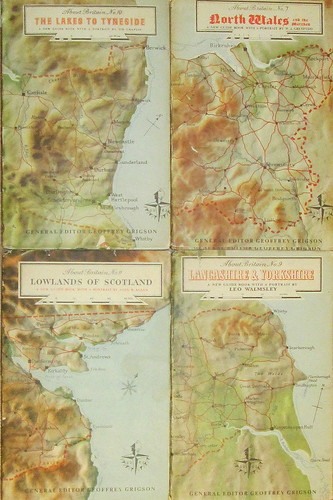
Festival of Britain Books

I only have four of the original travel books that the author was following (see above) but at some point in the future I’d like to visit some of the places mentioned in the books. In recent years we’ve gone on quite a few UK roadtrips, but usually we don’t plan them out too much, it might be interesting to follow some of the routes in the books although the idea behind the Festival of Britain was to show how forward looking the country was after the war, so the focus was on industrial areas, rather than the scenic places that we usually frequent.

This was a really interesting read, with some humour. I was lucky to be sent a digital copy of the book by Bloomsbury Publishing via NetGalley for review. About Britain is scheduled to be published on the 10th of June 2021.

Book Purchases in Edinburgh

There was a big book-shaped void in my life due to the shops being closed for what seemed like forever, and despite buying some books online it just wasn’t the same as going into actual shops and browsing the shelves. No book smell – no serendipity – no book chat with like-minded people. Book buying online is fairly soulless.

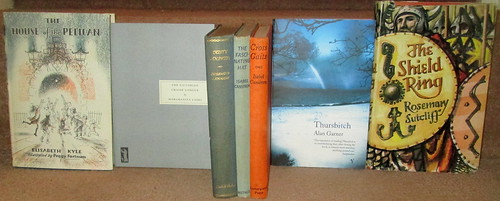
Anyway a trip to Edinburgh one day last week went some way to filling that gap as you can see. I had a lovely time even although we had to hang about outside the shops waiting for people to come out before we could go in due to the shops being fairly small.

Books Again

The House of the Pelican by Elisabeth Kyle (1954)
Thursbitch by Alan Garner (2004)
Cross Gaits by Isabel Cameron (1945)
The Fascinating Hat by Isabel Cameron (1941)
Dusty Answer by Rosamond Lehmann (1927)
The Victorian Chaise-Longue by Marghanita Laski (1953)
The Shield Ring by Rosemary Sutcliff (1956)

Not a bad haul I think you’ll agree, they’re all by authors that I’ve read before and enjoyed – except for The House of the Pelican. I don’t even think I had ever heard of Elisabeth Kyle before, but the setting of the Edinburgh Festival appealed to me so I started that one almost immediately and so far – so very good.

Have you read any of these books?

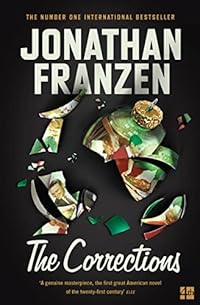
The Corrections by Jonathan Franzen

I read The Corrections by Jonathan Franzen because it won the James Tait Black Memorial Prize in 2002. I must admit that when I saw the thickness of the book I almost gave up on it before even opening it, it’s 653 pages long and it was a paperback that I borrowed from the library. I find thick paperbacks really awkward to read. My history with these James TBM winners hasn’t been all that great, but I really liked this one and I don’t really know why I did, because there are so many aspects of it that I really dislike in a book, such as it not having any really likeable characters. Most of them are quite objectionable but at times they all have moments of decency in them and I suppose that made them very human, it’s such a well observed book as far as people and families are concerned I think.

The elderly matriarch Enid Lambert lives in a bit of a fantasy world as far as her three grown up children’s lives are concerned, she’s happy for her friends to believe that they are all successful and everything is hunky dory in their lives. The truth is she hardly ever sees them and is struggling on her own with her husband Alfred who has been diagnosed with Parkinson’s disease. All she wants is for her two sons and her daughter to come home for a few days over Christmas – and maybe her daughter-in-law and grandsons too. She wants to have a last family Christmas in the home that they’ve grown up in, then maybe she will be able to sell it and move to somewhere more practical to live in. Alfred is losing his grip on reality, possibly because of the medication he is on.

The trouble is that the adult children’s own lives are a mess, and the more the reader discovers of their childhoods the easier it is to see why they have grown to be such broken and selfish adults whose lives are falling apart.

There were so many scenes in this book that rang bells for me, such as the fight over a child who hates the food he has been given for dinner and is forced to stay at the table until he has eaten it all. That reminded me of a woman I knew who did that with her son – but the outcome there was much more dramatic than the scene in this book!

There’s no doubt that Enid has always been unhappy in her marriage and she punishes them by cooking food she knows that her husband in particular hates. She had married Alfred because he was tall and well-built and he earned good money, but she was never going to be able to stop scrimping, that was just her nature, and she was always comparing her life-style with her friends and neighbours who had husbands with lower moral standards financially than Alfred had. But with a stock market crash on the horizon – will that matter?

Surprisingly the book’s ending is fairly upbeat as most of the characters get a second crack at life, hopefully having learned from their past mistakes.

It seems that there are lots of people who hated this book and gave up on it, but there are also lots who have given it 5 stars on Goodreads. I think I’ll give it 4 stars, mainly because it should have been shorter by 150 pages or so, but I understand that most readers nowadays like a big chunky book because they feel like they’re getting their money’s worth, publishers should just make slim volumes cheaper.

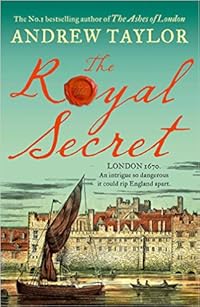
The Royal Secret by Andrew Taylor

The Royal Secret cover

The Royal Secret by Andrew Taylor is the fifth book in his Marwood and Lovett series which I’ve really enjoyed reading, I think this one is even better than the previous books in the series.

The year is 1670 and two young disgruntled girls are plotting to kill a man. Mr Abbott is Maria’s drunken step-father and Hannah is a servant in the household who is regularly beaten by Abbott. Hannah persuades Maria to help with the process which she says involves witchcraft – a dangerous business given the times. After the death of Mr Abbott Marwood looks around the now deserted home of the victim and he suspects that murder may have been committed. It seems that Abbott had been entangled with some dubious characters and had been drawn into frequenting a gambling house which had ruined him.

Meanwhile Cat Hakesby, nee Lovett is continuing with her architect business after the death of her elderly husband, annoyingly most people seems to assume that she isn’t actually doing any of the work and leaves it to one of her employees. After the success of a very grand design for a poultry house she’s asked to come up with an even more ornate plan for the much loved sister-in-law of the French king – Madame, the Duchess of Orleans (Minette) who happens to be the sister of King Charles II. The project requires a visit to the proposed site of the building in France and the trip there is eventful.

While at the French Court Cat is amazed to recognise a Dutchman she had had dealings with in London. Why is Mr Van Riebeeck in disguise and using another name?

Marwood and Cat are thrown together after some unfortunate presumptions on Cat’s part had led to a coolness between them. Marwood is on the track of the Dutchman and Cat can help. Thankfully this moves their relationship along somewhat, I live in hope – especially as Marwood’s whole face is transformed by his smile.

This was a great read, very well researched and based around actual facts. It’s one of those books that I didn’t want to come to an end so I’m already looking forward to the next one in the series.

Thanks to HarperCollins UK for a digital copy of this book for review via NetGalley.

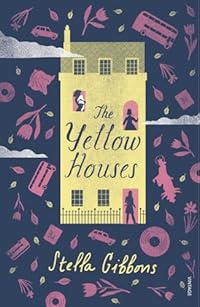
The Yellow Houses by Stella Gibbons

The Yellow Houses by Stella Gibbons was first published in 2016 by Vintage Classics – posthumously obviously – as the author died in 1989. If you’re expecting another book like the hilarious Cold Comfort Farm you might be disappointed as this one is very different, but I really enjoyed it.

It’s the early 1970s and Wilfred Davis is still bereft after the death of his wife six months previously, but almost worse than that is the behaviour of his teenage daughter Mary who has left home for the bright lights of London, about 70 miles from her family home in Torford, without so much as a cheerio. Mary just wants to find a husband and have three children called Max, Hugh and Cilla, she thinks that London is the place to meet her husband. Wilfred is overcome by sorrow while sitting on a park bench, his sobbing attracts the attention of a man who gives Wilfred a linen handkerchief.

So begins a strange friendship between Wilfred and the man who is called Lafcadio and the two women that he lives with in one of the yellow houses that Wilfred can see from his own home. The yellow house has a strange atmosphere and from conversations between Lafcadio, Miss Dollette and Mrs Cornforth it seems that the three of them might have somehow been sent to help Wilfred – or maybe not Mrs Cornforth, there’s something quite scarily tempting about her. All of Wilfred’s problems clear up and his daughter is soon back in touch with him, it really seems like his life is being orchestrated from on high.

I loved the 1970s, I know we aren’t supposed to but I’ve never been able to understand that, just think of all the great musical artists who came to the fore then, and are still around doing their thing nowadays (apart from Bowie sadly) and this book just oozes 1970s somehow. Yes I DO love flares!

In the book Mary manages to rent a grotty room in a poor part of London – Gospel Oak – an area I don’t recall ever having heard of before, but I was amused to hear on the radio recently that it’s deemed to be a very posh neighbourhood now.

This was one of those books that for me had a song running through it – The Beatles, She’s Leaving Home. It was written by Lennon and McCartney and I believe that they got the idea for the song from reading in the Daily Mirror about a teenager who had run away from home, but that was in 1967.

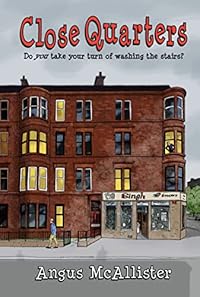
Close Quarters by Angus McAllister

Close Quarters by Angus McAllister was published in 2017 and I decided to read it because Jack was literally shaking the bed with laughter as he read it. I have to say that although it is funny in parts, I didn’t laugh out loud.

The setting is Glasgow’s West End, which if you don’t know it is a rather cosmopolitan and up market area with expensive housing, due mainly to the proximity of The University of Glasgow and the attractions of the Botanic Gardens, a posh hotel and restaurants, eclectic shops, the BBC (once of Queen Margaret Drive but now housed elsewhere in the city) but also ‘normal’ pubs and shops.

A ‘close’ in Scotland is the communal entrance area and stairwell of a tenement building in Scotland. Most of the book features the inhabitants of 13 Oldberry Street, a tenement building which contains seven flats, and a small shop on one side of the ground floor. One of the longest inhabitants of the building is Walter Bain and close to the beginning we’re told that Bain is dead – murdered. It seems that the deed must have been committed by someone who lives in the building as the close security door hasn’t been damaged.

The rest of the book features how Walter Bain’s horrible personality impinged on the lives of his long-suffering neighbours. Bain behaved as if he owned the entire building and spent his time firing off badly spelled and ungrammatical notes to them whenever he thought they had committed a heinous offence – such as not shutting the gate, missing their turn at cleaning the stairs, or having their television on! Bizzarely his mantra is ‘this is a family building’ despite the fact that there are no children in any of the flats. His tyranny has ruled the building for years before someone snaps and does him in.

Suffice to say that everyone has a good reason to murder Bain, in fact – in other parts of Glasgow he would have been bumped off a lot sooner – but then there wouldn’t have been a book, there would just have been a few columns in the Scottish newspapers and a few minutes on the Scottish TV news!

There is humour in it, it wouldn’t have been Glasgow if there was no banter and I really enjoyed strolling around Byres Road and the West End, our old stamping ground, it just didn’t have me shaking with laughter and I guessed the culprit very early on, as did Jack to be fair. His review is here. I’ll definitely try some of McAllister’s other books in the future.

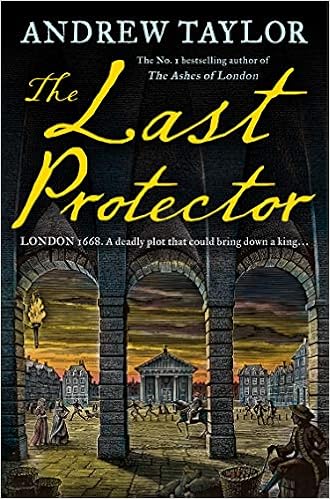
The Last Protector by Andrew Taylor

 The Last Protector cover

The Last Protector by Andrew Taylor is set in London 1668 where Oliver Cromwell’s son Richard has arrived clandestinely from France where he has been living. With the restoration of the King after the end of Cromwell’s Commonwealth following the civil war, Richard had been laden down with his father’s debts and he was in France to avoid his debtors. He’s really homesick for the countryside and his family apparently.

Cat Lovett had been friendly with the Cromwells as a child, a supposedly chance encounter with Richard’s daughter Elizabeth leads to a rekindling of the friendship. But Cat is suspicious, especially when her husband is befriended by Elizabeth and her friend Mr Cranmore.

There’s unrest in London as the Stuart court is completely immoral and there are many papists within it. This is upsetting a lot of people, particularly the Duke of Buckingham and his supporters and it seems that there might be a plot to overthrow the king. This is worrying for Cat, the daughter of a regicide, but her husband has always supported the Cromwells and he can’t be persuaded that he’s putting them in danger. Can Marwood protect Cat?

This is the fourth book in Taylor’s Marwood and Lovett series and I’m really looking forward to reading the next one The Royal Secret which is due to be published later this week.

The books are atmospheric and informative. The Guardian said of it: ‘This is historical crime at its dazzling best.’

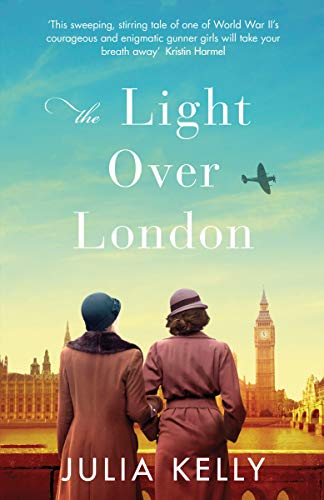
The Light Over London by Julia Kelly

 The Light Over London cover

The Light Over London by Julia Kelly was first published in 2019. It’s a dual time novel with the setting being in WW2 London 1941 and 2017 Gloucestershire. This type of structure often works well but at times they can be annoying if you are enjoying the story and the timeline suddenly switches away from it. The author is American but is now living in London.

Cara has recently divorced and relocated to Gloucestershire where she has got a job with an antiques dealer who does house clearances. When she finds a wartime diary in an old tin while helping with valuations and house clearing she asks her boss Jock if she can keep the diary and he’s happy for her to do so. The diary has been written by a woman who had run away and joined the army to do her bit, rather than stay at home and marry the young man that her rather bullying mother had planned out for her future.

The diary comes to an abrupt end and Cara is keen to find out what happened. She’s helped in her task by Liam, her new and rather good-looking neighbour. So the book contains two romances and a bit of a mystery, unfortunately for me it just didn’t work, in fact there are so many anomalies in the writing that I took to keeping a note of them, this might seem like nit-picking but if you are setting a book in England and all the characters are English then it’s important not to import Americanisms into it as it jars so badly.

The most obvious one was the use several times of the word purse where it should have been handbag.

The word blond was used to describe a woman but the ‘e’ also appeared in the next sentence, otherwise it was without the ‘e’.

The word stand-down was used in relation to the end of the war.

Card shark is used a few times, it should of course be card sharp, I have no idea if card shark is American.

Ticket taker should be ticket collector.

Do you think Princess Elizabeth will serve? The phrase in the UK is/was join up.

Off ramp was used when it should have been slip road, and tea kettle was used instead of just kettle.

In other words the book is in need of being edited to weed out the incongruous Americanisms – as well as the cornier romance parts.

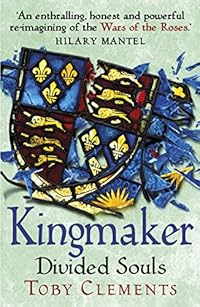
Kingmaker Divided Souls by Toby Clements

 Kingmaker Divided Souls cover

Kingmaker Divided Souls by Toby Clements was first published in 2016 and it’s the second book in the author’s Kingmaker series which begins with Winter Pilgrims, the second one is Broken Faith. I hadn’t read either of those ones as I was given this book by a friend who had bought two copies by mistake (we’ve all done it) and as I had recently read Conn Iggulden’s Wars of the Roses series I thought I would manage this one history wise anyway – which I did.

Toby Clements’s series seems to concentrate on telling the story from an ordinary person’s point of view rather than through an exalted character, so it’s all quite domestic and doesn’t have an awful lot of battles in it although there is some fighting.

The story begins just after Easter in 1469, Thomas and Katherine Everingham have built a little home for themselves on their employer’s land, but everything changes for them when their boss dies suddenly and his widow’s sons arrive to take over the running of the estate and they reluctantly have to leave their home and workplace and take to the road again with some friends, one of whom is heavily pregnant.

It looks very much like war is about to break out again with the Earl of Warwick conspiring against King Edward, mainly because of the behaviour of the king’s in-laws. The earl is scouring the countryside to gather up a large army to attack the king, but Thomas and his friends have had enough of fighting in their lifetime – not that they have much choice.

This was a really good read with adventure, intrigue and some great characters.