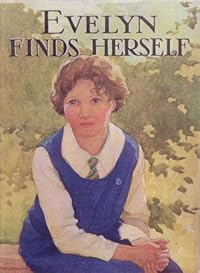
Evelyn Finds Herself by Josephine Elder

Evelyn Finds Herself by Josephine Elder was first published in 1929 but my copy is a modern paperback which has been reprinted by Girls Gone By, actually although it’s a paperback (I prefer hardbacks) it’s still a lovely book and there are 46 pages of very interesting information at the beginning. There’s some history of education in England and Scotland which had/have very different systems. Scotland’s system was way ahead of the English one which only really got into gear for ordinary children in the 1930s. It was the 1920s before commissions recommended that secondary education should be available free to all children in England. In contrast in Scotland education was sponsored by the state from the 18th century. There are also some interesting photographs of the original book covers, and some old schools and teachers.

Unusually this book is set in an ordinary girls’ secondary day school rather than a boarding school so the reader sees the girls at home as they visit each other to do homework together and also as they enjoy each other’s company outside school and socialise with their families.

Evelyn’s best friend is Elizabeth but when they meet up at school after the summer holidays they haven’t seen each other for eight weeks. It’s evident from the beginning that although they’re great friends they’re quite different characters. Elizabeth is always thinking ahead, such as planning to get what she thinks will be the most interesting seat locations in their new classrooms. Evelyn is altogether more serious about her studies.

When Elizabeth seems to be more interested in being friends with another girl Evelyn is surprised, she can’t see the attraction and the girls grow apart somewhat. There’s no animosity, just a coolness but Evelyn is hurt. It’s all character forming though, and all so familiar to anyone looking back on their own schooldays. I particularly enjoyed the way the girls were disdainful of the ‘Home Life’ department and the girls who were too stupid to do anything else – it felt so true to life. I just remember being astonished that anyone would need lessons on such things as washing clothes! I had been doing all the housework in my family home since I was ten years old.

This book is so well written and observed with the teachers also coming across as human beings with a life outside their workplace. This is a really enjoyable read so I’ll definitely be looking for more books by the author.
The Spanish Letters by Mollie Hunter

The Spanish Letters by Mollie Hunter was first published in 1964 but my copy is a Puffin book dating from 1972.

The setting is Edinburgh and the year is 1589, the end of January. Young Jamie Morton is a caddie in the city – that means he earns his living by doing messages for people, whatever is needed, maybe delivering a note to someone, a sort of odd job person who has to know the city inside out. He has been trained up by ‘the Cleek’ a much older caddie. There are a few hundred such males of all ages in Edinburgh, it might be a bit of a precarious living but Jamie likes it because he’s his own boss. He isn’t so keen on being starving half the time though.

When a young well known musician goes missing Jamie is asked to help track him down and so begins a tale of adventure, murder and kidnap with the Earl of Huntly – a favourite with King James involved.

There’s a ship from the Netherlands docked at Leith, Edinburgh’s port, and there’s a suspicion that it has Spaniards on board. Is there a Spanish plot afoot? A second Armada attempting to topple Queen Elizabeth. For once the Scots and the English are on the same side, well most of the Scots are.

This was a really enjoyable read, my first by the author but I’ve recently bought a couple of others. Her writing reminded me of Dorothy Dunnett’s adventures which is high praise indeed, but obviously not as convoluted (or long) as Hunter’s writing is aimed at youngsters. Her books are apparently all well researched so it seems like a painless way of learning history.

For anyone who has already read this book you might be interested in this blogpost that I wrote earlier, when I visited Huntly Castle in Aberdeenshire.

The Gates of Eden by Annie S. Swan

The Gates of Eden by Annie S. Swan was first published in 1893. This book is seen as her most successful one I believe and it was an interesting read for me as almost all of the action takes place within a couple of miles of my home. Unusually the author didn’t change the names of any of the villages involved in the tale. The main setting is a hamlet called Star which Annie S. Swan had moved to when her husband got employment there as a teacher in the wee school. They only lived there for two years, it must have been a bit of a culture shock for them as they would have been used to Edinburgh and Star was really at the back of beyond comparatively.

The story begins with the death of a young woman who has just given birth to twins, both boys. Before she died she asked her husband to make the eldest boy – Alexander (Sandy) a minister when he grew up and he was determined to keep his promise. The result was that Sandy was put above his younger brother James who was destined to help his father on the farm and was very much overlooked by everyone. Nobody seemed to realise or care that James was also talented and had dreams of his own, farming was drudgery to him, he wanted to be a writer. When Sandy left to go to St Andrews University James was deeply unhappy, especially as Sandy had always just taken for granted that he deserved the best things in life.

As you would expect Sandy had grown into a really self-centred snob with money and status being his god, which isn’t great for someone who is going to become a church minister, but James who has spent his time reading widely such people as John Stuart Mill, has turned into a really thoughtful, decent and compassionate human being. Still his father doesn’t appreciate James and it’s their Aunt Susan who has cared for the twins since their birth who eventually sees James’s worth.

This is a book very much of its time with a Christian slant but not overly preachy. The lessons are many – stick in and hard work will pay off, everyone deserves a second chance, don’t be a miser or proud and materialistic – forgive.

Locally Annie S. Swan is a bit of a heroine here for putting such small places in Fife on the map back then, but in truth, if you read her memoir as I have she was quite disdainful about the two years she and her husband lived in the area, but as she said – at least she got two books out of it.

There is a lot of Scots dialogue in this book, I can only surmise that back then readers were less easily put off by that, now many readers would find it too difficult or annoying to read. Interestingly despite the fact that there’s much mention in the book of the broad Fife speech it actually isn’t a Fife dialect, so perhaps the author couldn’t cope with that herself.

We Also Served by Vivien Newman

We Also Served cover

We Also Served by Vivien Newman is subtitled The Forgotten Women of the First World War. I’ve always been interested in WW1 so I’ve read a lot of books about the period but I still found a lot of new to me information in this book.

It begins with the feverish knitting of socks, scarves, gloves and such comforts as were desperately needed by the soldiers in the trenches and sailors. Even young children were knitting socks, one poor little eight year old boy was said to have been knitting almost right up to his last breath, but it was mainly females who were doing the knitting. The women in Dundee knitted over 6,000 pairs of socks in the early months of the war! It was a great way of making women feel that they were doing something for the war effort, they couldn’t go and fight but with so many women having a husband, brother, son at the front they wanted to do their bit. Knitting was approved of by the powers that be but when it came to doing anything more involving such as nursing women were told they couldn’t go to the front. Famously (if you know anything about this subject) the Scottish surgeon Dr Elsie Inglis was told to ‘Go home and sit still.’ The British government wasn’t interested in help from women. The Serbians, French and Belgians were much more sensible and Elsie Inglis and her nurses are still revered in Serbia today.

Early in the war women were recruited by the government to hand out white feathers to men that they thought should be in the army, a way of shaming them. I must admit that I hadn’t realised this was originally organised by the government.

Later as the war dragged on women were taken on in war service as nurses, munitions workers, were recruited in the armed forces (not armed of course) land girls, who were particularly disliked because they were used to free up men for the front. Their wives didn’t want their husbands going to war and up until then farm workers had been safe from conscription. Women were recruited as spies and if caught they were executed. The stress and strain of the horrific experiences of nurses led to them suffering from shell-shock and what we now call post traumatic stress disorder and sadly nurses did commit suicide.

This was a great read although at times infuriating as women were treated so badly, earned much less money than the men when they worked in munitions, despite the horribly dangerous work which often ended up with them being blown up or poisoned by the chemicals. Those accidents were hushed up.

The women who had been despised by male workers often ended up being admired by them because of the hard work and long hours they put in – and of course most of them had to go home and start doing all the work there too, so never got any rest at all. However, when the war ended the women had to give up their work and go back to the kitchen sink and often the only option open to them was to go back into service as a maid. Their efforts did go a long way to women getting the vote, but only if they were over 30 at first.

Thank you to Pen and Sword History and NetGalley for providing me with a digital copy of the book for review.

Upside Down /Love Among the Ruins by Denis Mackail

 Upside Down   cover

Upside Down or Love Among the Ruins by Denis Mackail was first published in 1943 and it doesn’t seem to have been reprinted since then, which is a shame as it’s an enjoyable read. I was lucky enough to find a copy for just a few pounds, in Edinburgh I think, but copies seem to be selling for around £30 on Ebay. Denis Mackail was of course Angela Thirkell’s brother, it might be entirely my imagination but at times I did think I recognised a resemblence in their writing, a sort of familial chattiness maybe.

The setting is London in early wartime where Mary Jesmond, a famous middle-aged actress is having a tough time finding work, like everyone else in the profession. Her grown up daughter Laura Rivers also has talents of a thespian nature but sensibly decides to sign up for war work, finding a job in a government office in London with Humphrey Knowsley as her boss, a rather eccentric bachelor.

Roy Vincent is a youngish playwright who doesn’t actually have a play written, but Mary Jesmond is desperate to secure the main part in any play he might write. With the blitz beginning in earnest they end up continuing get-togethers in air-raid shelters as the bombs fall around them. Mary’s beloved house had already been bombed, which is why she and Laura are in tiny adjoining flats, she’s quite sanguine about the whole thing, but she does wonder if Roy is more interested in Laura than in writing a play for her.

This book has a lot of humour in it and a very authentic wartime atmosphere as you would expect. It’s a pity that it isn’t more easily available to readers.

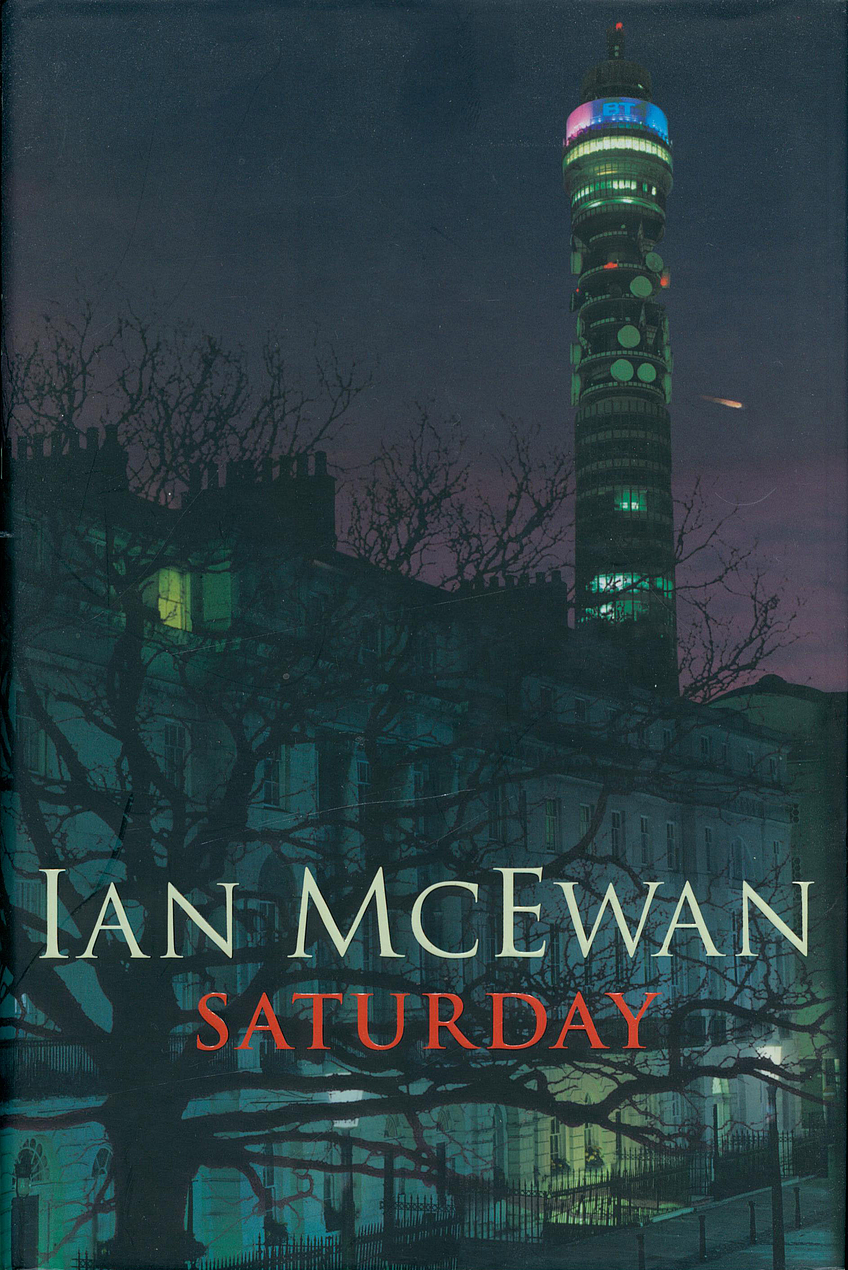
Saturday by Ian McEwan

Saturday cover

Years and years ago, before I started blogging I read a book by Ian McEwan and it had such a horrible ending I swore I would never read any more of his, but his book Saturday which was published on 2005 won the James Tait Black Memorial Prize. I have a personal project on the go to try to read all those prize winners, so I had to give Saturday a go. Luckily I found this one to be a lot better although I kept waiting for something awful to happen. It had its moments but nothing too horrific.

The story all takes place within Saturday, February 15th, 2003 in London. Later on in the day there’s going to be a massive anti-war demonstration – against what became known as the Iraq War (or the Second Gulf War.) But for Henry Perowne, a neurosurgeon it begins very early in the morning as he woke up and found himself drawn to look out of one of his very large home’s windows. There’s something flying across the London sky and at first he thinks it might be a comet, but it’s an aeroplane with an engine on fire, possibly it’s a terrorist strike, given the political situation. He’s worried that the perfect family life that he and his wife Rosalind have with their two grown up children might be threatened.

It turns out that it’s something far more mundane that leads to a terrifying situation for them all. A silly car accident and the ensuing confrontation with the other driver and his side-kicks, coupled with Henry’s refusal to back down almost leads to disaster.

There’s a lot to like in this book, the loving relationship between Henry and his wife Rosalind, the very talented and successful arty off-spring Theo and Daisy who also seem to be very grounded, but it isn’t all sweetness and light – like most families. There’s also a cantankerous grandfather, and an awful lot of information on various neurological problems, too much maybe. McEwan certainly did his research, and not just in books, in operating theatres too.

The setting of the family home is great too, a huge house overlooking a London square that Rosalind had inherited. It’s a weird thing but at the moment I don’t seem to be able to get away from London squares – and I don’t mean Albert Square.

This was a surprisingly good read.

An Edinburgh Reel by Iona McGregor

An Edinburgh Reel by Iona McGregor was first published in 1968. I’ve been reading a fair few books set in historic Edinburgh recently and this is another one. The setting is mainly around the Royal Mile, six years after the battle of Culloden, so 1752.

Christine has left her family home of Strathdallin in the Highlands to go and meet her father in Edinburgh, it’s her first visit to the capital and she’s not impressed as the place stinks. So although her family home at Strathdallin had been trashed by the Redcoats after the battle and there are only a few rooms left standing and the roof is leaking, she’s still homesick for the place. Living in a couple of freezing rooms at the top of a tenement building doesn’t suit her at all, despite having friendly but much better off relatives living in the same building.

John Murray, her father has spent most of the past six years in France after he managed to escape from a prison hulk after his capture, he knows that he had been betrayed by another Scotsman after Culloden but doesn’t know his name. He’s still a loyal Jacobite and is determined to get back at whoever betrayed him.

When Christime first sees her father she’s shocked that the he doesn’t look at all like the handsome tall man that she remembers. She must only have been nine years old in 1745 and she has grown while her father seems so old and shrunken, he has permanent health problems because of his treatment by the English and his estate has been seized by the government, so they are penniless.

Christine is worried for her father as he’s in danger of getting dragged into another Jacobite plot and ending his days kicking on the end of a rope.

This was a great read, very atmospheric with a wee bit of a romance too. I’m sure that Iona McGregor got it exactly right when she has the wealthy Edinburgh inhabitants getting all teary eyed and sentimental over the songs sung about ‘The Chevalier’ – despite the fact that most of them hadn’t been supporters of the Jacobites during the Rising.

This book was apparently aimed at children aged 11 and over, but like all well written books it’s appreciated by people of all ages.

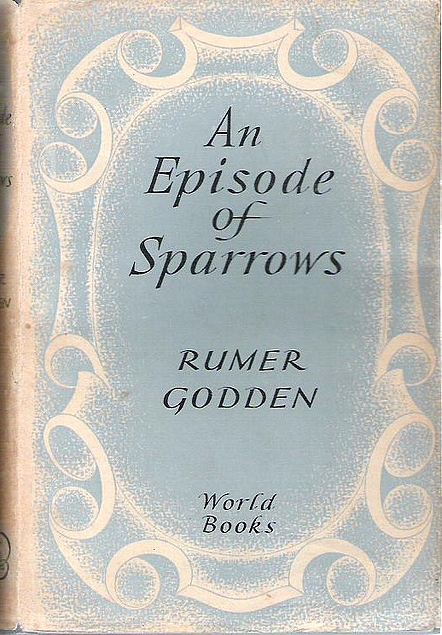
An Episode of Sparrows by Rumer Godden

An Episode of Sparrows cover

An Episode of Sparrows by Rumer Godden was first published in 1956. The setting is an area of London which like them all has a mixture of what had been grand houses fringing a poorer neighbourhood. The Victorian iron railings had been removed from the private gardens in the square belonging to the grander houses, and big holes were appearing in the grounds where large quantities of earth had been removed, it was a real mystery and Angela – queen bee of the Garden Committee – is determined to get to the bottom of it, although someone else will have to do the work of course.

Although I really enjoyed this book I did find it at times to be so sad as the main character, an eleven year old girl called Lovejoy Mason lives a loveless and neglected life as her mother has dumped her on strangers while she goes off to pursue a life on the stage, and doesn’t even send money for her upkeep with the result that Lovejoy has grown out of her clothes and shoes, something that she feels keenly as she has a love of good quality fabric and design, something that her mother had passed on to her.

A packet of cornflower seeds begins her love of gardening and she manages to make a secret miniature garden on a bomb site, the only one which didn’t seem to be inhabited by a gang of boys. But when the local baseball season was over (a game they had been taught by Zassi a little American boy) Tip Malone and his gang turned up to reclaim their patch and trouble ensues. But Tip Malone finds himself drawn to Lovejoy, it’s a mystery to him. He thinks maybe it’s because she always looks so clean with her hair well brushed, despite her obvious poverty. The garden becomes the most important thing in Lovejoy’s life and Tip gets dragged along in her wake.

The children – the sparrows – are the main characters in the book, but their exploits have a big impact on Angela and her older sister Olivia who has always lived in her young sister’s shadow. In particular Olivia who has never pushed herself forward is impressed with Lovejoy’s attitude to life although it has to be said that Lovejoy is anything but a Goody two-shoes.

Although there’s plenty of strife in this book the writing is lovely and it has a great ending so it turned out to be a perfect pandemic read.

I had been under the impression that I had read this book back in the 1970s when I had a big Rumer Godden binge, but I soon realised that I hadn’t, so that was a nice surprise. I wonder how long it has been sitting unread on my bookshelves!

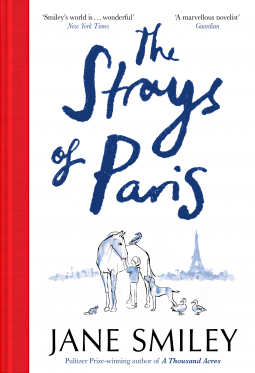
The Strays of Paris by Jane Smiley

The Strays of Paris

I must admit that I had never even heard of the Pulitzer prize winning author Jane Smiley until she featured in a Guardian Review article which mentioned that her latest book is The Strays of Paris, and luckily it was available on NetGalley, so I requested it and amazingly got a digital copy for review. I’m so glad that I did as this was one of those books that I just didn’t want to end.

It begins with a racehorse called Paras, or Perestroika as is her racing name, she’s an inquisitive horse and when she realises that her stable door isn’t locked she pushes it and manages to walk out of the stableyard and makes for Paris. The previous day she had won her first race, so she knew she had won a ‘purse’ so she took the purse that she saw lying on the ground outside her stable along with her.

She relishes her freedom and all the different smells around her, she’s happy to be able to crop the wild plants that she passes, her very good racehorse diet could get a bit boring. Eventually she reaches Paris where she realises it’s important for her to keep a low profile, but she makes friends with Raoul who is a raven, a mallard duck couple and Frida who is a stray dog since her human who had been a talented homeless street busker had died. Later on a couple of black rats are incorporated into the little stray family, and they can all communicate with each other.

Frida is wary of humans having been well warned by Jacques her human that most of them didn’t like barking dogs, Frida does a lot of grumbling under her breath. All of the animals are sort of semi attached to their own kind. The dogs of Paris bark at Frida because she doesn’t have a human and doesn’t wear a collar. Paras felt different from the other race horses in the stables, but she does miss the warmth as winter in Paris begins to bite.

Some of the human characters who also happen to be loners could also be described as strays, they realise that there is a horse living loose in their neighbourhood and befriend Paras, but it’s Etienne an eight year old boy who does most to get Paras through the winter and keeps her safe from inquisitive policemen. Etienne is yet another stray who lives with his very elderly deaf and almost blind grandmother who is the last of her generation. She worries about what will become of Etienne when she is no longer around.

This is a great read with the animal characters having hopes and ambitions for the future and it has a fairly happy ending, just what I was needing.

Thanks to the publishers via NetGalley for sending me a digital copy for review.

The Guardian Review – some links

I thought you might be interested in some of these links to articles from last Saturday’s Guardian Review.

The Guardian has asked seven writers about their survival strategies in lockdown, you can read the article here.

There’s a review of Kazuo Ishiguro’s new book Klara and the Sun. It’s another masterpiece apparently.

There’s a review of Two-Way Mirror: The Life of Elizabeth Barrett Browning.

There’s an article about a great crop of children’s books being published, aimed at children aged eight and over. You can read it here.