The Lotus Eaters by Tatjana Soli

The Lotus Eaters cover

The Lotus Eaters by Tatjana Soli won the James Tait Black Memorial Prize in 2010. If it hadn’t won that prize I doubt if I would have picked the book up because the subject matter didn’t really appeal to me, but I ended up really enjoying this book which was quite a surprise to me.

The book begins on April, 28th 1975 with Helen Adams picking her way through the streets of Saigon. The long war is coming to an end. There’s a lot of looting going on in the centre of town, it’s time for her to leave the city and go home, but she wants to hang on and be the last photographer to leave, she’s sure there are still great photo opportunities for her.

Ten years earlier she had decided to go out to Vietnam to become the first female war photographer there, she was totally clueless. She wore suede high heels and only had an instamatic camera so had never even loaded film into a ‘real’ camera. She had been drawn to go to the war zone because her younger brother had been killed there, she wanted to find out how her brother had died if possible, but it was also partly because she had always been infuriated by the way she had been left out of things by her father as he took her brother out with him to do father/son bonding things, such as hunting. She felt she had some catching up to do.

The male photo journalists weren’t happy about her being there, nor were the combatants, but Helen hung on to Sam Darrow’s coat tails and learned the job from him. From Linh his assistant she learned Vietnamese, something that the others didn’t bother to do.

This is a love story of sorts although the obsession with getting good photos that tell a story and will be of interest to the folks back home as well as the editor of Life magazine becomes paramount. Like others before her Helen is loth to leave and go home to a mundane life, she’s become a bit of an adrenalin junkie despite her terror as she accompanies the soldiers on patrols. The love interests didn’t ring quite true for me, but that’s me nitpicking.

Despite the descriptions of violence and the horror of the war this is a really good read, very atmospheric. It’s the sort of book I would normally avoid, simply because the setting is in such a steaming hot country – daft I know but I prefer books set in cold countries – but I’m really glad that I read this one. It’s quite amazing to think that this was her first book. It is so much better than the last James Tait Black prize winner which I read (Personality by Andrew O’Hagan).

I was also impressed by the two pages of bibliography which Soli listed at the back, she certainly did her homework.

Guardian links

Today I just have a couple of bookish links from this week’s Guardian.

There’s a review by Kathryn Hughes of Frostquake: The Frozen Winter of 1962 and How Britain Emerged a Different Country by Juliet Nicolson which sounds like an interesting read to me.

I enjoyed reading author Jane Smiley’s answers in The books that made me article which you can read here. In her answer to My earliest reading memory she mentions Laura Lee Hope’s The Bobsey Twins. I loved those books as a youngster and I’ve never seen anyone else mention them.

Did you read any of Laura Lee Hope’s books?

Sexton Blake on the Home Front

The Witch of Blackbird Pond  cover

This is a collection of two novellas. The first one is The Man from Occupied France and was written by Anthony Parsons in 1941.
The book begins with a young woman being sentenced to ten years in jail for passing information on to the Germans. It’s 1941 and Isobel Ensor had been working in an aircraft factory, in charge of the blueprints of all the aircraft designs. She had got the job through a friend that she had met at an organisation which had been set up to promote friendship between Germans and English people, but obviously when war broke out some of the Germans had decided to go home to Germany, as did Isobel’s friend. She gave Isobel a gold watch as a keepsake when she left.

When there was a tip off about the possibility of information having been stolen, Isobel is suspected of being the culprit and when her handbag is searched it’s discovered that the pocket watch which had been a keepsake was actually a small camera. Even then Isobel doesn’t realise that her so-called German friend had set her up.

Isobel’s fiance is determined to clear her name but he just makes matters worse, until Sexton Blake and his side-kick Tinker get involved. This is a really enjoyable thriller, full of atmosphere and suspense, with some humour too.

The second novella is called The House on the Hill and was written by John Drummond in 1945.
Jane Wray lives in a house which is owned by her employer who owns a mill, her mother also lives in the house and Jane’s fiance Jim is their lodger. When the owner of the mill dies his son inherits everything, he’s a violent man with a fierce temper. When there’s a murder Jane is worried that Jim might be involved – and Jim is worried about that too, and so begins a manhunt worthy of John Buchan, with plenty of twists and turns.

I received a digital copy of this book for review from Netgalley. It’s published by Rebellion and edited by Mark Hodder.

The Witch of Blackbird Pond by Elizabeth George Speare

The Witch of Blackbird Pond by Elizabeth George Speare was first published in 1958 and it’s a Newbery Medal winner. I must admit that I had never even heard of this author until I was very kindly sent a copy of the book by Jennifer of Holds on Happiness.

It’s 1687 and Katherine (Kit) Tyler is on board the Dolphin, sailing from the Caribbean island of Antigua to New England. Kit had had a very luxurious life, her parents were both dead and it was her grandfather who had brought her up, he was a titled plantation owner, but when he died there were lots of debts and Kit had to sail to her only known relative, her mother’s sister – Aunt Rachel. Aunt Rachel lived in Wethersfield, a small town in the Connecticut Colony. The town is a horrible culture shock to Kit who is used to the lush countryside of Antigua, the ‘roads’ in Wethersfield are just dirt tracks and the houses are all wooden shacks.

Her Aunt Rachel and Uncle Matthew Wood get a bigger shock though when Kit arrives at their cabin, she hadn’t told them she would be arriving and it’s obvious that she’s not really welcome. Life for them is already difficult with just two daughters, one of them crippled, and no boys to help Matthew with the farm work. Kit had never had to do any house or field work before, she had had a slave to help her in Antigua, but had had to sell her slave to pay for her passage on the Dolphin.

Life in the Wood household is hard and joyless, as it is in the whole town, it’s a Puritan colony and they are suspicious of people who aren’t like them, and Kit with her beautiful silk dresses is suspect, she can read and she can even swim, some think she might be a witch. The locals dislike anyone different from them and particularly hate the elderly Quaker woman who lives in a shack near the river.

This was a really entertaining read. It was good to be in the company of Kit who is a strong character, determined to do the right thing despite the evil tongues of some of the locals. After some angst there is a very happy ending for all, just what I was needing at the moment.

I imagine that as this book was at one point required reading in US schools some of you will be familiar with this one. Thanks again Jenny for sending me this one.

Personality by Andrew O’Hagan

Personality by Andrew O’Hagan was first published in 2003 and it won the James Tait Black Memorial Prize that year. I have to admit that that was the only reason I read this one as I have a bit of a personal challenge going on – trying to read all the books that have won that prize.

The author does begin with a note to the reader claiming that this is a work of fiction, but in truth it is very heavily based on the life of the Scottish child star Lena Zavaroni who becane wildly famous at the age of ten when she won Opportunity Knocks in the 1970s, for several weeks running. O’Hagan didn’t even bother to change ‘his’ personality’s place of birth or family circumstances. It didn’t feel like the 1970s and he got names wrong – Quivers Jelly might sound right but it was actually Chivers.

Young Maria Tambini of Rothesay, Isle of Bute, whose parents own a cafe in the town is well known locally for her amazing singing voice and when a talent scout is in the audience at a concert where Maria is performing the upshot is a spot on the very popular talent show Opportunity Knocks. A warning to readers from me is that the ghastly human being Hughie Green appears quite a lot in this book, but as a decent human being, not the vile man that we all discovered him to be after his death, although most of us probably had our suspicions. So at the age of 13 Maria is an international star, living in London with her female manager and her husband and having very little contact with her own family. Surprise surprise she develops anorexia nervosa and does a tour of TV shows talking about her problems, just as Lena did!

There is one sex scene in the book between Maria and her very caring and loving boyfriend, not that you would get that idea from the way it is written and the language used to describe it is just so wrong for the situation. I was wondering if O’Hagan was hoping to win that Bad Sex prize.

The only difference is the ending, and by that time we’re getting into a version of the crazy fan à la John Lennon, with a twist to that too. Hurrah, the author used his imagination. I cannot imagine how this book won the James Tait Black Prize, there must have been many better books published in 2003.

I so hope that the next prize winner I read is better. I’m so annoyed that he ripped off a very sad life, she was used and abused enough in her lifetime.

The Acts of King Arthur and his Noble Knights by John Steinbeck

In the Classics Club Spin number 25 I got The Acts of King Arthur and his Noble Knights by John Steinbeck. I’m a bit of a completist so I intend to read everything by Steinbeck which is probably the only reason I bought this book as I’ve already read a fair few versions of this subject. To begin with I really regretted putting this book on my list as I wasn’t enjoying all the never ending combat between various knights for no good reason, the beheadings, swords cleaving through armour and constant violence, but it did get a bit better further on. I suspect that as Steinbeck wandered further from his original inspiration of Thomas Mallory’s version and reached the ‘other sources’ mentioned on the cover then the stories became less rigid and felt a bit more modern.

After 293 pages the book comes to an end as Steinbeck just couldn’t continue with it. It seems that after Queen Guinevere and Lancelot got together and did the dirty on King Arthur he didn’t have the heart to continue with it.

There is a very long appendix which conists of letters between Steinbeck and Elizabeth Otis his literary agent and Chase Horton. In the letters Steinbeck details how he went about his research which was very detailed, I haven’t read all of the letters but it looks like they may be more interesting to me than the actual book was. You get a real sense of Steinbeck the person, just as you do in his book Travels with Charley.

However if you are planning to read books featuring King Arthur/Merlin I’d recommend the Mary Stewart series to you which is really very good. The Crystal Cave, The Hollow Hills and The Last Enchantment followed much later by The Wicked Day which isn’t quite as good.

Steinbeck was only nine years old when his aunt gave him a copy of Thomas Mallory’s Morte d’Arthur which the small boy fell in love with, strange spellings and the archaic words fired up a passion for the English language which never left him.

I suspect that his six year old sister who had to perform as his knight didn’t have quite the same enthusiasm for the subject!

Coriolanus by William Shakespeare

Coriolanus

In 2020 I didn’t read many books from my Classics Club list (2), in fact it was only the spin books that I read, so this year I thought I would start to chip away at the fewer than 20 that I have left to read from my second list of 50 classic books. So I decided to read Coriolanus by William Shakespeare which I knew nothing about. I picked it up a few hours after watching the insurgents live on CNN as they beat their way into the US Capitol building and it felt just a wee bit spooky with
Act First Scene 1 Rome. A street. Enter a company of mutinous Citizens, with staves, clubs and other weapons.Then they proceeded to march on The Capitol!

Those plebeians – the common people – were revolting over a lack of affordable grain, people were starving while others hoarded grain and made huge profits.

Caius Marcius (Martius) is a top officer in the army and he is absolutely full of himself, according to him he has saved Rome countless times over the years. His mother Volumnia is ambitious for her son and wants him to become a consul, but Marcius really despises the ordinary Romans and doesn’t hide the fact so he’s very unpopular with the citizens. Marcius tells the rioters that they don’t deserve any bread as they’ve never given any service in the army. He’s incensed when two of the rioters are rewarded with seats in the Senate.

News of a war having broken out with the neighbouring Volscians means that Marcius leaves to lead the Roman army in battle. When Marcius wins the war and news comes of his many brave deeds he’s given the title of Coriolanus after the town of Corioloni.

When back in Rome Coriolanus is encouraged to become a consul, but he needs to curry favour with the people which means he has to feign humility, he tries but his real character asserts itself and the upshot is that he is banished from Rome altogether.

In his fury Coriolanus teams up with his old enemy Tullus Aufidius of the Volscians and together they march on Rome. While Coriolanus and Aufidius are camped outside the city walls the Romans are in a panic, as is the army, and two of Coriolanus’s old friends go outside the walls to plead for mercy – to no avail. But when his mother Volumnia pleads with him to make peace he relents. This treachery infuriates Aufidius and Coriolanus can’t stop himself, he’s still bragging about how many people he has killed, which isn’t at all sensible as he’s in the company of a lot of Volscians – the relatives of the people he had killed. It doesn’t end well for Coriolanus!

And so another Shakespeare play bites the dust in these strange times, and there were some even stranger parallels between the two Capitols of Rome and Washington. The boasting and arrogant character of Coriolanus is very reminiscent of Trump, but that’s as far as the similarities go as Trump could never be called brave and at bottom he seems to have despised people who didn’t dodge the army which is the opposite of Coriolanus’s attitude.

My copy of this book is a very old leather bound one with no publication date, but it is inscribed, May N Haxton 25/12/06, so presumably it was a Christmas gift in 1906.

I read this one for the Classics Club and Back to the Classics.

Dimsie Goes to School by Dorita Fairlie Bruce

Dimsie Goes to School by the Scottish author Dorita Fairlie Bruce was first published in 1920 with the story taking place in 1919. It was originally titled The Senior Prefect. My copy was published in 1932.

It begins with the ten year old Daphne Isabel Maitland better known as Dimsie travelling by train from her west of Scotland home to her new boarding school at Westover, a coastal town in the south of England. She’s accompanied by her older cousin Daphne who is a prefect at the school.

There’s a bit of a mystery as to what has happened to Dimsie’s mother as she has disappeared and only communicates with her soldier husband through solicitors, but Dimsie is unaware of this. There’s a new headmistress at the school and many of the girls are upset by the change, especially when she cuts their hockey practice time by half, reasoning that they don’t do at all well in their exams. However she starts lessons in domestic science which hadn’t been taught there before. This is a good idea given that it’s just after World War 1 when the lack of servants became such a problem for middle-class households.

Although the war has ended it’s still very much part of the book as air-raids and coastal trenches are mentioned as well as shell-shock, and Dimsie’s father is a colonel in the army.

There’s talk of spies, counterfeit money, a strike and even a problem with burglars in the neighbourhood and rumours fly around, aided and abetted by Nita, a nasty piece of work who takes aim at Daphne with a view to getting her sacked as a prefect. The characters of the two Maitland girls shine through it all though with Dimsie in particular becoming popular with just about everyone, the addition of some well written Scots dialect was enjoyed by me anyway.

I found it interesting that it was written in 1919 and that first marking of armistice day is described as ‘the rejoicings’. That struck me as being really strange as today more than one hundred years later it’s always a very sober affair. I think a lot of people in 1919 who had lost family members in the war would not have felt much like celebrating and in a girls’ school there would have been girls who had lost fathers and brothers in the war.

Whatever, this was a really entertaining read and I think it was better than any by Angela Brazil that I’ve read and she was the most popular writer of school stories, but maybe that was just because she wrote so many of them.

The Black Book by Ian Rankin

 The Black Book cover

The Black Book by the Scottish author Ian Rankin is the fifth book in his Inspector John Rebus series. The setting is mainly Edinburgh but moves across the Firth of Forth to Fife from time to time as so often happens in this series. Rebus and Rankin both hail from Fife originally. It was first published in 1993 and it’s the first in the Rebus series which features his side-kick Detective Constable Siobhan Clarke. She’s a great character and really much smarter than Rebus, but he has the experience and local knowledge.

Rebus has moved in with Patience his girlfriend, she’s a doctor and is beginning to be impatient of his long working hours and broken promises. The writing seems to be on the wall for that relationship. To complicate matters Rebus’ younger brother Michael turns up – straight from jail.

Crime wise there’s an awful lot going on in this book, but Rebus is mainly focusing on a cold case. Five years earlier the Central Hotel in Edinburgh had burned down and a charred body was found in the ruins. They never did find out the identity of the body, but the hotel had been a bit of a den of iniquity, headquarters for all sorts of low life, including the biggest and most evil gangster in Edinburgh.

There’s violence but also plenty of humour and smart patter, so this was a really entertaining read. As the book is now 27 years old I suppose this can be seen as vintage crime now, it certainly often feels like that.

A Traveller in Time by Alison Uttley

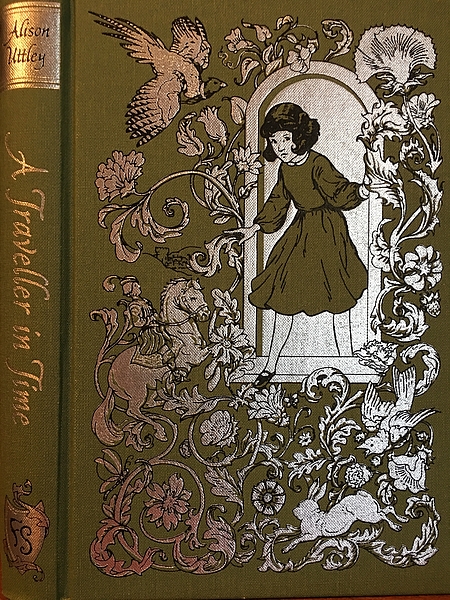
 A Traveller in Time cover

A Traveller in Time by Alison Uttley was first published in 1939. My copy is a lovely Folio edition which is illustrated by Omar Rayyan. It’s yet another children’s classic that I’ve only just got around to reading thanks to Constance who mentioned it on my blogpost about Uttley’s books for very small children. Th eauthor was very much influenced to write this book by her own childhood. She grew up in a house very close to the Babington manor house in the book and her father told her stories of those Elizabethan days as if he had lived them himself, and Alison Uttley visited them in her dreams.

A Traveller in Time is told by Penelope Taberner Cameron as she looks back to her childhood which began in London’s Chelsea where she was the youngest of three children and was regarded as being a bit ‘fey’. Possibly she has the second sight, or maybe she’s just a dreamer, her older siblings are happy to listen to her tales of the past. She’s prone to soar throats and her mother decides that Penelope needs to get out of the atmosphere of London to some fresh air. Aunt Tissie and Uncle Barnabas are contacted and they’re very happy to have all three children for the holidays at their manor house and farm called Thackers.

It isn’t long before Penelope finds herself slipping back in time when least expected and she becomes a much-loved member of the Babington household who are puzzled by her intermitent appearances but always happy to see her. Penelope knows her history so she realises that Anthony Babington, the eldest son of the house is on a path to a terrible end which she is powerless to change. Mary, Queen of Scots has been captive in England for years on the orders of her cousin Queen Elizabeth. Anthony is determined to rescue her and get her to safety in France.

This is a beautifully written book and it is such a shame that she didn’t write more books for older children. There are so many characters to like too so it was a treat to be in their company.

Apparently in 1978 the BBC dramatised the book, I don’t recall ever seeing it though. Do any of you remember it?

If you know the history of Mary, Queen of Scots you’ll be aware that she was moved around a lot over the twenty years that she was imprisoned, and several times she did manage to escape, in fact I’ve lost count of the amount of places I’ve been to that she has also walked around in. She was imprisoned in what was my childhood local castle Dumbarton Castle, and I believe escaped from there. More famously she escaped from Loch Leven Castle which is close to where I live now, you can see my blogpost about that here. Even closer is the hunting palace of the Stuarts Falkland Palace, which is a place that she loved in her younger years.