‘Glenbogle’ Ardverikie Estate, Scottish Highlands

a Glenbogle 1

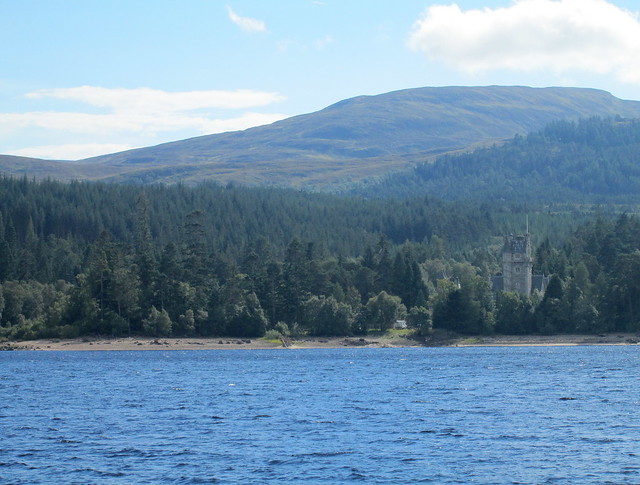
On our recent trip up to the Highlands with Peggy we were driving along admiring the views, well Jack couldn’t do so much admiring because he had to concentrate on the driving, when Peggy remarked that a lodge house we had just passed looked like the one from the TV programme Monarch of the Glen. When we saw a sign by the side of a few shops saying Glenbogle – she just about went off the scale of excitement! It is in fact Ardverikie estate and the loch is called Loch Laggan. The series was based on the books by Compton Mackenzie.
Glenbogle/Ardverikie estate

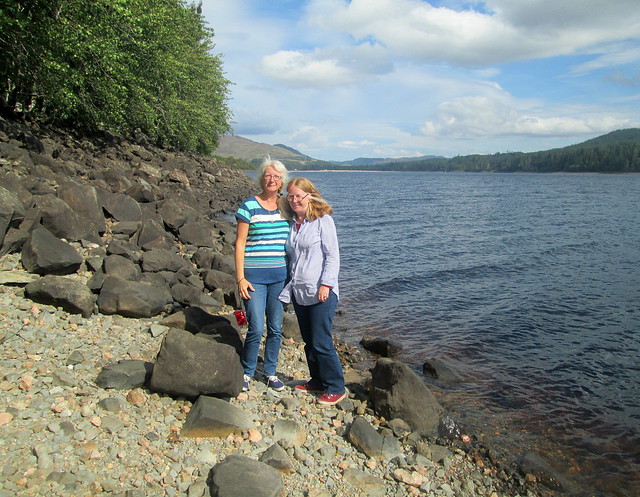
That road is pretty twisty turny but we did find a lay-by to stop off in and we climbed under/over the crash barrier and down a steep thistle and nettle edged path to reach the edge of the loch. As you can see we had a great day for sightseeing.
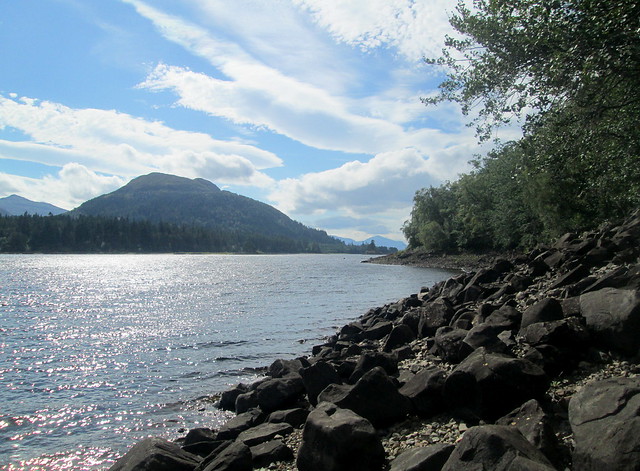
Glenbogle /Ardverikie estate

What a view the owners have from their home, I believe it was on the market a few years ago – asking price a mere 7 million quid. I wonder if it is now owned by a Russian oligarch or some such. The house is built in the Scottish baronial style, very popular in Victorian times.

I spotted the wee jetty that features in the programme too but seem to have managed to miss it of the few photos I took. I hope Peggy managed to get it.

The beach is my kind of beach with lovely glittering mica laden stones with bits of pink granite scattered around too. But we couldn’t linger all that long as we wanted to reach Dornie where our B&B accomodation awaited us. We did plan to go past ‘Glenbogle’ again and check out the few shops nearby but a slight change in the route back meant that we somehow missed the turn off. Ah well – maybe next time.
Candleshoe by Michael Innes

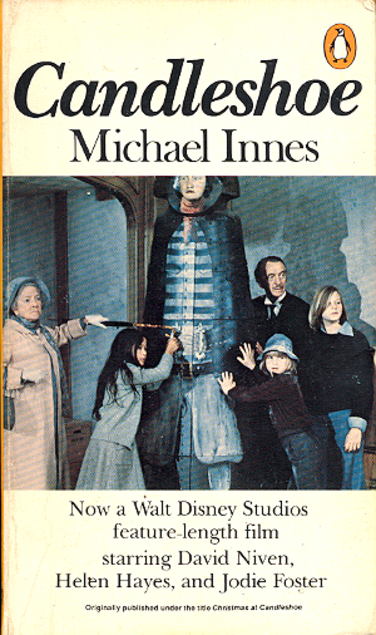
Candleshoe cover

Candleshoe by Michael Innes was a very recent purchase by me. I bought it when I was down in the Scottish Borders a couple of weeks ago. I hadn’t even heard of this book before but Peggy knew about it and she has seen the film that Disney made of it. In fact the book was originally called Christmas at Candleshoe but my copy is a later tie in to the film. The book has nothing to do with Christmas the festival at all, it’s someone’s first name. As you can see from the book cover David Niven starred in the film, I don’t know how I managed to miss seeing it. Possibly it was released during one of the several times that our local fleapit in Dumbarton was closed due to fire damage. The Rialto,the last surviving cinema was forever going on fire for insurance purposes it was rumoured!

It’s a bit confusing as although the film is apparently aimed at kids, being made by Disney, the book definitely wasn’t written for children. Michael Innes had a habit of using the art world as part of the plot in his books – as he does with this one but it bears no resemblance to his Inspector Appleby mysteries.

A very wealthy American woman tourist is in Britain touring the usual country stately homes. As her son is a student at Oxford and she is very keen on all the ancient history of England, she’s on the lookout for an estate to buy and refurbish. When she stumbles across a house that has been completely bypassed by the 20th century she’s enchanted.

Her son fears that she’s determined to buy the ancient pile and Jay a teenager who seems to be keeping the whole place going is also worried that the very elderly owners would be happy to sell up. Jay believes an old story that there is treasure somewhere in the house and he’s not surprised when the house comes under attack from thieves.

The whole thing is a bit crazy and I have to say that this definitely isn’t one of Michael Innes’s best books. He was always very keen to shoehorn literary elements into his books, I suppose because for his day-job he was a university lecturer in English, but I don’t think that mentioning Meredith and numerous other literati does much for the pace of a mystery. He drops in Latin phrases in much the same way as Dorothy L. Sayers did, which is fine if like me you were lucky enough to do Latin at school, but I suspect that it’s just an annoyance for many people. At least he doesn’t switch to Greek as Sayers did at times!

This is my 21st book read for the Read Scotland 2016 Challenge. That level was originally being named ‘Back O’ Beyond’ but since visiting the Isle of Skye recently with Peggy, I think it is now going to be called Skye, or Isle of Skye – it’s up to Peggy. Any levels beyond that being named Orkney and then the ultimate – Shetland.

I think I’ll be giving this one a three on Goodreads.

Goodreads Challenge Completed

A couple of weeks ago I realised that I had overshot my Goodreads Challenge goal. I had only signed up to read 80 books this year so that I wouldn’t be under any pressure come the end of the year, and end up only reading slim volumes in order to reach my goal. You can have a look at what I’ve read so far this year here. For some reason Rumer Godden’s Battle of the Villa Fiorita appears twice.

I think I’m now at around 90 books read. It sounds like an awful lot but I do read every word and don’t read that quickly, it’s just that I’m now at that stage in life when I have the luxury of time to sit down and read more or less when I want to, reading certainly comes before housework!

I plan to get stuck into some hefty classics between now and Christmas, including some Anthony Trollopes and Walter Scotts. I think I’m getting close to completing my Classics Club Challenge of 50 classic books. I hope to get that finished by the end of the year but I will still continue with reading classics after that and just keep adding to my list.

The Wonderful Wizard of Oz by L. Frank Baum

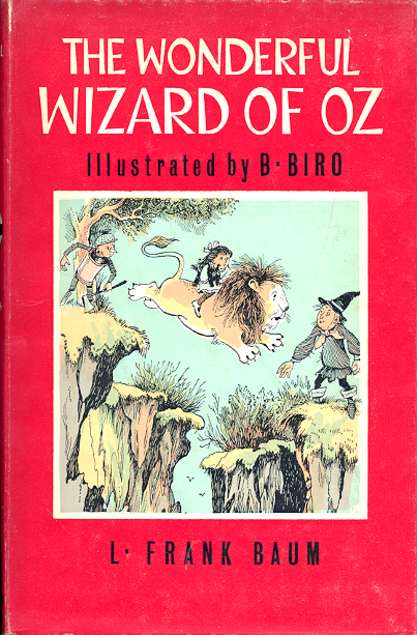
The Wonderful Wizard of Oz cover

The Wonderful Wizard of Oz by L. Frank Baum was one of those children’s classics that I hadn’t got around to reading, until last week. Of course I have seen the film umpteen times, but the book is quite different which is just as well as it would have to have been double the length otherwise.

The first time I saw Toy Story it struck me that it was just a remake of The Wizard of Oz. It had the same moral.

There’s not much else to say about the book other than it’s well written and an enjoyable read and I will read the sequels. I was surprised that the book was first published in 1900, I hadn’t realised it was that old.

Otherwise I was really chuffed to discover that Baum was of German/Scottish/Irish and English ancestry. I have a theory that the vast majority of children’s classic literature has been written by people with Scottish blood in them, a consequence of what happens to people when they are brought up in a strict Presbyterian atmosphere, the imagination goes into overdrive. In Baum’s case he was brought up a Methodist, a similarly strict variety of Christianity.

I read this one as part of the Classics Club Challenge. I wasn’t sure if I should count it towards it as it’s a children’s book – but then I thought – why not?!

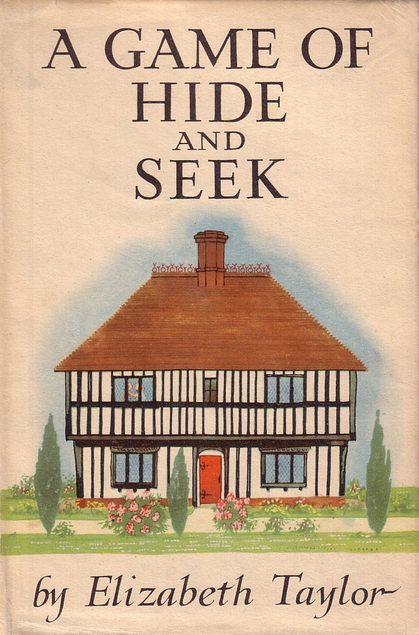
A Game of Hide and Seek by Elizabeth Taylor

A Game of Hide and Seek cover

A Game of Hide and Seek by Elizabeth Taylor was published in 1951 and I was lucky enough to find an old Book Club copy with a perfect dust jacket which I think is lovely, but I’m drawn to covers that feature a house.

Harriet and Vesey are teenagers who have been friends since early childhood. Harriet’s mother’s best friend is Vesey’s aunt and he spends a lot of time with his aunt and uncle as his mother isn’t exactly the caring type. Harriet’s mother and Vesey’s aunt had been suffragettes who had even ended up being imprisoned in their young days. Harriet’s mother had believed that as women had got the vote then her daughter would be able to do anything she wanted, maybe become a doctor or judge. But as Harriet wasn’t good at passing exams she had ended up by being a huge disappointment to her mother.

Harriet has always been in love with Vesey but he blows hot and cold and she ends up getting married to Charles, a man much older than she is, more to get away from her ever disapproving mother than for any other reason. Charles is a damaged soul having been jilted at the altar previously and his mother can never let him forget it. Harriet and Charles have a daughter Pauline and the mother – daughter relationship isn’t any better than that which had been between Harriet and her mother.

It all goes a bit Brief Encounter-ish (actually mentioned in the book) when years later Harriet and Vesey meet up again and start seeing each other. Vesey has become an actor but his career hasn’t been a success. Harriet is ready to pick up the relationship where it left off in their teenage days – it’s not going to be good for anyone involved.

This book came after Elizabeth Taylor’s ‘widely acclaimed’ Wreath of Roses which I read decades ago so I can’t compare them now, but it is certainly a good read.

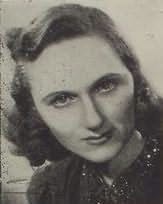
Elizabeth Taylor

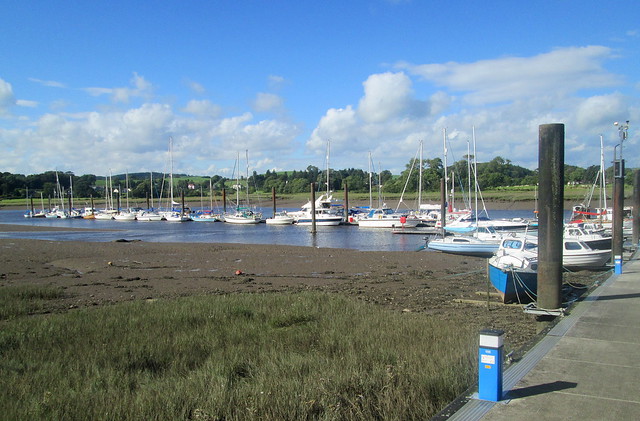
Kirkcudbright – Dumfries and Galloway, Scotland

harbour 1

Kirkcudbright was one of the places that I particularly wanted to visit when we were down in the south-west of Scotland recently with Peggy. I had been there once before, years ago when our boys were wee and we stopped off there just to break a journey. McClellan Castle below is a stone’s throw from the harbour.

McClellan Castle 1

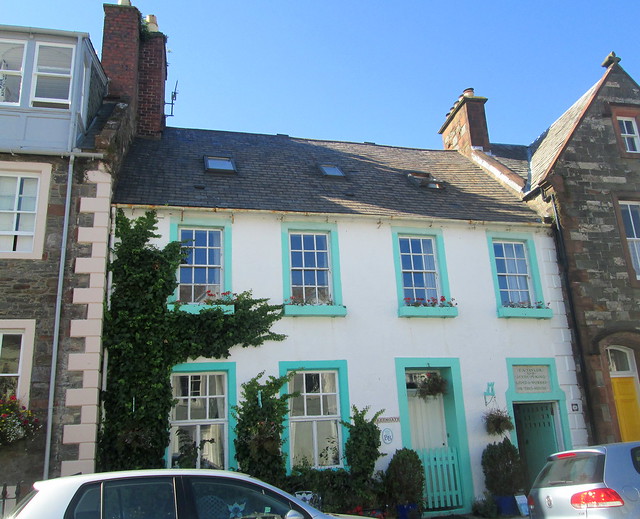
a street  Kirkcudbright 2

It’s well worth visiting this wee town but I must admit that I was a wee bit disappointed that it doesn’t have an awful lot in the way of shops or interesting places to visit. I had read somewhere that there were quite a few art galleries around as the town has always been very popular with artists, but we only found two galleries, one that had been taken over by an Edinburgh gallery for some weeks, and one which had artwork by just one artist.

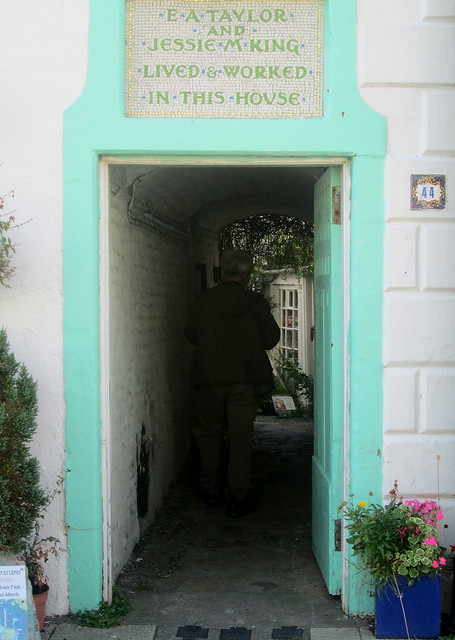
The house below belonged to the artist Jessie M. King. She’s probably best known for her book illustrations. They’re beautifully delicate and ethereal. She lived there with her husband fellow artist E.A. Taylor.

aTaylor and King 2

Taylor and King 1

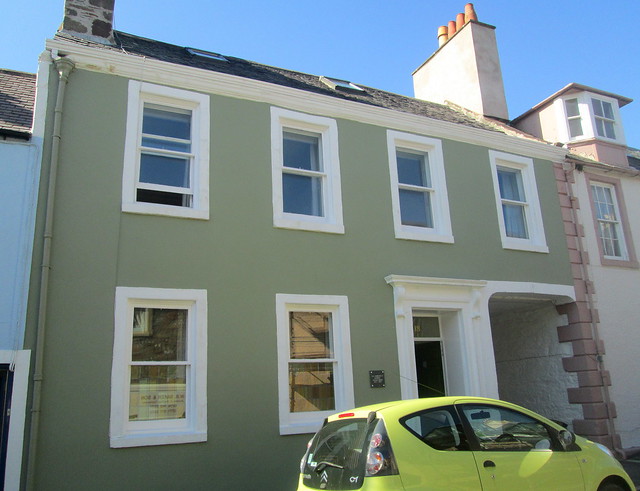
There’s a mixture of building types in the town, from teeny wee medieval cottages to quite grand Georgian villas, and just a stone’s throw from the main street the streets are amazingly peaceful.

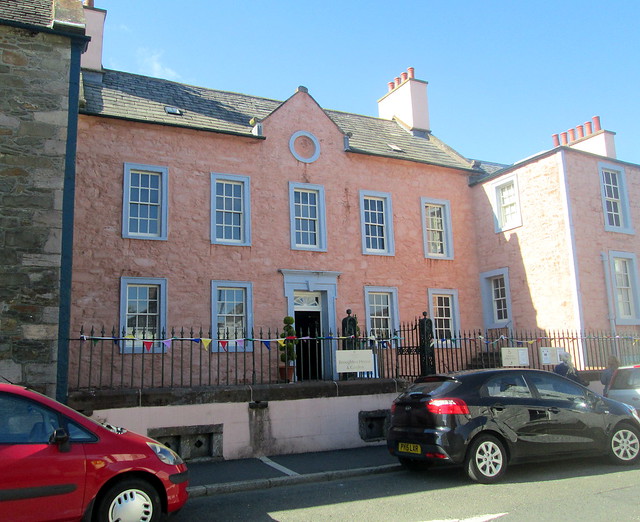
Broughton House

Below is the artist A.E. Hornel‘s house which is open to the public I think.

Hornel 2

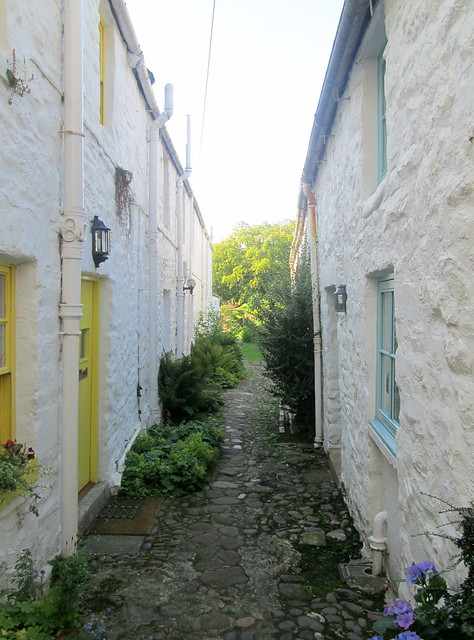
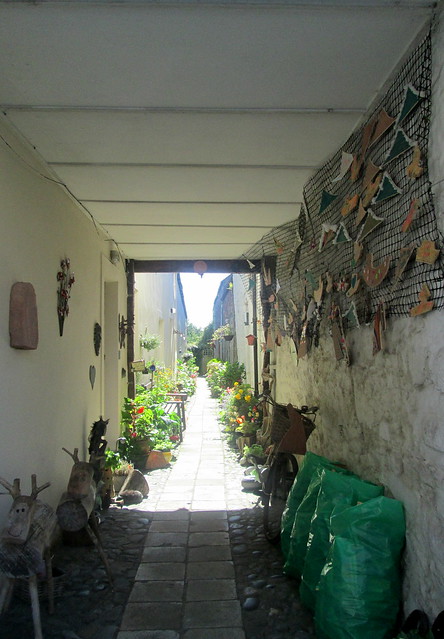
And there are closes like the one below leading to much older wee medieval houses.

a close 2

a close

Dorothy L. Sayers was one of the many artistic people who frequented Kirkcudbright and she actually set one of her books there – Five Red Herrings – when it was dramatised for TV they filmed it in and around Kirkcudbright.

It’s a fairly remote part of Scotland, but it’s a pretty wee place and it’s worth a visit if yoy find yourself in that area.

Visit Scotland – A leaf peeper’s guide to autumn woodland walks

I’m beginning to think that Visit Scotland should be paying me for promoting tourism in Scotland, but they keep sending me lovely ideas for places to visit and I just have an urge to share their ideas. You can see their suggestions for places to visit in autumn here.

Below is The Hermitage in Perthshire, one of my favourite fairly local places to visit.

Hermitage

And I visited the Falls of Dochart below a few days ago.

Falls of Dochart

I haven’t visited any of the others though – so many places to see!

Eilean Donan Castle, Highlands, Scotland

Peggy flew back to TN this morning, no doubt she’ll be in need of another holiday to get over this one in Scotland. Last week we took her up to the Highlands for a couple of nights in a Bed and Breakfast at Dornie, a short walk from Eilean Donan Castle. It must be one of the most popular places to visit for tourists. I couldn’t believe how packed out it was at 10 o’clock in the morning when it opened. Apparently this castle was featured in the film Highlander, but I’ve managed to dodge that one despite it having been on TV almost as regularly as the Bridget Jones films.

Eilean Donan 1

Luckily you can walk all around the outside of the castle when it is closed, or about to close, and take photos from all angles. The only difficulty is trying to take photos that don’t contain other people taking photos! For some reason they don’t allow you to take photos of the inside of the castle.

Eilean Donan

The castle is situated on a small tidal island just where three lochs meet; Loch Alsh, Loch Long and Loch Duich. You can read about some of the history of the castle here.

Eilean Donan Castle

You can see more images of the castle here.

It’s definitely worth going to see but even if the castle didn’t exist it would be worth going up to Dornie as the whole area is incredibly scenic. You can see more images of Dornie here.

You can see how clear the loch water is from this photo I took of golden seaweed below the surface of the water. It is of course a sea loch.

seaweed at Eilean Donan

And below is a photo of Peggy and me, we look estranged! but we weren’t.
Eilean Donan

It’s an interesting but very busy destination.

Bookish Links to the Guardian

There are quite a few interesting bookish articles in this Saturday’s Guardian.

You might be interested in reading le Carre on le Carre from the Weekend section. I think we have all of his books but I have yet to read any of them.

If you’re a fan of Val McDermid you can read an article by her here.

There’s an article on Ann Patchett here.

There’s an article about a biography of Beryl Bainbridge here.

There’s an article on a book about Monet’s waterlily paintings, read it here if you’re interested.

I have a feeling that most bookish people are inclined to be shy, as I am, so if that describes you too you might like to read this article – Shrinking Violets: A Field Guide to Shyness by Joe Moran.

Auldgirth and Belted Galloways

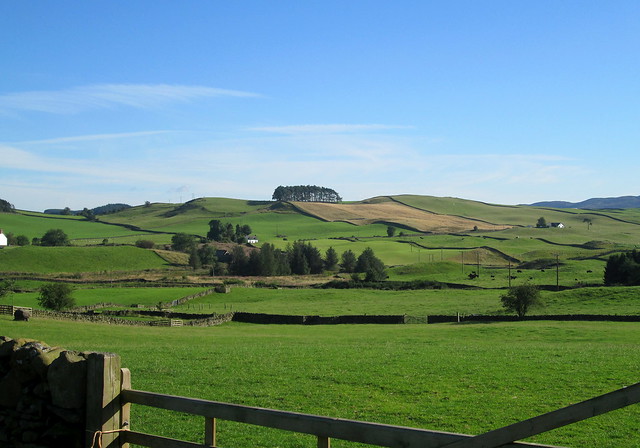
aview 1

Last week we were at Low Kirkbride Farm near Auldgirth in Dumfries and Galloway, Scottish Border country. It’s a very remote part of Scotland, very nice to visit but I don’t think I would want to live in such a far-flung rural place. I’m not one for the bright lights but I do like to feel that I can easily get to a big metropolis easily when the fancy strikes me.

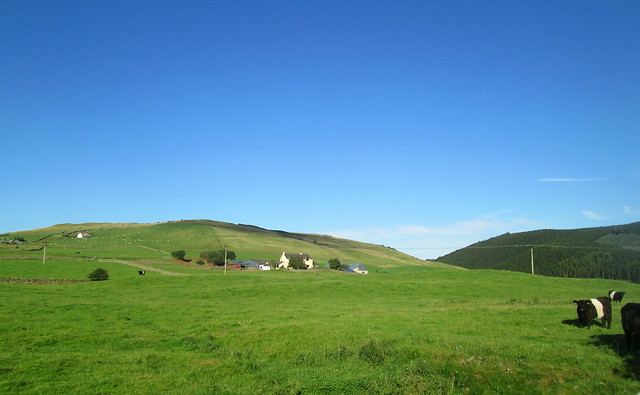
Auldgirth view 3 + cow

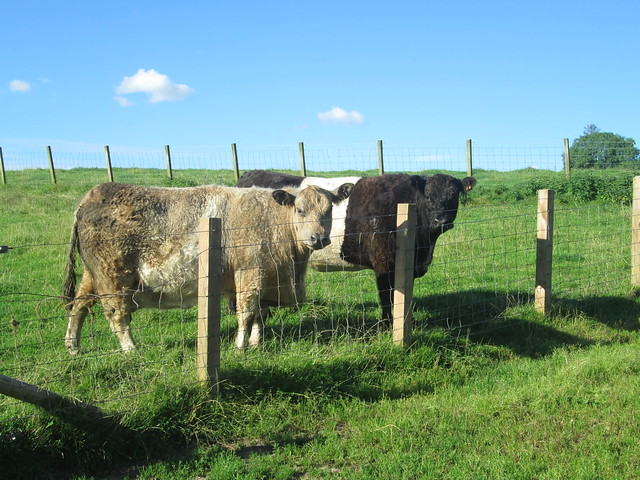
Peggy has a thing about cows, and Belted Galloways in particular which is why she chose to rent a teeny cottage in this area for a few days, as the farmer here seems to be one of the very few who still breed ‘Belties’. They’re very placid and we were assured that we could walk through the fields containing them and their calves with no worries at all – and we survived! I wouldn’t have chanced going too close to them though and we gave the field where the bull lived a very wide berth.

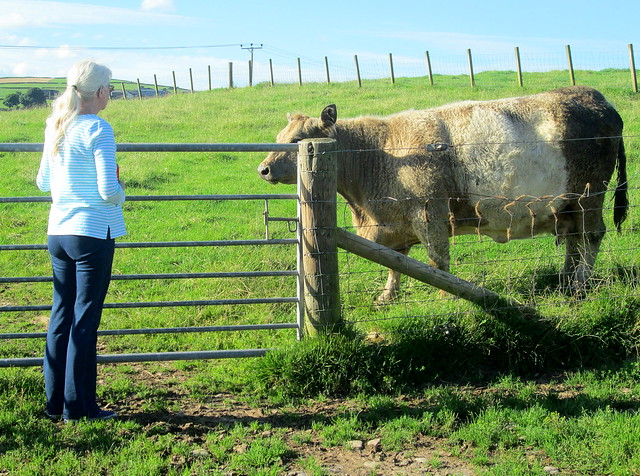
acows 4 + P

As you can see from the photo above Peggy was keen to get up close to this unusual Beltie which is a sort of honey colour with a cream belt rather than the more ususal white and black ones. That cow was having a rest from being pregnant or nurturing a calf for a few months before that beast of a bull got near her again. I suppose you could say she was having a bit of a holiday too, but she was missing her calf as it had just been taken to a neighbouring farm.

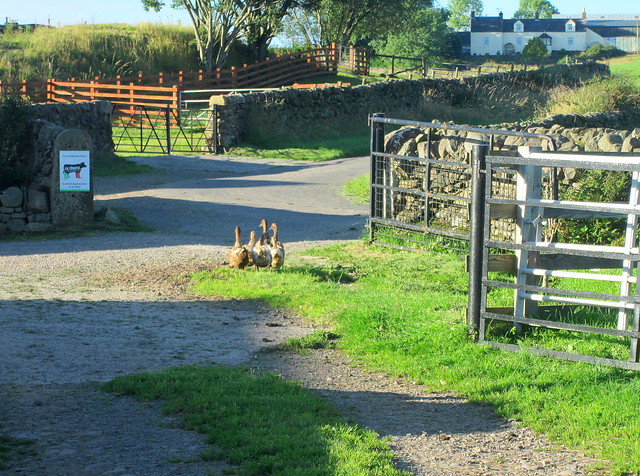
geese

We had a bit of a discussion as to whether these birds were geese or ducks – that proves we aren’t much use at this farming malarkey. Whatever they were they were very comical and if they are geese then they were also very well behaved. The white geese that I remember from my childhood that guarded the whisky barrels whilst the whisky inside them matured for several years were violent maniacs that you certainly didn’t want to mess with. The same kind that guarded ancient Rome I suppose.

cows 2

Poor things, they were a couple of very disgruntled ladies and they lost interest in us when they realised we didn’t have their calves. They’ll be pregnant again soonish though – it’s a hard life being a cow you know. Belted Galloways were in danger of dying out until recent times and I think there are still only about 1500 of them in the UK but their numbers have been slowly increasing which is a good thing as it would be a shame to see the end of these quiet and distinctive animals.