A Spell of Winter by Helen Dunmore

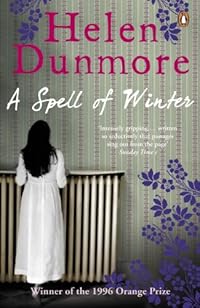
A Spell of Winter cover

A Spell of Winter by Helen Dunmore won the 1996 Orange Prize and it is a great read if at times a bit shuddersome for any woman with a brother anyway.

Catherine and her brother Rob live in the country in a large dilapidated old house which belongs to their grandfather. Money is scarce now but the family had been wealthy in the past. Their mother has abandoned them and they have no contact with her, their father is in a sanatorium as a long-term patient. Kate and Eileen look after the children with Kate in particular being more like a surrogate mother to Catherine.

Their grandfather keeps them in the dark about both their parents. Why has the mother abandoned her children? There’s a ghastly character called Miss Gallagher who is supposed to be teaching the children but she all but ignores Rob whilst fawning on Catherine who despises her.

Time passes and a wealthy next-door neighbour shows an interest in Catherine and Rob isn’t happy about that at all, which leads him to do something unspeakable.

This book is a bit like Wuthering Heights with a hint of Jane Austen. There’s a lot more to the story than I’ve written about, I like to be quite sketchy about plots.

The Guardian said of Helen Dunmore: An electrifying and original talent, a writer whose style is characterized by a lyrical dreamy intensity.

More knitting – a shawl/stole

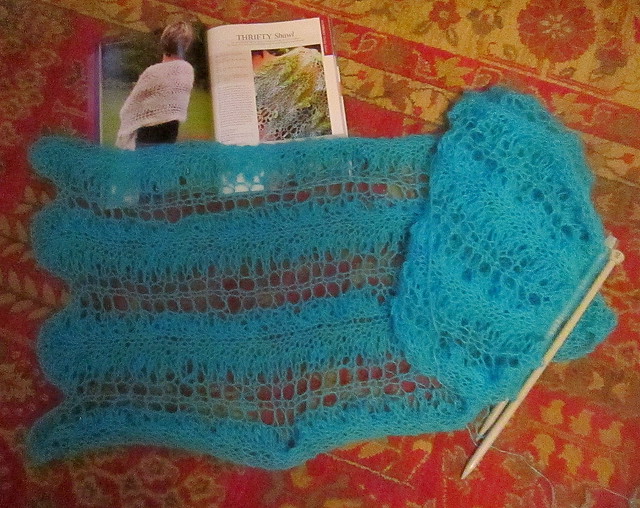
I’ve had some nice fluffy but not itchy Sirdar Kitten yarn languishing in my stash for a couple of years now, so I thought it was about time I browsed my knitting patterns and books to find something suitable to knit with it. I settled on this lacy shawl pattern, although I would describe it as being a stole as it’s just like a big wide scarf. It was recommended as a good design for using up bits and bobs of random yarns, and I might do that at some time in the future.

shawl/stole

This pattern looks quite complicated but it only involves two different rows and one of those is just all purl apart from the three stitches at the beginning and end of every row. The only difficult thing about the pattern is the fact that the needles used are massive. I used 12 mm needles and it’s a bit like knitting with a clothes pole. I don’t think I would have liked to tackle using the 15 mm needles that the pattern actually recommended.

The Wolves of Willoughby Chase by Joan Aiken

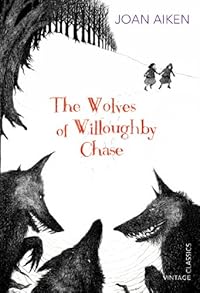
The Wolves of Willoughby Chase cover

Every now and again I like to read a children’s book that I missed out on when I was a child and The Wolves of Willoughby Chase by Joan Aiken fits that bill. It was first published by Puffin in 1962 but my copy is a Vintage reprint.

I suppose that there have been plans to build a tunnel between Britain and France for donkey’s years, but it still seems strange to have the Channel Tunnel mentioned in a book that was published 50 or so years before it existed. The setting though is even earlier than 1962, the year is 1832 and young Bonnie has led a charmed life, the much doted on daughter of Sir Willoughby and Lady Green. But there are changes ahead for them all as Lady Green has been ill for some time and her husband is taking her on a voyage hoping to find a cure for her condition.

This means that a governess is required to look after Bonnie and the family estate, and a fourth cousin of Sir Willoughby is chosen for the job – Miss Slighcarp. None of them have ever met her before but are relying on the fact that she’s a relative of sorts and so they assume she’ll be trustworthy. It turns out though that she’s anything but trustworthy and so begins a nightmare for the whole household, including Sylvia who is a young cousin sent to Willoughby Chase, she’s a good companion for Bonnie.

The tunnel has enabled wolves from frozen mainland Europe to reach Britain and it makes life extremely dangerous. But it turns out that Miss Slighcarp is even more of a threat to the young girls than the wolves are.

This is quite a tense read, considering it’s aimed at children aged 9+. There are quite a few books in the series and I’ll work my way through them all eventually. Did you read these books when you were a child – or older?

Joan Aiken is the younger sister of the author Jane Aiken Hodge.

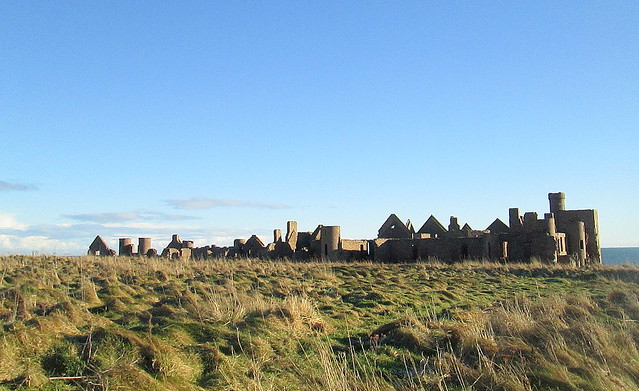
New Slains Castle in Aberdeenshire

New Slains Castle

A few weeks ago we drove up to Peterhead so that Jack could attend a football match – which ended up being cancelled, so we decided to make the best of the situation and visited some interesting locations around the area. My friend Christine had mentioned that Slains Castle was nearby, but might be a bit too spooky, and I must admit that I had never even heard of it. There are in fact two Slains Castles – an old and a new one. We visited both of them but there’s very little left of the old one and a farmer seems to be using it as a bit of a dumping ground.

New Slains Castle had a lot of re-building done over the years and the photo below shows that it ended up being given a Scots Baronial makeover at one point.
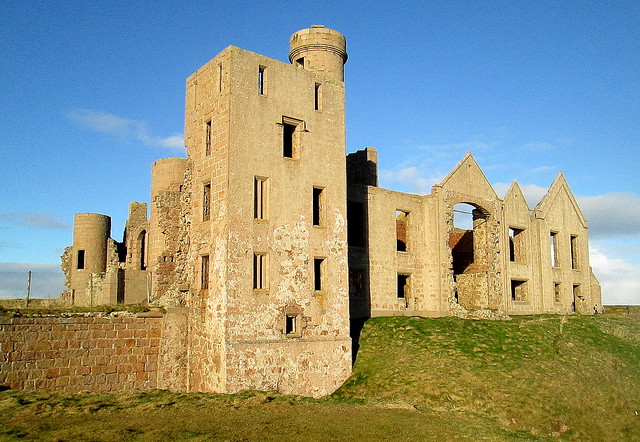
Slains Castle

Dracula author Bram Stoker had visited the new castle as a guest in its heyday and apparently the location inspired him to use it as a model for Dracula’s Castle. Sadly since those days the castle has fallen completely to ruin. In 1925 the owner decided to remove the roof to avoid paying tax on the building and as the building is practically hanging over the North Sea it won’t have taken long for the weather to ravage it, but it is very atmospheric.
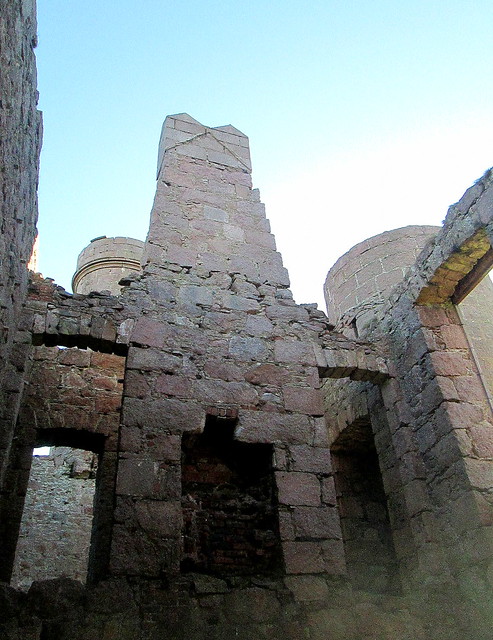
New Slains Castle
Unusually for Scotland there’s quite a lot of red brick in the building of dividing walls and such, I suspect these bits were re-done in the 19th century.
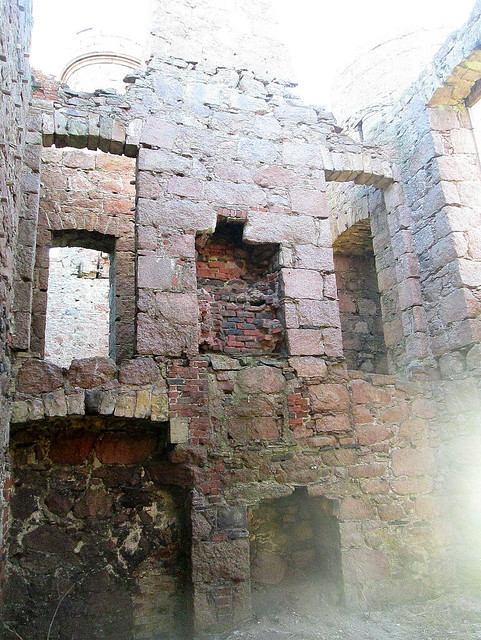
New Slains Castle
You can see where the beams and joists were originally.

New Slains Castle

New Slains Castle

When we were there it was quite busy with foreign tourists and local kids. Those youngsters are always heart-stopping for me as they are fearless, it seems that if there’s a cliff around then there’ll be kids dangling their legs over the edge of it. This time I was amazed to see some boys aged about 14 had climbed right down to the sea – and even more gobsmacked when they disappeared behind a rock and emerged wheeling their bikes – they had ridden down there it seems!

We did climb up some of the castle stairs for a better view and to imagine what all the rooms must have been like but it does feel quite dangerous up there as because the floors have all gone you can’t walk from one room to another as there’s always a big gap between them, if you aren’t careful it would be easy to fall down into a downstairs corridor, it’s as scary as looking down a ravine.
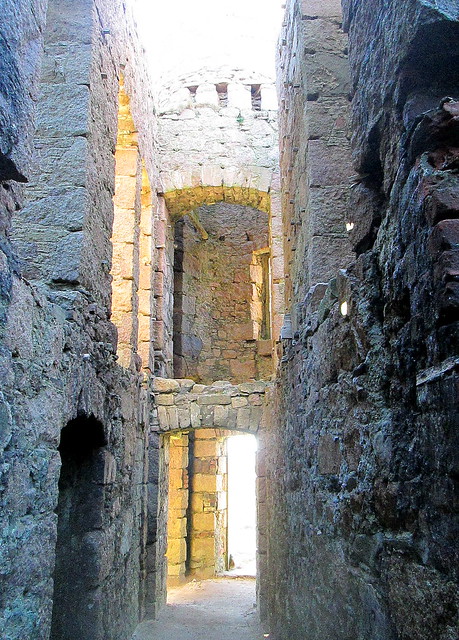
New Slains Castle

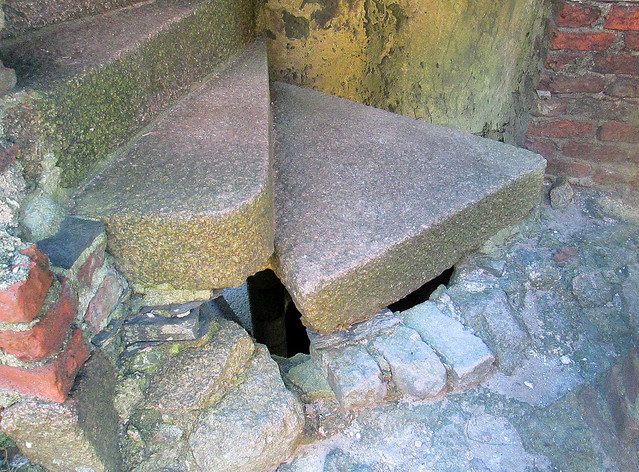
The stairs are distinctly dodgy!
New Slains Castle

They chose a good spot for the castle though – both defensively and just for a spectacular view.

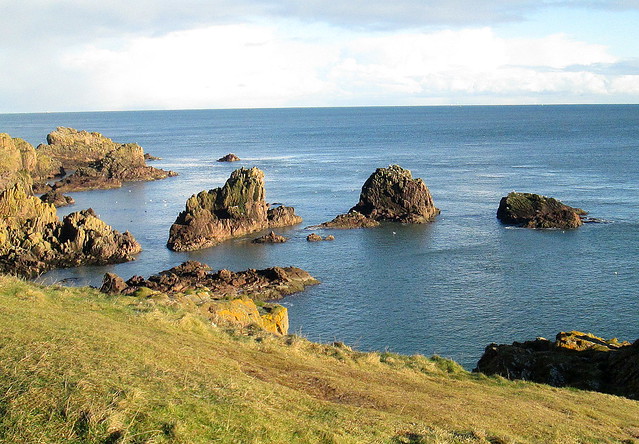
Rocks
Rocks

There have been quite a few accidents and strange deaths here and there were floral memorials and woven wooden things that must have been to keep witches away – and of course – red thread.

Somebody fell down the ravine below not long ago – don’t go too close!
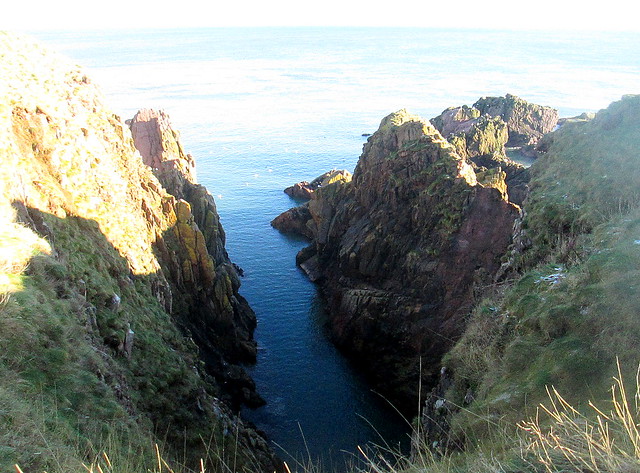
Slains Castle Sea inlet

You can see more images of Slains Castle here.

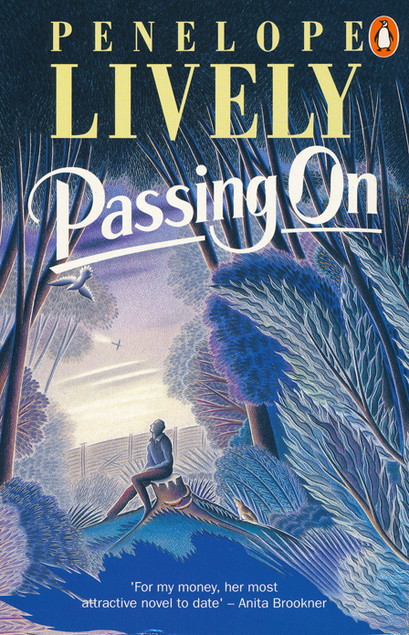
Passing On by Penelope Lively

Passing On cover

Passing On by Penelope Lively was first published in 1989. Her previous book Moon Tiger won the Booker Prize in 1987, but I think that Passing On is even better than that one.

The book begins with the funeral of Dorothy Glover. It isn’t a massive funeral as she had been disliked by everyone she came into contact with, for good reason as she’s a nasty piece of work. Dorothy was a manipulator and a domineering bully who obviously got a lot of enjoyment out of making other people’s lives miserable. Her oldest children Helen and Edward are in their late forties and early fifties and they’ve never been able to get free of her grasp on them. This has had a terrible effect on their lives, particularly Edward’s. Louise, the youngest of the family is married with two children and she managed to get away from her mother because she has her mother’s determination and bad temper.

Their father is long-dead but he had been a mild-mannered man and Helen and Edward must take after him. It’s a mystery to the ‘children’ how their parents got together in the first place. With Edward and Helen’s lives more or less being on hold until their mother’s death they both need to widen their horizons, and hope to enjoy new experiences. But will it be possible?

All through the book everything that Helen does is accompanied by a running commentary by her mother in her head. It seems as if Dorothy is still getting at her from the grave, which indeed she is because the will is not what they all expect it to be.

I’ve read quite a few of Penelope Lively’s books now and they just keep getting better.

The International Style of Muriel Spark at the National Library in Edinburgh

Light show

Yesterday we went up to Edinburgh for several reasons, the first one being to visit the Muriel Spark Exhibition on at the National Library of Scotland. It’s the centenary of her birth. When we got there I was disappointed to see that although they usually encourage people to take photographs they weren’t allowing it in this exhibition for copyright reasons apparently. She was born in Edinburgh but of course spent many years living abroad, mainly in Italy. Well the weather there would have been enticing apart from anything else.

Light show

It’s such a shame that you can’t take photos as Spark seems to have been a hoarder from an early age so there are even jotters from her schooldays of poetry she had written and a school magazine that she had poems published in. She saw herself as a poet despite writing so many novels.

She was a bit of a party animal and corresponded with lots of famous people that she had made friends with including Graham Greene, Doris Lessing, John Updike, Christopher Fry, Miriam Margolyes, Maggie Smith, Vanessa Redgrave and even the then Prime Minister Harold MacMillan. There are letters or telegrams from them but the typewritten letter from Marie C. Stopes (the famous contraception for women pioneer) who wrote the book Married Love is a scream. Stopes was vice-president of the Poetry Society and she was incensed at Spark being made president. In her letter Stopes describes Spark as being impertinent to her and she demands to know if Spark had been divorced by her husband. Presumably Stopes didn’t think such a person was fit to be the president. Spark’s reply says that she has no intention of giving her any details of her divorce, implying that Stopes is a dirty old woman for wanting to know what she hopes are salacious details.

If you click on the link above you’ll be able to see some of the things in the exhibition, such as her ration card. There are a couple of her dresses, one a long dark grey silk dress and a lovely blue velvet dress which apparently features in one of her books, I can’t remember which.

If you’re keen on Muriel Spark it’s well worth visiting – if you’re not too far from Edinburgh anyway. There are lots of early copies of her books on display and I just realised that I have far more of her books to track down than I thought.

I think that like many writers Muriel Spark was odd, it’s hard not to feel for her son whom she seems to have abandoned at a very early age, later she was incensed by his devotion to Judaism as an adult – she had ditched that religion and opted to become a Roman Catholic. It looks like she had no maternal instincts which must have been painful for him.

Light show

The photographs are of images that were being projected onto the front of the National Library of Scotland.

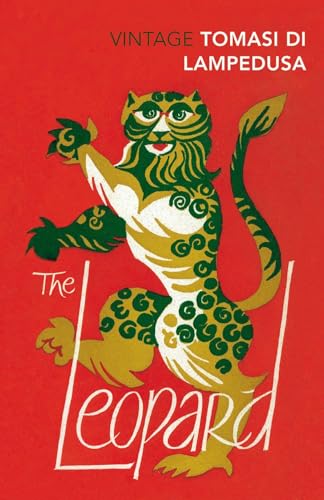
The Leopard by Tomasi di Lampedusa

The Leopard cover

The Leopard by Tomasi di Lampedusa was first published in 1958 but the first English translation appeared in 1961. It’s an Italian modern classic.

I enjoyed this one although not as much as most readers seem to have. I had hoped there would have been more about the history of the times than there is in this book which is essentially the story of an aristocrat Don Fabrizio, Prince of Salina and his extended family. He’s very wealthy and powerful so really he would be happy for things just to go on as they always have.

Changes are in the wind though, Garibaldi has landed on Sicily and people are deciding which way to jump so that they can be on the winning side in the end.

I’m probably the only reader that would have been happier with more politics and less family saga – maybe it was just the mood I was in at the time.

This book was published posthumously and the author based the characters on his own family apparently.

The Exiles Return by Elisabeth de Waal

The Exiles Return cover

The Exiles Return by Elisabeth de Waal was published by Persephone in 2013. This is one of five unpublished novels that the author wrote in the 1950s. The mystery is – why wasn’t it published back then? It’s a really good read and reminded me of Irene Nemirovsky’s writing, although maybe it’s just the subject matter which does that.

Professor Kuno Adler who is a Jew had escaped from Austria when the Nazis took over, he and his wife had gone to America where he got a job teaching, but his wife Melanie has been even more successful as she set up her own corsetiere business, she is brilliant at it making the most of rich women’s less than perfect figures and she earned a lot of money doing it and had fun making disparaging comments about them to their faces. She loves her life there but Kuno decides he wants to go back to pick up his old life again, refugees are apparently entitled to get their old jobs back. Life in America had been a disappointment for Kuno as he had encountered far more anti-Semitic prejudice there than he ever had in Vienna in the 1930s, but going back isn’t as easy as he thought it would be.

Kuno Adler is the most interesting exile I think but there’s also Marie-Theres, a difficult teenager who was born in America to exiled parents. She’s sent off to live with her aunts in Austria for a while and to begin with everything is fine but she gets embroiled with the sort of people that she’s never encountered before and it’s overwhelming for her.

There’s some beautiful descriptive writing of landscape, houses, decor and clothing. I really enjoyed this one, I’m just swithering over whether to give it a 4 or 5 on Goodreads.

Elisabeth de Waal was the grandmother of Edmund de Waal who wrote The Hare with Amber Eyes which was very popular some years ago, but as ever I haven’t read that one – yet. If you have read it maybe you could tell me if I should read it – or not.

Isle of Skye

It must be around 20 months since we visited the Isle of Skye, but I have never got around to blogging about it, unlike Jack. So if you want to see some photos of Skye, albeit on a fairly misty day have a look at the link. Isle of Skye

We only spent a few hours there and it was quite busy at all the ‘beauty spots’ although it wasn’t quite as busy as it has been this last summer, when it actually said on the news that the Isle of Skye was full to bursting point and so if you didn’t have a reservation at an hotel, B&B or campsite then – don’t go. It’s the Outlander effect apparently. I must say that Skye isn’t my favourite part of Scotland, I suffered a horrible fortnight’s holiday there when I was 11. It involved a caravan, a boggy field, a brother and a lot of rain, it put me off holidays for years!

Automation = exploitation

Be warned – this is a bit of a moanfest – but I’m annoyed!

I have to admit that I’m a bit of a Luddite, especially when it comes to things like supermarkets and banks. I’d much rather deal with a human being when I’m carrying out any transactions, and I think that if lots of us had eschewed online banking then the banks wouldn’t have seized the chance to close most of their branches, throwing their employees onto the dole queue and leaving people in more rural areas high and dry.

When the supermarkets started installing self-service tills I decided that I was never going to use them. I’m not absolutely ancient but I do just remember the days when we used to go to the shops with our basket and string bags and actually be served by a human being who gathered all your items from the shelves themselves and rang everything up on the till. I couldn’t help thinking back to those days when I went to an ASDA supermarket on Monday, it was 2 o’clock in the afternoon, the store is a really big one and it was full of shoppers.

I didn’t intend to buy an awful lot, I just wanted some fruit so I took a hand-basket and when I made my way to the check-outs I was shocked to discover that although they have around 23 check-outs only two of them had actual human beings working at them, the rest were all empty, the alternative was for me to serve myself and use an automated check-out. The two ‘womanned’ check-outs were queued up with people who had large trollies full of food, so I just had to abandon my basket and leave. My fruitless supermarket visit was just a waste of time.

I was/am more than a wee bit annoyed, when you consider the massive profits that the supermarkets make it seems ridiculous that they are now employing as few people as they can get away with employing. There used to be a time when employers felt an obligation to the community that supplied them with customers – and employees, but now the only important thing is profit. Costs have been pared back to the bone and the people who provide the businesses with money – the customers – are expected to do the work that was once done by paid employees. For some people a short chat with a shop worker is the only point of contact they have with another human, modern life with family scattered far and wide can be a lonely place, especially for the elderly.

There’s no doubt that in many ways society is going backwards. I’m quite cheesed off about it all. I would probably be regarded as a bit of a red by some people but I really think that if companies are making enormous profits – as supermarkets and banks do – then they shouldn’t be allowed to lay workers off and replace them with machines which exploit their customers for labour.