My Garden

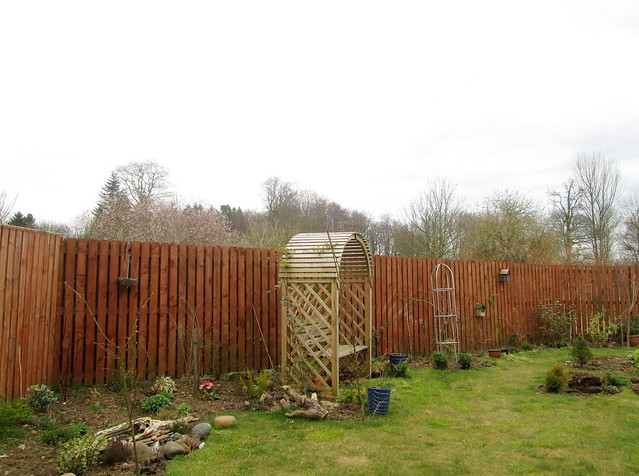
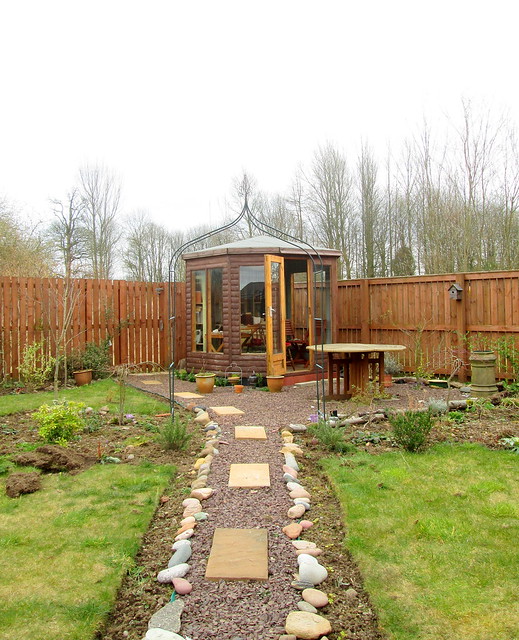
We’ve been having some decent weather for a change here in Fife. It seemed like we had non stop rain for three months or more, and I really did think that a lot of my plants would have been drowned over the winter, especially as my new garden is mainly heavy clay.

my garden

But by the looks of things just about everything has come through the winter fairly well. I think that within the next few weeks there’ll be quite a difference in the place when all the deciduous shrubs should be in leaf.

my garden

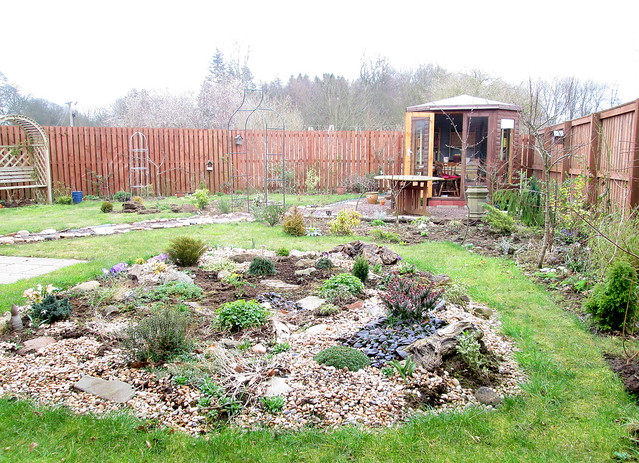
The main thing I want to do this year is finally cut away the last of the turf that I want to get rid of. Then I can concentrate on getting good edges on the flower/shrub beds and then plant some ground cover plants to try to help keep the weeds down. That’s the plan and hope anyway.

Earlier this week I planted some more Dutch iris bulbs, lily bulbs, dwarf daffodils, Alpine wallflowers and some more aubretia.

It’s still a work in progress, like all gardens. It should look good when it all gets going though, the change in our clocks this weekend will give us lots of lovely daylight. Then we’ll just need a bit more warmth!

my garden

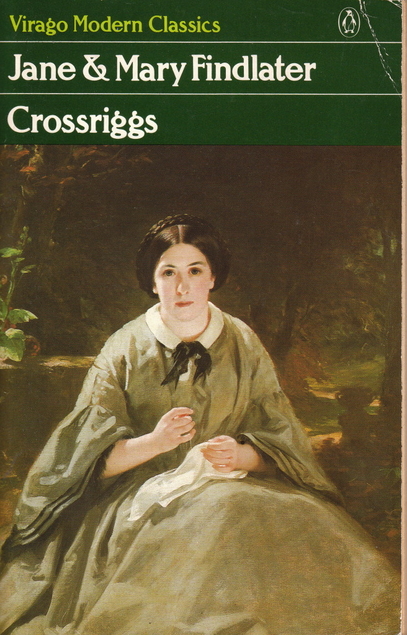
Crossriggs by Jane and Mary Findlater

Crossriggs cover

Crossriggs by Jane and Mary Findlater was first published in 1908 and it’s one of those books which I’ve been meaning to get around to reading for years. I’m quite intrigued by the thought of two people writing a book, and I wonder how they actually went about it. I must admit that I had no idea that these Scottish sisters had been so famous in their day. They travelled to the US amongst other places and were friends with writers such as Robert Louis Stevenson, Walter de la Mare, Henry James, Rudyard Kipling and Virginia Woolf. The sisters were the progeny of a Scottish Free Presbyterian Church minister.They lived in Lochearnhead until their father’s death when they moved to Prestonpans, a small town close to Edinburgh.

Crossriggs is a small town which is not far from Edinburgh by train. The Hope family live there. Alexandra Hope is a young woman who runs her elderly father’s very poverty stricken household. Mr Hope is a vegetarian/fruitarian who would nowadays be described as being a vegan. He’s a peace loving man who doesn’t want to cause anything any harm, but although he is regarded as being very clever he is forever having crazy ideas about new ways of growing things and it usually ends up in failure and loss of money, which is just what they can’t afford.

When the recently widowed elder daughter Matilda comes back from Canada with her five children it falls to Alex to slave at various jobs to try to earn money to feed them all. It never seems to occur to Matilda that her young sister is taking on all of the responsibility for the family.

Alex is a great character, what we in Scotland call ‘a nippy sweetie’. She’s very ‘pass remarkable’ and often has a sarcastic but witty thing to say about her neighbours and their appearance. However one of her neighbours is a well respected academic/writer and it’s obvious that Alex is in love with him, but he is married so he’s completely off limits of course.

Alex is unwilling to just settle for what she regards as an inferior sort of man and so turns down marriage proposals, to Matilda’s disgust.

This book has lots of echoes of various books in it. It’s similar to Jane Austen’s Emma in parts. Alex is like Jo from Jo’s Boys, but this is an essentially Scottish book, moral and spiritual but not to a sickly degree.

I also found it similar to O. Douglas’s (also the daughter of a Wee Free minister) books although hers are perhaps a bit more light hearted and more preachy, or maybe just a bit less well regarded or dare I say it popular. The elements are the same though: A young woman looking after a load of children who are not her own, a lack of money, annoying neighbours and relatives and romance.

R.L. Stevenson said that there is a difference between the Scottish and English psyche. In England they ask you – What is your name?

But in Scotland they ask – What is the chief end of man?

This is the difference between Scottish and English literature anyway. It’s probably because straightforward story telling was regarded as being frivolous, but if it had a moral and a sound feeling for what was right and wrong, then it was worthwhile.

I read Crossriggs for the Read Scotland 2016 Challenge, it’s my fifth one this year, and also for the Women’s Classics Literature Event and for Reading My Own Damn Books. Three down with one stone!

I was interested to see that the book is dedicated to:

Kate Douglas Wiggin and Norah Archibald Smith
two sisters,

from two sisters,
Mary and Jane Findlater.

It’s a good read.

Edinburgh Botanics and books

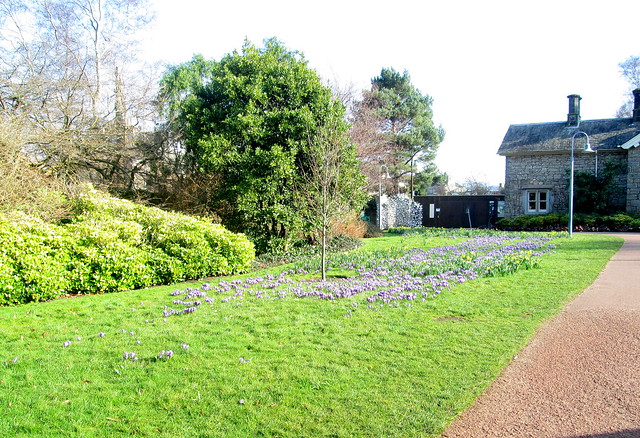
On Thursday we had a family dinner date in Edinburgh so as it was a lovely bright day we decided to go early and have a walk through the Botanic Gardens. As you can see the crocuses were enjoying the sun.

Crocuses

Then it was on to the Stockbridge area of Edinburgh. If you’ve been reading this blog for a while you’ll realise that Stockbridge is usually a dangerous destination for me, due to the secondhand bookshops in the vicinity. Mind you it was only about three weeks since we had been there so I did think (half hope) it might be a case of slim pickings book wise, but I was wrong!

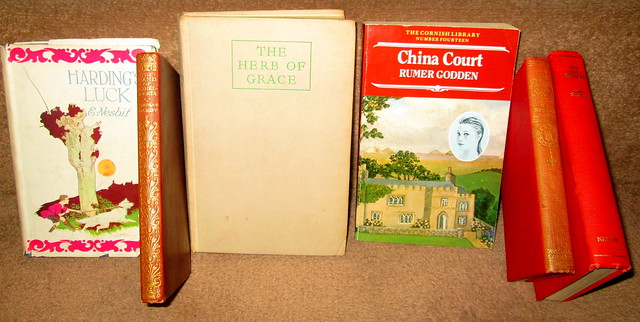
Books Again

China Court by Rumer Godden
The Princess Sophia by E.F. Benson
The Three Hostages by John Buchan
The Hand of Ethelberta by Thomas Hardy
Harding’s Luck by E. Nesbit
The Herb of Grace by Elizabeth Goudge

I know I read China Court way back in the 1970s but I’ll read it again and I seem to be collecting the Goddens that I read when I was a teenager but then I borrowed them from the library.

I have a horrible feeling that I gave my Nesbit books away before we moved house, when I was trying to de-clutter. But they might still be in a box in the garage, I live in hope, I definitely haven’t read Harding’s Luck anyway. The House of Arden comes before it so I think I’ll have to read that one first, I might just put that one on my Kindle.

I don’t think I’ve read anything by Goudge before but I know she is well loved by some people.

The Princess Sophia was written in 1900, long before Benson wrote his Mapp and Lucia books that I love.

I seem to be collecting John Buchan books although it’s a good long time since I actually read any.

I read a lot of Thomas Hardy books as a teenager and I loved them although they are often quite grim, especially the endings. The Hand of Ethelberta is apparently a comedy in chapters – could be interesting, but then again, might not be. Anyway it’s one of those wee books with thin paper and gold topped pages, like most of my other Hardy books, so it’ll fit in well – after I’ve had a bit of a shuffle around of that bookcase!

Have you read any of these books?

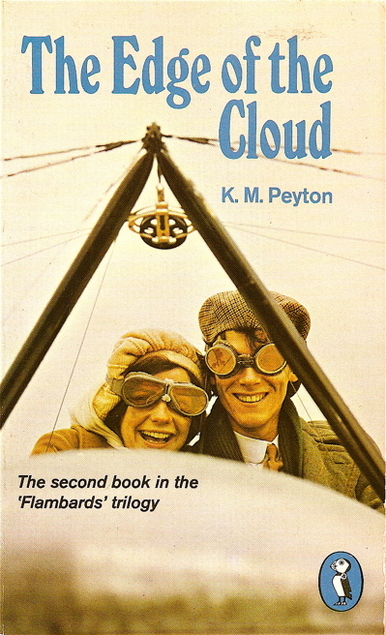
The Edge of the Cloud by K.M. Peyton

The Edge of the Cloud cover

The Edge of the Cloud by K.M. Peyton is the second book in the Flambards series and was first published in 1969.

Christina is now eighteen and she has been living with her uncle and her two male cousins who are a bit older than her. Her uncle is determined to marry Christina off to her eldest cousin Mark and so keep Christina’s money in the family. Her uncle and cousins are cash poor but do have a large house and estate where horses and hunting are the only things of importance. Christina is in love with the younger cousin Will, and unlike the rest of the family he is terrified of horses and riding, flying aeroplanes is his obsession.

Christina can’t get her hands on her money until she is twenty-one and she and Will can’t get married until then either, as Uncle Russell will never consent to their marriage, so they run off to stay with Aunt Grace where Christina has to help her with the sewing by which she earns her living. Meanwhile Will has managed to get a job as a mechanic at an airfield and is living in a shed, it’s not what he wants, he dreams of becoming an aeroplane designer and flying them. Eventually he does begin to teach other people to fly and earns much needed money by taking part in air displays, looping the loop and such like.

Christina is terrified of flying and of course lives in fear of Will being involved in an accident, neither of them can understand the other’s fear of riding/flying. Inevitably accidents occur.

This book is set in 1913 when flying was all new and wildly exciting. A note at the beginning of the book states that the first loop the loop was demonstrated in England by Pegoud in September 1913. The first British pilots to loop were B.C. Hucks and G. Hamel later in the year. Forty-eight British pilots were killed in various accidents from the beginning of flying in 1910 up to the outbreak of war in 1914.

The Edge of the Cloud won the Carnegie Medal in 1969 and the trilogy won the Guardian award in 1970. It was published by Penguin as a Puffin Book so was meant to be read by older children, but it’s a good read for children of all ages.

I loved the Flambards series when it was shown on TV years ago, that was aimed at adults. There isn’t much in the way of horse riding in this book but if you’re keen on early aviation you might find this one interesting.

Foodie Friday – cherry scones

Scones

It’s no secret that for years I’ve been trying to bake decent scones and each batch always comes out resembling hockey pucks more than anything you would want to eat, so I swore that this was going to be my last go. Jack was going to get the gig if these ones failed, he’s the keen scone eater anyway!

To my surprise though, these ones are the best yet, although as Jack says the texture is a bit more cake-ish than scones should be, a plus as far as I’m concerned. The recipe is for plain scones but cherry scones are our favourites and most of the shop bought cherry scones are very disappointing. I swear they stick a few pieces of cherry on the outside of them as often on the inside there isn’t so much as a hint of cherry.

Plain Scones

225g (8oz) of self-raising flour
40g (1 and a half oz) of sugar
75g (3 oz) of butter or margarine, diced
30 ml ( 1 fl oz) of milk
1 egg, beaten

Preheat the oven to 220 C (425 F) Gas mark 7

Lightly grease a baking sheet and dust with a little flour.

Put the flour into a large bowl, add the sugar and then rub in the diced butter or margarine, until the mixture resembles fine breadcrumbs. Add the milk and beaten egg and briefly mix it all together.

Turn out onto a floured surface, knead lightly and form a dough. Roll out to a thickness of at least 2.5 cm or 1 inch. Cut out the scones using a 6.5 cm cutter (2.5 inches)

Brush the scones lightly with a little bit of milk if you are that way inclined, I don’t bother.

Bake for about 10 minutes until risen and golden brown. Place on a wire rack to cool.

If you want to add fruit as I did do so just before the milk and agg are added. Use 3 oz of cherries (halved) sultanas, dates or cheese if you wish.

I decided to try this recipe because I thought that as it uses self-raising flour there was a better chance of it working. So it isn’t quite as dense as normal scones. I left mine in slightly too long, next time I’ll check them after just 8 minutes I think.

I forgot to re-do the ingredients using a US set of cups, so if anyone wants me to do that let me know and I’ll do it next time and amend the post.

.

Anita Brookner 1928 – 2016

I hadn’t heard anything about it on the news so it was only when I turned to the Guardian’s obituary page that I realised that Anita Brookner had died on the 10th of March. You can read it here.

Apparently she wasn’t too keen on writing fiction, it was just something she was more or less addicted to, writing one book a year on average.

I must admit that I only read Hotel du Lac when everyone was reading it way back in 1984 after it had won the Booker prize. I recall it was quite enjoyable but nothing astonishing as far as I was concerned.

Apparently Brookner’s favourite novel was Oblomov by Goncharov which happens to be the book I got in the Classics Club spin. I’m now really looking forward to reading that one.

Murder of a Lady by Anthony Wynne

Murder of a Lady by Anthony Wynne was first published in 1931 and as you can see it’s subtitled A Scottish Mystery.

The setting is Castle Duchlan, a remote and grim Highland pile. The laird of Duchlan is a very weak sort of man, dominated completely by his sister who has never married, but has lived her life as head of the household, even when Duchlan married, his sister Mary Gregor was still the boss. I say ‘Duchlan’ because of course in Scotland the laird often goes by the name of the place rather than his family name.

Duchlan’s son is now in the army and is married with a son of his own called Eoghan and Mary Gregor was determined to take over as the boy’s mother. She’s one of those dreadful women who are so jealous that they can’t bear any males in the family to have anything to do with any other women. It’s a difficult situation for all concerned, especially for the young mother.

When Mary Gregor is found dead in her bedroom after having been stabbed it’s a real puzzle as there appears to be no way it could have been done. Her door is locked and the only real clue is a fish scale which is found in the wound. The superstitious Highlanders believe in fishy creatures which come from nearby water and the scale seems to prove their theory to them anyway.

But Inspector Dundas is brought up from Glasgow to crack the case, he’s helped by the local doctor – Eustace Hailey who is an amateur sleuth.

This is a good mystery which has plenty of twists and turns. I did guess the culprit but by then I wasn’t too far from the end.

Anthony Wynne was the nom de plume of Robert McNair Wilson who was a Glaswegian cardiologist. He was one of those people who had lots of interests and you can’t help but wonder how he managed to have a very successful medical career as well as writing mysteries, histories, biographies and was also interested in politics and economics, also writing books on those subjects. He stood for parliament twice, standing as a Liberal but he was not voted in, which is a plus as far as I’m concerned. He was also the medical correspondent for The Times for over 30 years and wrote for The Pictorial magazine.

I think maybe he had an identical twin brother!

I note that the link above to Fantastic Fiction states that Wynne was an English physician when he was in fact Scottish.

If you are thinking of buying this book you should check your local charity shops as I have come across four copies of it in various shops within a few days.

Robot Attack!!

When I tried to do some blogging yesterday I only got a message saying that the site had been subject to an “overage” so I was unable to do anything. Having consulted my techy guy – Duncan – it was something he was aware of as all the ‘family’ blogs had been affected by – A ROBOT ATTACK!!

Overnight they had been targetted by various different entities, including Google, with completely legitimate messages, ddos not spam, but for some reason the robots had become incredibly enthusiastic and sent thousands which had ended up bringing us all down.

Oy vey – as they say – we just changed the hosting company to avoid hackers and then get done in by this lot.

Anyway, much blocking and cease and desisting has gone on and hopefully it won’t happen again.

Recent Book Purchases

Books are still coming into the house faster than I can possibly read them. Even although I don’t work nowadays I still only manage to read at most two books a week, unless I’m on a vintage crime binge and then I can read more. When you consider that most weeks my book ownership is going up by four or so books, you’ll realise that I’m never going to be in a position of having nothing at all to read.

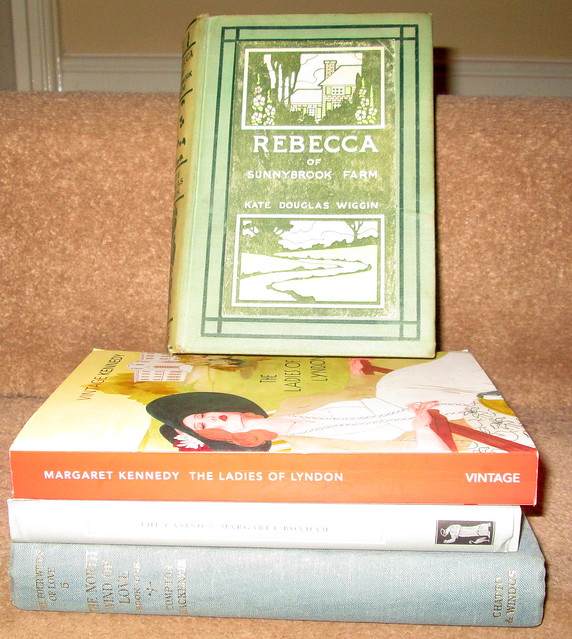
Latest Books

Last week I bought:

The North Wind of Love by Compton Mackenzie
The Casino by Margaret Bonham
The Ladies of Lyndon by Margaret Kennedy
Rebecca of Sunnybrook Farm by Kate Douglas Wiggin

I was under the impression that The North Wind of Love was the beginning of Mackenzie’s ‘Four Winds of Love’ series – but it isn’t.
I’ve never read anything by Margaret Kennedy but I know lots of bloggers love her books so I’m hopeful.
I’ve also never read anything by Margaret Bonham but it’s a Persephone so I think it’ll probably be good.

Rebecca of Sunnybrook Farm is pure nostalgia. All of my childhood books were given away by my mother when my back was turned, I think my Rebecca book was a cheap paperback, but I couldn’t resist this hardback from 1903. I love its cover and I’ve just realised that it’s a first edition, not that I’m bothered by such things, and it seems to be dirt cheap on the internet anyway.

Have you read any of these books?

Andrew Carnegie’s birthplace in Dunfermline

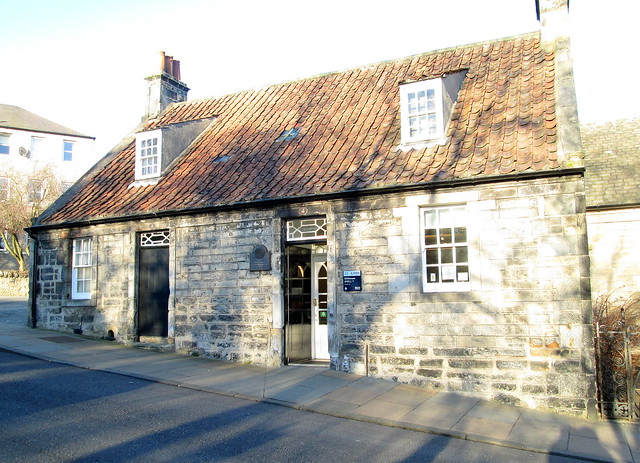
You know what it’s like – you never seem to get around to visiting the tourist hotspots on your doorstep, which is why it has taken us 35 years or so to get around to visiting the wee cottage that Andrew Carnegie was born in. He was of course famous for having made lots of money and using a lot of it to build libraries, often in deprived areas. He was a huge believer in people educating themselves out of poverty through books.

Andrew Carnegie's Birthplace

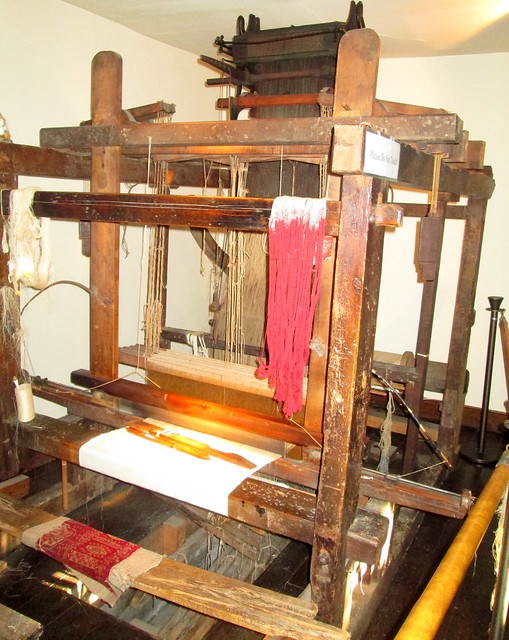
Above is a photo of his birthplace, two families lived in this wee building. It’s a weaver’s cottage and the loom always took up the whole of the ground floor.

Carnegie Loom

Students from the local college have rebuilt an old loom on the ground floor, just as it would have been in Carnegie’s day as his father was a weaver.

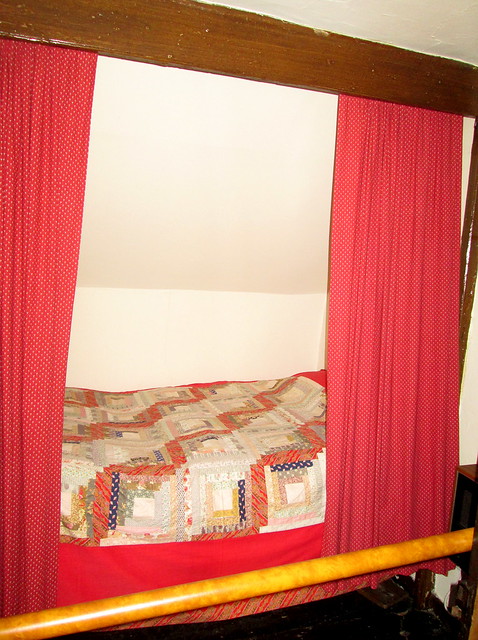
Carnegie Bed Recess

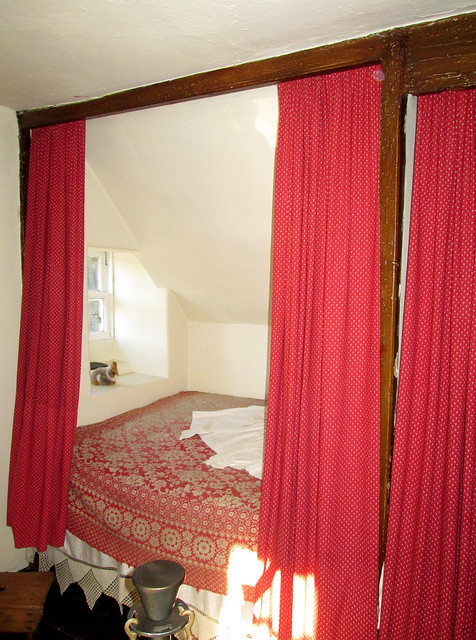
There are two bed recesses in the room upstairs which the Carnegie family lived in. The box beds are built into the alcoves in the wall. It’s a teeny space, cute looking but imagine what it would be like having a family in such a small space, not much privacy that’s for sure.

Carnegie Bed Recess

Carnegie Room

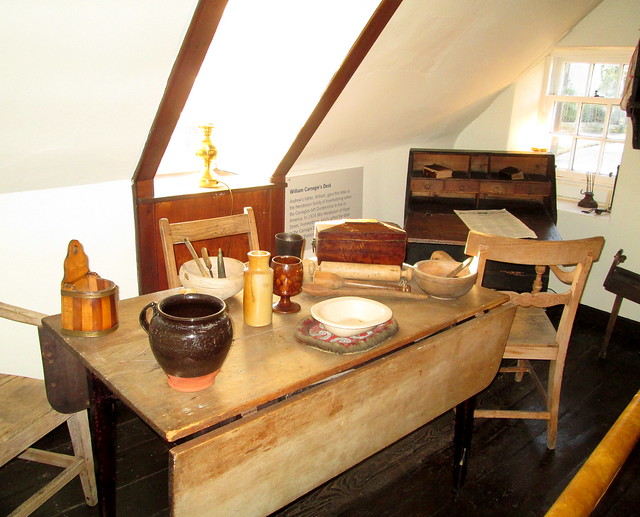
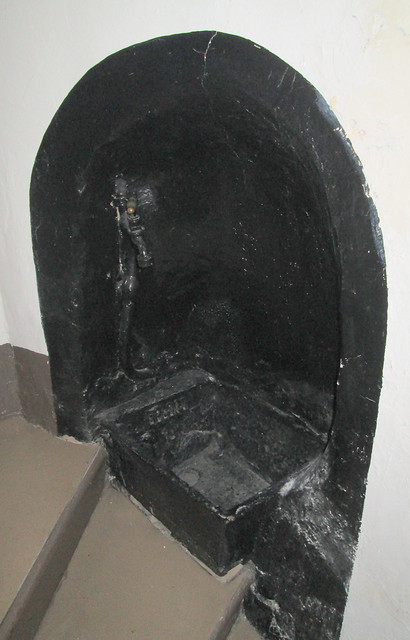
The other side of the room has the kitchen table and a desk in it, all the living and sleeping and eating done in one room. There’s an old sink at the bottom of the stairs and it has been painted black as you can see below. I doubt if it would have looked like this when it was in use, I think it would have just been plain stone. There’s a tap at the left hand side. This would have been regarded as a modern convenience by Carnegie’s family, I’m sure it wasn’t there when he lived in the cottage as it was one of Andrew’s jobs to get the water from a well.

Andrew Carnegie Sink

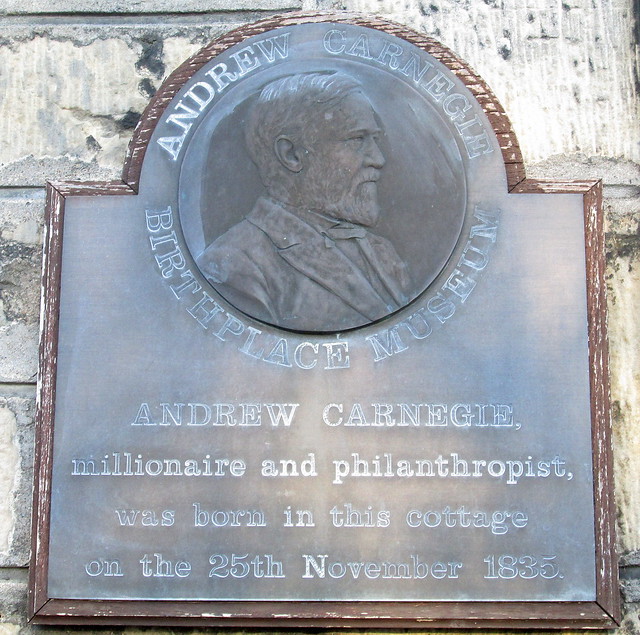
Below is a photo of the plaque attached to the wall of the cottage. It’s a stone’s throw from the very first Carnegie library, he was keen to show the folks back home how well he had done for himself. Carnegie spent a lot of time in Scotland over the years and he bought Skibo Castle which remained in the Carnegie family until 1982.

Andrew Carnegie Birthplace

The Carnegie family had a hard life and when things got even worse they contemplated leaving Scotland and going to America in search of a better life. Encouraged by relatives who were already there they left Dunfermline in 1847, Andrew wasn’t keen to go apparently and life was even harder when they got to America, especially as his father died not long after they settled there. But Carnegie made the best of it and although nowadays it’s fashionable to call people like him ‘robber barons’ it’s not something I would agree with.

He had a brilliant business mind and at least he did something useful with his money. Some people have said it was pure vanity which made him give so much money away, building libraries all over the place. I just wish there had been more like him in the past, and nowadays it seems to have been left to Bill and Melinda Gates to be philanthropic.

I learned a lot whilst at the cottage, a large extension has been added on to the cottage to house a museum which tells his story. He was at the battle of Bull Run the first battle of the American Civil War, as an observer. Later on though he was able to pay an Irishman to take his place when he was called up. I think Carnegie paid him $960 to take his place, a huge amount of money then, I don’t know if that chap survived the war though.

It was an interesting afternoon out and if you’re in Dunfermline it’s definitely worth a visit – and it’s free!