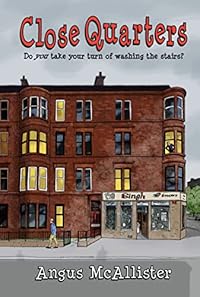
Close Quarters by Angus McAllister

Close Quarters by Angus McAllister was published in 2017 and I decided to read it because Jack was literally shaking the bed with laughter as he read it. I have to say that although it is funny in parts, I didn’t laugh out loud.

The setting is Glasgow’s West End, which if you don’t know it is a rather cosmopolitan and up market area with expensive housing, due mainly to the proximity of The University of Glasgow and the attractions of the Botanic Gardens, a posh hotel and restaurants, eclectic shops, the BBC (once of Queen Margaret Drive but now housed elsewhere in the city) but also ‘normal’ pubs and shops.

A ‘close’ in Scotland is the communal entrance area and stairwell of a tenement building in Scotland. Most of the book features the inhabitants of 13 Oldberry Street, a tenement building which contains seven flats, and a small shop on one side of the ground floor. One of the longest inhabitants of the building is Walter Bain and close to the beginning we’re told that Bain is dead – murdered. It seems that the deed must have been committed by someone who lives in the building as the close security door hasn’t been damaged.

The rest of the book features how Walter Bain’s horrible personality impinged on the lives of his long-suffering neighbours. Bain behaved as if he owned the entire building and spent his time firing off badly spelled and ungrammatical notes to them whenever he thought they had committed a heinous offence – such as not shutting the gate, missing their turn at cleaning the stairs, or having their television on! Bizzarely his mantra is ‘this is a family building’ despite the fact that there are no children in any of the flats. His tyranny has ruled the building for years before someone snaps and does him in.

Suffice to say that everyone has a good reason to murder Bain, in fact – in other parts of Glasgow he would have been bumped off a lot sooner – but then there wouldn’t have been a book, there would just have been a few columns in the Scottish newspapers and a few minutes on the Scottish TV news!

There is humour in it, it wouldn’t have been Glasgow if there was no banter and I really enjoyed strolling around Byres Road and the West End, our old stamping ground, it just didn’t have me shaking with laughter and I guessed the culprit very early on, as did Jack to be fair. His review is here. I’ll definitely try some of McAllister’s other books in the future.
The Last Protector by Andrew Taylor

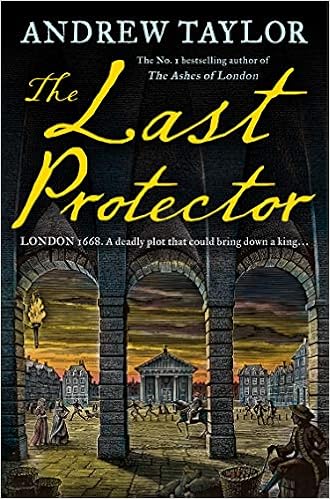
 The Last Protector cover

The Last Protector by Andrew Taylor is set in London 1668 where Oliver Cromwell’s son Richard has arrived clandestinely from France where he has been living. With the restoration of the King after the end of Cromwell’s Commonwealth following the civil war, Richard had been laden down with his father’s debts and he was in France to avoid his debtors. He’s really homesick for the countryside and his family apparently.

Cat Lovett had been friendly with the Cromwells as a child, a supposedly chance encounter with Richard’s daughter Elizabeth leads to a rekindling of the friendship. But Cat is suspicious, especially when her husband is befriended by Elizabeth and her friend Mr Cranmore.

There’s unrest in London as the Stuart court is completely immoral and there are many papists within it. This is upsetting a lot of people, particularly the Duke of Buckingham and his supporters and it seems that there might be a plot to overthrow the king. This is worrying for Cat, the daughter of a regicide, but her husband has always supported the Cromwells and he can’t be persuaded that he’s putting them in danger. Can Marwood protect Cat?

This is the fourth book in Taylor’s Marwood and Lovett series and I’m really looking forward to reading the next one The Royal Secret which is due to be published later this week.

The books are atmospheric and informative. The Guardian said of it: ‘This is historical crime at its dazzling best.’

The Light Over London by Julia Kelly

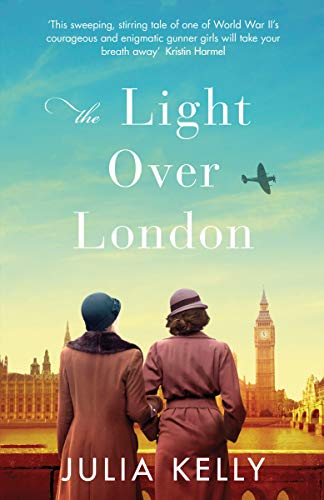
 The Light Over London cover

The Light Over London by Julia Kelly was first published in 2019. It’s a dual time novel with the setting being in WW2 London 1941 and 2017 Gloucestershire. This type of structure often works well but at times they can be annoying if you are enjoying the story and the timeline suddenly switches away from it. The author is American but is now living in London.

Cara has recently divorced and relocated to Gloucestershire where she has got a job with an antiques dealer who does house clearances. When she finds a wartime diary in an old tin while helping with valuations and house clearing she asks her boss Jock if she can keep the diary and he’s happy for her to do so. The diary has been written by a woman who had run away and joined the army to do her bit, rather than stay at home and marry the young man that her rather bullying mother had planned out for her future.

The diary comes to an abrupt end and Cara is keen to find out what happened. She’s helped in her task by Liam, her new and rather good-looking neighbour. So the book contains two romances and a bit of a mystery, unfortunately for me it just didn’t work, in fact there are so many anomalies in the writing that I took to keeping a note of them, this might seem like nit-picking but if you are setting a book in England and all the characters are English then it’s important not to import Americanisms into it as it jars so badly.

The most obvious one was the use several times of the word purse where it should have been handbag.

The word blond was used to describe a woman but the ‘e’ also appeared in the next sentence, otherwise it was without the ‘e’.

The word stand-down was used in relation to the end of the war.

Card shark is used a few times, it should of course be card sharp, I have no idea if card shark is American.

Ticket taker should be ticket collector.

Do you think Princess Elizabeth will serve? The phrase in the UK is/was join up.

Off ramp was used when it should have been slip road, and tea kettle was used instead of just kettle.

In other words the book is in need of being edited to weed out the incongruous Americanisms – as well as the cornier romance parts.

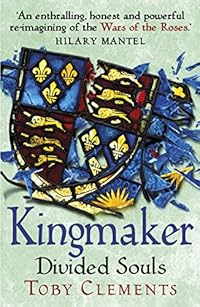
Kingmaker Divided Souls by Toby Clements

 Kingmaker Divided Souls cover

Kingmaker Divided Souls by Toby Clements was first published in 2016 and it’s the second book in the author’s Kingmaker series which begins with Winter Pilgrims, the second one is Broken Faith. I hadn’t read either of those ones as I was given this book by a friend who had bought two copies by mistake (we’ve all done it) and as I had recently read Conn Iggulden’s Wars of the Roses series I thought I would manage this one history wise anyway – which I did.

Toby Clements’s series seems to concentrate on telling the story from an ordinary person’s point of view rather than through an exalted character, so it’s all quite domestic and doesn’t have an awful lot of battles in it although there is some fighting.

The story begins just after Easter in 1469, Thomas and Katherine Everingham have built a little home for themselves on their employer’s land, but everything changes for them when their boss dies suddenly and his widow’s sons arrive to take over the running of the estate and they reluctantly have to leave their home and workplace and take to the road again with some friends, one of whom is heavily pregnant.

It looks very much like war is about to break out again with the Earl of Warwick conspiring against King Edward, mainly because of the behaviour of the king’s in-laws. The earl is scouring the countryside to gather up a large army to attack the king, but Thomas and his friends have had enough of fighting in their lifetime – not that they have much choice.

This was a really good read with adventure, intrigue and some great characters.

Balbirnie Woodland, Fife, Scotland

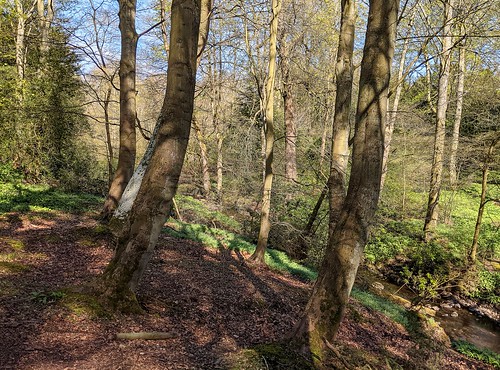
No matter how lovely a place is, if you walk in it every day it tends to get a wee bit boring, so yesterday we decided to walk through the Balbirnie Woodland for The Guardian, rather than skirting it as we usually do. I decided to take some photos. There’s a burn/stream in the photo below but it has been so dry recently and it’s so low, it’s difficult to spot.

Back Burn, Balbirnie, Fife

Back Burn , Balbirnie, Fife, Scotland

Back Burn, Balbirnie, Fife, Scotland

If you look between the rhododendrons below you should be able to see a cute wee bridge.

Back burn + bridge, Balbirnie, Fife

It was a lovely and unusually calm day, I’m not so keen to walk through so many trees when it’s windy as there are always branches being blown down, or even whole trees!

Back burn, Balbirnie, Fife

Back burn, Balbirnie, Fife

I spotted some people riding horses in the distance and managed to snap them, they were comfortably far away. I’m not so happy when they are just right on your toes and you have to turn aside to let them past. They can be very nervous.

horses, Balbirnie woodland, Fife

Back burn, Balbirnie, Fife

It’s all quite a contrast to the shaved turf of the golf course which we passed on the way into town. It’s a pity that these places are so artificial and steeped in chemicals to ‘improve’ the grass, but there are some great trees on the course, so it’s not all bad.

Balbirnie fairway, Fife, golf course

Balbirnie fairway, Fife, golf course

I hope you enjoyed our walk on the wilder side of Balbirnie estate. It was a bit longer than usual, but a nice change.

The Secrets of Meadow Farmhouse by Katie Ginger

Katie Ginger

The Secrets of Meadow Farmhouse by Katie Ginger is the first book that I’ve read by the author, it’s not really my usual sort of book but it was a bit of a comfort read in pandemic times, and despite having a fair idea of how it was going to end (this is possibly an attraction of romances – no big shocks!) I still found it to be an entertaining read.

Amelia has been living in Paris for the last ten years, she has carved out a successful interior design career there and seems settled, but when she unexpectedly inherits a farmhouse from her Great Aunt Vera she returns to Meadowbank, the village in England where she had grown up, to deal with the sale of the farmhouse. Amelia’s parents had died when she was only eight years old and Vera had taken her in, but when Amelia left the village to go to university she and Vera had had a disagreement – and Amelia had never returned.

But it wasn’t only Vera that Amelia had cut ties with. She had promised to contact her boyfriend Adam who also lived in the village, but she hadn’t done so. Adam is still living in the village and Amelia is nervous of meeting him again, in reality it’s his mother that she should be nervous of!

While Amelia is clearing out Vera’s cottage she is intrigued by a locket that she finds there. It has two photographs in it, but no clue as to who they are of. Maybe a local historian will be able to help her. Vera had always been rather standoffish with the villagers but Amelia finds them to be friendly and she realises that she doesn’t really have any friends in Paris. That coupled with the fact that she is growing more attached to her old childhood home leads her to re-think her plans, but will Adam feature in them? This was an enjoyable read.

The Secrets of Meadow Farmhouse was published on the 17th of March 2021 and I was sent a digital copy of it via NetGalley.

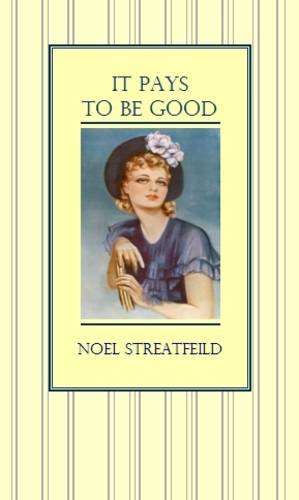
It Pays To Be Good by Noel Streatfeild # The 1936 Club

The 1936 Club is hosted by Simon at Stuck in a Book and Karen at Kaggsy’s Bookish Ramblings.

 It Pays To Be Good  cover

My last read for The 1936 Club is It Pays To Be Good by Noel Streatfeild. My copy is a 2015 re-print by Greyladies. This is the third book that I’ve read for the 1936 Club and and happily they’ve all been books that have been languishing on my shelves unread for quite a wee while (years).

Flossie Elk’s entry into the world had been difficult, in fact since then her mother had never felt quite right, her insides had a tendency to ‘flop’ and she was told by the doctors that Flossie must be her only child. The astonishing thing is that Flossie is such a beautiful child with white blonde curls, born to very ordinary parents. Her father George Elk is a greengrocer with an evangelical Christian leaning and he wants his daughter to grow up to be a good wife to a nice man, but her mother Fanny thinks that Flossie must be beautiful for a reason, and that she should make a career of her looks. Flossie was still a toddler when she realised that screaming her head off to get her own way was hard work, it was far easier to silently look at her father and fill her eyes with tears, no man seems to have been able to withstand her manipulative tears and hurt look for long. Flossie is thoroughly spoiled and really should come with a stamp on her forehead warning she is a danger to men, although to be fair she even manages to fool the sillier women that she encounters – such as her teacher at infant school .

At the start of World War 1 George joins the army and four years later when he hirples home the damage is done as Fanny has sent Flossie to a stage and dancing school with the result that Flossie thinks she is above everyone and she treats her poor mother like a servant. She manages to twist her father around her little finger and it’s not long before he agrees to her being on the stage.

At the age of 16 an audition results in Flossie getting a leading part in a London show, just because of her looks, in truth she’s not that talented but that doesn’t seem to matter. She’s chaperoned by Mouse who needs a lodger who will help pay her rent. Mouse has to train Flossie to seem like a well-bred young woman, not the common as muck girl that she really is. Flossie is a quick learner and in no time she has legions of men of all ages lusting after her. By this time her name has been changed to Virginia and her management have fed a rumour to the press that Virginia is the off-shoot of some sort of royalty and Virginia herself has started to believe it, she certainy behaves that way and her poor parents are completely forgotten.

There’s a lot more but I’ll leave it at that. Suffice to say that I really enjoyed this book although it’s quite a frustrating read as Flossie/Virginia is the sort of person that you would never get tired of slapping, and she doesn’t really get her comeuppance. I have a horrible feeling that there are quite a lot of her type around. Nowadays she would be described as being ‘a piece of work’ I suppose but by her own moral standards (and her father’s) she’s above everyone else in the book.

I’ll definitely have to track down more of Noel Streatfeild’s novels for adults as until now I had only read the books that she had written for young people.

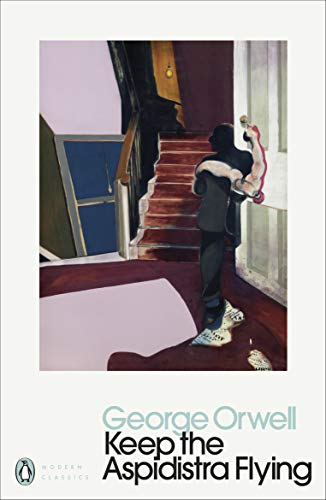
Keep the Aspidistra Flying by George Orwell – 1936 Club

 Pigeon Post cover

The 1936 Club is hosted by Simon at Stuck in a Book and Karen at Kaggsy’s Bookish Ramblings.

I was really happy to see that Keep the Aspidistra Flying by George Orwell had been published in 1936 because it’s one of his books that I hadn’t got around to reading. However, I found it to be quite a depressing read although it’s obviously well written.

Gordon Compstock is a 29 year old poet, he has already had a volume of poetry published, but he doesn’t realise that it was really his wealthy friend Ravelston who was instrumental in getting it published, only 153 copies were sold. He had previously had a ‘good’ job in an advertising agency but had given it up as he hated the whole industry. His boss says he can come back if he changes his mind, but Gordon really doesn’t want to be part of the rat-race and commercialism.

His job in a second-hand bookshop fits in with his ideals, but he’s earning a lot less than he was and living in deep poverty, often not having anything to eat all day, especially towards the end of the week as his money has run out. He has had to ‘borrow’ money from his much older sister Julia, despite the fact that she’s really poor herself and works in a tea-shop. She has been brought up to put her brother first though, being the son of the family has meant that all the family’s efforts have been put into him, including a private education which might have been a big mistake as his schoolfellows realise he’s poor – and boys will be boys.

He has been in love with Rosemary for two years, but rarely sees her due to a lack of money. He won’t have Rosemary paying her half of any outings or meals out, that would be too shameful to him. They can’t visit each other in their rooms as their landladies don’t allow that. With his decent clothes in the pawn shop people avoid him, thinking he’s a tramp. As it’s the Depression there are plenty such about. Gordon almost wishes that there would be another war.

Gordon squinted up at the leaden sky. Those aeroplanes are coming.In imagination he saw them coming now; squadron after squadron, innumerable, darkening the sky like clouds of gnats. With his tongue not quite against his teeth he made a buzzing, bluebottle-on-the-window-pane sound to represent the humming of the aeroplanes. It was a sound which, at that moment, he ardently desired to hear.

He lives in hope of getting a cheque from a publisher that he has sent poems to and when an American magazine does send him $50 for a poem Gordon is ecstatic. The dollars equate to £10 and some shillings!! Gordon promises himself that he will keep £5 of it to give to Julia but he ends up going on a disastrous boozy bender and ends up in clink overnight.

Like many an artist before him Gordon realises that he can’t afford his scruples, it’s time for him to grow up and earn his £5 a week and join the rest of society. He even decides he must get an aspidistra, they seem to haunt him! They were apparently the mark of a respectable and aspirational middle-class life. Rosemary isn’t convinced.

Everyone rebels against the money-code, and everyone sooner or later surrenders. He had kept up his rebellion a little longer than most, that was all.

It would seem that this is a very autobiographical novel which is really sad as presumably some of the humiliating situations that Gordon experienced actually happened, or Orwell observed.

1936 club

My Spring Garden

Flowers, my garden

There’s quite alot of colour in the garden at the moment, spring is definitely here as far as the flowers are concerned, but it started to snow not long after I took these photos!

daffodils, my garden

I haven’t planted many daffodils as there are so many wild ones growing in the woodland near my house, but these ones above are smaller and daintier than the more common daffs.

Flowers , my garden

The primroses and primulas do well here as they seed all around the place, I love getting plants for free! The hellebore below seems to be the only one thriving in the clay soil of my garden, at least two other varieties seem to have disappeared.

Flowers, my garden, hellebores

The red quince is flowering well as you can see but my white one is later, I hope it has survived our seemingly never ending winter.

quince  Flowers , my garden

The very slow growing holly below is supposedly suitable for rockeries, so far so good as I’m not great at hacking back shrubs, I feel their pain!

small holly, my garden

The tulips are flowering earlier than usual, very surprising given what our weather has been like and this pot has been frozen solid at times.
tulips, my garden

Not long after I took these photos it began to snow – such is life!

primulas, my garden

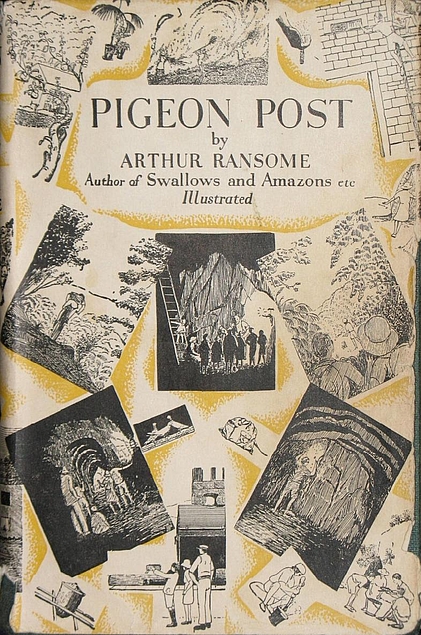
# 1936 Club – Pigeon Post by Arthur Ransome

 Pigeon Post cover

I read Pigeon Post by Arthur Ransome as my first book for the 1936 Club, it’s the sixth book in his Swallows and Amazons series and I can’t say that it was a favourite of mine. To be fair the the Swallows and Amazon children aren’t enjoying themselves much to begin with. It has been a dry summer and the ground is parched so there’s no water near the camping ground they intended to pitch their tents. This means that they’re having to camp out in the back garden and because of the fear of a camp fire setting the whole area on fire they aren’t even allowed to cook for themselves.

Nancy and Peggy’s Uncle Jim is on his way back home to the Lake District, he’s been having an adventure of his own in South America, searching for treasure unsuccessfully. The children hear a rumour of a long forgotten old gold mine in the nearby mountains and set about looking for it, they know it is in a cave with some heather nearby. But they’re upset by the appearance of a suspicious man that they name Squashy Hat. He’s roaming all over the hills and daubing paint on stones, they’re sure he’s also looking for the gold.

Things improve when Titty discovers that she’s able to dowse for water and they manage to dig a well which gives them good water, so they are able to camp out after all, and they can communicate with Mrs Blackett by using some carrier pigeons.

Other readers seem to have really liked this one, and it did win the Carnegie medal, but I was never going to enjoy the subject as the children went off every morning, all armed with their hammers, merrily attacking the Lake District mountains with them and crushing up loads of quartz. Even as a child I had an aversion to mines and quarries, especially quarries due to my beautiful local mountain being completely hollowed out for use as hard core for road building! I’m looking forward to reading the next one in the series though.