The Sixteen Trees of the Somme by Lars Mytting

 The Sixteen Trees of the Somme cover

Edvard is a young man living on his family farm in rural Norway, growing potatoes and farming sheep. He has been brought up by Sverre, his grandfather, as Edvard’s parents had died when he was only four years old. It’s all a bit of a mystery, Edvard can hardly remember his parents, but he knows that on the day they died he disappeared for four days and then turned up in a doctor’s surgery.

Edvard’s grandfather Sverre had been in World War 2 as had been his brother Einar, but they had chosen to fight on opposite sides, and the brothers had been completely estranged. When Sverre dies the local funeral director says that his coffin is all organised and has been waiting for him for years. It’s a very special coffin, art deco in design made using flame birch wood and had been sent to Sverre years before. Edvard knows that Einar had been in Shetland during the war and decides to go there to find out more about him. Eventually Edvard makes his way to the World War 1 battlefields and cemeteries as obviously the author did as he describes it all so well.

This was a great read which also involves a couple of young women, one in Norway and one on Shetland, so there’s a bit of romance of a sort, but mainly it’s a mystery, very well written, and it was translated from Norwegian by Paul Russell Garrett, he made a great job of it.

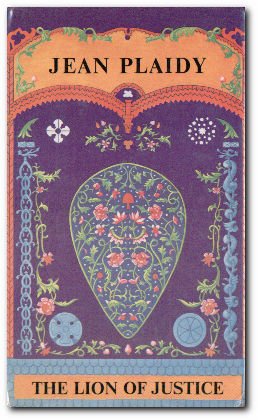
The Lion of Justice by Jean Plaidy

 The Lion of Justice cover

The Lion of Justice by Jean Plaidy is the second book in the author’s Norman Trilogy, but I haven’t read the first one, I don’t think that was a problem though. It was first published in 1975. She wrote under several pseudonyms including Victoria Holt.

I must admit that I was a wee bit disappointed with this one when I began to read it as the writing style seemed quite chunky when compared with more modern writers of historical fiction. There’s a lot of very obvious info-dumping, however I got used to the style and ended up enjoying it although I would only give it three stars.

Scottish princesses Edith and her sister Mary have been placed in a nunnery after the death of their mother Queen of Scotland. The nunnery is run by their aunt Christina who is determined that they will take the veil. The girls aren’t enamoured with that idea though and hope that they will be able to get married in the future, this incenses Aunt Christina the mother superior and she becomes more and more violent, especially towards Edith. So when some men from the royal court visit them they see their chance to escape. Edith hangs on for a son of the Conqueror. Henry is the youngest of that dead king’s sons, and is third in line to the throne. As you can imagine Edith is quite happy to change her name to Matilda as Henry asks her to. She’s of Saxon blood and the Norman Henry’s idea is that if he does become king marrying a Saxon will make him popular with the common people. But Henry is a philanderer and already has multiple illegitimate children, that’s all such a heart-ache for the young Matilda over the years.

Henry spends a lot of time in Normandy and when he’s not there he’s often in Wales with Nesta, his favourite other woman of long standing. Actually that part reminded me so much of another heir to the throne!

Anyway, I don’t think I will rush to read the other books in this trilogy but it was fairly entertaining.

The Swift and the Harrier by Minette Walters

The Swift and the Harrier by Minette Walters is set in southern England in 1642 the beginnings of the English Civil War, which has now been re-named more correctly The Wars of the Three Nations as it did spread beyond England.

Jayne Swift has been born into a fairly well-off family, but she has no intention of conforming and marrying as is expected of her. She has trained as a physician and has been travelling around on horseback using her skills where they are needed. When the civil war catches up with her she’s determined not to take sides, she’ll help whoever needs it. Actually there’s quite a bit of changing sides going on at times, so it’s best to stay as neutral as possible anyway.

It isn’t long before Jayne gets plenty of opportunities to practice her skills and pass on her knowledge to others, resulting in her becoming very much esteemed by those she has helped.

I sort of enjoyed this one, but I really had to suspend my disbelief because the whole premise just seems so unlikely. There’s no way that a young woman would have been able to learn the skills that she had in those times. No matter how determined a character had she would have been stuck firmly in her family home helping with the housework, until she married. The blurb on the back of the book gives the impression that it is quite heavy on the romance but really there’s hardly any romance at all with just a few unromantic meetings between Jayne Swift and William Harrier before – hey presto – romance, so I found it all slightly disappointing.

The dastardly behaviour of marauding soldiers towards the civilian population was quite depressing too, especially as it has been going on in Ukraine – nothing changes in that way it seems.

The Case of the Missing Bronte by Robert Barnard

The Case of the Missing Bronte by Robert Barnard was first published in 1983.

Suoerintendent Perry Trethowan of Scotland Yard is driving back to London with his wife Jan after visiting his family in Northumberland, but the car breaks down in the Yorkshire Dales and they’re forced to spend the night in a small village.

While having a drink in the local pub they’re joined by a local. Miss Edith Wing is a retired schoolteacher and she tells them she has just inherited a lot of old documents from her cousin. One of them looks like it might be a Bronte manuscript, it looks very similar to their juvenilia so is written in tiny print and is almost illegible. She wonders if they know anything about such things. Jan confesses that she loves looking at old documents.

In no time they’re all involved in dangerous situations, it’s probably not sensible to talk about such a possibly lucrative possession in the local pub!

I liked this one although it is definitely on the bizarre side, but that’s not a problem for me. While reading it it seemed like a vintage crime publication to me, it might have been something to do with the book cover which is reminiscent of the British Library covers, but I don’t regard 1983 as vintage, maybe I should as it’s almost forty years ago now.

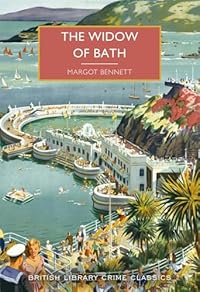
The Widow of Bath by Margot Bennett

The Widow of Bath by the Scottish author Margot Bennett was first published in 1952.

The book begins with Hugh Everton having a meal in a hotel in Margate, he works for a travel agency and part of his job consists of going around hotels and trying them out, he’s very jaded by the whole thing with the same meals appearing at the different hotels.

When a group of people walk into the bar Everton realises that one of the women is Lucy, an old flame of his, and she’s with her new husband, Gregory Bath who is a retired judge. Everton agrees to go back to the judge’s house for drinks along with Lucy’s aunt and some others.

When murder ensues Everton finds himself in a difficult position as he has had a bit of a brush with the law in the past.

For me this was mainly a bedtime read, and that might have been the problem with it as I found it to be too convoluted for a tired brain, otherwise I wasn’t really enamoured with any of the characters and that’s always disappointing. However the writing is good and I appreciated the humour.

The cover design has been taken from a British Rail travel poster advertising Plymouth on the south coast of England. I had a look at modern photographs of the area on the internet and was very happy to see that all that art deco architecture has survived, which is quite surprising considering how comprehensively Plymouth was bombed during World War 2.

Thank you to British Library who sent me a copy of this book for review.

Plymouth

the 1976 Club

It’s the 1976 Club which is hosted by Simon of Stuck in a Book and Karen at Kaggsy’s Bookish Ramblings.

For me 1976 has been a bit of a slim year reading wise, since blogging it seems that I’ve only read two from that year:

A Stitch in Time by Penelope Lively

Touch Not the Cat by Mary Stewart

I enjoyed both of those ones a lot. This week I’m reading a couple of short books by Ursula Le Guin, novellas really, A Very Long Way from Anywhere Else and The Word For World is Forest. These ones are both from Jack’s Le Guin collection, most of which are SF of course but the first one I mention isn’t SF.

I must admit that 1976 has seemed like a fairly bad year for publishing. I can’t say that I noticed at the time, I did work in a large public library back then, but it was also the year that I got married, yes I am fairly ancient, but I was a child bride!

Where the Crawdads Sing by Delia Owens

Where the Crawdads Sing by Delia Owens was first published in 2018. The setting is Barkley Cove which is a quiet town on the North Carolina coast. The book begins in 1952 when Kya the youngest of a large family is only six years old, and her mother has just left the family home, a shack on the marsh. The mother was a very much abused woman, but she has left her two remaining children in the care of her abuser, and he hasn’t been slow to lift his hand to his children in the past. It’s a tough life for Kya as it’s not long before Kya’s older brother leaves her and then her father abandons her. She barely manages to feed herself, but when Jumpin’ Jackson who runs a small store that sells fuel realises that Kya is on her own, he, his wife and the congregation of their black church end up helping to clothe Kya.

The white people in Barkley Cove have closed their eyes to everything as they don’t want anything to do with those ‘marsh people’ and when Kya does have to go into town she’s shunned and avoided. So when years later the body of Chase, a well thought of local married man is found on the marsh, fingers are pointed at Kya.

This was a new to me setting which I really liked, the author’s descriptions of the surroundings brought it all to life and I loved that Kya was able to rise above a disastrous upbringing. Although the ‘mystery’ part wasn’t much of a mystery to me I thought that the treatment meted out to Kya by her supposed betters was so authentic, as was her nurturing at a distance by the poorer members of the society.

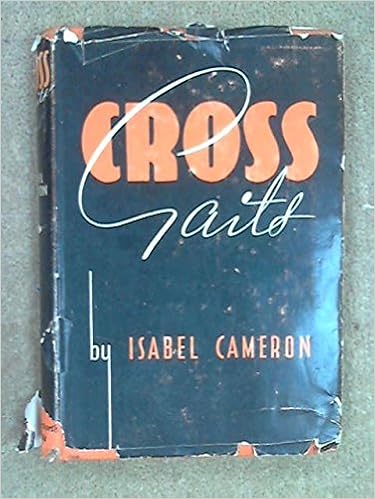
Cross Gaits by Isabel Cameron – 20 Books of Summer 2021

Cross Gaits cover

Cross Gaits by Isabel Cameron was first published in 1945. The setting is Scotland and in the beginning it’s 1904 and Margory Mackay is preparing to marry Hugh Mcgregor a church minister, but there’s turmoil within their branch of Christianity with a split likely among congregations and the so-called church leaders, the usual ‘Free Church of Scotland’ thing. They decide to go ahead with the wedding anyway.

This book isn’t as interesting or amusing as the previous book that I’ve read by this author – The Fascinating Hat. I can vouch for the authenticity of the background of the tale though as it was a hard life being a minister’s wife back in those days, unless you were lucky enough to have money of your own, or the husband had. Those huge manses that they were given as part of the very small stipend were impossible to heat and life was a struggle, especially for the wives. I had that first hand from Jack’s granny who became a rector’s wife during World War 1.

This was just too ‘churchy’ to be a comfy read for me. I’ve bought a few more of Isabel Cameron’s books, just because of the Scottish setting, I feel that they’re a glimpse into the social history of the times, so I hope those ones are more enjoyable than this one.

I read this one for 20 Books of Summer 2021. My copy didn’t have the dust cover.

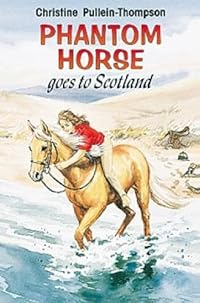
Phantom Horse Goes to Scotland by Christine Pullein-Thompson

Phantom Horse Goes to Scotland cover

I went through a phase of reading pony books when I was probably about 9 or 10 and the Pullein-Thompson family wrote so many such books, it seems it was almost a family business, so I definitely read some of theirs back then, but not this one which was written long after my childhood.

Phantom Horse Goes to Scotland by Christine Pullein-Thompson was first published in 1981, it was later re-titled Phantom Horse Island Mystery.

It’s the summer holidays and Jean and her brother Angus are disappointed because their parents are having to go abroad because their father is a sort of diplomatic troubleshooter, he’s got to fly to the Middle East (nothing changes!) and their mother always accompanies him. But what will happen to the children?

Luckily Angus had seen an advert in a newspaper about The Island School and College of Further Education whch focuses on riding and dressage, ideal for Jean, and Angus can be coached on mathematics which is his weak point. Mr Carli is the headmaster and everything is arranged very quickly. The children fly to the Scottish island, as does Phantom, Jean’s horse!

Apparently Mr Carli had only recently bought the island and most of the original inhabitants had recently left to go to the mainland. There’s only one cottage which is still inhabited and they will be moving out soon as the woman is heavily pregnant. There’s something strange about the whole set up, but Jean is very happy with the training in dressage that she’s getting and the teachers seem fine.

When Jean and Angus realise that some new horses have been moved onto the island under cover of darkness they are sure there must be some sort of nefarious purpose behind it and their investigation leads to danger.

This was a very quick read and quite an entertaining adventure. I will give it three stars on Goodreads I think. I was a bit annoyed that as far as I was concerned there were some details of the tale which weren’t satisfactorily tied up.

It might seem unlikely that parents would send their children off for the summer to a place that they hadn’t even checked out, owned by a man that they knew absolutely nothing about, but some people did do things like that to their children. I was sent to Germany for a month to stay with a penpal and really we knew very little about the family, and it was the summer before I went to high school. I had to fly from Glasgow to Dusseldorf (where I got lost), then on to Stuttgart airport. I survived but I would never have done that to my own children! I still remember the shock I got when I saw the Nazi medals in pride of place in their display cabinet, everyone I knew at home had their WW2 medals hidden away in a drawer, and the one thing that my parents had warned me about was – do not mention the war!

Beamish Folk Museum, County Durham, England

We are members of lots of arty and historical organisations such as the National Trust, Scottish Heritage, Friends of the Edinburgh Galleries and such AND we got annual passes to Beamish folk museum when we visited there last year, it’s situated near Stanley in County Durham. We were sure we would go back as we had such a good time there but we didn’t manage to get there as planned at Christmas and after the winter it didn’t open because of the Covid-19 situation of course. Anyway it turns out that I didn’t blog about it although I could have sworn that I did. Here are some of the photos I took. In the beginning Beamish was just farmland, you can read about the history of the place here. The buildings have all been moved to the site brick by brick and stone by stone to be saved for posterity rather than being demolished.

Beamish, Church + from waggonway

There are all sorts of buildings there, below is Pockersley Hall which has a lovely chocolate box garden.

Pockersley Hall, Beamish, County Durham, folk museum

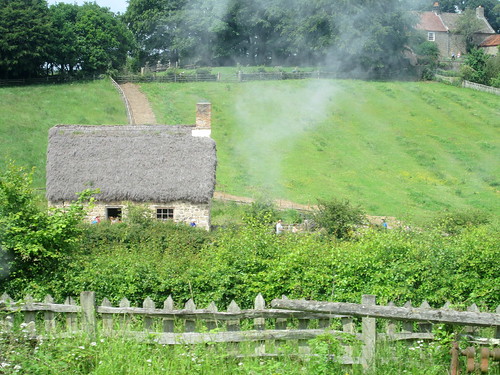
A teeny wee thatched cottage, this photo was taken from an ancient steam train as we were riding on it.

thatched cottage, Beamish from waggonway

And this is the train we were on, I remember seeing illustrations of a train like this one when I was ‘doing’ the Industrial Revolution at school, I never thought I’d actually have a trip on one!

Puffing Billy and train, Beamish, County Durham

You can go inside all the buildings, a few of them I would quite happily have lived in.

Farm terrace, Beamish, County Durham

Volunteers are on hand, living the life, rolling out pastry or whatever and answering questions.

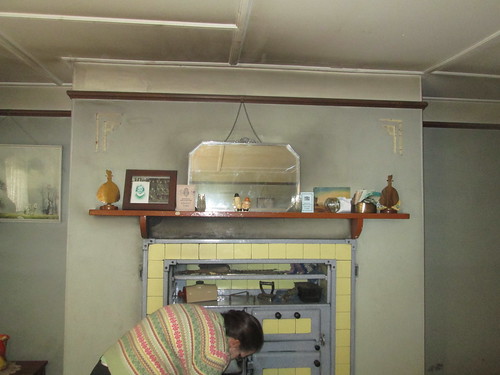
1930s fireplace, Beamish, County Durham

Actually it all seemed very homely to me as most of the ‘stuff’ was very similar to the furniture that we had had to get rid of when we downsized to a more modern and manageable house – all of six years ago now. I looked at a Victorian bed chest and could have sworn it had been ours! And the gate below is exactly the same as the back gate of the 1930s house that I grew up in, except ours was in better condition and painted rural green.

1930s gate, Beamish, County Durham, folk museum

1930s chairs, Beamish, County Durham, folk museum

Do you remember those halcyon days when we didn’t have to worry about crowds and social distancing? Below is the queue for the working bakery at Beamish but we didn’t bother to join the queue, it looked like they might run out of stuff to sell anyway! I was really taking the photo of the lovely Edwardian?Victorian window. There’s also an old sweetie shop selling authentic sweets, we DID queue up for that one. Indian Limes anyone? They were delicious.

Beamish, Edwardian  windows,

We hope we’ll be able to visit again – sometime.

Pockersley Hall from road, Beamish, folk museum, County Durham