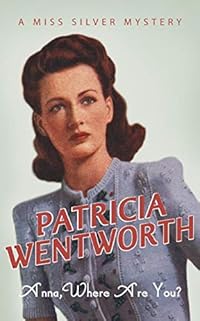
Anna, Where Are You? by Patricia Wentworth

 Anna, Where Are You?  cover

Anna, Where Are You? by Patricia Wentworth was published in 1953 and it’s a Miss Silver mystery.

Unusually (I think) Miss Silver’s entrance in this book is on the very first page where she’s perusing the births, deaths and marriages columns of her copy of The Times, but it’s the Agony Column which really attracts her interest. Someone called Thomasina is looking for Anna – Please Write. That short message leads Miss Silver into a dangerous investigation.

Thomasina is looking for her old schoolfriend Anna who has left a suitcase with Thomasina to look after. It’s ages since Anna has been in touch though and Thomasina is worried about her. Thomasina’s fiance Peter Brandon can’t understand why she is worried as Anna isn’t a very nice person and not much of a friend, but Thomasina feels sorry for her.

Miss Silver’s investigation takes her to Deepe House which is a bit of a wreck as the middle of it had been bombed during the war. Peveril Craddock, the new owner, has re-named it Harmony House, he’s an obnoxious character who is supposed to be writing a great work but his wife Emily and step-children are obviously frightened of him, although he has a bevy of strange female admirers who live in ‘the colony’ – nearby cottages.

Anna had been at Deepe House, looking after the rather out of control children but she had left no clue as to where she was going. Inspector Frank Abbott gets involved when during his investigation into a nearby bank robbery and murder he has to question the people at the house and the colony. Miss Silver’s past experience as a governess comes in handy as the Craddocks are very happy to have her as part of the household where she solves the mystery and sorts out the children too.

This one was a bit of a slow burner for me but it ended up being really good as I had no idea what had been going on!

The Christmas Card Crime and other stories

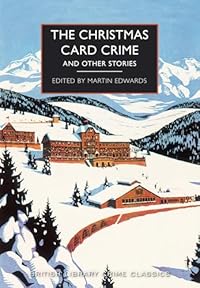
 The Christmas Card Crime cover

The Christmas Card Crime and other stories is edited by Martin Edwards and is a British Library Crime Classic.

This compilation of eleven Christmas/winter themed vintage crime short stories is as you would expect a bit of a mixed bunch, but that means that there will surely be something to suit everyone. Each short story is preceded by a short biography of the author, which I found interesting.

For me it was the story from which the title of the book came which was most successful. The Christmas Card Crime was written by Donald Stuart. Some of the stories are sooo short, and I can’t help thinking that the author used up a good idea which could have been worked up into something a lot longer and for me more inetresting. I suppose that just means that I’m not a big fan of short stories, well not very short ones anyway.

The other authors featuring in this anthology are:

Baroness Orczy
Selwyn Jepson
Ronald Knox
Carter Dickson
Francis Durbridge
Cyril Hare
E.C.R. Lorac
John Bude
John Bingham
Julian Symons

The book cover is taken from a vintage travel poster.

Mont-Revard poster

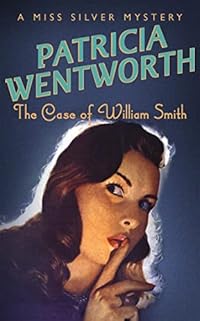
The Case of William Smith by Patricia Wentworth

 The Case of William Smith cover

The Case of William Smith by Patricia Wentworth was first published in 1950 and it’s a Miss Silver mystery.

William Smith can’t remember anything that happened to him before 1942. His first memory is of being in a German hospital, and from there he was transferred to a concentration camp. The identity disc around his neck says William Smith. In the camp he strikes up a friendship with a Czech prisoner who teaches him how to carve small wooden toys and when William eventually gets back to London after the war his talent is spotted by Mr Tattlecombe, a toy shop owner who takes William on as an employee. Mr Tattlecombe’s son had been in the concentration camp with William but he had died there and to Mr Tattlecombe William had begun to take the place of his dead son.

When Mr Tattlecombe is involved in an accident William takes over the running of the business and takes on a female sales assistant. There’s a bit of a mystery as to why she wants the job at all, but William seems keen on her and when ‘accidents’ continue to occur it’s Miss Silver with her gentle cough who comes to the rescue.

I liked this one a lot, it has likeable main characters, twists and turns and Miss Silver sorts it all out as she knits two pale blue coattees for a baby and then begins on a cherry-red cardigan for the mother. She’s some woman!

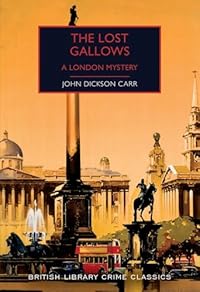
The Lost Gallows by John Dickson Carr

 The Lost Gallows cover

The Lost Gallows by John Dickson Carr has just been reprinted by the British Library but it was first published in 1931. In no way could this book be described as a cosy mystery, it’s the very opposite, so atmospheric and full of creepiness, verging on horror at times, but still a good read even if you lean towards comfy crime usually.

The setting is a very foggy autumnal London, beginning in the notorious Brimstone Club where M. Henri Bencolin and Sir John Landervorne are examining a miniature set of gallows. Sir John had been assistant commissioner of the metropopitan police and Bencolin is the head of the Paris police. The set of gallows had suddenly appeared on the desk of Mr El Moulk, another member of the club, and it has unnerved him more than just a wee bit. The rumour is that Jack Ketch, a famous London hangman of folklore is roaming around London with his gibbet, looking for people to hang.

There’s many a spooky incident, with a limousine apparently being driven by an obviously dead man. With Bencolin making frequent references to the Red Widow, in other words the guillotine, this is very far from the works of the likes of Agatha Christie who steers clear of anything as sordid as the death penalty. To be honest I’m happier with that style of writing. I’m going to be utterly sexist here and possibly entirely wrong but I think that John Dickson Carr’s style might be more popular with male readers. Having said that this is the seventh book by John Dickson Carr that I’ve read and I’ve liked them all, he’s just not a favourite. This is a good read though, especially if you lean towards horror.

I was sent a copy of this book by British Library for review, my thanks to them.

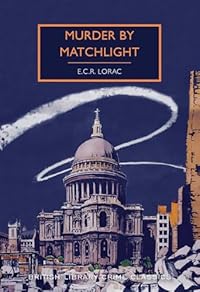
Murder By Matchlight by E.C.R. Lorac

 Murder By Matchlight   cover

Murder By Matchlight by E.C.R. Lorac was first published in 1945 but was reprinted by British Library in 2018.

It’s London 1945 and this story begins in a very dark Regent’s Park where 30 year old Bruce Mallaig is pleased to be, pre-war he wouldn’t have been able to visit the park after hours, but now there are no railings and locked gates to keep anyone out, the metal railings have been removed to be melted down to make aeroplanes (supposedly a morale/doing your bit thing but in reality they weren’t used for the war effort) but it seems that the park might be the venue for clandestine meetings. A sudden flare of light from a match shows Bruce that there are two men near him and in no time one of them has been murdered, knocked on the head. But Bruce hadn’t heard anything at all.

Chief Inspector MacDonald is heading the investigation and it turns out to be a difficult one as even the murder victim’s identity is a puzzle.

These British Library reprints can be a wee bit hit and miss but I really enjoyed this one with its very atmospheric wartime setting and unusual characters.

Bookshelf Travelling in Insane Times – 18th of October

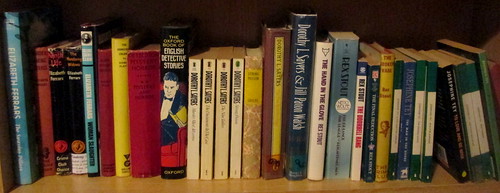
It’s that time again, how quickly Bookshelf Travelling in Insane Times comes around. This meme was created by Judith at Reader in the Wilderness but I’m hosting it at the moment. Click on it to enlarge the photo.

More Books

This week the bookshelf is in a bookcase (Ikea Billy, so many of us seem to have at least one) which is in my reading/sewing/hobby/ironing room which is located in the smallest spare bedroom in our house. It’s very fair to say that it’s generally in a bit of a mess as I just have too much yarn, fabric and stuff in general.

It’s a shelf of vintage crime, it’s just a coincidence that the beginning of the shelf houses Elizabeth Ferrars books and the end of the shelf is home to Josephine Tey books, both Scottish writers who wrote murder mysteries. In between them is the very English Dorothy L. Sayers and the very American Rex Stout, I find his books are very thin on the ground in secondhand bookshops in Scotland, but I’ve really enjoyed the ones I’ve managed to get a hold of. Of those four authors Josephine Tey is my least favourite. Dorothy Sayers I love and I’ve really enjoyed the Elizabeth Ferrars books that I’ve read.

Are you Bookshelf Travelling this week? I’ll add any links below.

A Bluestocking Knits

A Son of the Rock

Staircase Wit

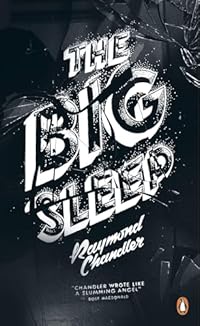
The Big Sleep by Raymond Chandler

The Big Sleep cover

The Big Sleep is the first book by Raymond Chandler that I’ve read but I’ll definitely be tracking down his others. This book was first published in 1939 and it’s the first book which features the private investigator Philip Marlowe. I must have seen the 1946 film of the book umpteen times, if I see it’s on TV I’ll always watch it again if possible, I’m a Bogart and Bacall fan.

Marlowe is hired by General Sternwood to track down whoever is blackmailing his daughter Carmen. Sternwood is wheelchair-bound and obviously a very ill man, he has two daughters and they’re both spoiled, the youngest Carmen is really out of control. The eldest daughter Vivian is married, but her husband is missing which is also a worry to Sternwood as he got on well with his son-in-law. Vivian is addicted to gambling, playing roulette.

Marlowe’s investigation uncovers a world of gangsters, gun-runners, pornographers and murderers. The plot is great but the writing is even better – honestly I had no idea that Chandler was such a good writer. I love that he describes everything and everyone, but manages to avoid overdoing it somehow. Writing the screenplay must have been a fairly easy task as Chandler had already written all the action and dressed all the actors. Add to that Marlowe’s dry wit and classiness, this book is a very entertaining read.

I was really surprised to read that Chandler went to school in England and even joined the British civil service. In 1917 he joined the Canadian Expeditionary Force and fought in France with the Gordon Highlanders.

imbibing

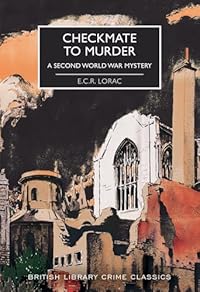
Checkmate to Murder by E.C. R. Lorac – Readers Imbibing Peril XV

 Checkmate to Murder   cover

Checkmate to Murder by E.C.R. Lorac was first published in 1944 but has been reprinted by British Library Crime Classics who kindly sent me a copy to review. It’s just the second book by the author that I’ve read but I’ll definitely read more as I enjoyed it. I read her book Fell Murder last year.

The setting is London during World War 2 and Lorac makes a great job of evoking the foggy and dank atmosphere of the city. In Hampstead an artist Bruce Manaton and his sister Rosanne are renting a large studio, they also live there and their ancient and miserly landlord lives next door. Rosanne is a bit of a doormat, supporting her brother and putting up with his moods and as the mystery begins she’s cooking supper for her brother and two friends who are playing a game of chess while Bruce paints a portrait of an actor who is dressed as a cardinal.

Rosanne is constantly worried about money and is afraid that if their windows aren’t screened properly and show a chink of light then the special constable will fine them £5, they’ve had trouble in the past with him. But when there’s a commotion at the front door it’s the special constable who has a young soldier in custody, he claims that the soldier has just committed a murder.

Inspector Macdonald of Scotland Yard is called in to sort things out, but it’s not an easy task as everyone has an alibi.

E.C.R. Lorac lived in London throughout the war which no doubt went a long way to making the setting seem so authentic, you can just about smell the fog. Lorac also wrote under the name Carol Carnac, Lorac is obviously Carol backwards, but she was born Edith Caroline Rivett and wrote a lot of Golden Age mysteries.

Corpses in Enderby by George Bellairs

 Corpses in Enderby  cover

Corpses in Enderby by George Bellairs was first published in 1954 and I read it on my Kindle, the first time I had used my Kindle for ages because I much prefer actual books, for one thing you can flick through them easily to remind yourself of details, and put bits of paper in the pages. I did use the notes bit on my Kindle but now can’t get into them! Modern life – huh.

Anyway Corpses in Enderby if I’m recalling correctly more or less begins in a pub in a small English town where there’s a bit of a ‘stooshie’ because a local businessman Ned Bunn has refused to help one of his neighbours who has a dying wife and needs some money. Ned Bunn is obviously not a good guy and the neighbour swears he’ll kill him. When Bunn leaves the pub to walk across the road to his ironmonger’s shop and home he’s furious to discover his daughter and shop assistant having a bit of a canoodle. The widowed Ned Bunn is determined to keep his daughter a spinster so that she can look after him, he has seen off her previous boyfriends. As he throws the poor man out into the street there’s a huge bang and Ned Bunn is dead, but who did it?

The local police waste no time in calling in Scotland Yard in the shape of Inspector Littlejohn and his assistant Cromwell. It turns out that the Bunn family is a big one and they’re all obsessed with money and Ned Bunn had been the top of the pile. In fact there is more than a baker’s dozen of Bunns and also an awful lot of other characters with names beginning with ‘B’, it’s a bit bizarre!

I enjoyed this one, there’s more murder, quite a lot of snarky humour and some entertaining female characters. I really like Inspector Littlejohn and his side-kick Cromwell so I’ll look out for more of these books. I got this ebook free from the George Bellairs Estate. Thank-you.

Six in Six – 2020 edition – My Choices

six

For the first time I’m participating in Six in Six which is hosted by Jo at The Book Jotter. The idea is that you choose six books that you’ve read in the last six months, from six different categories, click the links if you want to read my thoughts on the books.

Six books by Scottish authors:

1. Agatha Raisin and the Dead Ringer by M.C. Beaton
2. The Paper Cell by Louise Hutcheson
3. A Rope in Case by Lilian Beckwith
4. Still Glides the Stream by D.E. Stevenson
5. My Friends the Miss Boyds by Jane Duncan
6. The Double Image by Helen MacInnes

Six historical fiction books:

1. Black Sheep by Georgette Heyer
2. The Mirror and the Light by Hilary Mantel
3. Joseph Knight by James Robertson
4. Young Bess by Margaret Irwin
5. Elizabeth, Captive Princess by Margaret Irwin
6. Niccolo Rising by Dorothy Dunnett

Six books in translation:

1. East of the Sun, West of the Moon by Kay Nielsen
2. The Little Town Where Time Stood Still by Bohumil Hrabal
3. The Master and Margarita by Mikhael Bulgakov
4. Wolf Among Wolves by Hans Fallada
5. Autumn Quail by Naguib Mahfouz
6. Snow by Orhan Pamuk (still to be reviewed)


Six children’s books:

1. Peter Pan in Scarlet by Geraldine McCaughrean
2. The House in Norham Gardens by Penelope Lively
3. Eight Cousins by L.M. Montgomery
3. The Mousewife by Rumer Godden
4. Peter Duck by Arthur Ransome
5. From the Mixed- Up Files of Mrs Basil E. Frankweiler by E.L. Konigsburg
6. The Story of Doctor Dolittle by Hugh Lofting


Six vintage crime books:

1. The Blind Side by Patricia Wentworth
2. Hide My Eyes by Margery Allingham
3. The White Cottage Mystery by Margery Allingham
4. The Case of the Famished Parson by George Bellairs
5. Blood on the Mink by Robert Silverberg
6. Out of the Past by Patricia Wentworth

Six by new to me authors:

1. Young Bess by Margaret Irwin
2. The Paper Cell by Louise Hutcheson
3. Greenery Street by Denis Mackail
4. The Glorious Thing by Christine Orr
5. Merlin Dreams by Peter Dickinson
6. Autumn Quail by Naguib Mahfouz

I’ve really enjoyed compiling this post and I’ve also learned a lot from it. I hadn’t realised that so far this year I’ve not read much in the way of vintage crime when compared with past years, and my reading of classics has just about fallen off a cliff this year – so far. I’m putting that down to the appearance of Coronavirus/Covid 19 in the world as I’ve been concentrating on reading lighter fiction, especially at the beginning.

Thanks for organising this Jo.